
REVIEWED BY IVY KAYE
EDITED BY CHARLOTTE FRASER
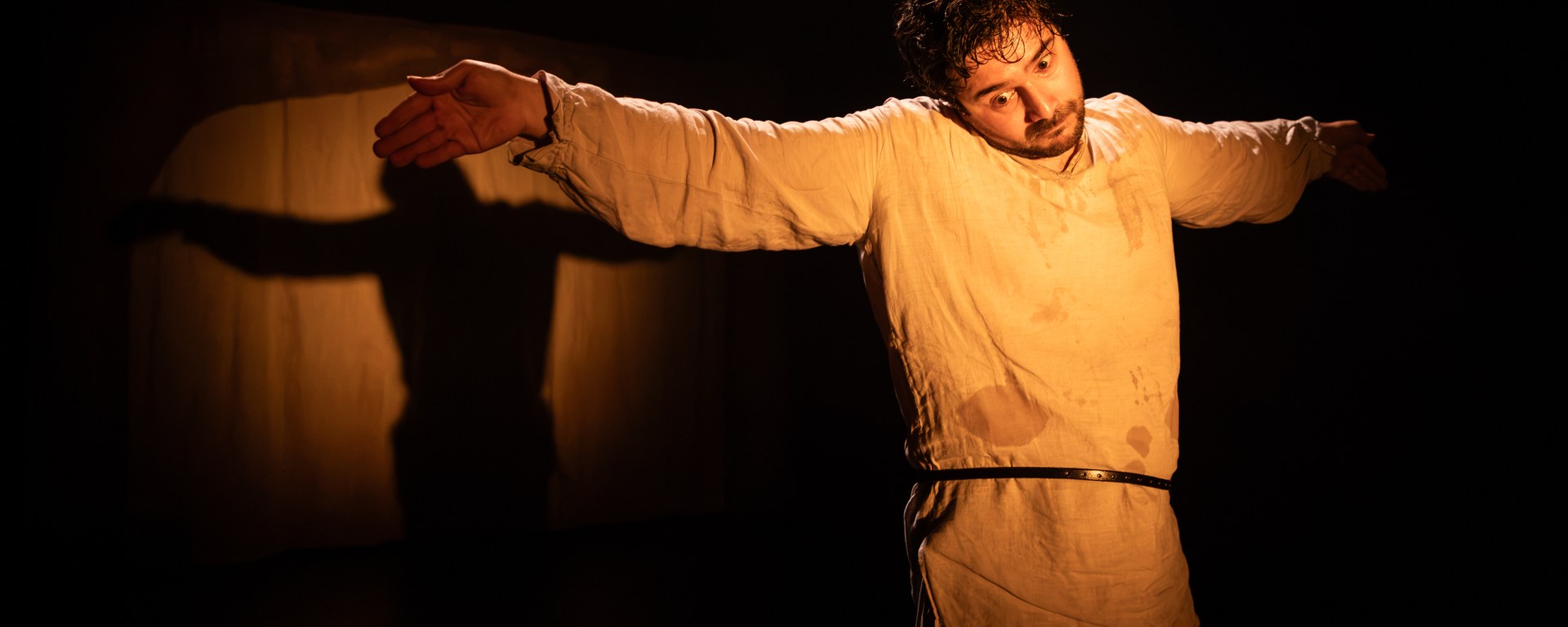
Directed by Giovanni Fusetti and performed at St. Kilda’s Explosives Factory, Holy Fool is a play that manages to take a person who died exactly 800 years ago and turn him into a message of hope for today, a reminder of the need for compassion in a time where selfishness and materialism runs rampant. It’s also a hilarious, nonsensical performance, courtesy of actor and writer Fabio Motta, who tells the story of Saint Francis of Assisi as a kind of cross between a dramatic character study and a stand-up comedy routine.
The performance follows a younger version of Saint Francis, who begins as a soldier seeking glory before being imprisoned during a war, and upon his release becomes determined to “rebuild [the] house” of Jesus. In a sudden revelation, marked by golden light and a dramatic vision of Jesus himself, Francis is quickly compelled to embrace generosity, forsaking his material possessions and turning to a search for the true meaning of “abundance”.
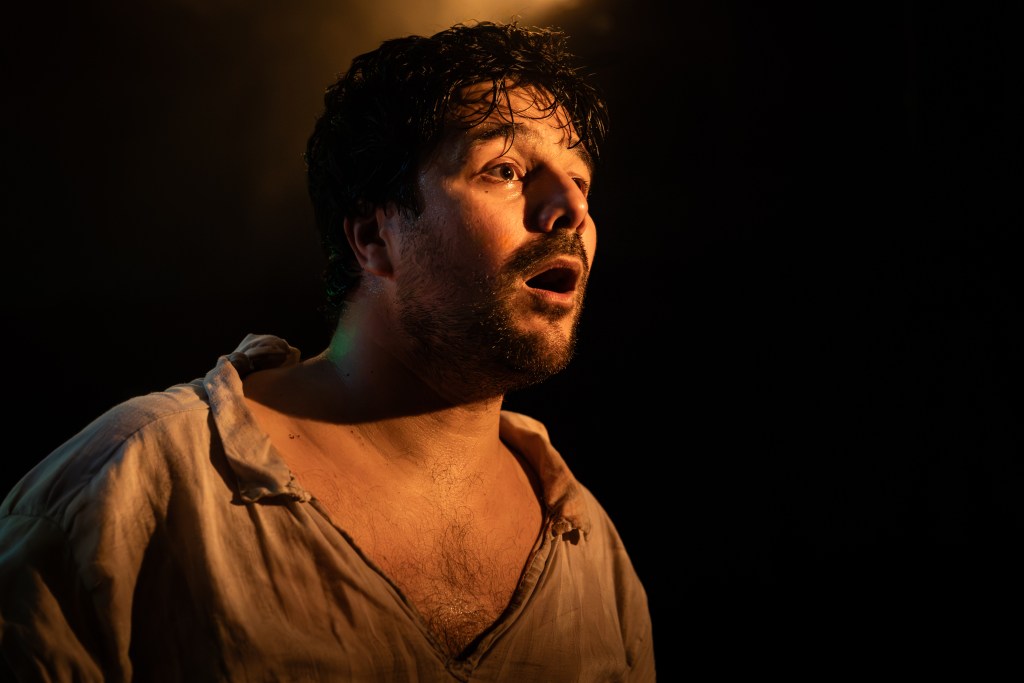
The first thing that blew me away was just how physical and embodied the performance was. The opening sequence, in which the younger, more naïve Francis is sent out to war, has Motta miming out a tense sequence, throwing himself off imaginary horses and being chased by opposing armies. It’s meant to be a lesson that teaches Francis about how terribly the people of this earth are treating each other, but no one’s saying it can’t be funny at the same time. Motta delivers what is essentially an uninterrupted slapstick comedy routine. As he is eventually captured on the battlefield and taken into a dungeon, this slapstick does begin to feel a little crude and stale, but it serves as a light-hearted introduction to what is otherwise the heaviest, slowest part of the narrative, and I would argue it does its job well.
Adding to Holy Fool’s comedy-routine-feel, and honestly the real highlight of the show, is Motta’s excellent crowd work. During his imprisonment, as the wide red lighting of the battlefield is replaced by a murky green filtering through the imagined walls of the dungeon he is kept in, he begins to interact more with the audience, inviting crowd members to partake in his torture. Slowly miming being dragged along by a chain towards the audience, he is soon presented before the front row, who are immediately transported into the scene itself, silently understanding that they now hold a whip, and – in the most comedic way they can think of – are tasked with being hilariously mean to the poor, endlessly suffering Francis.
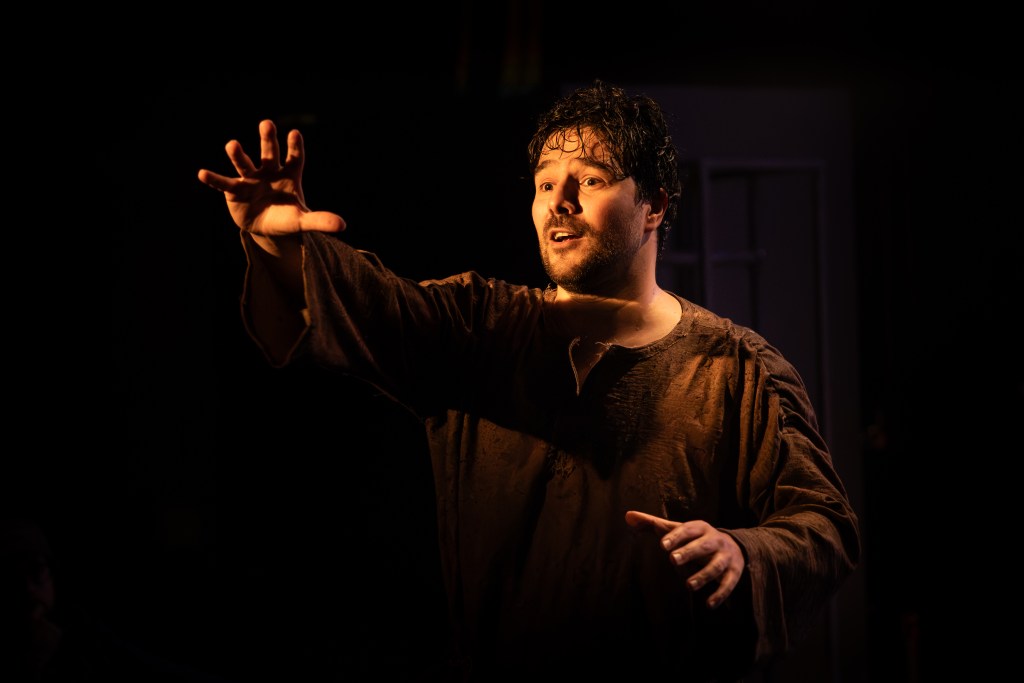
It’s not all mean-spirited, though. While most of these early moments stay within the realm of comedy, upon being bailed out of prison by his materialistic father – a perfect comedic foil who Motta also plays – Francis becomes consumed by the desire to donate material objects and wealth to the poor. This comes, of course, in the shape of rounding up objects from the audience (a watch, a jacket and the tote bag which contained the laptop with which I’m writing this review now) and donating them to a viewer who Motta cheekily designates as a “leper.” This is also where Motta’s one-man-show acting is given ample time to be shown off, as his performance switches up, immediately becoming Francis’ father and swiftly returning all of the donated items (berating me for giving away my laptop in the process).
What starts with Motta gradually introducing his crowd work routine (the whipping, the donations) slowly turns into more of a dialogue between himself and the audience. He wanders around the many “brothers, sisters and siblings” of the crowd, asking about things that they’re grateful for, before taking all of their input and transforming it into a song, which the whole audience then sings back to him, adopting it as a kind of shared theme tune for the rest of the night. It was really quite heartwarming, made all the more emotionally potent by Motta’s rich and nuanced performance, wandering through the crowd and marvelling at the natural beauty present in everyone’s faces, bringing the entire room together in a way that felt like a spiritual experience in itself.
Whilst the input from the crowd was absolutely a highlight, the real emotional core of the show comes from Motta himself. Where much of the show does just revolve around the relationship between Saint Francis and his followers, there are a few other characters that Motta must also play, ensuring the dynamic with the audience remains fun and fresh at every twist and turn. In addition to Francis’ aforementioned father, we also see appearances from God himself, who speaks in a charmingly cheesy New York-slash-Italian accent (his final line is an impassioned “forget about it!”) and from the then-Pope, who sings each of his lines in a way that reminded me a little of Javert in the 2012 Les Misérables film.
The Pope brings an ironic, haughty self-seriousness to the play that shows off part of Motta’s range that the kind, gentle Francis doesn’t quite embody, ensuring for a welcome amount of comedic tonal whiplash. With the difference in character, the crowd work has to adapt alongside, with some shenanigans ensuing as members of the audience have wildly different reactions to being asked to kiss the Pope’s hand or attempting to sing back his musical lines with varying degrees of accuracy. It’s commendable just how fast Motta is to respond to each piece of audience input, regardless of how baffling it is. A particular shoutout, on the opening night, goes to “brother River,” an audience member who managed to steer a scene about sharing food into a conversation about cannibalism and later impressed everyone in the room with the accuracy of his wolf impressions.
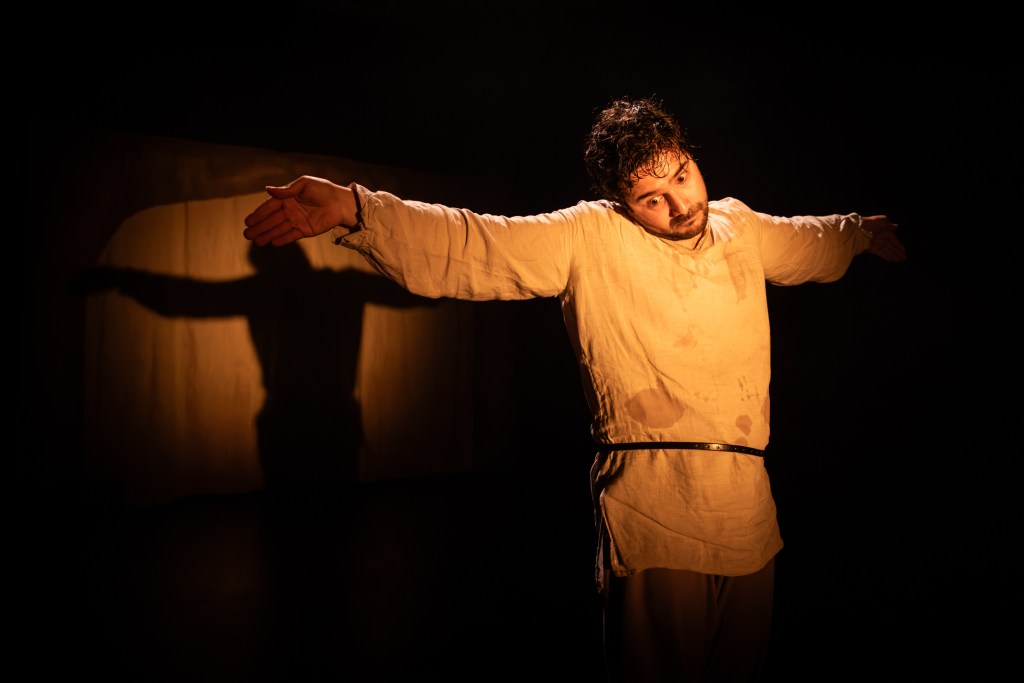
The final notes of the play, as Saint Francis gathers his followers just before he is taken by death, are those of community and of wholeness. Motta brings everyone up onto the stage with him, asked to kneel before him as he shares food (vegan, gluten-free AND nut-free cookies) with the brothers, sisters and siblings of his order, before leading a chorus of the same improvised song from earlier in the play.
As Francis takes his final moments, and we briefly hear a farewell speech from God, Motta beckons for his eager followers to accompany him outside, leading everyone down the Explosive Factory’s staircase and out into the alleyway. The final notes of the play are fittingly moving and ridiculous at the same time: Francis, leaving the mortal world, is flown away by a divine bird (he drives away on an e-scooter with cardboard wings). There’s something incredibly absurd about the whole scene, and the play as a whole, but that absurdity makes for a truly transformative experience.
Walking out of the alleyway and into the night, I was almost convinced to give away my material possessions and embrace the teachings of Francis myself – but more importantly, I was reminded of the need for community, for generosity, in a time where it’s all too easy to turn a blind eye to the needs of those around you.
Holy Fool played at Theatre Works Explosives Factory 9 – 19 September 2026.
IVY KAYE (she/her) is a second-year Bachelor of Arts and Diploma of Music student! When she’s not writing reviews for Farrago and now The Dialog, she plays saxophone, keys, and clarinet, and is obsessed with writing about all things music and live performance.
CHARLOTTE FRASER (she/her) is a writer, performer and editor based in Melbourne. She holds a BA in English and Theatre Studies and is currently completing her Masters degree at the University of Melbourne. Charlotte is also the 2026 Dialog Editor.
The Dialog is supported by Union House Theatre

