
REVIEWED BY ALYSSA MCDONALD SMITH
EDITED BY CHARLOTTE FRASER
Directed by Lilah Benetti and written by Jamila Main, How to Eat Rabbit took to the La Mama Courthouse theatre as part of the Hope Punk Climate festival. At first entrance to the theatre, my friends and I were offered a raffle ticket for the door prize, and whilst waiting we speculated that the prize may be the nearby framed “Save a rabbit, eat pussy.” With little knowledge about the context of the show, we were left wondering what role this shirt would play – were we in for an erotic lesbian sex drama, or a brutal play about animal cruelty?
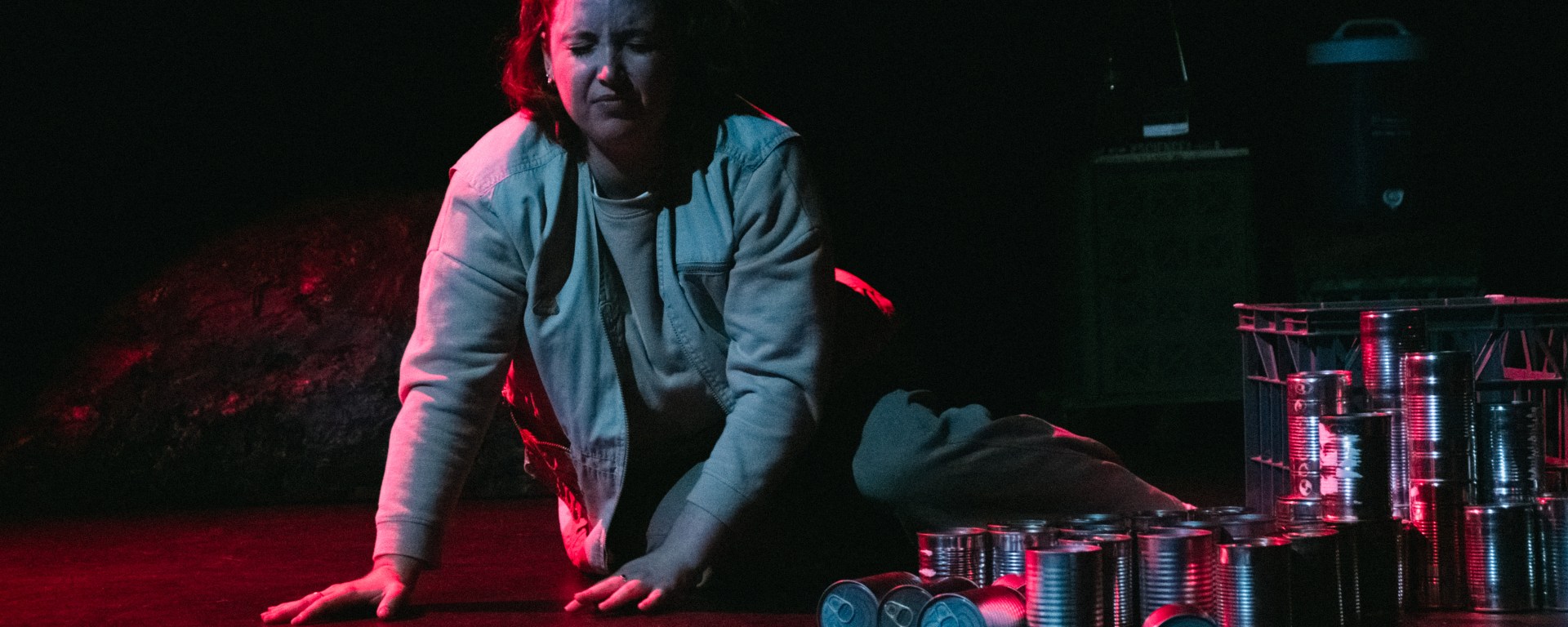
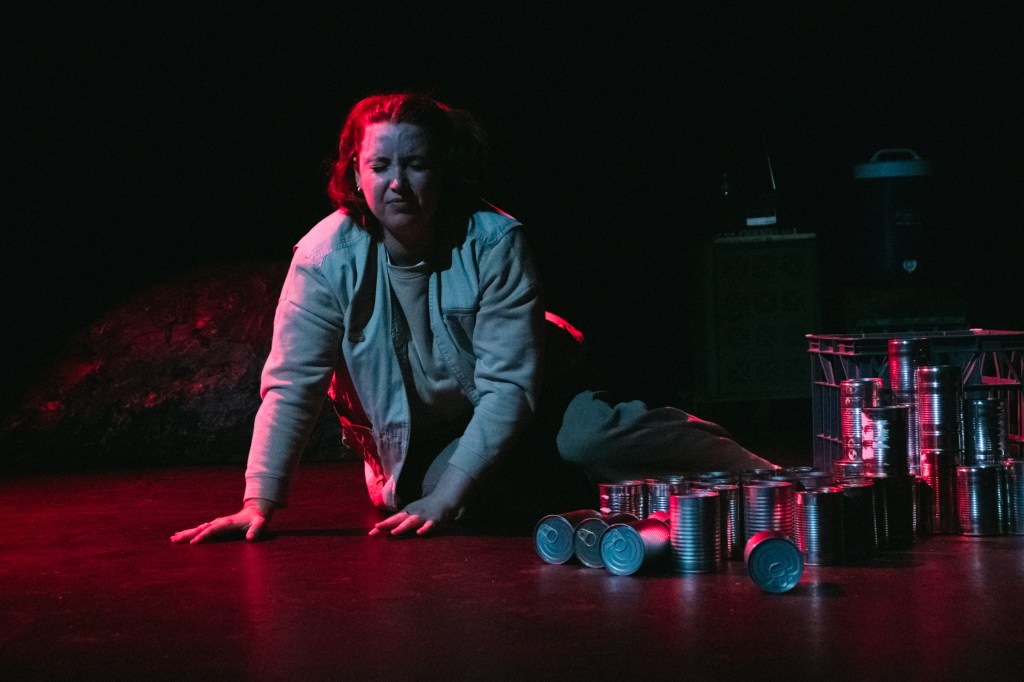
Entering the venue, we were greeted by a dark, militaristic set, bordered by rows and rows of silver tins and a stone wall covered in paintings (closely resembling the lesbian flag), setting the scene for something much more post-apocalyptic. Lara Chamas’ set immediately immersed us in the end of the world, and following a raffle for ‘the last coffee on earth,’ we were ready to enter Main’s dystopia.
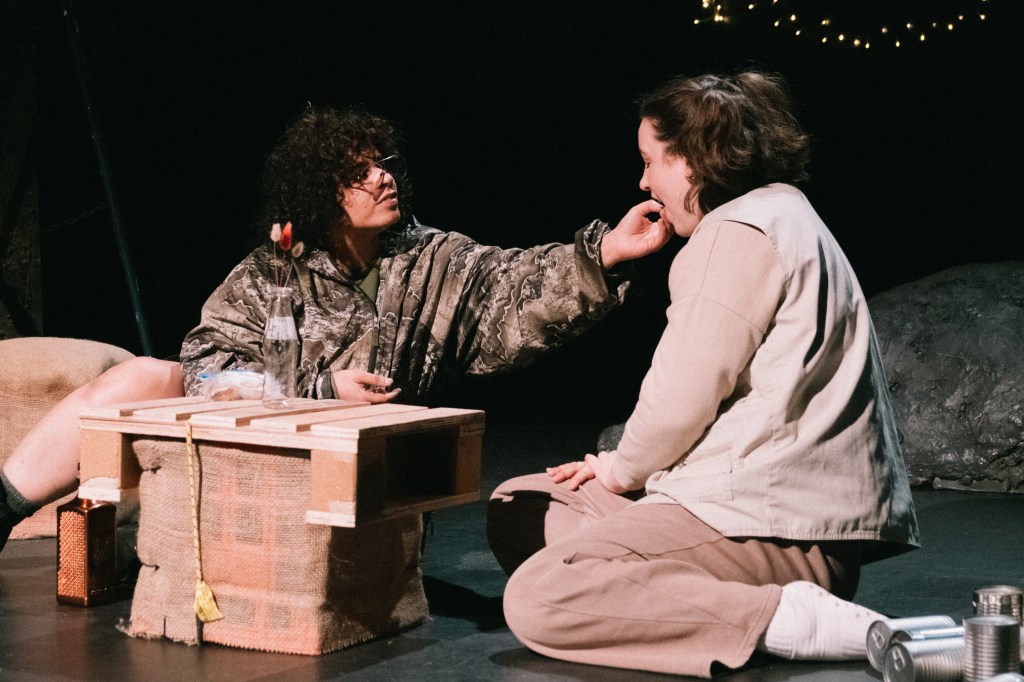
The play follows Cam (Jamila Main) and Alex (Nory Gretz) in their efforts to create a bunker and prepare themselves for the end of the world. Although the cause of destruction and environment of the outside world is left ambiguous, they are fighting for survival in their shelter with days filled with ‘cycles’ of fitness, wellness, hygiene and more to ensure survival and an efficient routine. However, this routine faces difficulty when Cam begins to suffer from pain, needing an IUD removal, which is presented as near-impossible in this post-apocalyptic world.
Gretz enters the performance with a strong persona for Alex – survival-oriented, hardworking, disciplined and orderly. With elements of humour concealed by this tough-guy attitude, Gretz skillfully portrays a guarded survivalist who doesn’t want to let emotions and feelings in the way of survival. Main, on the other hand, constructs Cam as a gentler mannered, convenience loving person who misses the luxuries of modern life and, consequently, is constantly begging Alex to allow them these certain luxuries that are perhaps counterintuitive to Alex’s survivalist agenda.
The catalyst of tension within this play orientates around the moral dilemma of if, as someone who lives in the modern world embodying values synonymous with those of a vegetarian, that something you can compromise in order to survive at the end of the world? Alex continually pushes the necessity of this, whilst Cam is held back, looking first for alternatives that would not require them to compromise their values. Although Alex tries to maintain a tough exterior, Gretz presents us with a powerful scene showing Alex’s own struggles with killing a rabbit by their own hand, and that despite the powerful image they try to construct in front of Cam, Alex holds a moral struggle of their own. This disagreement forms the climax of the play as Alex secretly feeds Cam rabbit to prove their point, sparking a betrayal and subsequent conflict.
However, this conflict provided me with more questions than answers. As Cam expressed their unhappiness at Alex for betraying their trust, I held many curiosities as to what their relationship was before Alex invited Cam to live in the bunker. There is a lot of emphasis on how they chose each other don’t need anyone else, yet a bit more development on their relationship may have allowed these scenes of interpersonal conflict to pack more of a punch, as at times it felt as if there was a lack of care or urgency from Cam’s side despite just experiencing what the audience would perceive to be the ultimate betrayal.
The plot is divided into a series of scenes, opened with Cynthia Spleen’s ominous and inviting soundscapes, marking the beginning of a new ‘chapter.’ Although at times these scenes felt repetitive, it gave the audience an insight into how the daily life inside a bunker plays out, and subsequently the boredom and seemingly endless nature of this.
At the final scene, after a buildup of Cam’s IUD-induced pain throughout the performance, this culminates in an emergency health disaster, with Cam experiencing extreme bleeding and pain. Despite the urgency of this situation not necessarily feeling on par with that of someone dying on stage, the scene was cut short with Gretz and Main breaking the fourth wall, where Main addresses the audience as themself, with a passionate statement about who gets to survive in the apocalypse, and made the audience reflect of the systemic exclusion of those with disabilities.
As a disability rights activist, Main included valuable accessibility features within the production such as captioning projected onto the back wall. However, the effect of these captions was lessened due to synchronicity issues with the cast’s presentation of the lines, occasionally skipping chunks of dialogue whilst the caption controller struggled to keep up or taking glances back at the screen to prompt their memory. Perhaps to avoid the temptation to glance, in the future captions could be presented on screens towards the front of the stage as opposed to on the back wall.
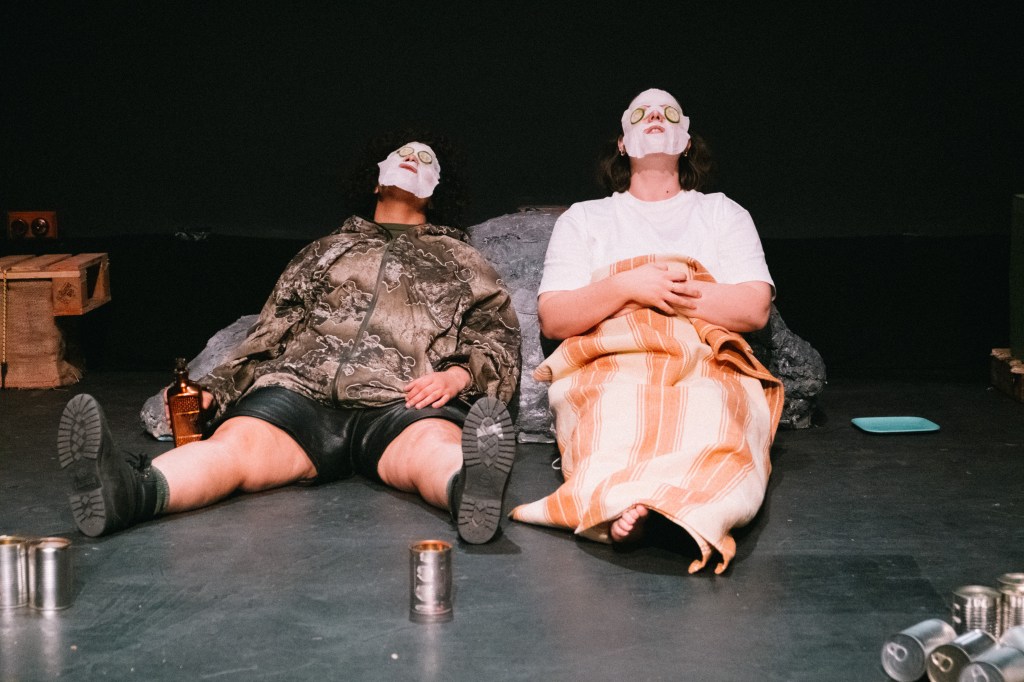
Overall, Main takes us on a curious investigation as to how, with the way we live right now, bathed in conveniences and luxuries, would the end of the world look like? Would we all simply be lying in our shelters with our facemasks on and cucumbers over our eyes? Or would we face our greatest incompatibilities with the way in which we currently live, and eat the rabbit?
How to Eat a Rabbit by Jamila Main was presented by Pillow Fight Theatre at the La Mama Courthouse 8-11 September 2026.
ALYSSA MCDONALD SMITH is a third year Bachelor of Arts student majoring in English/Theatre Studies and Criminology. Driven to student theatre through her love for set design, she is seeking to broaden her involvement in the uni theatre scene.
CHARLOTTE FRASER (she/her) is a writer, performer and editor based in Melbourne. She holds a BA in English and Theatre Studies and is currently completing her Masters degree at the University of Melbourne. Charlotte is also the 2026 Dialog Editor.
The Dialog is supported by Union House Theatre

