
REVIEWED BY SUNDAY WILLIAMS-STARKIE
EDITED BY AZMY
The Melbourne Fringe Festival represents the uniquely human tendency to create, and I had the delight of being a part of the ritual that celebrates this, being at the Motley Bauhaus for the first day of Fringe. I love a theological discussion, and I hate AI, so spirits were high walking in to see Deus Ex Machina, which promised to fulfil this year’s Fringe theme by turning towards some of the hottest topics of now: artificial intelligence and religion.
Deus Ex Machina, written by Fourth. Theatre Co. Creative producer Esmé Stripp, draws a compelling and ambitious comparison between religion and the worship of artificial intelligence. The two hander explores the relationship between a programmer, Isaac (Marcus Leder) and Dora (Felicity Barrow), a volunteer sent on behalf of a local church. The two discuss the ethics of programming a machine that allows believers to speak directly to God, and to hear God directly speak back.
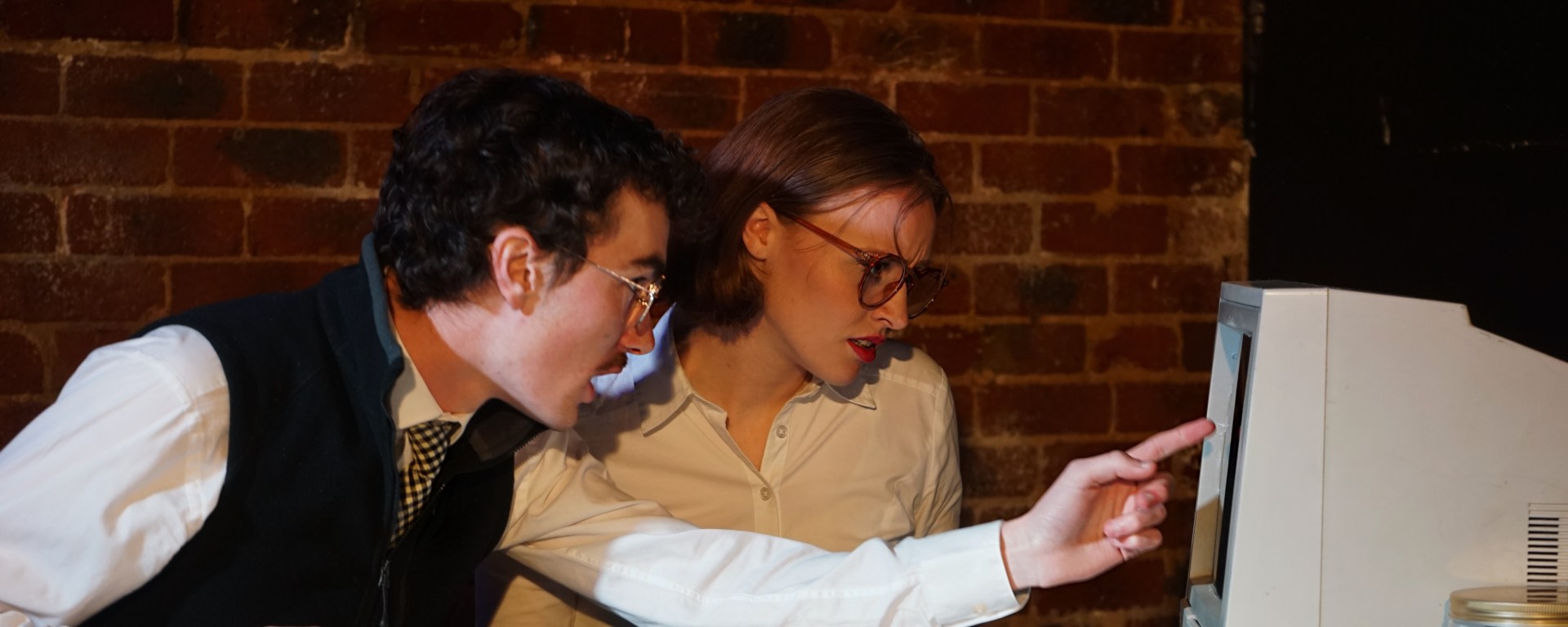
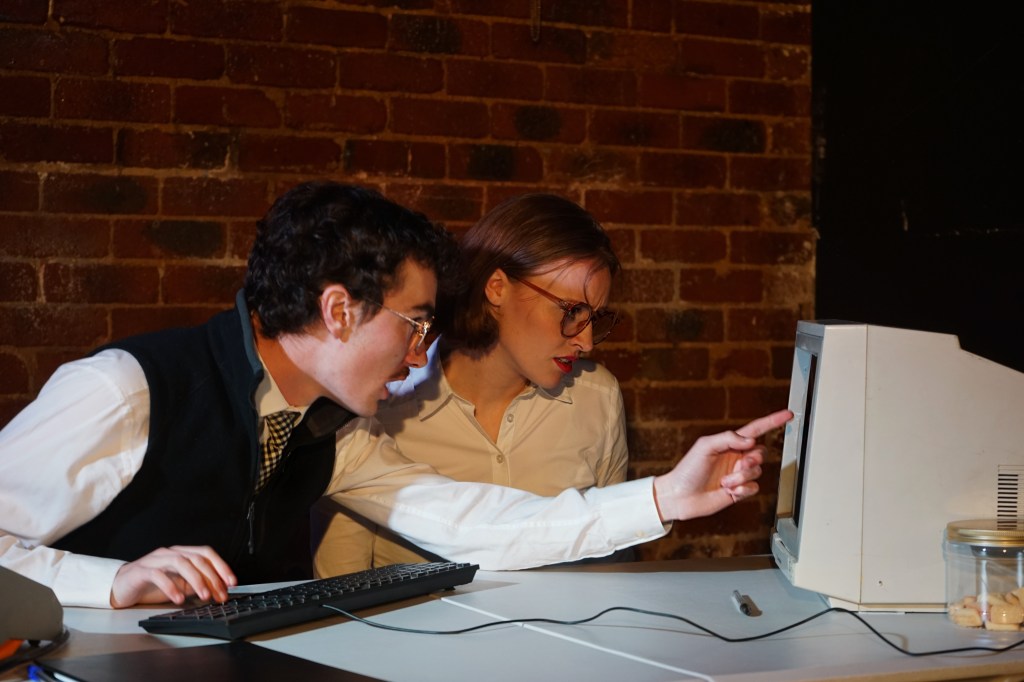
Dora is bright and optimistic, a leader in her church community. She describes her faith as based on love and finds herself as a voice of authority on how to make the Machine ‘sound like God.’ Barrow depicts Dora with an undeniable sweetness but doesn’t shy away from giving her status in her debates with Isaac. Dora is at times frustratingly indecisive but gains momentum in her ambition to understand and develop the Machine.
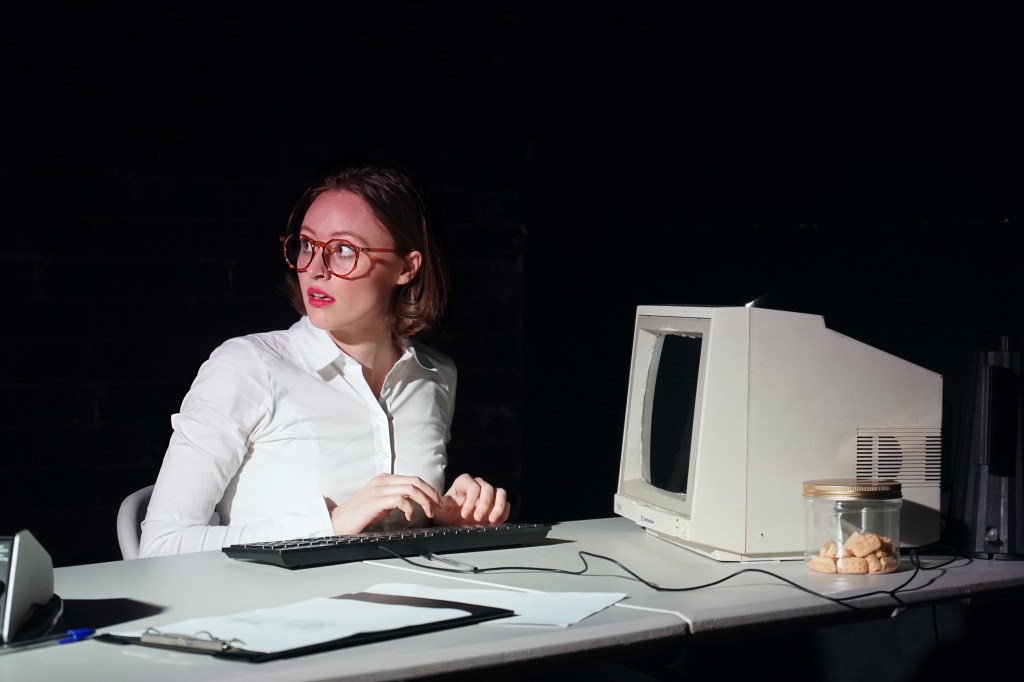
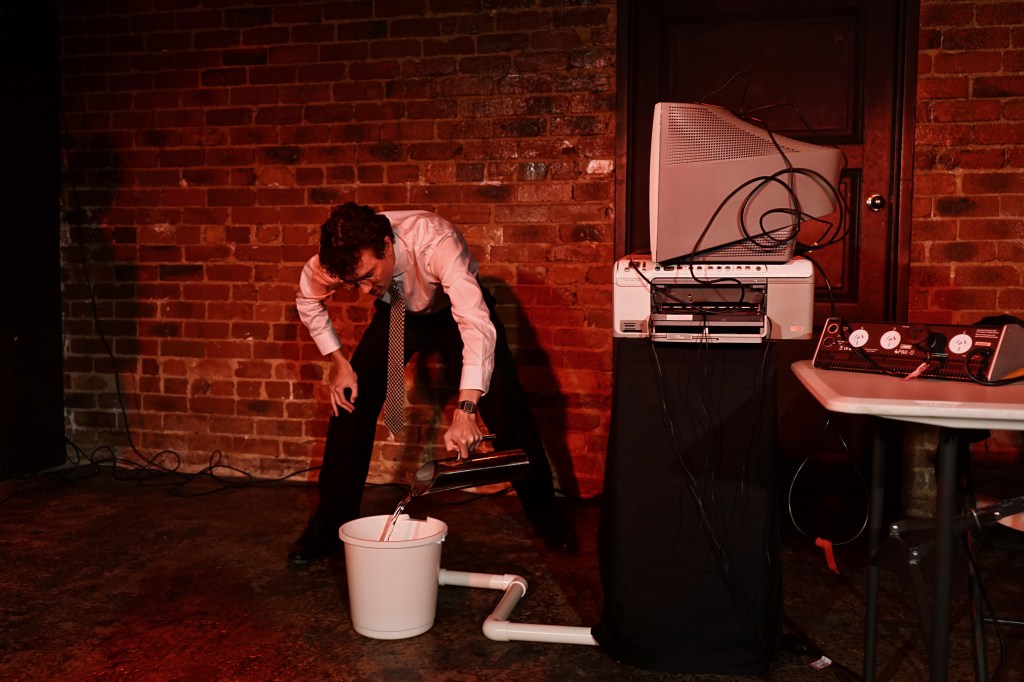
Leder depicts Isaac as aloof and arrogant. He claims not to believe in anything, but is dedicated to the creation of this Machine, so much so that he cools its servers by hand with his own water like he’s bathing a grumpy toddler. I was particularly charmed by Leder’s intermittent snacking on his jar of shortbread that lay on his desk. It strengthened Isaac’s characterisation as relaxed and strangely self-indulgent.
The play speaks directly to the (dangerous) rise of techno-optimism. To quote their manifesto, written by Marc Andreessen, ‘Techno-Optimists believe that societies, like sharks, grow or die…We believe that there is no material problem – whether created by nature or by technology – that cannot be solved with more technology.’ For Isaac, the problem to be solved is God – or rather, the fact that God won’t necessarily respond. Isaac has a very practical perspective on God, and doesn’t understand the value of having the potential for interpretation and nuance that you get from prayer. This grasping for a God you don’t have to interpret yourself is not as far flung a story as one might think. Peter’s Chapel in Lucerne, Switzerland, has installed their very own DEUS EX MACHINA, built on religious texts, allowing individuals to hear directly from God. Writer Stripp has done well to draw on such a pertinent example and explore it so thoroughly.
The ideas in the text of this piece are very strong. I was particularly struck by the analogising of Roko’s Basilisk and Pascal’s Wager. The script did an excellent job of explaining them in a way that didn’t feel overly expository but maintained a didactic element. The problem of whether it is better to believe on the basis of faith or punishment has stuck with me and in my opinion was the clearest point of comparison between the religious and techno-optimist world view. However, I did think there was room for the particular relationship between Dora and Isaac to be further developed, with idiosyncrasies that go beyond their stance on faith. A personal friendship or particular vendetta (beyond being slightly antagonistic coworkers) would have increased the pathos and personal risk for both of them.
The sections of dialogue were also offset by simple transitions and movement sequences. I appreciated the slow pace of these transitions that gave the sense of real time passing, and the gentle musical underscoring gave these moments an almost prayerful quality. I would be interested to see how this choreography could be expanded upon while still maintaining a sense of minimalism, and whether exits and entrances to the space through the large Theatrette door could be given a stronger sense of significance in these transitions.
The sound in this piece, designed by Max Pickering, was exemplary. Each moment was perfectly scored, with tuneful, vapor-wavey synth scores that, like the rest of the mise-èn-scene, was subtly yet recognisably 80s inspired. I was particularly struck every time the soundtrack felt in any way hymnal, with long organ chords. Additionally, the soundscape of water intermittently dripping and echoing was haunting and made the confessional sequences feel perfectly off kilter, a tasteful abstraction of water, and by extension, the natural order, and tied in nicely to the previous water sequence.
The Theatrette space is small and the set, designed by Stripp, heightened the claustrophobic and intimate elements of the office space to build the world of the shut-in Isaac. In the centre was the machine itself: an old printer spitting out wires, topped with an 80s fatback monitor turned to face the wall. There was also a large desk with a second monitor, a kettle, and the famous box of shortbread. A classic and slick office set. The minimalist grayscale colour palette that permeated the set and Isaac’s costume made Dora’s warm red lipstick and tortoiseshell glasses frames stand out as a beacon of warmth and humanity in the drab space, and the golden crucifix around her neck would often catch a ray of light and glow sublimely.
For me, the set truly came alive under the lighting, designed by producer and stage manager Karen Ng. When a solitary birdie light turned on inside the monitor of the machine, it cast an eerie glow on the actor sitting across from it: it elucidated the imagery of a confession booth, or candlelight, and the minimal visibility seemed to suddenly expand the tiny office space and throw us into the liminality of a spiritual space.
I was also fascinated upon entering to see that a small lighting desk sat inconspicuously on Isaac’s desk as a part of Isaac’s general clutter. I wish Leder’s ability to control the lighting from inside the machine had been explored further, as in performance he only touched the desk once to quickly and surreptitiously turn on a light. If Isaac is so intent at playing God within the story, I would have loved to see him actually control the theatrical space in a meaningful way.
The Machine itself was literally and figuratively central, being a catalyst for the action, yet I believe the performance lacked a clear embodiment and connection with the Machine itself. As mentioned, the monitor faced away from the audience. While it was interesting to have just the character speaking to God privy to the face of the machine, I believe the mystery and eerie intangibility of the machine would have been augmented if we could see it. Does this god have a face? Text on screen? I also wished the machine had, in some way, a capacity to be moved or puppeted, perhaps with different or moving lighting from inside the box, to increase the level of status it held in the space. I also found that having the actor voicing God onstage took the focus away from the Machine, especially with the mostly deadpan delivery of its lines. I wonder, in future iterations, if there is the potential for the actor voicing the machine to interact with the other actor, take on a more extreme shape or vocal quality, or be entirely invisible to allow for the monitor itself to shine. Stronger choices surrounding the Machine would have helped to earn the high stakes of the latter scenes. As of now, the stakes the machine represented seemed a little distant from its materiality as an old monitor.
This play is undeniably current. It speaks to the obvious anxieties young people, particularly artists, feel surrounding artificial intelligence but takes a bold and new perspective on it by exploring a comparison between the techno-optimist devotion to ‘progress’ and religion, which to a character like Isaac, seems anachronistic. The language sets it firmly in the present, the program places it a few years in the future, so I have to ask: why design the set and costumes to be so distinctly 80s? There is a benefit to seeing old-fashioned technology onstage: it is an easily recognisable symbol across generations, and seeing a fatback monitor creates a sense of nostalgia even for a youth like me. It also helps to reframe the technology young people are so familiar with and translate this familiarity into a theatrical landscape. The anachronistic tech also depicts Isaac as disconnected from the prospective users of the Machine and their needs – to the point that he himself had never ‘spoken to’ the Machine before Dora. A creator that avoids his creation, knowing it now exists beyond his power, like Mark Zuckerberg with Facebook and Sam Altman with ChatGPT. Why shy away from the fact that the audience is familiar with AI systems and interfaces shoved in their face in their everyday life? Why hide away from visual allusions to interfaces like Copilot and ChatGPT when they are, at least on the surface, the systems that draw the ire of the play? And why let the audience off the hook by placing them in the visual language of charmingly timeless anachronistic tech? I wonder whether there would be the possibility of seeing the technology onstage evolve throughout the performance, taking on life of its own and becoming more like the machines that the Machine is modelled off.
I’m going to enter spoiler territory here, so if you haven’t seen it yet, skip this paragraph. Deus Ex Machina has a run time of only 45 minutes and spends the first few scenes exploring relatively common knowledge surrounding artificial intelligence, for example, its extortionate use of water. It wasn’t until around 30 minutes in that the script began to truly problematise the comfortable relationship Isaac has with the Machine. The final moment of the show depicts Dora looming over Isaac, now sure she is the only one who should be responsible for the Machine, suddenly a true believer in its value and power. Her only meaningful interaction with the Machine had been in transitions where she was seen editing its program. Yet, there was a large gap in the text that skipped over Dora becoming actually convinced that the Machine is something worth investing her energy into. In order to truly explore what it is that makes AI dangerous, it is the process of how people fall into habitual use of it that is most critical. Structurally I would love to see the first scenes shortened and the middle section extended with more time spent with Dora for clearer messaging, and counterintuitively, some more empathy towards those that fall victim to AI. I did see a glimmer of this in the allusions to Isaac in the bible that the Machine makes. It is understandable that Isaac, a gifted scientist, seeks clear-cut answers, rather than allowing himself to act on faith. There was more room to explore his emotional world and the conflict or fear he may feel when being confronted with ambiguity. All this to say, I think the show deserves more time to say what it needs to.
Deus Ex Machina is saying something that needs to be said in the face of the rise of AI. When something as innately human as religion becomes commodified, and the responsibility of holding it placed in the hands of a machine, (especially considering they do not have hands), even an atheist such as myself can feel a cringe of sacrilege. If a machine, designed at the hands of a singular man, can decide and feed back to us what our God should be and what that God wants for us, there is nothing sacred in that. Passing a revelation made of a thousand revelations before it, the Machine robs us of the opportunity to find our own meaning, seek something for ourselves to have faith in. It is murdering human connection even as it simulates it, satisfying our hunger for an answer and killing our drive to seek one.
To say you don’t believe in anything is naive, misled, and leads you down a path best left untrodden. So, what do you believe in? Where will it lead you?
Deus Ex Machina was presented by Fourth Theatre Co at the Motley Bauhaus Theatrette 28 Sep – 4 Oct 2026.
SUNDAY WILLIAMS-STARKIE (she/they) is a Theatre-maker pursuing their BFA in Theatre at the Victorian College of the Arts. She’s completely obsessed with Theatre of all kinds, and believes a good show is one that’s talked about.
AZMY is a creative studying a Bachelor of Arts at UniMelb. This year, they are making theatre with The Werkz Ensemble and Cipta Theatre company!
The Dialog is supported by Union House Theatre

