
REVIEWED BY SUNDAY WILLIAMS-STARKIE
EDITED BY CHARLOTTE FRASER
Last year, in November, I saw Butterflies on the Wheel performed as a reading at the VCA, amongst a festival of other works from the Masters of Writing. Ashleigh August Shearman’s work makes the most of its epic form, following a cast of 9 characters in vignettes that travel across time and space from ancient Rome to modern day Australia. The first thing I thought upon leaving that reading is how much the script was itching to be performed in full. It was an absolute delight to discover that this Fringe festival, at Gasworks arts space, the script would get that very opportunity.
The narrative explores every facet of queer experience, the ugly, the challenging, the beautiful and the ecstatic. It reimagines the story of Sporus, a real life individual from ancient Rome, who as a young boy became a favourite lover of Emperor Nero on account of the striking resemblance the boy shared with Nero’s late wife, Poppea Sabina. In his later years as Emperor, Nero castrated Sporus and married him, referring to Sporus by the name Poppea, and by the title wife.
The script is challenging, and requires a lot of work from the production areas to contribute to the meaning-making for the audience in terms of time, space and character.
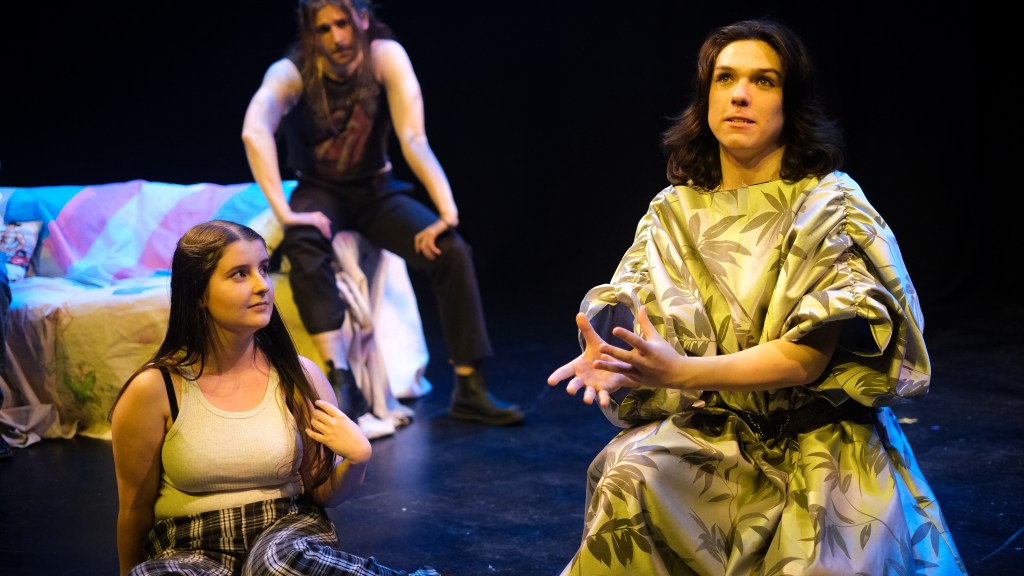
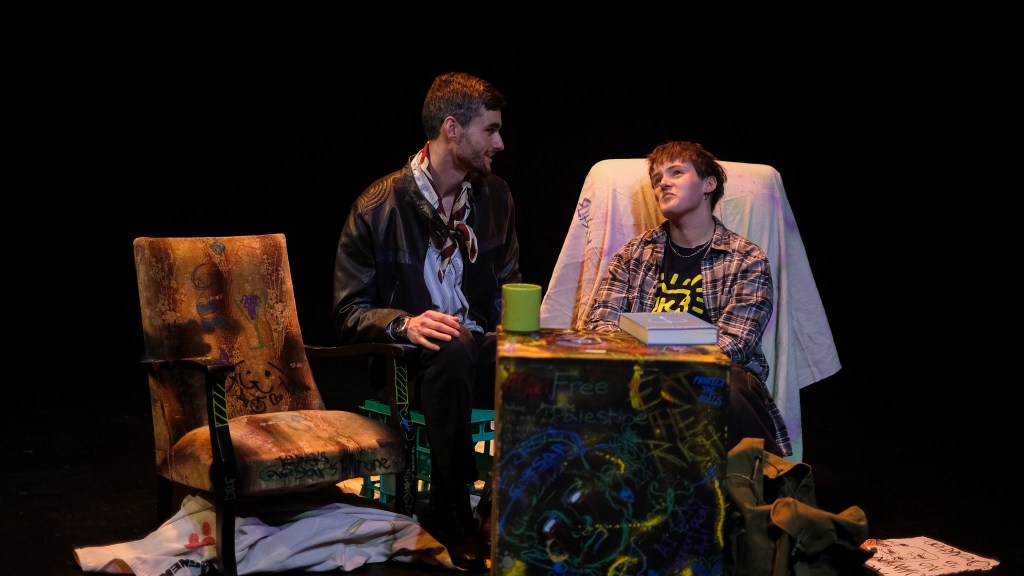
I was delighted by the set upon walking in. Designed by director Tyler Ryan Wood, the set placed the queer punk aesthetics front and centre from the first moment. A queer household evoked with the shark shaped fairy lights and ‘50’s pinup cushions. I loudly chuckled at the graffitied set of drawers that featured a tag that read ”it’s giving manti core.” It looked lived in and loved, and I wasnt surprised to discover the cast and team had hand graffitied the set, in an act of group creativity. It served particular scenes perfectly, however, as the show went on and we were taken across so many spaces I found myself longing for the set to have some kind of transformative quality that could aid in the sense-making. I would have loved to see some kind of flat to designate the space, beyond plain black curtains, or even some minimal projection. However I would not want to see the cozy vibe changed as it grounded and contrasted the more fantastical scenes.
Ryan Wood did a fantastic job in making the most of the space through blocking. Having two seated areas, a couch and two armchairs, was simple and effective, and to a certain extent did aid in delineating space in split-stage scenes. When the chorus spread across the stage it created a wonderfully expansive tableaux, producing a heightened sense of grandeur to suit Nero’s palace. The heightened blocking could have been taken even further in the ancient scenes in response to the splendour of the text, potentially including more exaggerated body shapes from the actors.
The sound, designed and composed by James Carolan, also did a lot for signposting spaces. The show began with a beautiful and peaceful musical soundscape that elicited the image of a fountain in a garden. Later, we hear the ambient sounds of a bar and a cafe. I wonder if there’s a potential for more musical elements in the body of the play, especially to mirror the punk elements of the other design areas, and whether music and sound could have been created live onstage at any point, by actors or instrumentalists.
The lighting, designed by writer Ashleigh August Shearman, invigorated the space with colour and movement often, yet was also subtle and naturalistic when it needed to be. In particular, Tiresias’ split stage scene had the most fabulous split colour state.
Ella Barret’s costuming was extraordinary, with a clear attention to detail and character in every costume. The distinct styles of each character grew and developed over the course of the performance in a satisfying and authentic way, creating a sense of real-time and personal growth. I particularly enjoyed Poppy’s battlejacket and the patches on Tiresias’s blazer. However I do think that, in contrast to the set, the costumes may have benefitted from some more simplicity for clarity’s sake. I also wanted a bit more opulence from the ancient costumes, particularly for Poppea.
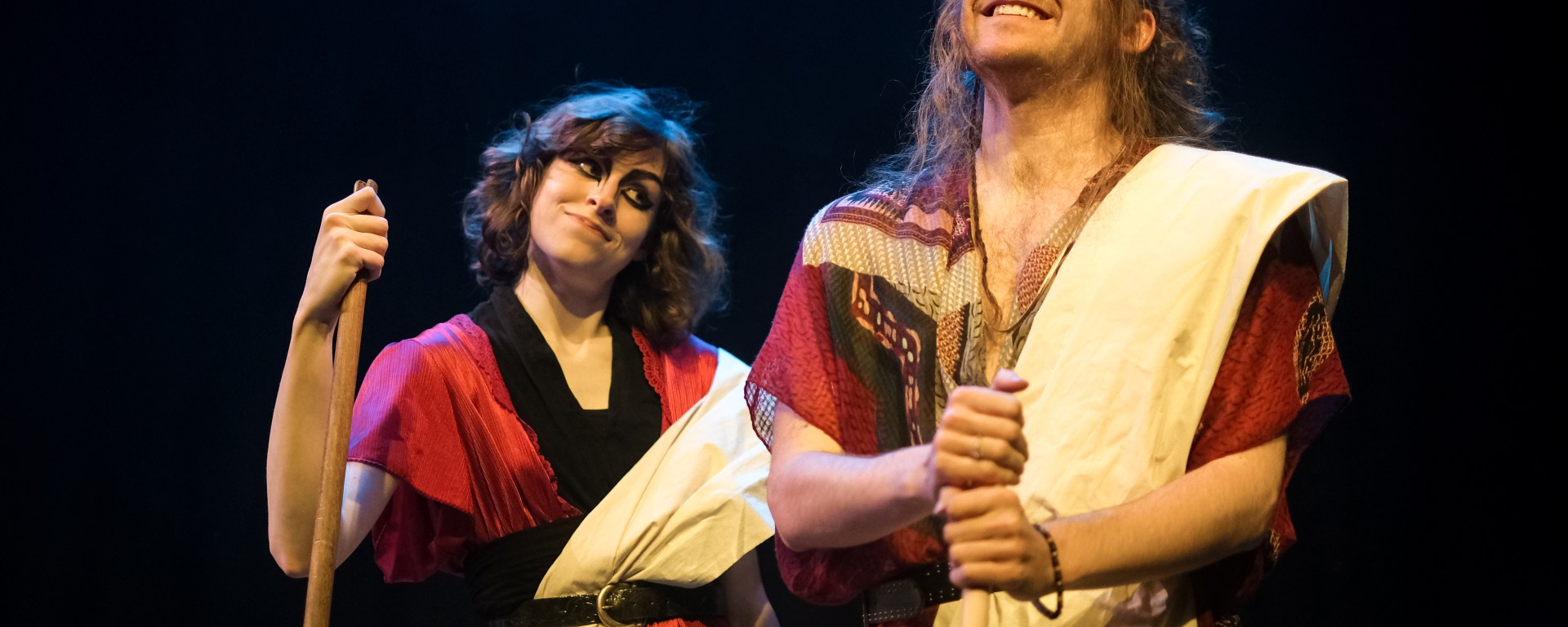
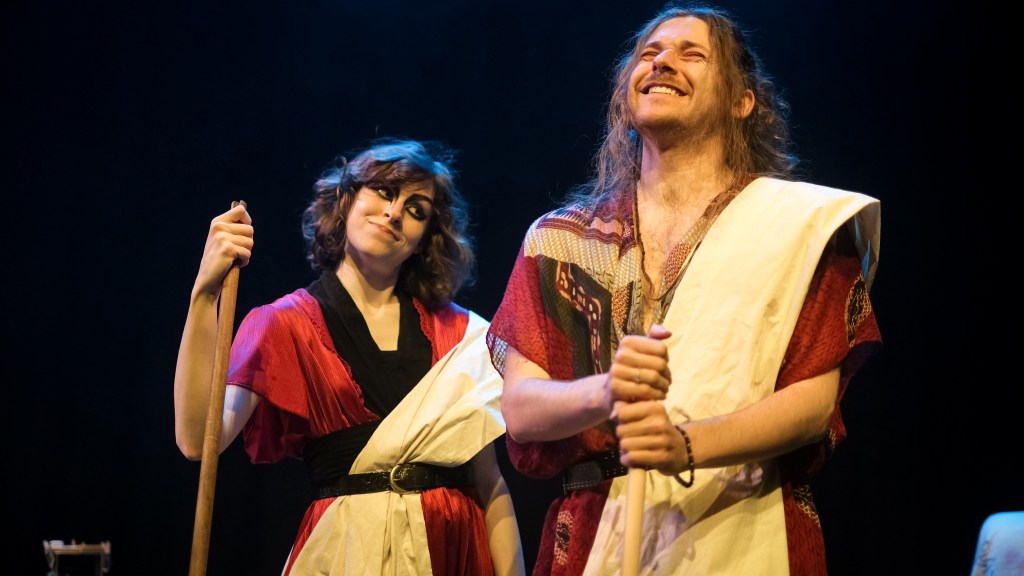
Alongside the characters of Poppea, portrayed by Jade Bishop, and Nero, played by Cameron Rixon, we see several other mythological and historical characters from across Greece and Rome. Each character exists between ancient times and modern, each with a unique relationship to one another.
This show was carried off beautifully by the cast. With each actor playing multiple roles, jumping between chorus and principle, and swapping between modern speech and verse, it was no simple task. Bishop’s portrayal of Sporus/Poppea was a particular standout for me. When we first see Poppy enter the stage, she has the undeniably awkward and sweet demeanour of somebody who doesn’t quite know what to do with themself yet. Over the course of the story we see Poppy blossom into someone much more self-assured and confident, which is made all the more poignant when we compare her life to the one of her ancient counterpart.
We don’t see much of Narcissus in the middle of the play, but Darcy Crawford’s portrayal of him was affecting and vulnerable. Despite the Greek myth we may be well acquainted with, this Narcissus is quiet and, when we first meet him, very insecure. Crawford plays this with subtlety and truth.
The strength of the cast however was most felt in their moments of connection and presence together as a full ensemble, in moments of both joy and tragedy. The closing scene in particular was engaging, all of the separate relationships that the play sets up finally come together. The chemistry the actors share with one another and the ease with which they share the space gets to shine.
The prior knowledge required to fully understand a play built on this much research is immense, many of the scenes seem to intentionally dock expository information surrounding the original myths and instead explore internal realities of the characters, which makes it more accessible. However, much of this expository information included things like names and autobiographical details, which, in conjunction with a double cast, makes it often difficult to tell what exactly is happening onstage until much later. The mysterious elements of the script actually make for a very compelling viewing experience so long as the audience are willing to hang on every word the actors say. For this reason, I give sincere credit to the actors for every moment of clear annunciation. You can never overdo it in an epic play like this – more direct audience address and clearer articulation would not have gone astray.
Halfway through the show, as a respite from the narrative, there was an advertisement for Manticore Energy, prerecorded and played as a video. While I appreciated the production’s decision to use a mixed media element, I would have preferred it if this advert had been performed live, as it would have been a great 11 o’clock number to invigorate the audience. In its current form, the video was played on the caption screen and was very small – from where I sat it was difficult to see, and I missed key details meaning the final punchline didn’t land.
I drew a connection to the scene of Nero describing his struggle to quit Nicotine. This scene, like Manticore Energy, features the entire ensemble and direct address. Queer individuals do tend toward nicotine and alcohol abuse than their heterosexual counterparts, a fact I didn’t know before writing this review. Addictive and dangerous substances are often marketed towards and associated with queer people, which can be mistaken for true representation. This problematises the idea that being acknowledged is enough to be truly respected, and refers to a specific and current issue in the LGBTQIA+ community, one that often goes ignored or is even sometimes valorised as a side effect of an inherent party culture.
In debates as to whether queer people truly deserve respect, I am sure I am not the only one who has heard sentiments to the effect of “But we’ve always been here! What about the ancient Romans? Gayest people ever”. It is true that we’ve always been here, and that queerness is natural, but I find it hard to accept that the pedophilic, misogynist society of ancient Rome is the best parallel we can draw. There is hardly anything in this reality that is worth aspiring to for modern queer lovers.
It would be very easy to turn Sporus/Poppea’s story into a sanitised cutesy story of queer joy as a trans woman discovers her identity and autonomy in the marvellous society of ancient Rome. But Butterflies does not do this. Instead, Poppy and Poppea’s story is riddled with contradictions, fear, confusion and nuance. By allowing these difficulties and nuances to exist, this play sets itself apart as a truly queer story, for queer people, that investigates our history and the values we hold now. How much do we want to subscribe to the histories we belong to? I applaud August Shearmann for their bold and unflinching take on this piece of history.
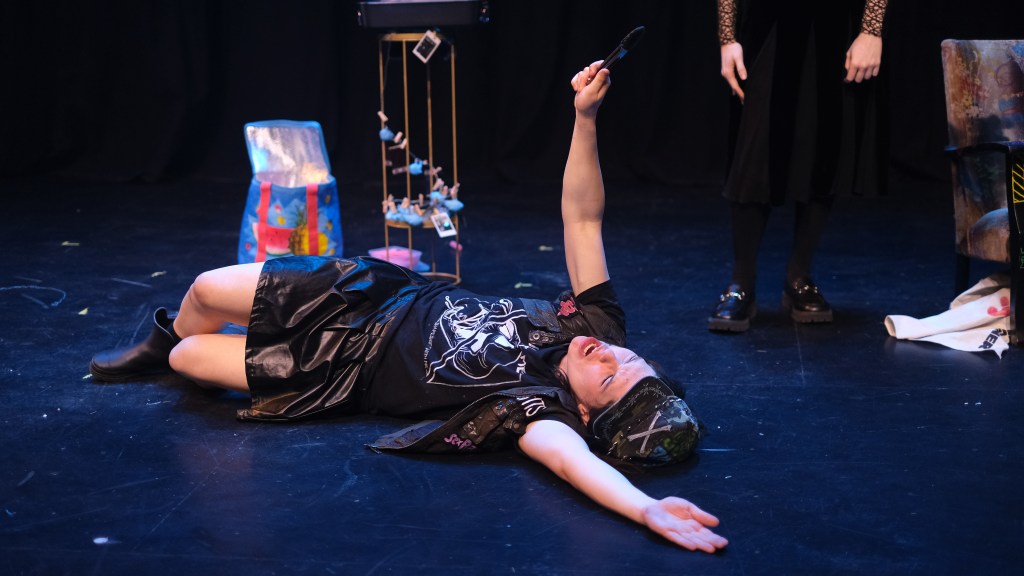
One of the strongest moments in the play is when Poppy expresses that she doesn’t wish to be reduced to their positionality as a genderqueer person, and is more concerned with living their own life now in peace than carving a path for “those that come up after” them. It was fascinating to contrast this with the position the ancient Poppea found herself in. Did they have the autonomy to choose such things? The historical Sporus certainly did not have this autonomy.
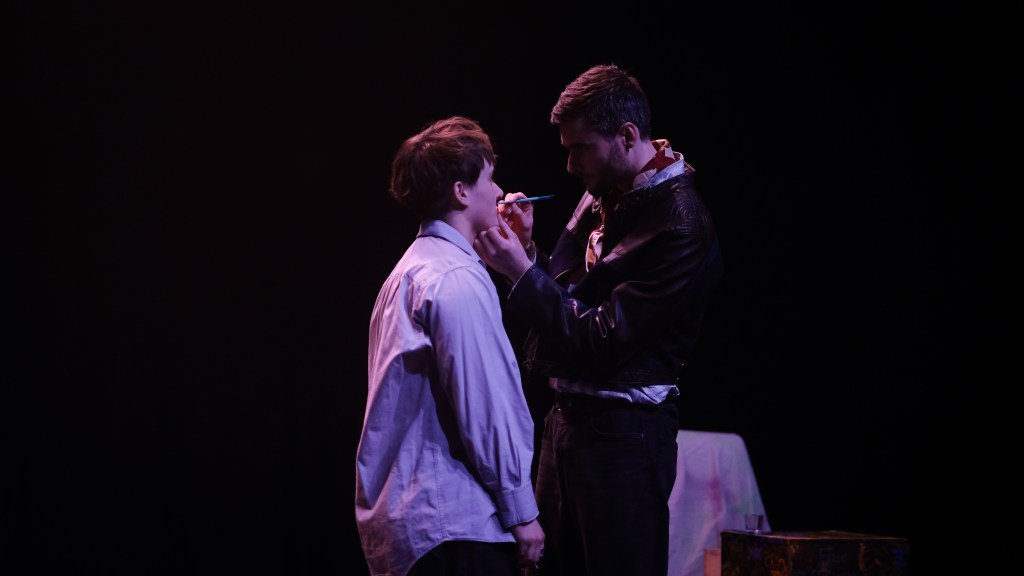
The polaroid camera is a prop that beautifully captures this theme, of wanting to make a mark of evidence on your own life. My favourite moment was when Cadmus captures Tiresias on camera, as they have asked him to see them and be present with them. The repetition of this motif added so much meaning to the graffitied elements of the set, and made them more than an expression of rebellion. The play suggests that insisting you exist, being seen as you are and as you wish to be, is an essential part of realising your identity and your future, and there isn’t shame in it. Though, again, do we really have control over such things?
Butterflies on the Wheel explores queer culture for queer people. What kind of impression do we leave for those that come after us? Is suffering now going to ultimately bring us further in the future or is it suffering for suffering’s sake? To me, looking back and reimagining Sporus/Poppea’s story as one of joy and autonomy is comforting and invigorating. But what would it have meant to the people of the time? What will it mean to be people of the future?
I don’t know the answers, and I think that’s the benefit of an epic structure like this. We come from somewhere, as queer people. We have a history, and we have a future though it is sometimes hard to see it. I hope that more stories like Butterflies on the Wheel can be a part of it.
Butterflies on the Wheel played at Gasworks Main Theatre 6 – 10 October 2026 as part of the Melbourne Fringe Festival.
SUNDAY WILLIAMS-STARKIE (she/they) is a Theatre-maker pursuing their BFA in Theatre at the Victorian College of the Arts. She’s completely obsessed with Theatre of all kinds, and believes a good show is one that’s talked about.
CHARLOTTE FRASER (she/her) is a writer, performer and editor based in Melbourne. She holds a BA in English and Theatre Studies and is currently completing her Masters degree at the University of Melbourne. Charlotte is also the 2026 Dialog Editor.
The Dialog is supported by Union House Theatre

