
REVIEWED BY AZMY
EDITED BY CHARLOTTE FRASER
You want to be with people who hurt you?
I want to belong.
Changeling, written by Charlie Simmons, is set in a Scottish town and deals with the intersections between neurodiversity and folklore. The show draws its inspiration from the old belief that that strange children were the result of faeries stealing human babies and swapping them with ‘less desirable’ changeling babies. Changeling is a thoughtfully crafted tale about neurodivergent self-acceptance and the search for belonging in a world that was not made with you in mind.
I was lucky enough to have watched a previous version of the show at last year’s fringe festival and found the new version to be quite different in a great way. The relocation to a smaller venue was a much-needed move given the reflective nature of the show, and I feel had the additional bonus of being much more immersive. (Also, Club Voltaire is seriously beautiful!) With this new script, Simmons allows the metaphor to speak without overexplaining in such a way that anyone who watches the show will be able to relate to its many themes including neurodiversity, identity, patriarchy, motherhood, and family.
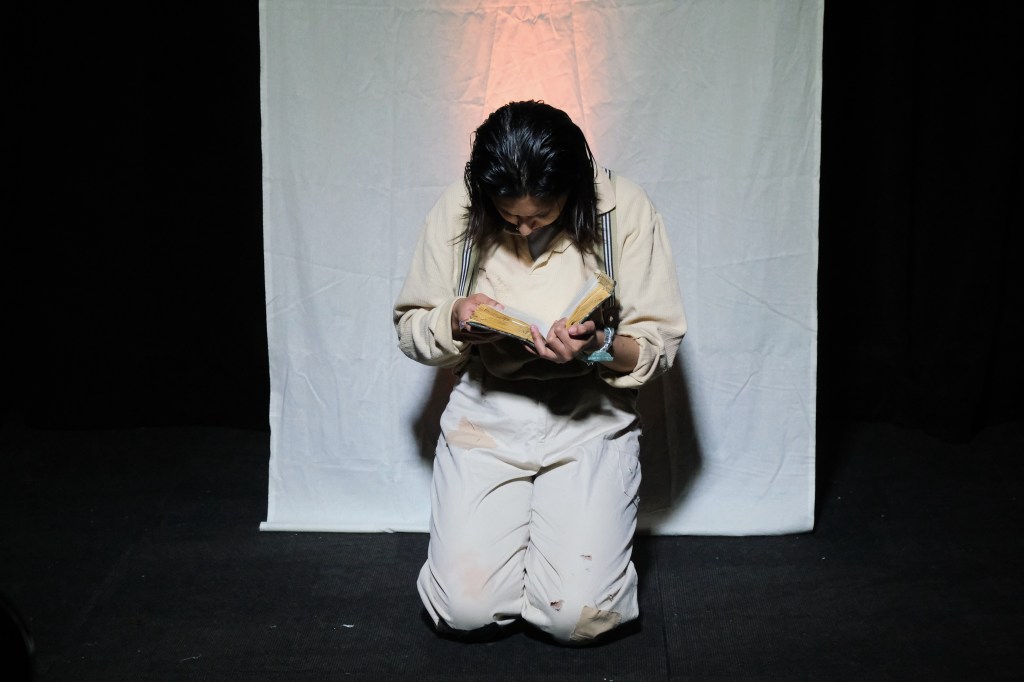
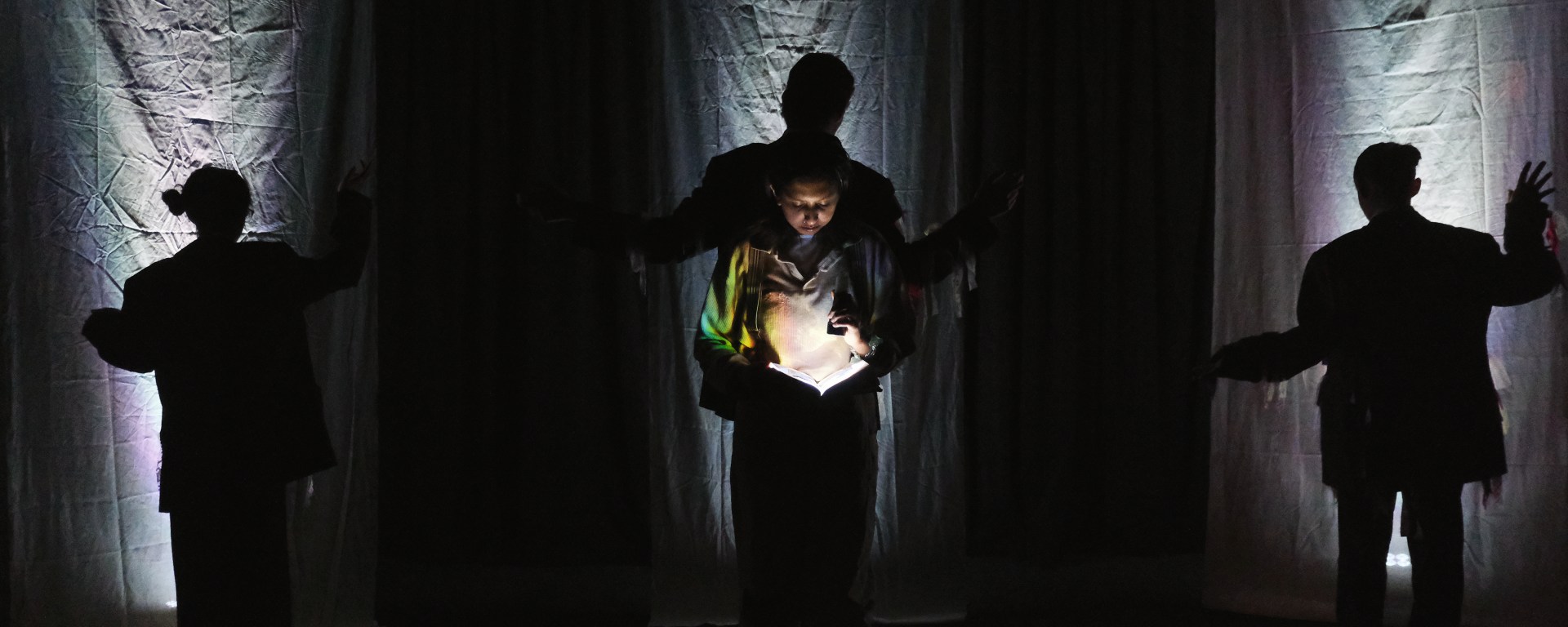
Three white sheets drape a small stage. The minimalistic design here is clever: with a coloured light behind each sheet, the stage easily transforms between forests, houses, and marketplaces. Director/Production Designer Amelia Joy Fraumano alongside assistant director Frankie Thorne are unafraid to be creative with space. Despite the stage small stage, I never felt that the actors didn’t have enough room to provide a great performance, as the story occupied both the space of the stage and that of the audience, allowing for greater immersion. Furthermore, the lighting and sound design by Jason Sridher compliments the location, expanding the small area into a lively village.
Changeling follows the coming of age of a changeling child, played by Ria Sen. The changeling deeply desires to be a ‘normal child’ and help with the farm but finds themselves either unable or not allowed to partake in typical activities. Strange things happen when they’re around, and if they’re upset, a mystical and destructive wind blows. Their father, played by Joshua Bruce, abhors this child and is bent on making this changeling ‘flee’ so that his supposed ‘normal’ child can return. The mother, played by the brilliant Marianne McLoughlin, offers an indispensable contrast to the father. She remains loving towards the changeling child, because changeling or not, this is the child she has loving raised for so long.
One day, while out to buy leather straps for the broken wagon, the changeling meets Pedlar – a whimsical merchant played with energetically by Jemima Christie. Christie’s lively performance was a highlight. She nails the accent and provides great richness to the show, especially in contrast to the timid changeling child. Sen and Christie perform wonderfully together. Their strong senses of emotionality juxtapose to create a well-rounded perspective on how it feels to be an outsider, and the arc of their friendship was both convincing and touching.
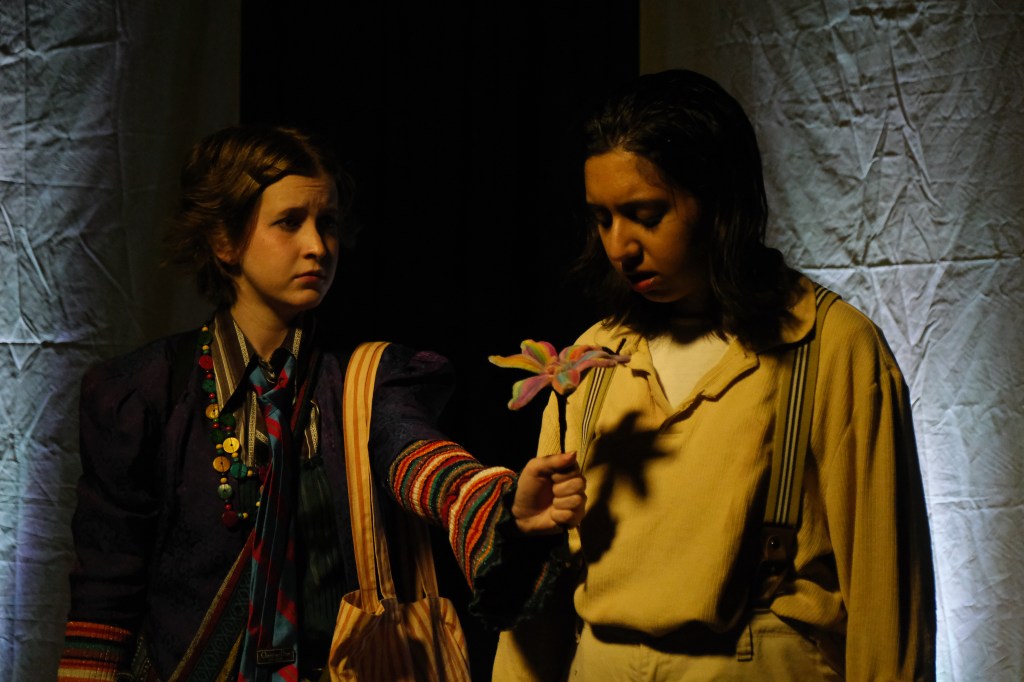
One cannot talk about Christie’s performance as Pedlar without mentioning how iconic Pedlar’s costume was. Costuming seems to have been a collaborative process between Fraumano, production manager Yang Xiao, production assistants Azra Adilah and Luka Dangal, and production designer Amy Thomas. The collective passion and vision of all these artists culminated in some beautiful costumes. I particularly loved the detail of Pedlar’s tie being put on back-to-front, as well as the cute dinosaur bag!
The use of masks was also excellent, though less dramatic than last year’s interpretation. Here, the term ‘masking’ is flipped on its head, with the neurotypical villagers having masks permanently affixed to them as if they were extensions of their faces, proving their ‘normality’. Eventually, the changeling finally figures out how to mask (with the assistance of Pedlar), which leads to a brilliant comedic scene of awkward small talk between the changeling and Father. I really enjoyed how in this case, masks were the default rather than something that is just put on by the neurodivergent person. This choice has a defamiliarizing effect, forcing the audience to re-acquaint themselves with the concept of a face in a way that centres the neurodivergent perspective.
Another highlight was the ensemble, consisting of Hamish L. Suttie, Siya Gauri, and Ivy Pearl. They are certainly a mesmerising trio who played off one another with sharpness. All their lines were tightly delivered, and their movement was always fun to watch. I especially loved the choreography with the suitcases.
I have been a fan of Lore Phoenix Burns ever since seeing their incredible cello compositions for Numa and Karl last year. This new iteration of Changeling has allowed them to step out of their comfort zone and work with a more electronic rock sound as opposed to their usual cello work. Burns continues to paint themselves as a fantastic composer whose careful ear for detail and musical motifs consistently supports the thematic content of every show they work on, without being self-aggrandizing or overwrought.
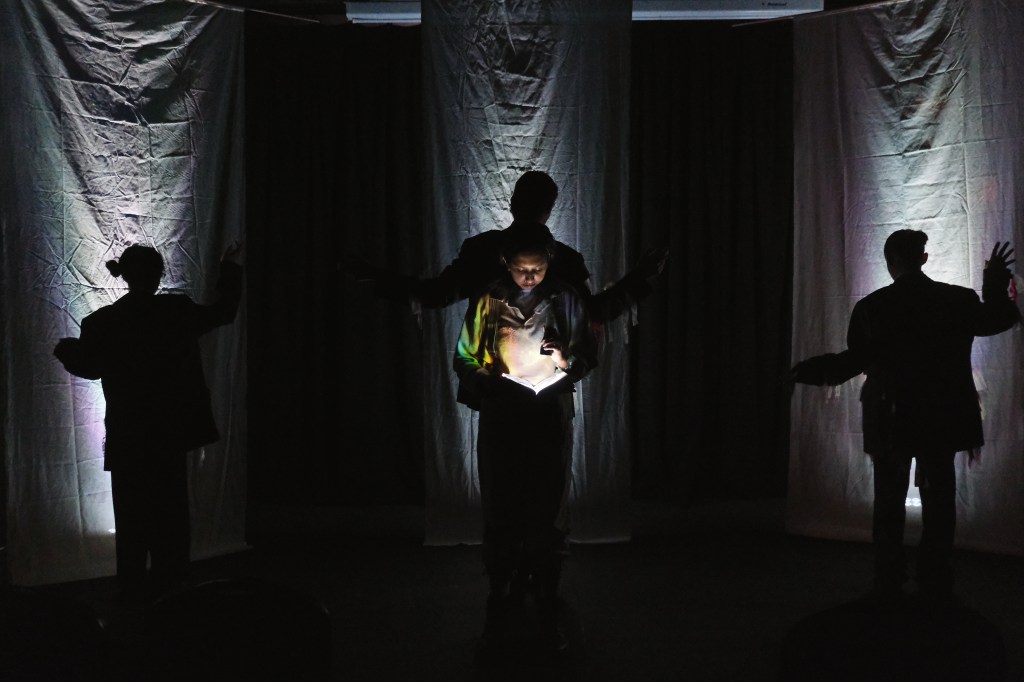
However, I am unsure that the voiceovers which bookend the show, as well as the voiceover of the changeling sounding out the grimoire, were necessary. While I can see the intent in the chaos provided by the bookending voiceovers, I wonder if these would be made more effective if performed with dim lighting in the flesh to enhance the immediacy and intensity of these moments of foreshadowing (at the beginning) and memory (at the end). For brief moments, the digital quality of these voiceovers took me out of the world of the show, especially when the changeling was reading, and felt a bit uncanny in comparison to the careful attention to physical presence displayed by the rest of the staging and underpinning the work’s theme of connection. This is however a minor criticism in the context of the rest of the show.
I did think that the voiceover worked well in the scenes with the father, which demonstrated how easy it is to move people to violence when you tell them what they want to hear – an especially pertinent message amongst discussions of gendered extremism and the manosphere.
Everyone who worked on Changeling should be proud of what they have done. Having hosted a trivia night, a zine-making workshop, and even selling their own changeling-themed merch, Changeling transcends the status of ‘Fringe show’ and is a whole bustling village in its own right.
Changeling played at Club Voltaire 7 – 18 October 2026 as part of the Melbourne Fringe Festival.
AZMY is a creative studying a Bachelor of Arts at UniMelb. This year, they are making theatre with The Werkz Ensemble and Cipta Theatre company!
CHARLOTTE FRASER (she/her) is a writer, performer and editor based in Melbourne. She holds a BA in English and Theatre Studies and is currently completing her Masters degree at the University of Melbourne. Charlotte is also the 2026 Dialog Editor.
The Dialog is supported by Union House Theatre

