

REVIEWED BY KIT WILLS
EDITED BY AZMY
Performed, read, and studied time and time again, Shakespeare’s classic tragedy Hamlet is a play filled to the brim with revenge, existentialism, and violence. Even those unfamiliar with theatre often recognise its titular character as the ‘guy holding the skull’ and contemplating “to be or not to be.” Often considered a landmark in modern interiority, Hamlet has achieved iconic status in Western culture for its complex musings, tragic ending, and gripping violence that has kept audiences coming back for centuries.
Breathing new life into a classic play isn’t an easy task, especially one with such an extensive history of performance and cultural phenomena. Despite this, Melbourne University Shakespeare Company met this challenge head on. Co-directors Eva-May Tegart and Elanor Groves O’Brien brought new life into Hamlet with a central stage surrounded by audience seating, heightening the collective experience. The Guild Theatre was transformed into a woodland clearing, with grassy hills and flowers forming a minimal set designed by Kailen Stork-Finlay and Clara Verbeek. As the house lights dimmed, the productions first deviations from the original became apparent: Parul Mehta playing the lovely Ophelia stepped out strumming a guitar and singing a lilting folk melody. Paired with the outdoor-inspired set design, this choice established Ophelia’s significance in MUSC’s interpretation by centring her experience more prominently. This emphasis continued through additional vignettes of Hamlet (Hannah Belle Mebalds) and Ophelia lying together in the grass. Paired with this, Guinevere Fisher’s sound design offered soft, romantic acoustics that amplified these moments and acted as a nice contrast to the intense drama found in the rest of Hamlet. These additional scenes suggested a deeper romantic connection than is often foregrounded in productions of the play, strengthening the emotional chemistry between Mebalds and Mehta in the process. Ultimately, these additions led to some visually beautiful moments, but struggled to reconcile the production’s heightened romance with the trajectory of Shakespeare’s original text.
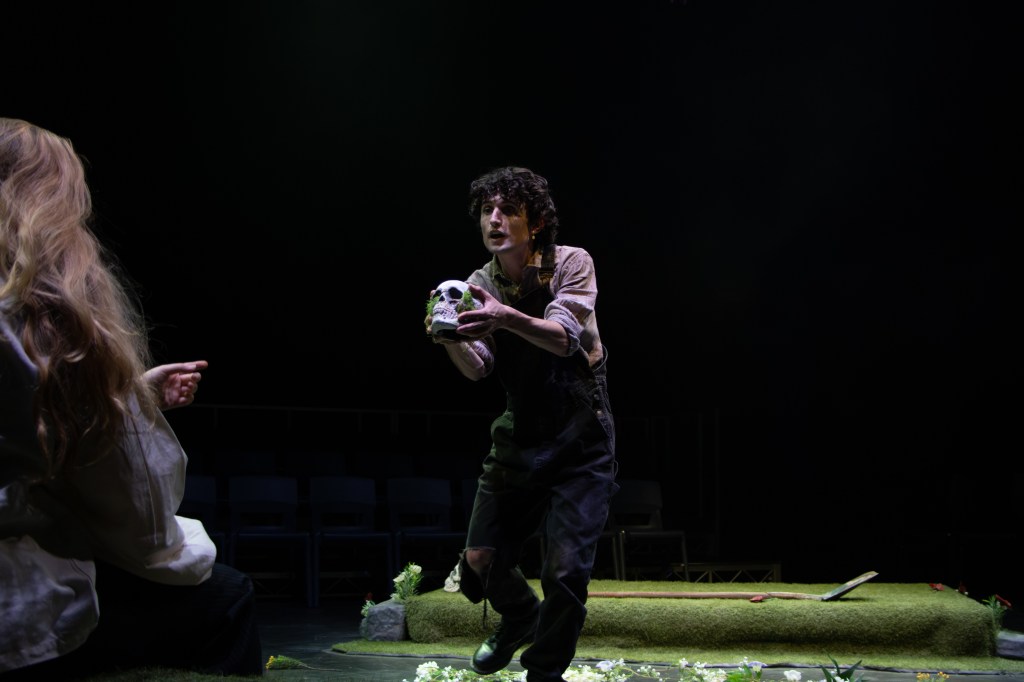
In the opening scene, the ensemble (Eliza Murdoch, Dan Fonn Prichard, and Annabel Edwards) along with Horatio (Isaac Leslie), did an excellent job at establishing the supernatural, spooky undertones of the play. Together, the ensemble heightened the Ghost’s (Jamie McBeth) reveal, in a playful, comedic fashion that worked as a nice contrast to the haunted atmosphere. Charlie Campbell’s dark lighting design, punctuated by flashes of bright spotlights, increased the scene’s unsettling atmosphere while the fog machine, further intensified the supernatural elements. Commendable was Apsara Shah’s costume design which paired the smart silhouette of 60s business wear with a botanical subtheme. Notably, the Ghost was painted entirely grey whilst wearing a suit that had rope attachments covering the blazer and pants. This worked well in creating harmony between the set and the costumes which at times I felt were a little disjointed. McBeth especially leaned into this with his acting choices; a slow rocklike shuffle, and a guttural voice that felt as if it was pulled from the earth. As a whole, when MUSC embraced the botanical aesthetic is when their Hamlet was strongest, though for the most part the play felt transposed onto the natural setting rather than fully integrated.
The production’s character relationships were another strength, brought to life through the cast’s expressive performances. As Polonius, Hugh Campbell commanded the stage through his rich vocal delivery and comedic timing. In the scenes between Polonius and Ophelia, Campbell and Mehta played off one another effortlessly to create a lively father-daughter dynamic. Mebalds playing Hamlet did an exceptional job at distinguishing her relationship with Claudius (played by Tommy Howard), her mother Gertrude (played by Ashlyn O’Toole), and lover Ophelia, with each pairing feeling refreshingly distinctive. In the bedroom scene (Act 3, Scene 4), O’Toole plays the conflicted Gertrude with an evocative stillness. Capturing Gertrude’s struggle between self-preservation and maternal love, O’Toole presents a rigid, strong-willed Queen capable of standing her ground against her son.
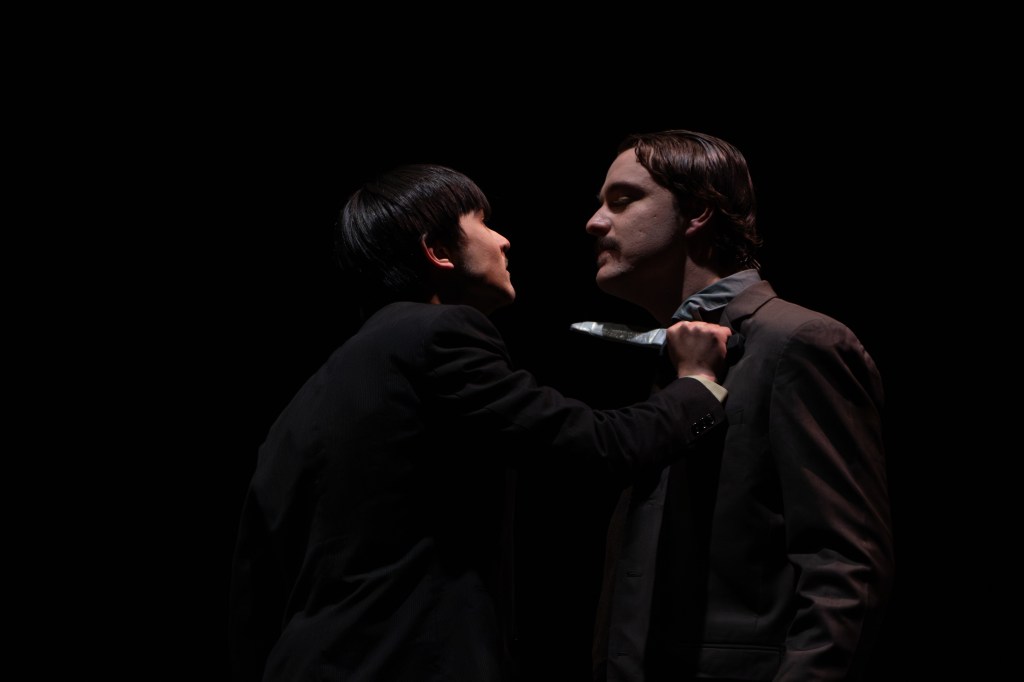
While the cast was consistently strong, two performances stood out in particular. The first was Mebalds as Hamlet, who offered a sincerity and vulnerability to her performance that left the audience hanging on to her every word. Given that Hamlet was performed by a woman, I expected the production to acknowledge this casting through changes to the script or its interpretation. It did neither, leaving me interested in what contemporary themes or questions might have emerged had they engaged more explicitly with Hamlet’s gender. Having said that, Mebalds’ Hamlet was focused and precise. Playing into Hamlet’s emotional rashness, she evocatively altered her tone, pace, and body language with minute detail, fully becoming Hamlet in the process. And in sweet, lovely contrast was Mehta’s Ophelia, whose angelic voice and tragic ending lingered in my memory long after the performance. Often gentle in characterisation, Mehta’s Ophelia was instead passionate, steadfast, and haunting. This change, paired with the focus on her song throughout, allowed for a satisfying pushback against Hamlet and a stronger representation of one of Shakespeare’s most tragic heroines. However, one aspect that felt underdeveloped was the portrayal of madness in both Hamlet and Ophelia. If this was a deliberate choice, then I would’ve liked it to be clearer, otherwise, it would’ve been interesting to see them both experiment more with the character’s psychological unravelling. For example, whilst Mehta’s guitar and singing were incredibly beautiful, Ophelia’s ‘madness scene’ (Act 4, Scene 5) felt more like a concert than an internal spiral. When she eventually put the guitar down and sung unaccompanied, Mehta was able to lean further into this which was especially powerful.
Campbell’s lighting design transformed the space from meadow to bedchamber to church, providing much of the visual context for each location. In Claudius’ prayer scene (Act 3, Scene 3) Campbell’s kaleidoscope of colours emphasised the holy space with beautiful clarity, while the haunting echoes of church hymns further immersed the audience in the setting. Against this strikingly designed backdrop, Howard delivered Claudius’ monologue with a vulnerable honesty, eliciting an unexpected degree of sympathy for the play’s antagonist.
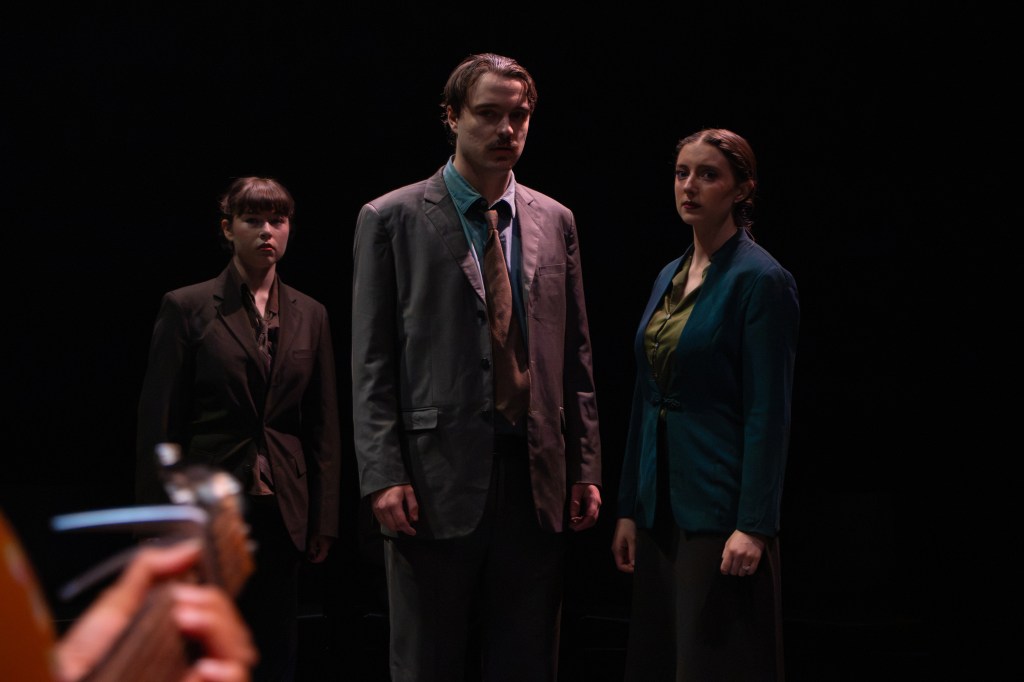
The production’s tragic culmination arrives in the final duel between Laertes (Kailen Missen) and Hamlet, as the play’s tensions finally erupt into violence. Sorry for the spoiler, (you’ve had over four hundred years to catch up), but the final moments before the characters meet their fates are particularly effective. The rapier duel between Missen and Mebalds was fast-paced, rash, and at times intensely comic. In one particular moment, Mebald’s swung both swords with reckless abandon gaining a large laugh from the audience in the middle of a truly passionate scene. Missen was a standout in this scene, embodying Laertes’ anger with clarity and fervour. As the remaining character’s all took their last breaths, Horatio was left alone to confront the impending invasion.
Although MUSC’s vision would have been stronger had the production fully embraced its botanical, earthy aesthetic, their Hamlet remained moving, grounded, and captivating. Through the casts compelling performances, the thoughtful design, and a heightened focus on Ophelia’s singing MUSC delivered a fresh and emotionally resonant interpretation of Shakespeare’s classic tragedy.
MUSC’s Hamlet played at the Guild Theatre 15 – 18 October 2026.
KIT WILLS (she/her) is a third year UniMelb Arts student majoring in English and Theatre studies. Driven by her passion for performance and writing Kit is excited to be a new reviewer for the Dialog.
AZMY is a creative studying a Bachelor of Arts at UniMelb. This year, they are making theatre with The Werkz Ensemble and Cipta Theatre company!
The Dialog is supported by Union House Theatre

