
REVIEWED BY CHRISTARON NEWSTEAD
EDITED BY CHARLOTTE FRASER
The portrait of Ronald Reagan, 40th President of the United States, in a modest brown frame, akin to something like the painting of a saint, metaphorically and literally looms over BL Theatre’s Glengarry Glen Ross. Reaganomics purveys the play’s script in its entirety, men shouting and yelling and pleading and denying and angering and bargaining and depression-ing, but never quite getting to that sweetness of acceptance. A man’s world is brutal. Harsh. In this world you’re either driving home in the sexiest Cadillac, bringing schmucks to their knees, sick with jealousy or buying the missus another pair of steak knives because you know how much she loves having a knife for each day of the week.
When first walking into the Guild Theatre I noticed the stage, set up like a restaurant with some of the performers having a nice meal. They speak, idling amongst each other, and this moment of serenity is possibly the calmest any of them will be for the duration of the show. The show begins and that hypothesis is immediately proven correct. The dialogue of Glengarry Glen Ross jumps and cuts and this constant rhythm is a tennis match to behold. Timing, in particular comedic timing, is key to keep the flow of the scenes going.
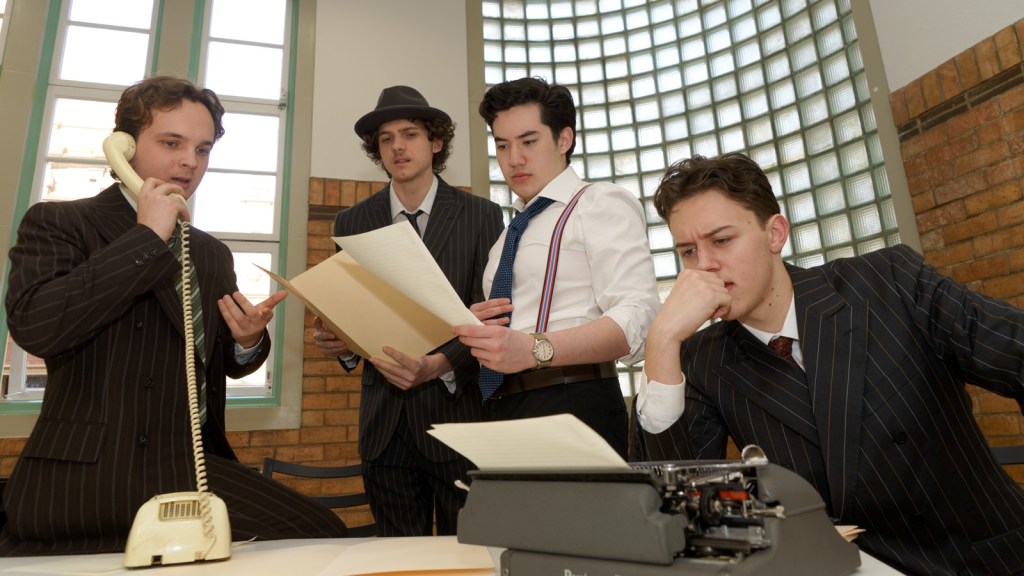
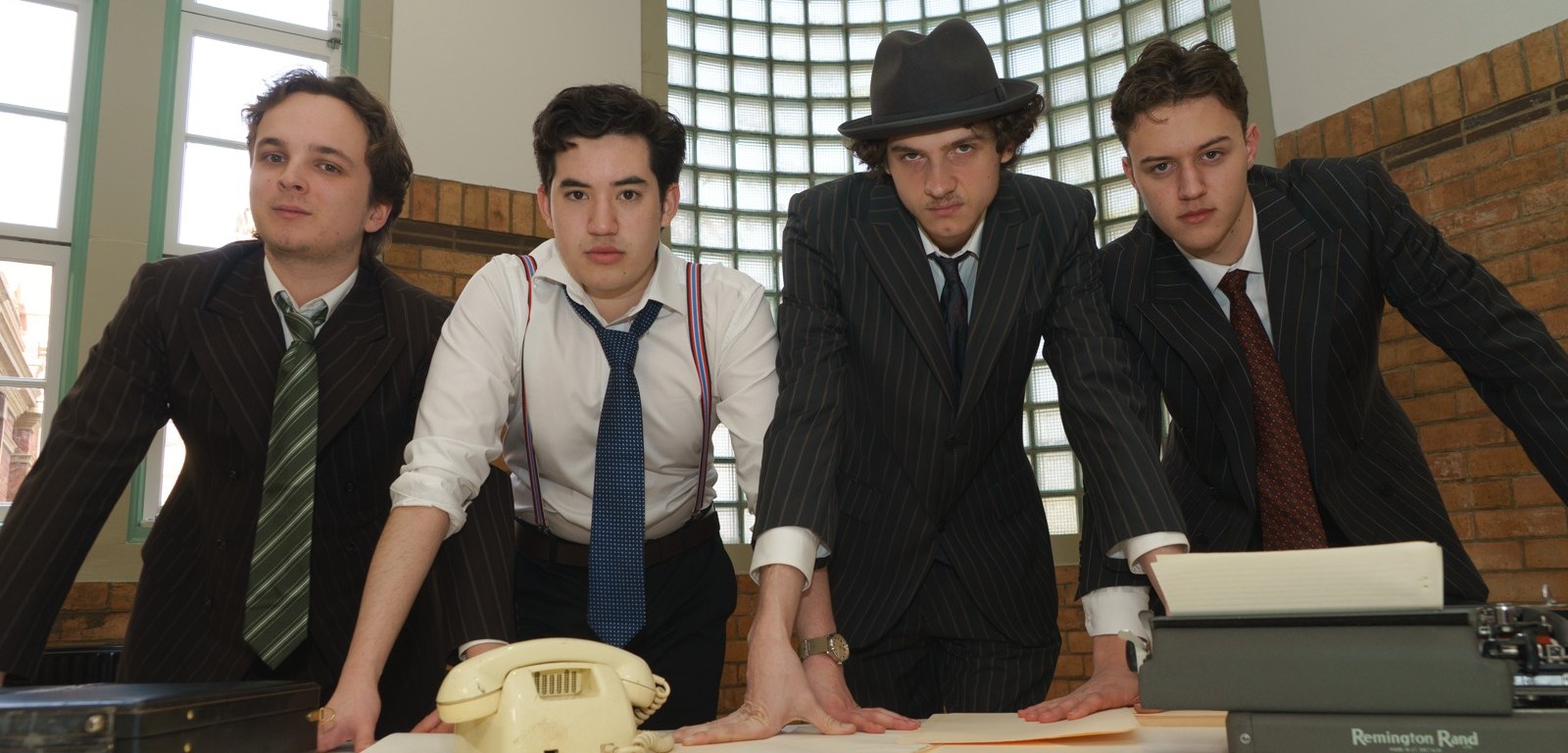
The play itself only has two settings though the set design by Gretel Baulch and Caitlin Munnings was incredibly effective in minimising any long transitions. The double-sided panel serving as both the backdrop of the Chinese restaurant as well as an office wall sets the physical boundaries of the space. With most of the stage left barren, this empty space serves as a liminal passageway, something the performers take advantage of in their exits and entries. The costuming, also by Baulch and Munnings, was incredibly exciting! The monochromatic pinstripe suits acted as a sort of uniform, though differing slightly between each performer in colour there was a cohesiveness that matched the “go getter” attitude the characters displayed, and despite their cunning against each other, they weren’t distractingly distinctive.
Something I found interesting and wasn’t aware of prior to seeing the show was the nature of the portrayal of Baylen and Lingke. Glengarry Glen Ross is famous for being a long play about men and the absurdity of the male capitalistic climb and… not much else. The mention of women are few and far between, being reduced to mentions of wives or occasional sexual partners. The rules of Glengarry Glen Ross in a straight, no-buts-about-it production are as follows: women do not really exist. That said, it was a surprise – and not an unwelcome one – when the characters of Detective Baylen and James Lingke were played by Stephanie Cotronis and Alex Fallshaw respectively. I spoke with Sean Lin, who also played Shelley Levene, and learned that the casting of Fallshaw was fairly last minute. The performer who was set to play Lingke originally was unable to do so, so this casting choice was less as a conscious recontextualising of the play, but simply a logistical solution. And whilst both actors are portraying the characters as men, it added a layer of nuance to the way the audience understood the performance.
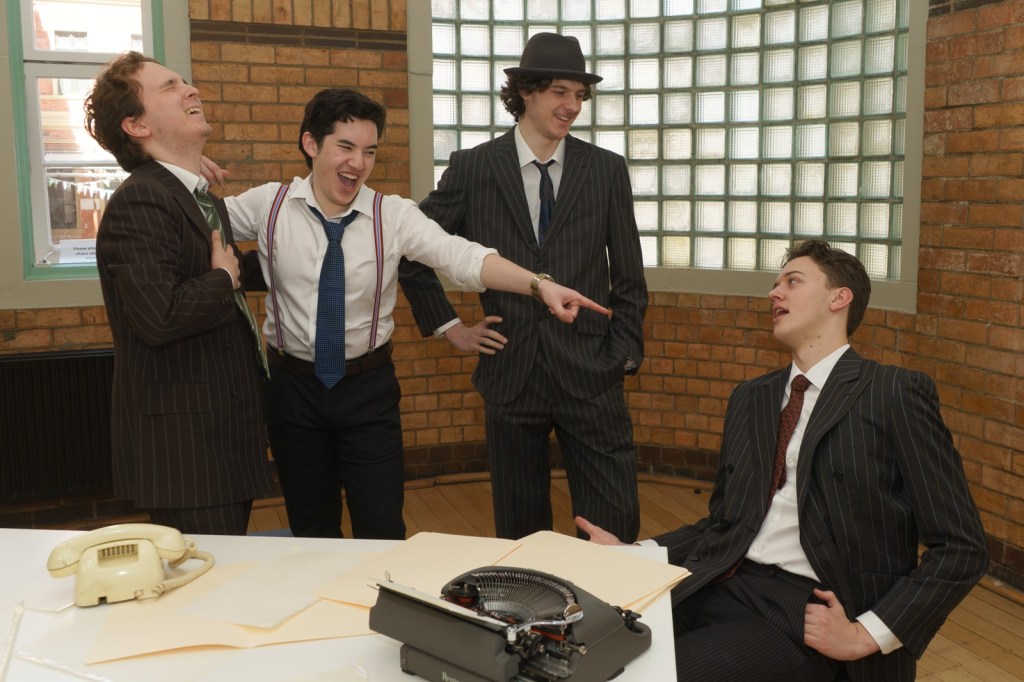
Lingke stands in opposition to the protagonists in his hesitance to be as cutthroat as they are. He “doesn’t have the power” to operate on the same level as them and this delineation positions us to view him as the basis of morality within the show. The promotion of Glengarry Glen Ross leaned heavily into the competitive aspect that the show operates off of, it drew audiences into analysing these men and gave the opportunity to pick our horse in the race. The one we think has ‘It’.
The performances felt incredibly well-balanced despite how exceedingly dramatic the characters are. This was instrumental in enhancing the chemistry between characters and adding depth to their dynamics. Each character has a moment of being in the spotlight which gives the performers an opportunity to shine in their roles and it never comes with a speed through of the scene nor were things elongated for tension’s sake. Even scene to scene the “main character” is always shifting and whilst the latter half of the play seems entirely focused on Roma and Lingk, Oliver Holland, Prezley Lea, Sean Lin and Sam Pruscino were performers I consistently thought back to.
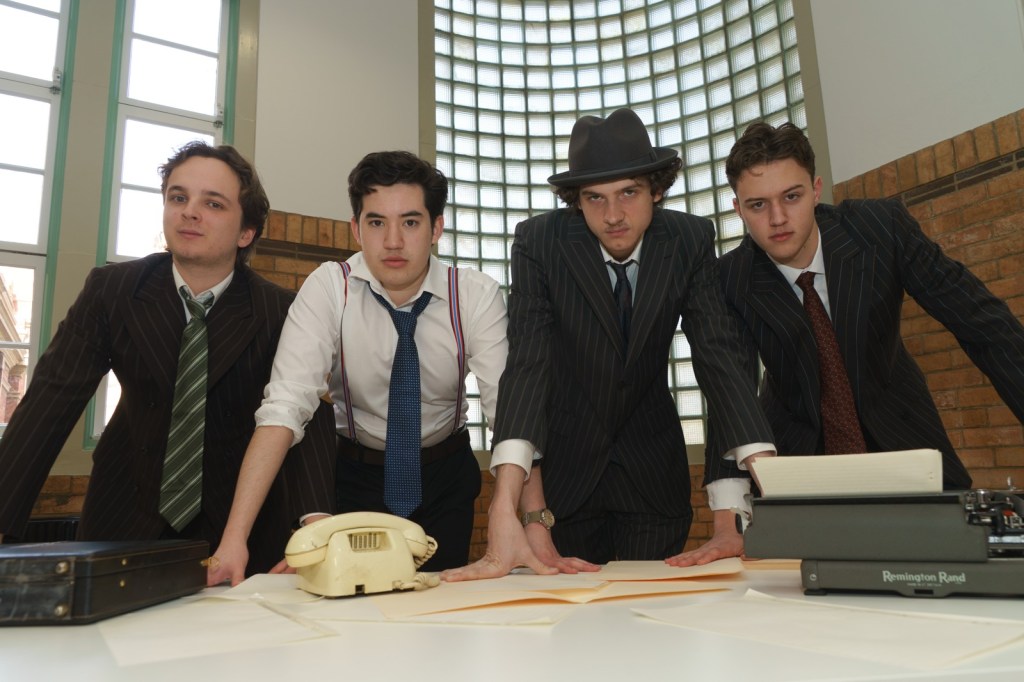
The direction of the play never fails to settle down to address that these men, pushed to the extremities of capitalism, have become unrecognisable in the face of reality. The comedy woven into the play can give a director the option to make these characters as facetious as the text allows them to be, or, people that can be empathised with. I really enjoy how that decision doesn’t leave the characters as stagnant and unable to overcome their circumstances, especially within a work as reframed and recontextualised as Glengarry Glen Ross. I had a fun time watching this and I’m excited to see what BL Theatre has in store next.
BL Theatre’s Glengarry Glen Ross played at the Guild Theatre 3 – 5 September 2026.
CHRISTARON NEWSTEAD is a theatre student who enjoys works that challenge both the audience and the performers.
CHARLOTTE FRASER (she/her) is a writer, performer and editor based in Melbourne. She holds a BA in English and Theatre Studies and is currently completing her Masters degree at the University of Melbourne. Charlotte is also the 2026 Dialog Editor.
The Dialog is supported by Union House Theatre

