
REVIEWED BY MIA SUTHERLAND
EDITED BY AZMY
Along with most of the audience sitting in the intimate Guild Theatre, I was excited and becoming restless, eager for it to tick over to 7:30 pm. We were (impatiently) waiting to watch the drama unfold across three student-written works for Cipta Theatre Company’s Semester Two comedy showcase, In Hot Water. For one hour, I was fully immersed in the hilarious and chaotic worlds of Baron Robbins, Smokeshow, and Chick-O-Clock.
The showcase begins with Kiran Tin’s Baron Robbins, where two thieves, Alena (Sophie Willmott) and Dale (Sunday Williams-Starkie), are stopped by the wealthy household matriarch as they are about to flee. Willmott and Williams-Starkie comically entered from the upstage curtains to heist-themed and almost Pink Panther-esque music designed by Stephani Shaw and Sarah Pennefather which engaged the audience instantly, making you laugh from the very first moment of the showcase.
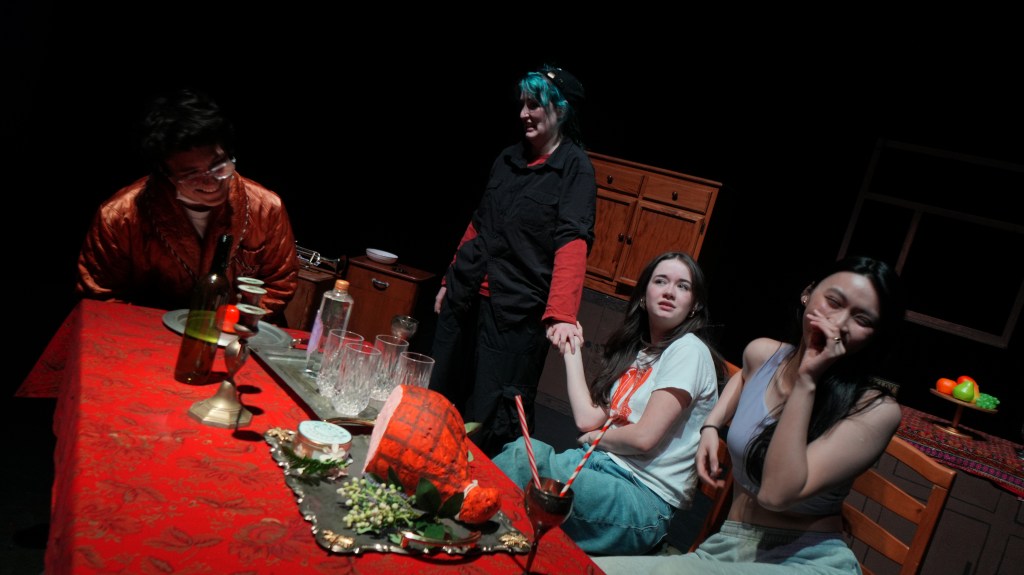
The dynamic between Willmott and Williams-Starkie was commendable. Williams-Starkie’s performance as Dale was a true highlight of the showcase, with comic talent and physicality, they were constantly making the audience laugh and holding our attention. Annabelle Goh and Bodhi Keech rounded out the Baron Robbins ensemble as the wealthy homeowners. This play was full of tension, drama and jump scares with excellent comedic timing. The minimal yet extremely effective lighting design by Jamie Tran and Ashley Detomo included spotlighting at times of conflict or revelation, emphasising the comedic style of the show.
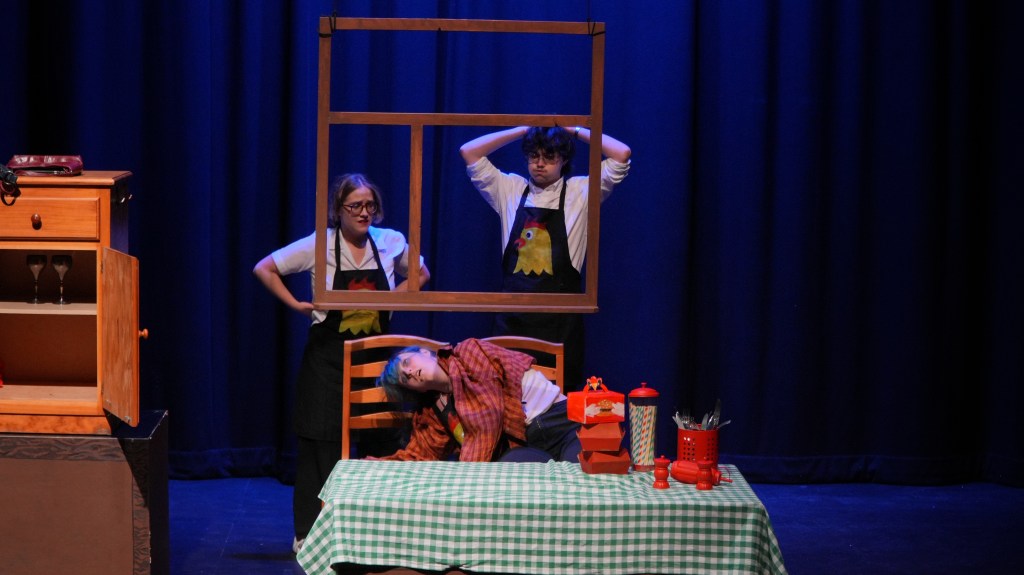
The set and props design by Yini Zhong, Henry Nguyen and Ash Tilson was well-executed with a balance of simplistic yet detailed work. The dining table was well positioned, making the audience feel as if they were a part of the unfolding situation. A particularly clever piece of set design was the hanging window positioned upstage, behind the main action. The use of the window in all three pieces, under direction of Alex Fallshaw and Kaashvi Jain, saw characters arguing, observing others, and even hiding a dead body. It signified another space, inviting the audience in on moments other characters were not aware of. This further highlighted the comedic style, and specifically for Baron Robbins, added tension.
At times, there could have been more movement from the characters during longer periods of dialogue. For example, during Jonathan’s (Keech) monologue about his thrice Great Grandfather’s archnemesis, it would have been great to see Keech move around the space more, rather than solely staying on one side of the stage. Maybe he could have walked over and interacted with Alena and Dale who were actively listening and reacting to the story being told. Nevertheless, the engaging actors (and plot!) ensured that this was not a major issue.
One of my favourite aspects of the show were the transitions between the student works. The creative choices by Fallshaw and Jain were innovative, using the space, actors, crew and set to their advantage, ensuring every moment engaged the audience, providing interest and humour. The transition from Baron Robbins to Smokeshow was a highlight: the four actors stood in a concluding tableau (the thieves being caught by the suddenly intimidating, gun-wielding homeowners) as the production crew moved set pieces and props around them to create the next space: a smokeshop. Once the transition was done, the actors came out of the freeze frame and ran loudly offstage. Thieves Alena and Dale returned to the stage and seized the opportunity to quickly steal from the smokeshop, to the annoyance of the owner, Bryce (Ryan Chang). What a fantastic way to link the two worlds and two stories!
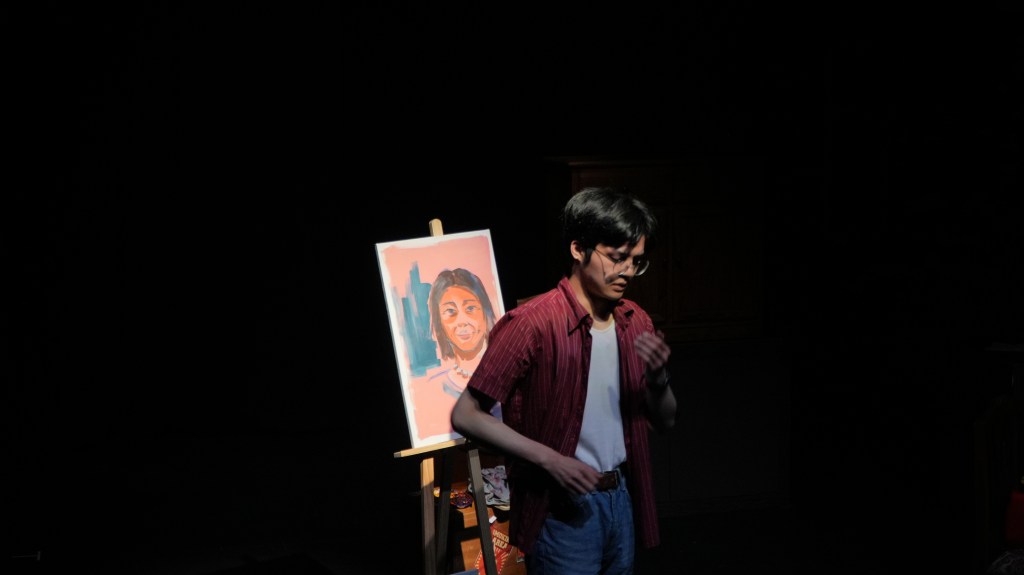
Smokeshow, written by Liam Petheram, follows the relationship between Bryce (Chang), the young shop owner and regular customer, Richie (Louis Dickins). This piece had a much slower pace. Although still a comedy, the focus was on human connection, grief, and emotion. Smokeshow asks us to reflect on the ways we should care for one another and demonstrates the importance of vulnerability in forming genuine friendships. This message seems even more necessary and powerful for the world we are living in today. As Richie says himself, there is the need to appreciate “quiet beauty” in life, whether it arises out of love, loss or both.
The second play concluded with the subtle yet undisputable sound of fire with a bright spotlight on Bryce’s painting he had made of his late mother. The combination of sound design and spotlighting was powerful enough for the audience to know the building was being destroyed. I heard multiple people around me gasp with shock and sadness. Although coming to see a comedy performance, the audience were emotionally connected to the story which is a testament to Petherman’s writing as well as Chang and Dickins’ acting.
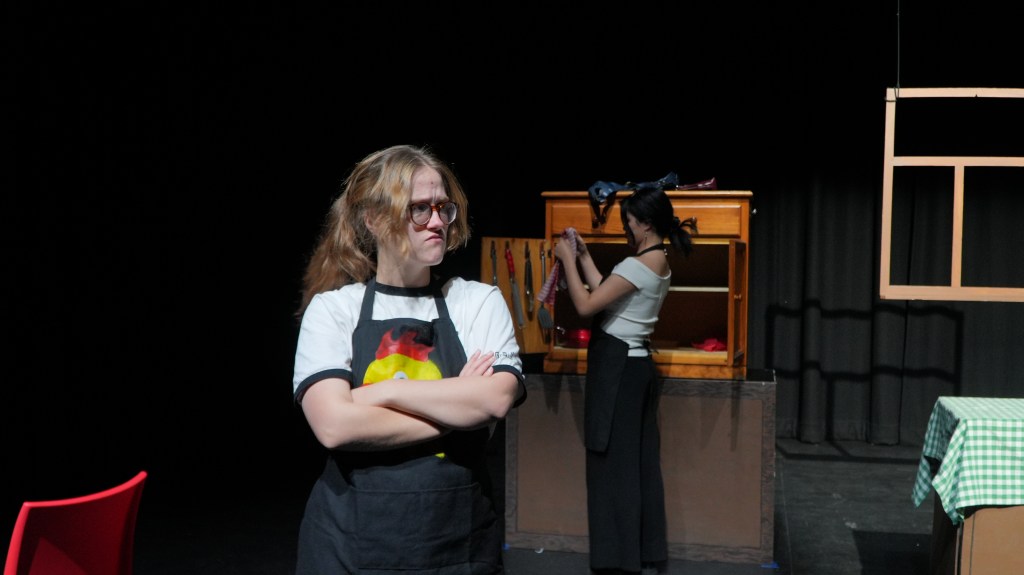
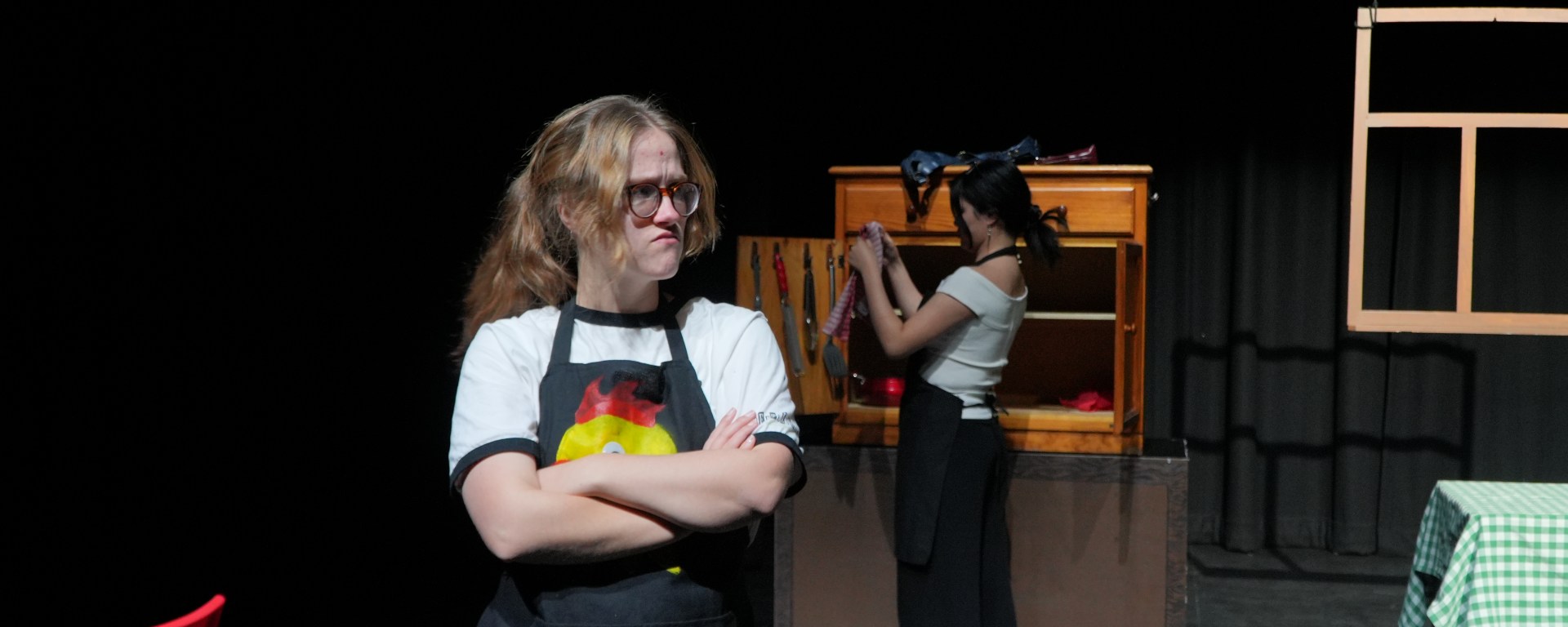
After Smokeshow, we were transported into the world of Billie Prescott’s Chick-O-Clock. Set in a chicken shop, Rosie (Abigail Liptrot-Spillane) energetically arrives at work and discovers co-worker, Ron, dead. Williams-Starkie returns to the stage with a hilarious portrayal of the deceased worker. With her fellow co-workers Cam (Will Hunt) and Makayla (Jiayu Kok), Rosie attempts to hide Ron’s body from health inspector Sage (Renee Tian). Tian’s performance as Sage was a standout, providing even more fun and humour to the play with her infectious energy. From her attempts to secure a date with Cam, including an unforgettable dance sequence, you almost forget about the dead-body-in-the-shop situation!
The running joke about Rosie’s work nemesis, Sharon (who never appears on stage) getting employee of the month was possibly overdone. It would have been great to see Sharon appear on stage at the end, interact with the other characters, or maybe the burgers could have been left for her to eat.
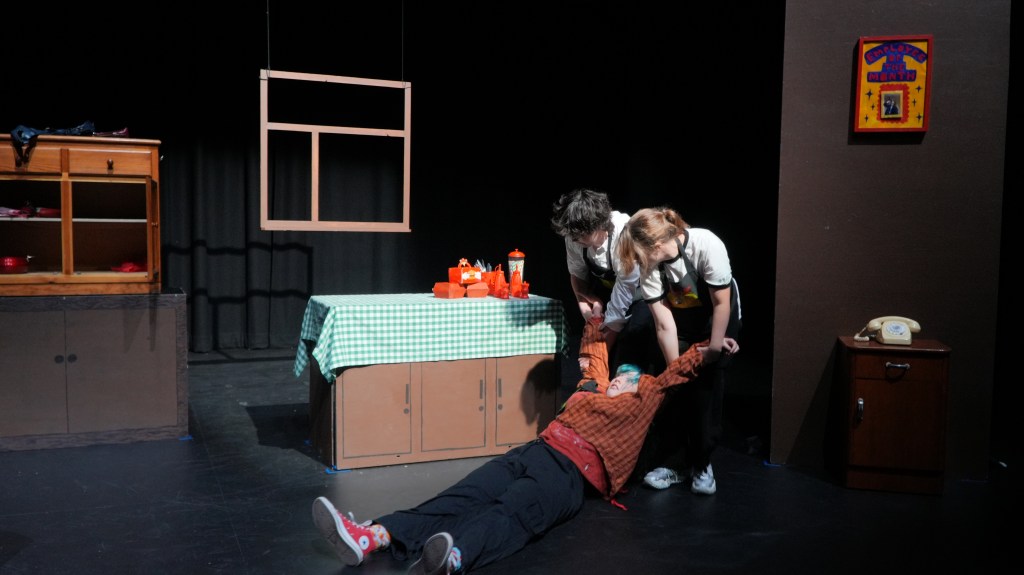
The use of lighting and the hanging window in this play was extremely effective as different characters’ conversations were happening across different parts of the stage. A great example of this was when Cam and Rosie were arguing behind the window over what to do with Ron’s body while Sage and Makayla talked in front of it, with the audience hearing the latter conversation although well aware of what was going down in the former.
Despite the storyline involving a possible murder (the cause of Ron’s death is never confirmed), Chick-O-Clock was a lot of fun and a great way to conclude the night.
Whilst all plays in the showcase demonstrated sticky situations, each play was unique in its storyline, drama, level of tension, key messages, and even the type of comedy provided. The only thing I could think of afterwards was that I wanted more!
Cipta Theatre Company’s In Hot Water played at the Guild Theatre 10 – 12 September, 2026.
MIA SUTHERLAND is studying a Bachelor of Arts and Diploma of Languages (Indonesian) at the University of Melbourne. She has always had a passion for theatre and is in her first year reviewing for The Dialog.
AZMY is a creative studying a Bachelor of Arts at UniMelb. This year, they are making theatre with The Werkz Ensemble and Cipta Theatre company!
The Dialog is supported by Union House Theatre
 The Dialog