

REVIEWED BY KIT WILLS
EDITED BY CHARLOTTE FRASER
Content Warning: contains references to sexual assault, trauma, shame and mental health.
There must’ve been an event running in the bar space of the Motley Bauhaus when I arrived, as the building was warm with loud talking and small groups of people drinking pints and laughing amongst themselves. I walked past the groups gathered in the bar and into the cosy Theatrette where Jayden Alexander’s play Look to Your Left, Look to Your Right was about to be performed. Upon entering, I was handed a little leaflet with a QR code for feedback on the show. As this was a developmental play reading, the cast held their scripts in hand, and the set (designed by Azmy) was minimal to focus on the other elements of the play.
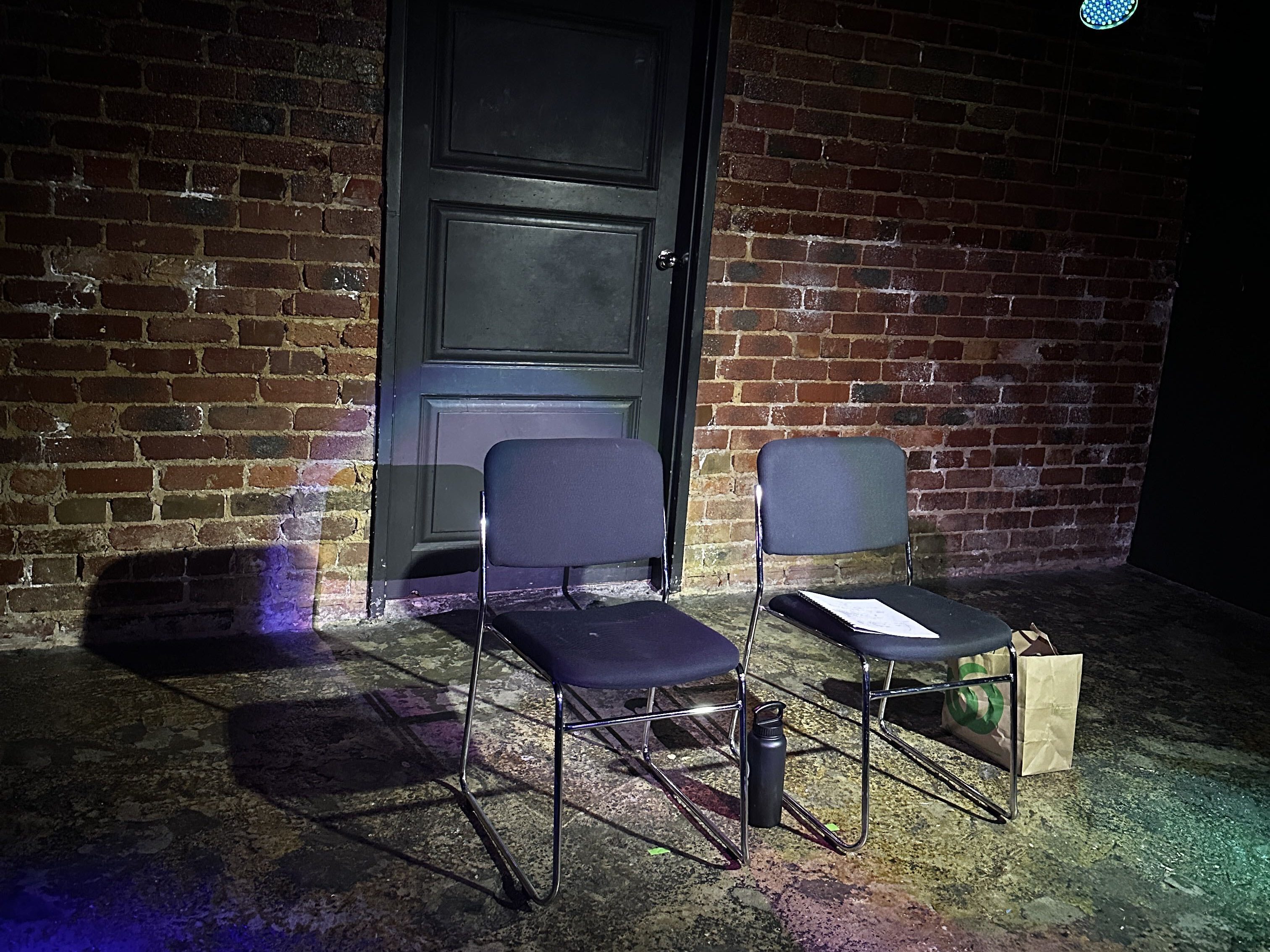
While I understand the practical purpose of a play reading, both cast members knew their lines quite well, and I occasionally found the scripts distracting. I would love to see this show as a fully realised production in the future, although I recognise the importance of this developmental stage in the process. Director Azmy did a wonderful job of toeing that line between reading and performance – props, costumes and blocking were all incorporated to make the play feel closer to a performance than a traditional reading. I went into this showing blind, assuming that given the show’s title it had something to do with cars but no other preconceived ideas on the subject matter. Interestingly, I believe this was beneficial to my viewing as I was able to experience firsthand the subtlety of Alexander’s writing and piece together the car crash analogy without being explicitly aware of its meaning.
Look to Your Left, Look to Your Right follows ‘Boy’ (Jayme Lau) in the aftermath of a traumatic event, as he struggles with the shame and self-doubt that accompany this. The play explores his navigation of identity and masculinity as he confronts the consequences of the event and the institutional failures and psychological impacts that happen in the aftermath. Perhaps a quarter of the way into the play I began to suspect that the car crash was an analogy for SA, I tentatively jotted it down not wanting to fall into the trap of over-analysis. This complex nuance was beautifully written by Alexander: his sharp, contemporary prose moves playwriting in a new direction – one that holds onto the reins of the audiences empathy, strapping them into the experience with suffocating closeness. Alexander writes Boy as both a reflection of masculinity and a figure through whom anyone who has experienced a similar situation can find recognition. His framing of each scene with the pronoun “you” is also incredibly effective in furthering this closeness.
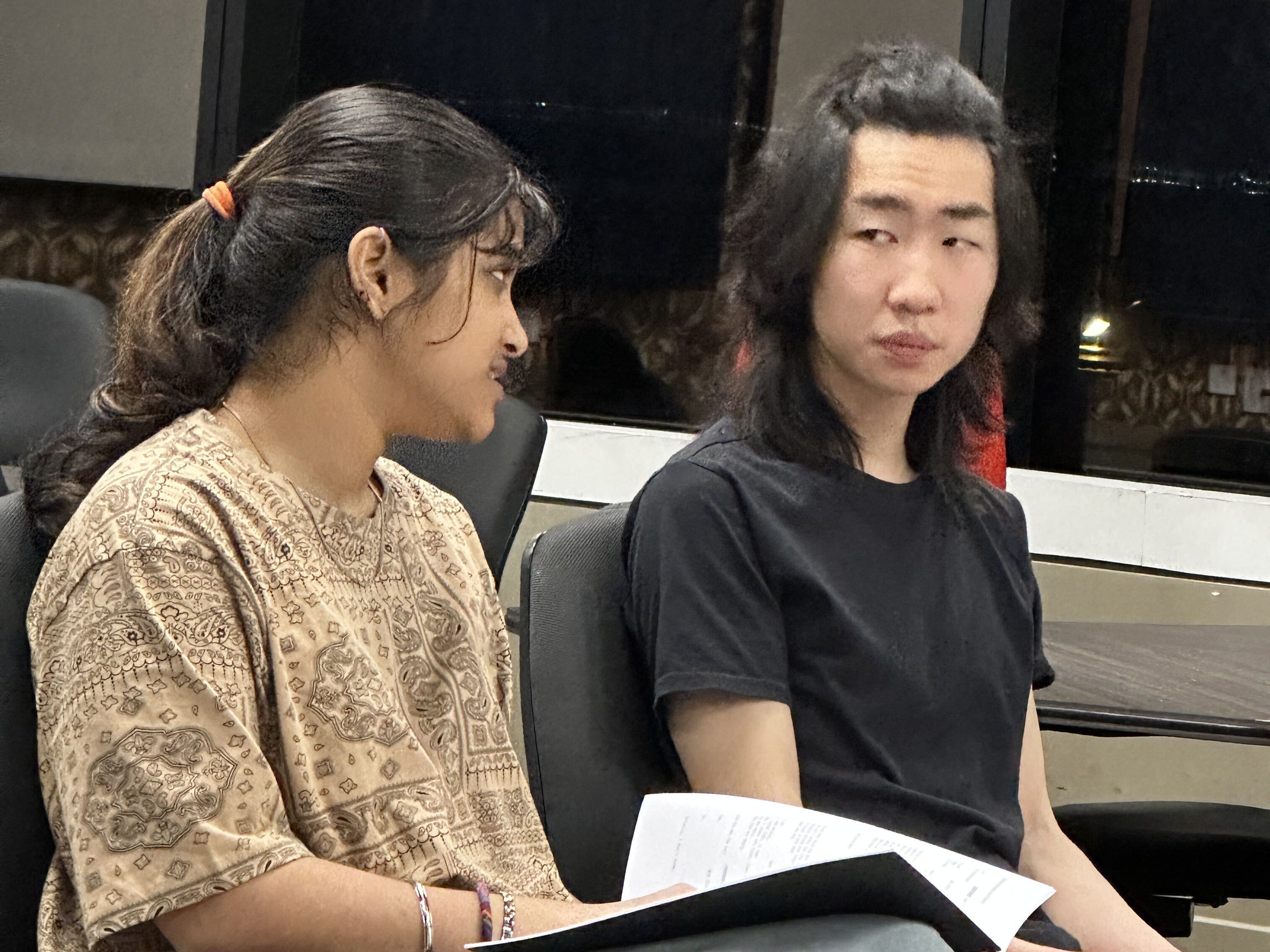
The play opens with Boy crossing a road and being hit by a car. He later sees the perpetrator in the supermarket and calls him out for what happened. The man (played by Gayatri Subramanian) acknowledges it by brushing it off and walking away in dismissal. This act sets up the rest of the play which shows the internal and external world of Boy as he navigates this traumatic event. From a therapist (Subramanian) who gives him the same performatively empathetic responses, a friend (Subramanian) who Boy struggles to open up to when she shares a similar experience and a medical practitioner (Subramanian) who reduces his ‘injury’ as unimportant pushing it down the calendar of appointments, Boy is met with challenges he must navigate at every turn. Subramanian playing all the ensemble characters was especially effective in shifting the emphasis onto Boy’s experience, she expertly navigated the wide range of characters, embodying each of them in a way that made each one feel distinctly different, yet also collective.
As the play continued, I found further evidence that the car crash was a metaphor. The way the therapist spoke about the perpetrator, the roundabout way the police were brought up and the continuous washing of the clothes that Boy could never quite get the gravel out of all contributed to this reading. Throughout the play, Boy experiences a rollercoaster of emotions, some quiet and dismissed, others panicked, others angry and loud – to quote Alexander “Boy literally crashes out”. Lau did an incredible job of playing this emotional instability, showing the vulnerability and pain Boy experiences in a way that heightens realism and draws the audience in.
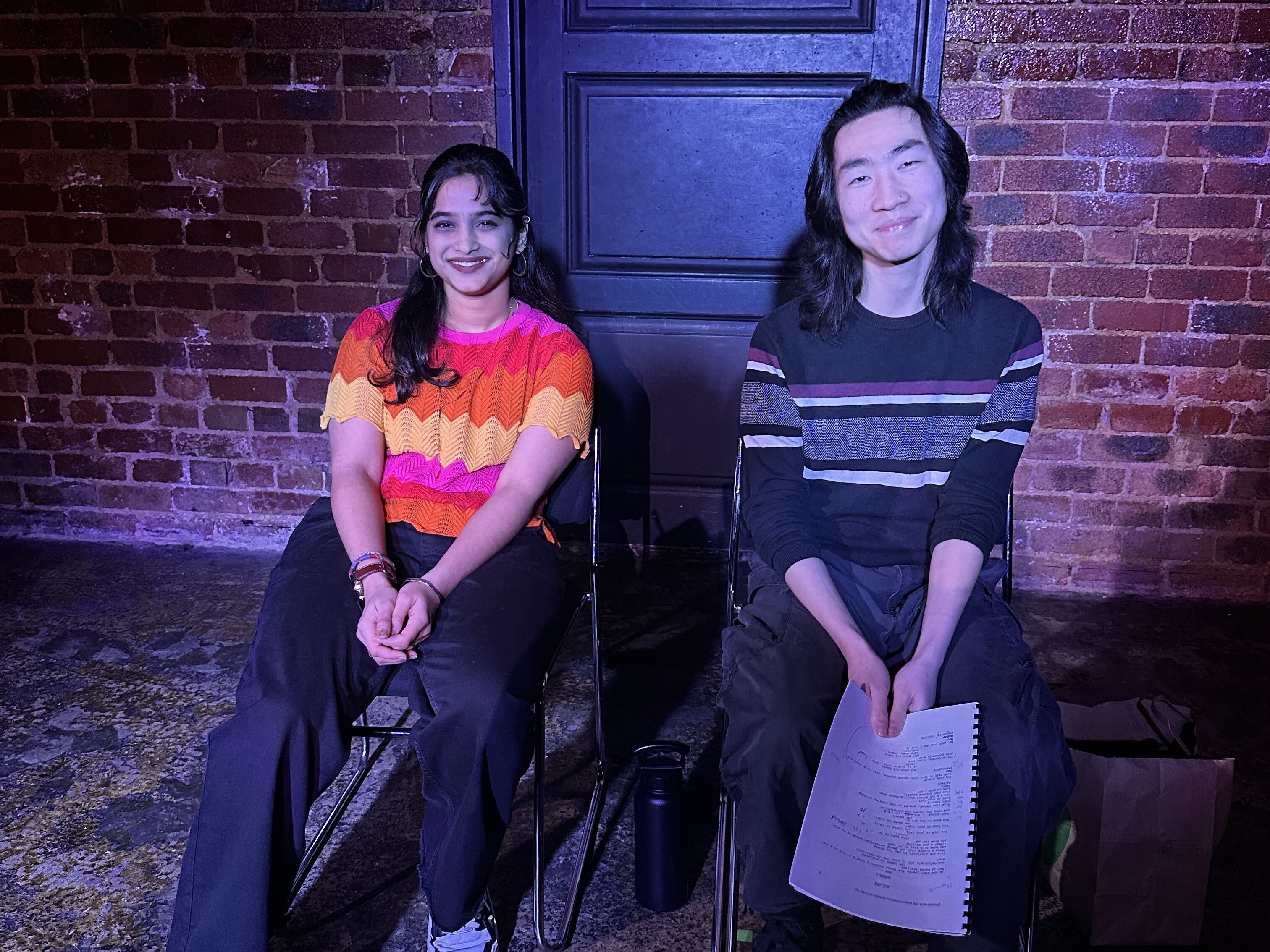
In one moment of the play, perhaps a third of the way through the house lights (lighting design by Stuti Ghosh) were turned on and Boy started directly toward the audience. I felt incredibly perceived and it was an effective technique to call attention to the audiences involvement in the play, highlighting the dynamic between the audience watching Boy as he vulnerably opens up. One note I would give is that while bringing up the house lights was incredibly effective the first time, its impact diminished when the technique was repeated. I wondered whether the lights were coming up in the medical office as if the audience were also in the space waiting to be seen? But I feel like its intended impact lost clarity the more it was used. Having said that, Ghosh’s lighting design was excellent in elevating the play reading by providing contrast in tone and setting especially when the rest of the set was kept simple. During a scene taking place at a bar, the pink lighting was an excellent tool for indicating space and emphasising Boy’s disassociation.
Additionally, I felt some of the scenes toward the end lacked some clarity as the rapid changes of characters became slightly confusing. As I stated before, having Subramanian play all the ensemble characters was an excellent technique, but sometimes I got confused as to who Boy was talking to or if the character on stage was one who hadn’t been shown before.
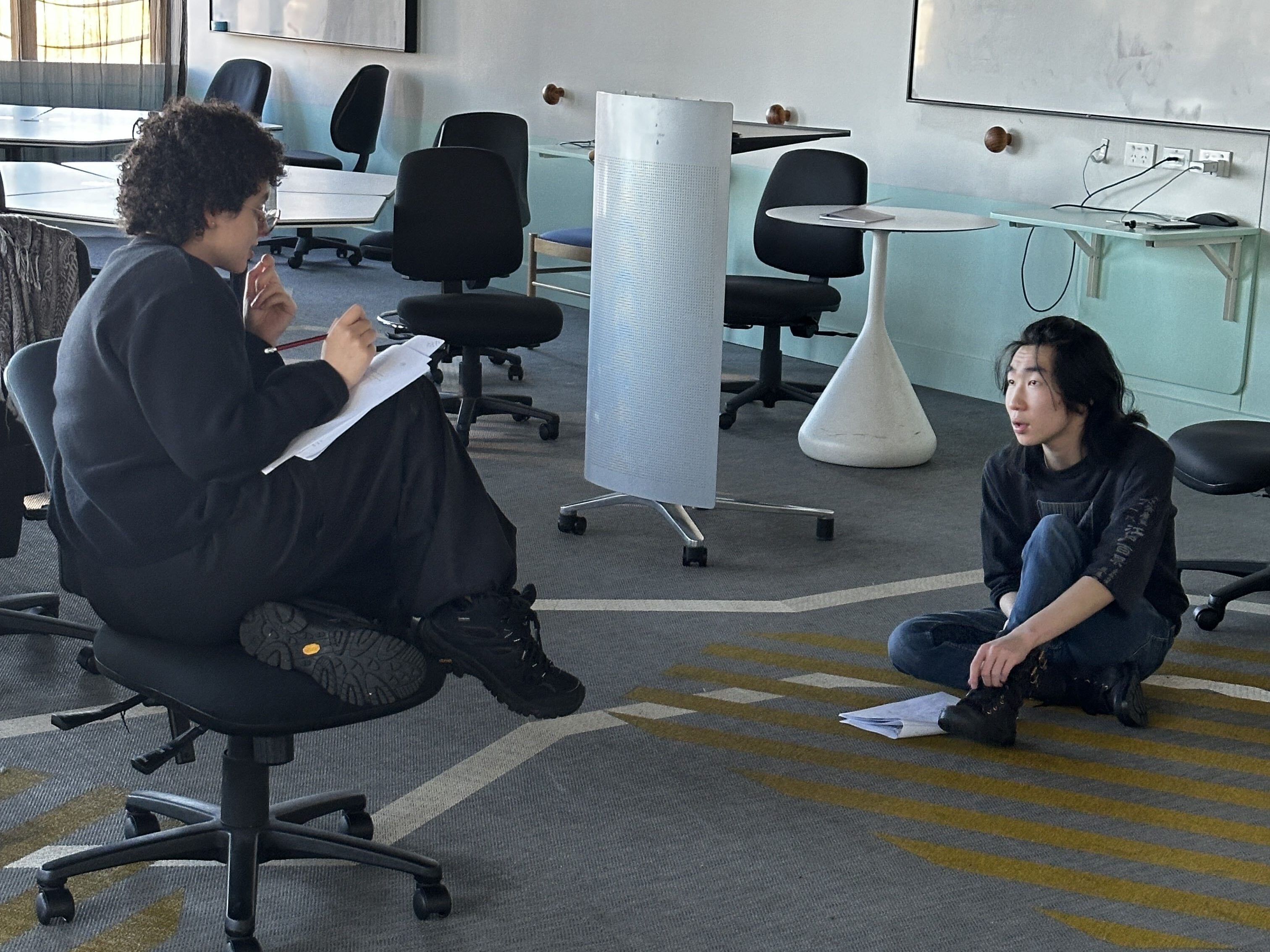
Nevertheless, the last scene of the play tied everything together perfectly, standing out for its attention to connection, moments of stillness and such raw vulnerability. Boy confides in his friend on the curb of the club and he shares that he feels like the experience didn’t make him stronger; he is merely trying to survive.
Jayden Alexander’s Look to Your Left, Look to Your Right presents a complex, emotionally wrought look at the aftermath of a traumatic event in a unique, contemporary style that straps its audience into the passenger seat and forces them to confront the reality head on. Gritty, vulnerable and thought provoking, it will continue to stay with me for a long while every time I cross a busy road.
Look to Your Left, Look to Your Right played at the Motley Bauhaus 11 – 14th of August 2026.
KIT WILLS (she/her) is a third year UniMelb Arts student majoring in English and Theatre studies. Driven by her passion for performance and writing Kit is excited to be a new reviewer for the Dialog.
CHARLOTTE FRASER (she/her) is a writer, performer and editor based in Melbourne. She holds a BA in English and Theatre Studies and is currently completing her Masters degree at the University of Melbourne. Charlotte is also the 2026 Dialog Editor.
The Dialog is supported by Union House Theatre

