
REVIEWED BY KIERA EDELSTEIN
EDITED BY CHARLOTTE FRASER
The palimpsest of all stories ever, wherein sediments of human experience over millennia each pose fruitful matter for excavation, has delivered us into an age where the only logical answer seems to be adaption. A successful adaption must take old works and reconstructing them to find new meanings and new audiences, while maintaining truthful to its source(s). It is a method not without its enemies, especially after 17 consecutive years of Disney’s Live Action Remakes, but so too does it have avid fans. Indeed, thanks to the adaptation, we have Clueless, Ten Things I Hate About You, Goodfellas and the Lion King. Now, we have William Shakespeare’s Reservoir Dogs.’
As foretold in the name, Theatreworks’ show selects Quintin Tarantino’s 1992 film as a source material, a story which is certainly abundant with meanings to extract. This adaption sticks to faithfully to the plot of the original. The adaptation comes in the form in which this plot is conveyed. Reversing the method aforementioned adaptations, where older works are given modern retellings, this play (I’m inclined to say musical, given the vibrant band which soundtracked the performance) takes a modern story and transfers it into the traditional language, as the text of the whole show has been translated into Shakespeare’s English.
In the original and the retelling, the basic plot follows 6 criminals (or, more aptly, dogs) who have been contracted by a mob boss. In the film, this hardened, stern-faced figure is known ‘Joe Cabot’; on stage, he is ‘Elizabethainised’ into ‘Lord Joseph’(played by Donna Winters). This shift is but one example of the witty transposition of contemporary hierarchies onto familiar structures of the Bard’s time.
The story’s premise is that the Lord has conscripted his connections of experienced criminals to assist in him in performing the big job of a established jewellery shop heist.
The show opens the morning of the deed, with Joe deftly dealing out the details; each participant’s colour-coded cover names, their a plan of action, the getaway location. Of course, emphasising the show’s dance with fragile masculinity, we see Mr Pink (Seon Williams) ask for an exchanged alias – his is a bit girly.
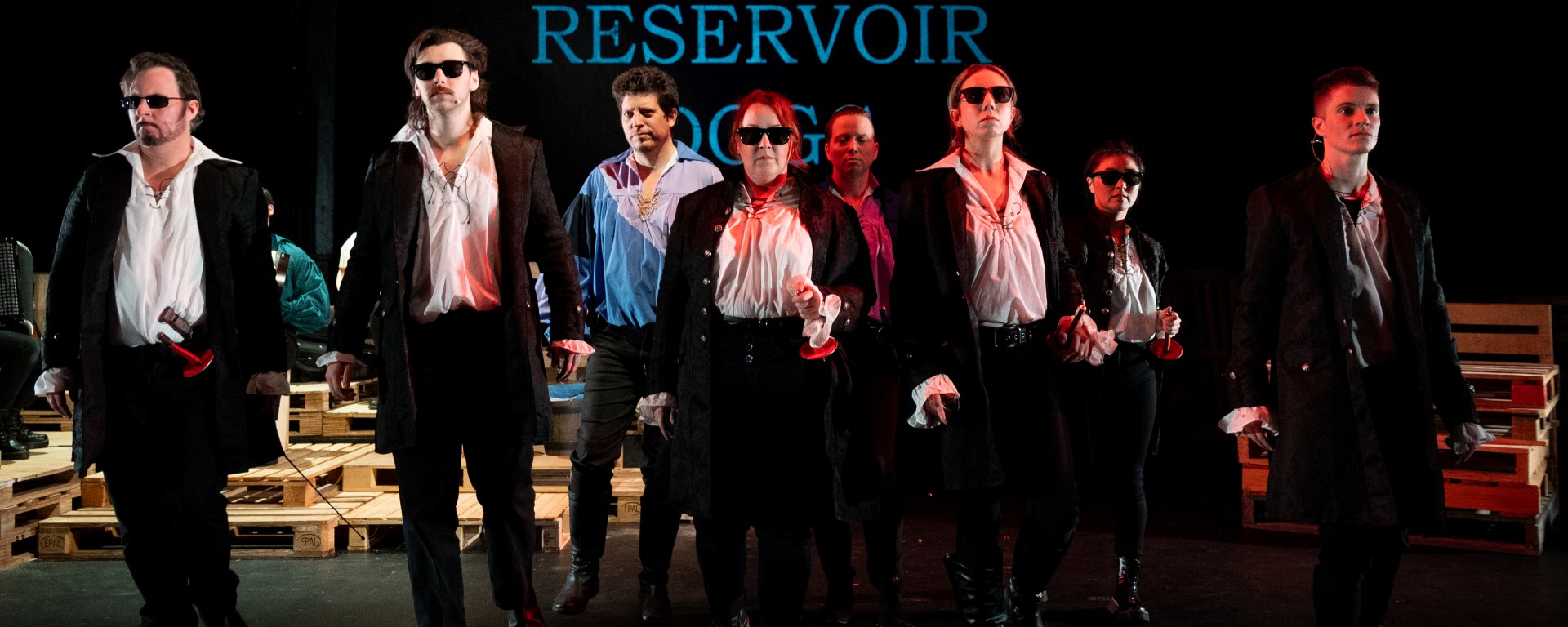
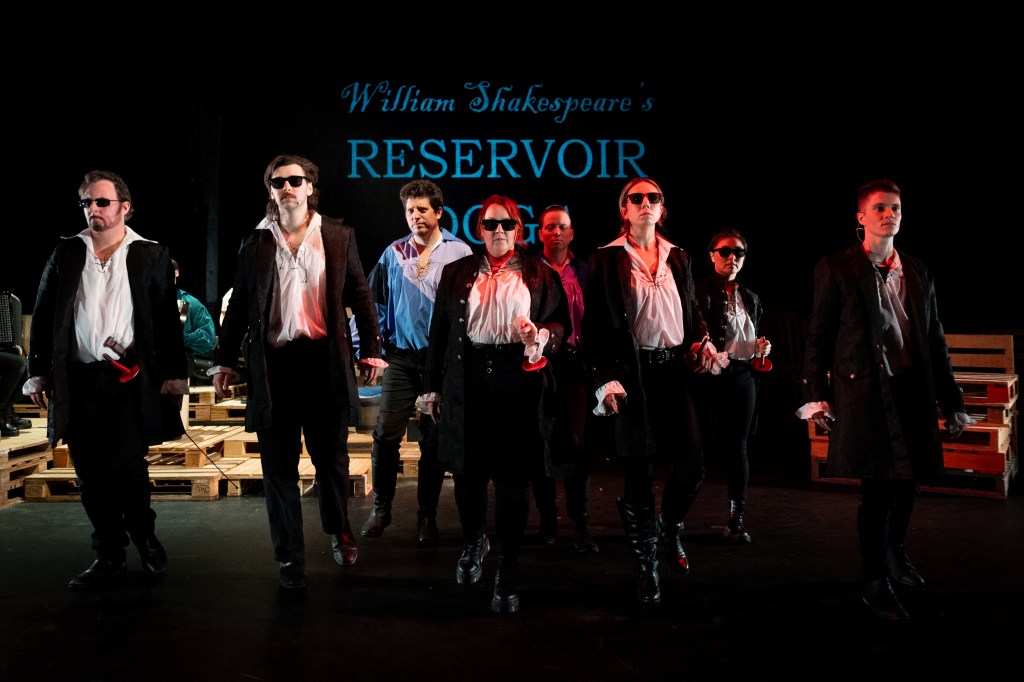
Slick as their greased hairdos and wearing matching Ray-Bans, the wolf pack exit the café (reset as a tavern for the 16th century setting) and walk towards the crime-scene-to-be with a chilling calmness. A smash cut to a bloodied backseat, with Mr Orange (Elysia Janssen) shrieking in agony, skips right over the crime itself, picking up when it’s all gone terribly awry. At the designated reconnaissance point, a funeral home warehouse – remained for the stage as simple ‘The Woods’ – Pink, along with Sir White (Cassandra Hart, who doubled as Producer/Production Designer), and, later, Sir Blonde, suspect they were set up. Paranoia ripples through the group as they attempt to decipher who the rat might be.
Unforgivingly wry, at times deeply disturbing, grounded in a delightful pop-culture relevance, Tarantino’s breakout script was, and remains groundbreaking for good reason. Even without the surprisingly beautiful and often shocking cinematography and editing, the clinical story grafts a powerful sermon on masculinity, egoism and the senseless honour/hubris between criminals.
For this reason, I had high hopes that the work would find solid footing on the stage, especially translated onto lyrical depth of Shakespeare’s poetic form. The metaphor itself is solid. In the black suits of the original, it’s clear that these criminals take themselves to be kings, much like Shakespeare’s tragic subjects. So too are parallels clear to Hamlet or Macbeth when the ambition and lofty sense of self of these men trips over itself and circles into senseless bloodshed. Unfortunately, translated into reality, the meanings of the mashup seem far less crystalline.
Steven Hopley’s text is filled with easter eggs for the avid Shakespearean fan. Patting myself back on the few I managed to catch – ‘All the world’s a stage’and ‘To be or not to be’ both made bright appearances – provided a joyous game throughout that I’m sure would only expand with deeper knowledge of classics. So too, was the delight provided by some Hopley originals, which harked back to the true poetics of the English playwright: Janssen as Orange meaningfully reiterates, despite his wound, he is “grieved but not yet grieving.”
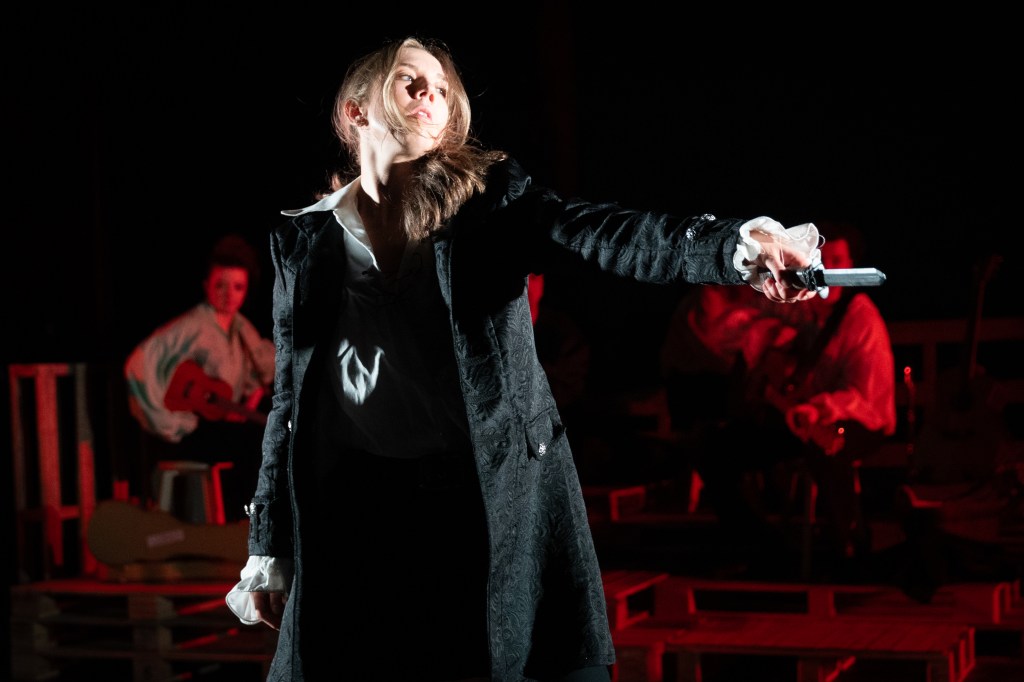
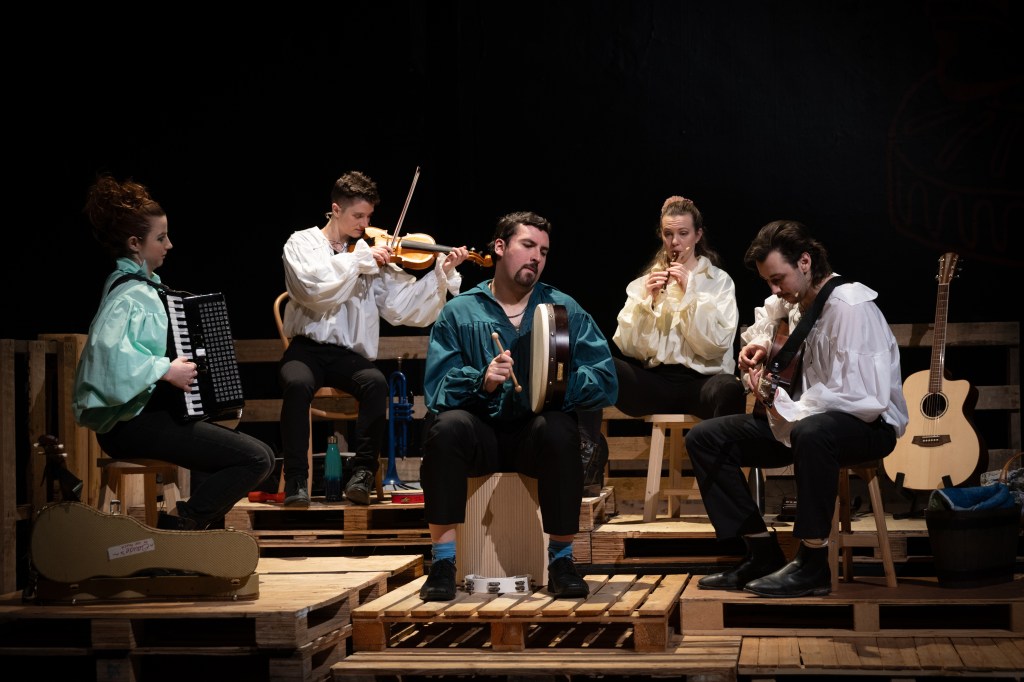
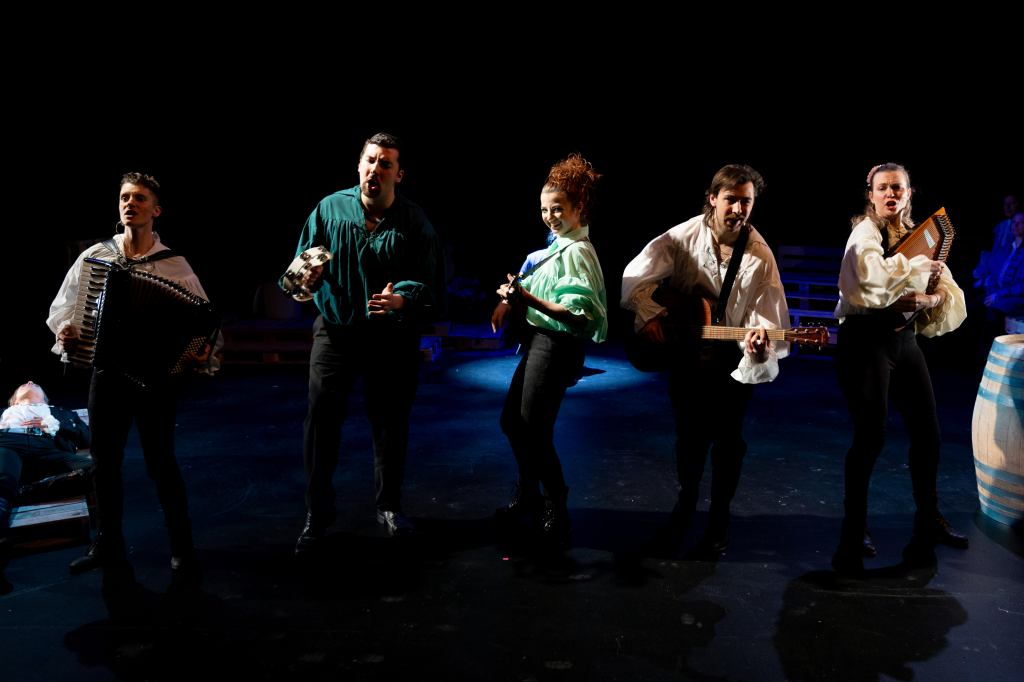
In spite of the lofty language, Lloyd’s direction and the ensemble’s playful work ensured no one took themselves too seriously, a critical asset for such a surreal work. True delight could be heard as the 5 piece-medieval band, armed with both a flute and a lute, embarked on a rendition of ‘Stuck in the Middle with Thee.’
That being said, one issue I had with the play was how clarity of Tarantino’s script fell apart in this new translation. As soon as the show began, I was bent forward and craning to decipher the dialogue. ‘Oh God,’ I have written at the top of my notes, ‘I don’t speak Shakespeare.’ Many of the best jokes and references of the original work became clunky in the new translation. This quality was amplified by the combination of the cast’s thick cockney accents (albeit a clever dramaturgical nod to their rugged characters, especially when the clean toned police officer must learn to speak gritty to go undercover); the echoey acoustics of the playhouse; and the at times overbearing sound of the band, which made it a real challenge to decipher exactly what was going on. Even for someone who has seen the movie a few times, there were a good few moments, including some relatively pivotal plot-points which had me psst-ing in a hushed whisper over to my friend to check what had just happened.
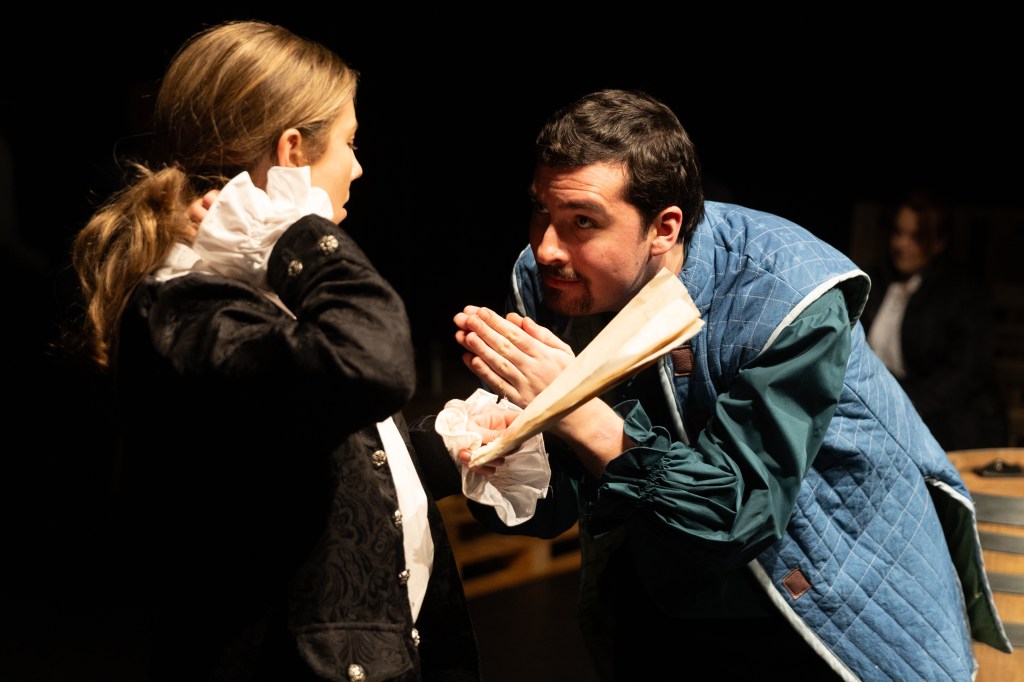
As the story plunges second half, the show became increasingly cohesive. Hart’s performance as Sir White was consistently stable and considered, providing a strong throughline in the otherwise more unstable settings. The connection between Hart and Janssen served as a palpable, grounding beat for the middle scenes in the warehouse, as Sir White attempts to save the wounded Orange by advocating to get him to a surgeon. So too was William’s performance as the nervous, slimy and slightly neurotic Sir Pink, enrapturing. She balanced the dynamics of the character well, leaning into the challenges of portraying a male role with skill, finding both masculinity and femininity, an angle that itself added an additionally conceptional layer. Ultimately, when bloodthirst and violence overcome all the others, William’s final look, eyes out and the bag of diamonds in hand, was a powerful one – communicating how honour does not service criminals.
While delightful in the iconic torture scene, where he famously razors off the ear of an innocent officer (Peter Mitrousis-Kothe) Corey Glamuzin’s performance as Sir Blonde was less consistent in its effectiveness. In this, his moments of deep affect were pared by times his portrayal tended towards shrill rather than emotionally unstable, such as in a dialog with Lord Joseph in the flashback scene revealing Blonde’s backstory as a convicted criminal out on parole.
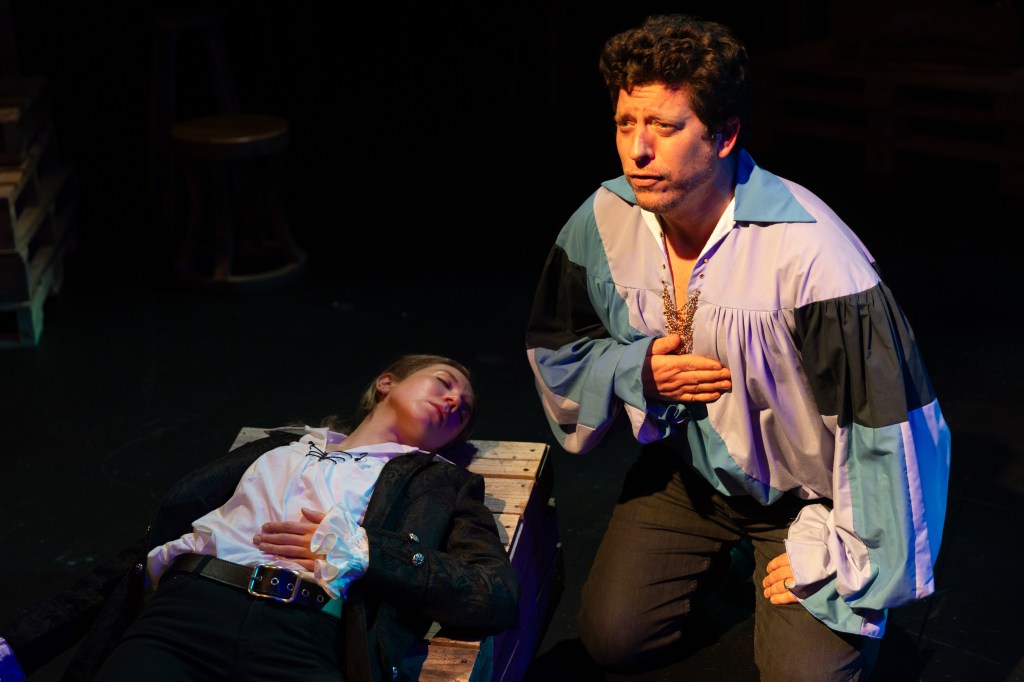
Speaking of which, Donna Winters as Lord Joseph, rounded out the ensemble with a solid presence. In the challenging context of these ‘flashback scenes’ which slowly reveal backstory of each character in a reversely engineered structure, this is an impressive feat. At times where her playmate’s varied, Winters held down the tough, severe line of a mob boss, in a way that made the character feel strangely trustworthy, all things considering.
In the play’s final act, Cabot arrives on the scene to be the only one capable of accurately suspecting the ‘rat’ as Sir Orange. However, at this point, loyalties have become too entangled for the boss to simply do away with the traitor, and in a tragic sequence Sir White avenges Orange by killing Cabot, inevitably leading to his own demise. In the end, no one but Pink survives. Ultimately hubris of the mob men as they plunge rapier first to avenge each other’s honour rings just as true in this depiction – if a little more comical in the absurd context.
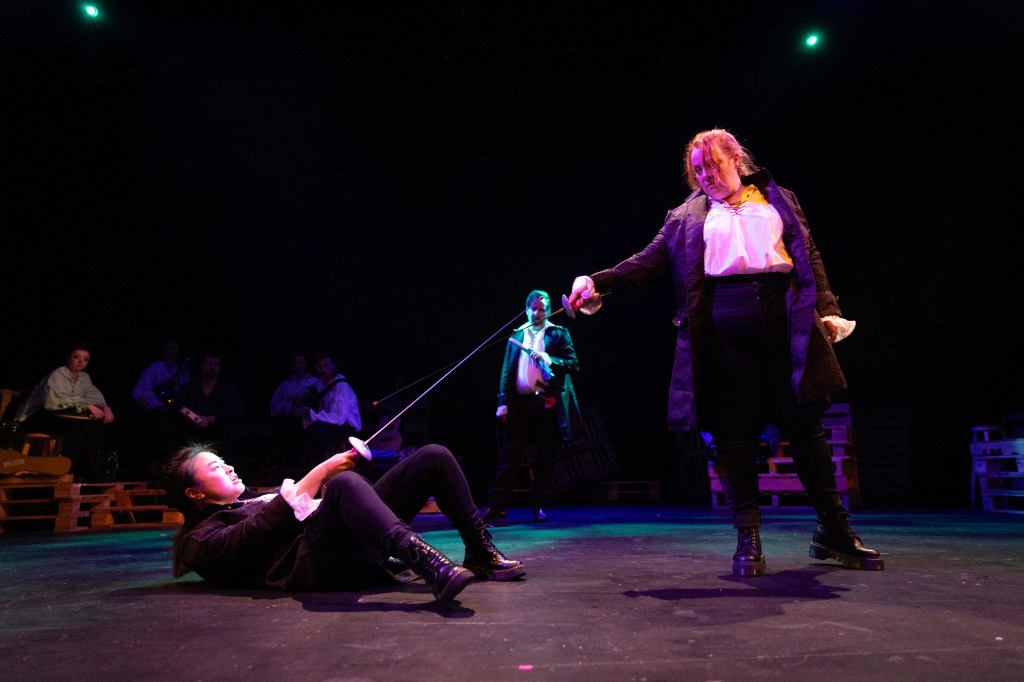
Design-wise, I appreciated The Ghostlight League’s interpretation. Patrick Slee’s lighting was a highlight, as he embraced the black-box quality of the space with stunning variety. The costuming was equally as enjoyable, including a puffed sleeve shirt homage to Nice Guy Eddie’s iconic Nike windbreaker in the film (Matt Young appropriately played it as Pleasant Fellow Edward).
Folks well versed with the source material would be likely to extract great joy out of witnessing both works breathed into fresh language. Even as I struggled with comprehension of the conceptual overtones, William Shakespeare’s Reservoir Dogs provided an exciting and comical evening out, with delightfully clever beats and many enjoyable moments.
William Shakespeare’s Reservoir Dogs was presented by The Ghostlight League at Theatre Works 5 – 15 August 2026.
KIERA EDELSTEIN is a First Year Bachelor of Arts student who loves all things reading, writing and storytelling. She doesn’t know what her major is yet but has decided in the meantime to take part in as many parts of the student-theatre that she can.
CHARLOTTE FRASER (she/her) is a writer, performer and editor based in Melbourne. She holds a BA in English and Theatre Studies and is currently completing her Masters degree at the University of Melbourne. Charlotte is also the 2026 Dialog Editor.
The Dialog is supported by Union House Theatre

