
REVIEWED BY SUNDAY WILLIAMS-STARKIE
EDITED BY MYA HELOU
I tried my very hardest to go into watching The Goat, or Who is Sylvia? blind. When I volunteered to review it, I was warned: ‘make sure you’re careful about that one. It’s pretty… full on.’
In my case I decided to carefully stay uninformed. I got the sense the play relied heavily on shock factor, and I didn’t want my review tainted by prior knowledge. Through some unhappy coincidence, however, I discovered a pretty big spoiler in advance.
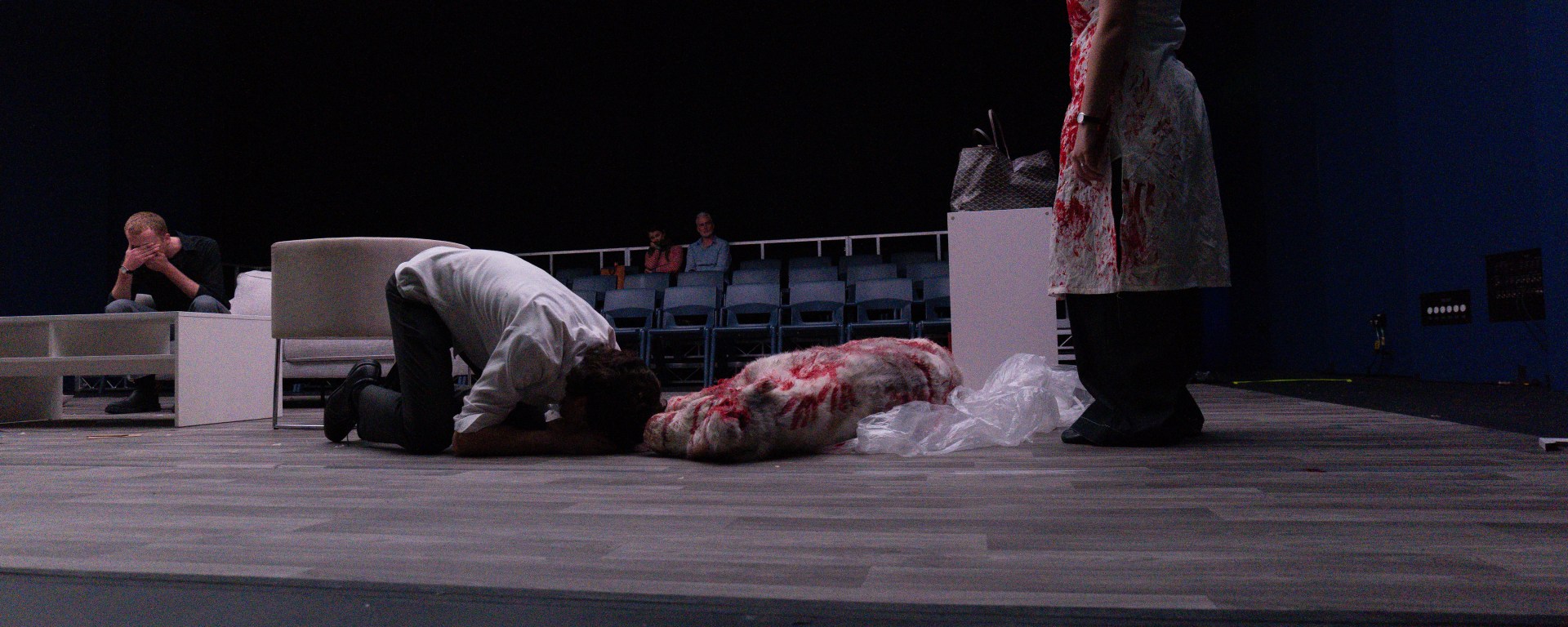
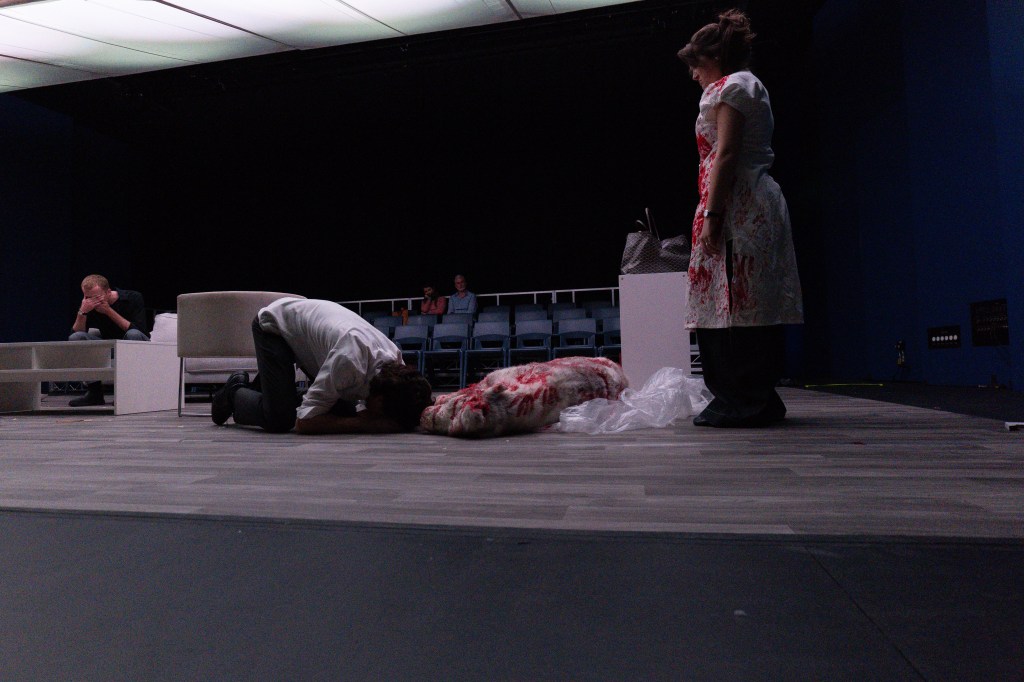
Luckily for me, the fact that Martin has cheated on his wife, Stevie, by having a repeated and supposedly emotionally intense sexual affair with a goat is one of the first things the audience discovers.
Right. I thought. Good to know it can only get more harrowing from here.
Moving Pieces Theatre company has decided to make a splash in the student theatre scene by debuting with a production of The Goat, or Who is Sylvia? by Edward Albee. The play was first performed in 2002 and has been seldom performed since, due to its extremely difficult content and themes, including bestiality, rape, incest and paedophilia. It played at the Guild theatre from April 16th – 18th, 2026.
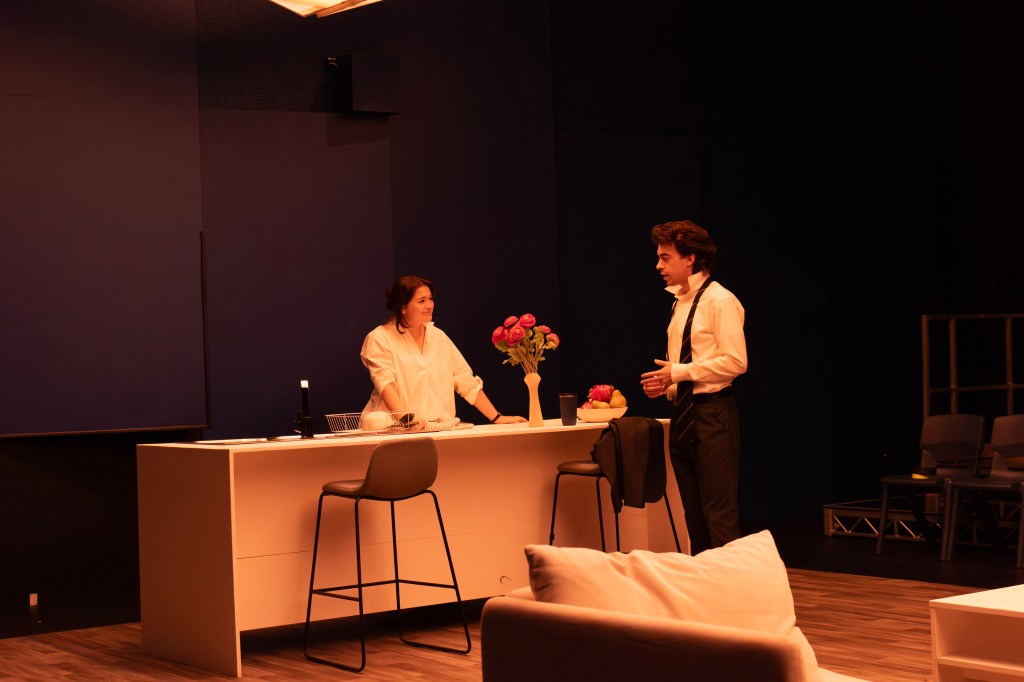
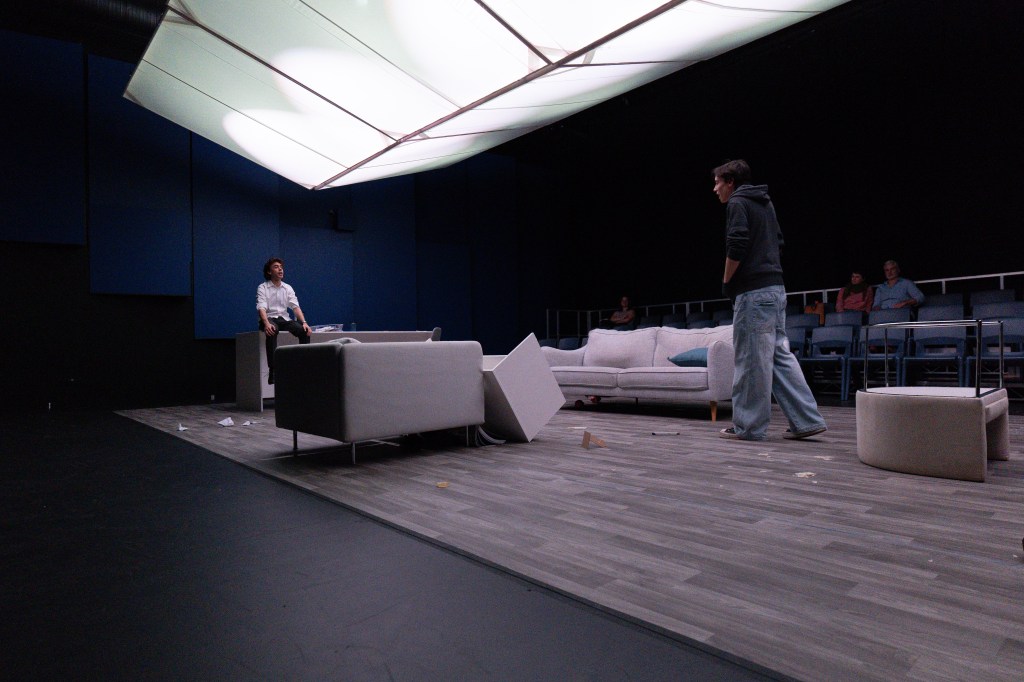
The stage is live from when the audience enters – Stevie, played by Esther Nastri, reads a book in a clean, modern home. A nostalgic, upbeat playlist underscores. A bit of Beatles, a bit of Talking Heads. I share a boogie with my friends across from me in the traverse seating. The house lights go down, but as the stage lights come up, I am delighted to see both sides of the traverse were still softly but clearly lit. Enter Martin (Finn McBurney), a famous architect celebrating his 50th birthday. Stevie greets him. A perfectly normal marriage, in a perfectly normal home. The first time Martin admits to his love affair with Sylvia, who is an honest to God goat, it’s played off as a goofy and sweetly domestic joke with his wife. But that’s pretty much our only moment of peace. We then meet Gryff Connah as Martin’s good friend Ross, who’s arrived to interview the influential Martin. Ross brings up one of the most important dichotomies of the play: private vs public life. Connah does this through his hilarious distinction between ‘onscreen’ and ‘offscreen’ Ross. The two men discuss Martin’s son and his queerness, assuring each other he will ‘grow out of it.’ Alistair Brett appears later as Martin and Stevie’s son Billy, in the thick of an argument between his parents. Billy’s anxiously energetic presence diffuses some tension between other characters, but perhaps he is more troubled than he seems.
In the program, the show is described as an exploration of changing morality around queerness in the 2000s. It encourages us to examine the limits of what is acceptable or perverse. Martin himself asserts, halfway through the play, that it’s not important what he does, morally speaking. It’s only wrong if people find out. As a 2026 audience, the themes of queerness are present, but the main thing on my mind was the release of the Epstein files, and the way depravity is excused within circles of the wealthy elite. It’s impossible to ignore Martin’s fame as being an influence on his character, shown through his sleek and professional aesthetics and costume (designed by Elise Craig). Connah’s humorously macho portrayal of Ross and their locker-room style conversation seemed to exemplify a patriarchal objectification and disrespect for women, that Martin conveniently considers himself exempt from. The play’s unflinching nature allows for nuanced interpretations. I am impressed by the decision to perform it here and now and believe it to be a fiercely necessary text.
Nastri’s portrayal of Stevie is heart wrenchingly powerful and nuanced. Even in her most high intensity moments of rage, she does not lose her grounded and intelligent delivery and does not once slip into one-dimensionality. Ross, the blokey best friend of Martin, is played by Connah with relish and charm. Connah’s gravelly voice and casual gestures created a hilarious and confronting contrast to the subject matter. Yet Connah expertly navigates the tonal shifts of the performance in his later entrances, smoothly becoming a grave and grounded voice of reason. Brett plays Billy with an endearingly vulnerable anxiety. The play text makes clear Billy’s concern for his mother, and Brett does a fabulous job of appearing nurturing and protective of her, a strangely sad reversal of a healthy family dynamic. Brett does not shy away from the ickier complexities of his character at any moment. Even in silence and stillness, his unwavering gaze on Martin in the final scene was bone chilling. McBurney’s interpretation of Martin is, as I have mentioned, seemingly sweet and innocent. I found myself extremely drawn in by his lovable insecurities. It made it believable that he did not believe he had done anything wrong. McBurney’s almost ditzy demeanour even in the face of unbelievable tragedy onstage spoke to a great ease onstage and a deep knowledge of the character. The whole experiential and symbolic throughline of the show relied on the exact balance that he was able to find. The script is not only difficult because of its themes, but because of the language that oscillates between poetic and hyper-conversational. The cast carries it off beautifully. My favourite element of textual delivery is that the word ‘Goat’ is never stressed in a sentence. It seems to sometimes float by, without fanfare.
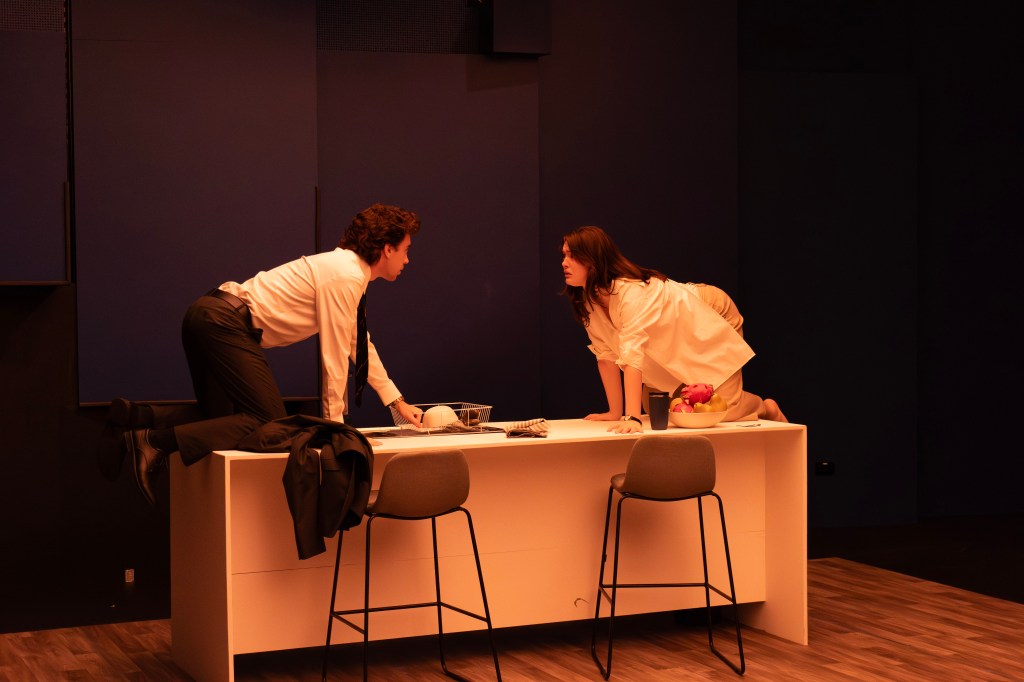
The lighting, designed by August Johnson, was a particular standout for me. A panelled scrim is hung from the ceiling which diffuses the lights into a stunningly cinematic and flattering wash. Working in conjunction with set design by Georgia Campell and Declan Duffy, having a roof created the sense of a full box-set and a realistic home. I have also mentioned the audience being lit. Usually a traverse is used to encourage an audience to reflect on themselves and their reactions to the action onstage, but in this case, there was an additional sense of voyeurism. The lighting augmented this with its subtlety. I truly felt like a fly on the wall. There was also the added drama of occasional bright red washes to separate scenes, which raised the stakes, coming to a head in the final image of the show. Campbell and Duffy, assisted by Alexandra Fimeri, created a set that wonderfully responded to the intimate space of the Union theatre and spoke to the privilege of the characters. Pops of red detail the set, an underlying promise of violence. Tina Vuong and Elsie Craigie, prop and costume designers respectively, tastefully brought the production into the modern day. The costumes were simple and stylish, timeless, but not anachronistic. I was absolutely captivated by the fact that Stevie, in scene one, pulled a pair of cloven-hooved tabis out of the drawer (foreshadowing…). Vuong’s smashable props were unforgettable. A vase dropped and exploded, shards skidding into the audience in a moment that was dramatically chaotic, but also completely controlled. I would also like to specifically throw some praise to Rebecca Fortuna, intimacy coordinator, for creating some particularly harrowing moments, and the marketing team, Campbell and Lucy Xan Fu, for advertising the show with such visually distinct and symbolically rich imagery.
In her program statement, The Goat director Georgia Campbell describes the topics explored in the play as ‘incredibly difficult and uncomfortable…ones that seem so out of the realm of possibility, that we don’t bother putting in any effort to understanding why they are so horrible’. The directing team, Campbell and Sophia Murphy, have done wonders in depicting the abjectly horrifying content of the play in a subtle and filmic light. It would be so, so easy to allow for the characters in a scenario like this to slip into the realm of schlocky caricatures. Martin could have been gleefully malicious, Stevie could have been the stereotypical wailing wife and Billy a homophobic depiction of a limp-wristed sex fiend. The text already provides so many images of depravity, that to lean into them again would border on comedic. Instead, the production we see is firmly grounded in a strange empathy. The display home-like set; the soft, filmic lighting; Martin’s nervous, youthful demeanour; and the chemistry that the actors depicted onstage made each moment of disgust even more gag-inducing. It allows for the opportunity for the audience to really see the phantasmagorical complication of Martin ‘fucking a goat’ as having real-world consequences.
Moving Pieces has triumphed in putting on a highly relevant and skilful production, but the content warnings and accessibility measures did not adequately reflect the needs of the piece. A ‘reference to incest’ is different to a depiction of it, and different again to a graphic depiction of it, and requires more detailed warnings. A policy for exiting the performance space should have been discussed openly and directly in the pre-show announcements. For example, exit paths highlighted with reflective tape, or ushers placed visibly on the seating bank. I would have also appreciated referrals to help-lines for additional support in the program, or a social script being made available. It is for shows like these that the need for accessibility measures become so clear.
Yet, the value in performing The Goat, or Who is Sylvia? Goes beyond shock factor. Martin is not the only rich and famous white man with a sense of entitlement that leads him to unthinkable perversions and abuses of power. It’s essential to question the scenarios that seem the most outlandish and counteract your own desire to look away, though it may make you cringe, gag, or feel a little faint. Moving Pieces has made it impossible to look away from the action without running into yourself, reflected at you across the stage, chewing your nails or twiddling your thumbs and you look on in dumbstruck horror.
The Goat, or Who is Sylvia? was presented by Moving Pieces Theatre Company in the Guild Theatre 16 – 18th April 2026.
SUNDAY WILLIAMS-STARKIE (she/they) is a Theatre-maker pursuing their BFA in Theatre at the Victorian College of the Arts. She’s completely obsessed with Theatre of all kinds, and believes a good show is one that’s talked about.
MYA HELOU (they/them) is an English and Theatre Studies major whose love of theatre was fostered by Shakespeare and classical Greek tragedies. They will take every opportunity to discuss either.
The Dialog is supported by Union House Theatre

