

REVIEWED BY BATRISYIA MD KHAIRIL
EDITED BY CHARLOTTE FRASER
When entering the Motley Bauhaus, you’ll notice the colourful posters of various comedy festival acts. Keep an eye out for the poster for If You’re Hearing This. It’s the one with a space-suitted Ally Morgan looking out with mild confusion and bewilderment. Don’t let this fool you; Morgan knows exactly what she’s doing. Using only a variety of instruments, a projector screen and a couple of chairs, Ally Morgan takes us on a rollicking intergalactic musical odyssey, breathlessly jumping from bangers to ballads with gags scattered generously throughout.
Ally escapes the apocalyptic earth as we know it and literally puts herself out there, the furthest ‘there’ possible: space! Life on her spacecraft is pretty sweet: between snacks and viewings of her favourite film, her weeks are spent doing nothing but broadcasting her radio-style chats and original songs. Ally explains (via song) what a terrible mess the earth is in and waxes poetic about the hopes and dreams of life in space.
“Maybe there we’ll get it right,” she sings.
Abruptly, an extraterrestrial being punctures her lonely haven, forcing Ally to confront herself and the mess of a world she’s left behind.

It’s no secret that people are feeling helpless against cosmic catastrophes like climate change, war and increased inequality and disenfranchisement, and resort to humour to deal with it all. Subject to ridicule in her joke filled songs, too, are the usual suspects: billionaires, celebrities, consumerism, capitalism… Digging beneath these punching bags of modern society, Morgan asks why are so many of us feeling this way, and why can’t we ever fix it?
Remarkably for a one person show, this complexity is given life with two characters: Ally and her extraterrestrial fan Waylon (Morgan, through a voice changer). Ally is a self-preoccupied amateur astronaut, who is #girlbossing in her spacecraft. She’s alone, but it’s fine because she’s got everything she loves! It’s so fine! #girlboss!
Waylon speaks with an exaggerated optimism and naiveté, a funhouse mirror of Ally’s persona on her radio broadcasts. Ally adopts a parental role, singing her experiences to communicate with Waylon, and explaining the choices she’s made. A personal favourite sci-fi trope that receives much love in their interactions is the mangled understanding of common earth experiences (see also: most scenes involving Data in Star Trek: The Next Generation).
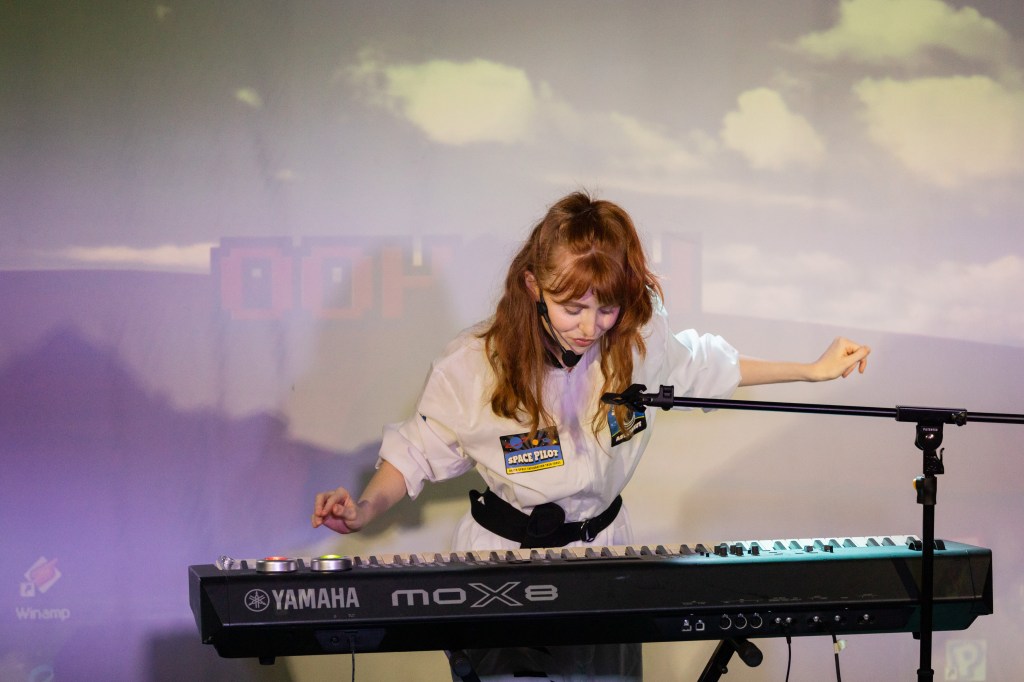
In her dual roles, Morgan literally interrogates herself, tapping into her own memories, her feelings and her fear of growing up for an answer. Morgan bets, correctly, that the audience will resonate with her responsibility of inheriting a fundamentally broken society and the crushing disappointment that comes from not being able to really do anything about it. Systemic issues are to blame, but they’re far too big for any individual to solve with recycling or vegetarianism, far from the fairytale image of slaying a mythical beast.
Ally’s space mission poses a solution to this conundrum. By refusing to face the global – and, we learn, personal – issues of an unhappy life back on earth, Ally prioritises her own comfort above all else, driving a rift between her newfound friendship with Waylon. Despite this, continually through her broadcasts, Ally still cries out for rescue. Her space launch is a refusal to grow up: a state of perpetual childishness, surrounded by her favourite toys and a desperate cry out for someone to come help clean up her mess.
Space exploration is also a metaphor for Morgan’s privilege. Ally had the resources to launch herself into space and survive alone, with the freedom to spend her time making and enjoying art. Morgan is keenly aware of this indulgence, turning a critical view to her lifestyle choices as a person on the happier end of universal inequality. On that global scale, Ally’s life complaints seem like a tantrum, her escape a flippant choice under the mildest of pressures. Her desire for even more comfort than her relative luxury echoes the same greedy impulse of the billionaires and mega corporations that she’s been mocking as evil throughout. Does Ally deserve be rescued? Do we? Can anyone even rescue us? Is anyone listening?

With all this in mind, I hasten to remind you that this is indeed a funny show. All this heady philosophising goes down a treat with the power of song, and especially with a kazoo rendition of the Star Wars theme.
Morgan is a confident storyteller and plays the songs, emotional beats, and punchlines with equal brilliance. As with all good musicals, a song comes at a narratively and emotionally satisfying point. Unlike many musicals, each song is also a vehicle for comedy, a clown car cramming in more jokes that appears to fit. Often the audience feels a little too comfortable taking a back seat and is hesitant to be directly involved: we’re having such fun, it almost feels rude to speak up even at her invitation. We’re rapt, waiting for her next witty line and lyric.
Using space as the ultimate big picture view on society and her place in it, If You’re Hearing This delivers on its stellar premise. It’s an emotional journey with the feel of a wonder-filled adventure, never bogged down by preachiness or the heaviness of its subject matter. A complex balancing act pulled off as effortlessly as if gravity really was an option.
If You’re Hearing This was presented by Ally Morgan at the Motley Bauhaus 6 – 19 April 2026 as part of the Melbourne International Comedy Festival.
BATRISYIA MD KHAIRIL (she/her) is a student who does side quests alongside studying. She loves thinking about stories and storytelling and particularly likes the side quests that give her the opportunity to do so.
CHARLOTTE FRASER (she/her) is a writer, performer and student editor based in Melbourne. She holds a BA in English and Theatre Studies and is currently completing her Masters degree at the University of Melbourne. Charlotte is also the 2026 Dialog Editor.
The Dialog is supported by Union House Theatre

