
REVIEWED BY ELIJAH VALERY SLAVINSKIS
EDITED BY CHARLOTTE FRASER
If you visit the Melbourne Fringe Festival website and click through a bunch of hyperlinks to find the page for Living the Dream a new play by Tom Wornsop, you will find that it describes itself as, “simultaneously comedically ridiculous and painfully confronting.”
After exiting the MC Showroom and stepping out onto the rain-soaked footpaths of Prahan I was undeniably baffled by what I had just seen. It gets a massive tick for delivering on the ridiculousness! But in terms of the comedy and the confrontation… I’m not too sure.
Was this a complete and utter mess? Or a moody masterstroke?
The hour-long Twilight Zoneesque original follows English teacher James as he moves into Arcadia Place, a slice of rural Victorian suburbia where everyone knows everyone (and everyone knows everyone’s business too). An agitated James has to confront his past, a possible romance, an overbearing neighbour and the general sense of strangeness that accompanies this housing estate. On paper, this premise may sound slightly archetypal but if executed well could yield a fantastic night out at the theatre!
It pains me to say that I don’t think I can call my experience with Living The Dream, perhaps my most internally divisive production I’ve seen this year, ‘a fantastic night out at the theatre’. For me, Living The Dream was an almost ‘mood-less’ show that was reliant on vibe over narrative, but the vibes weren’t really there at all. It is like promising a friend that the hike you’re about to go on has the most beautiful views of forests and oceans, then duct taping both of your mouths shut so you can’t talk the entire time, and then the views are actually not beautiful at all.
This show sent me spiralling. By the end of the play, I couldn’t tell you what Living The Dream was actually about. This review is going to be a journey of discovery for both you, dear reader, and myself.
Let’s start with some pieces of unmistakable quality.
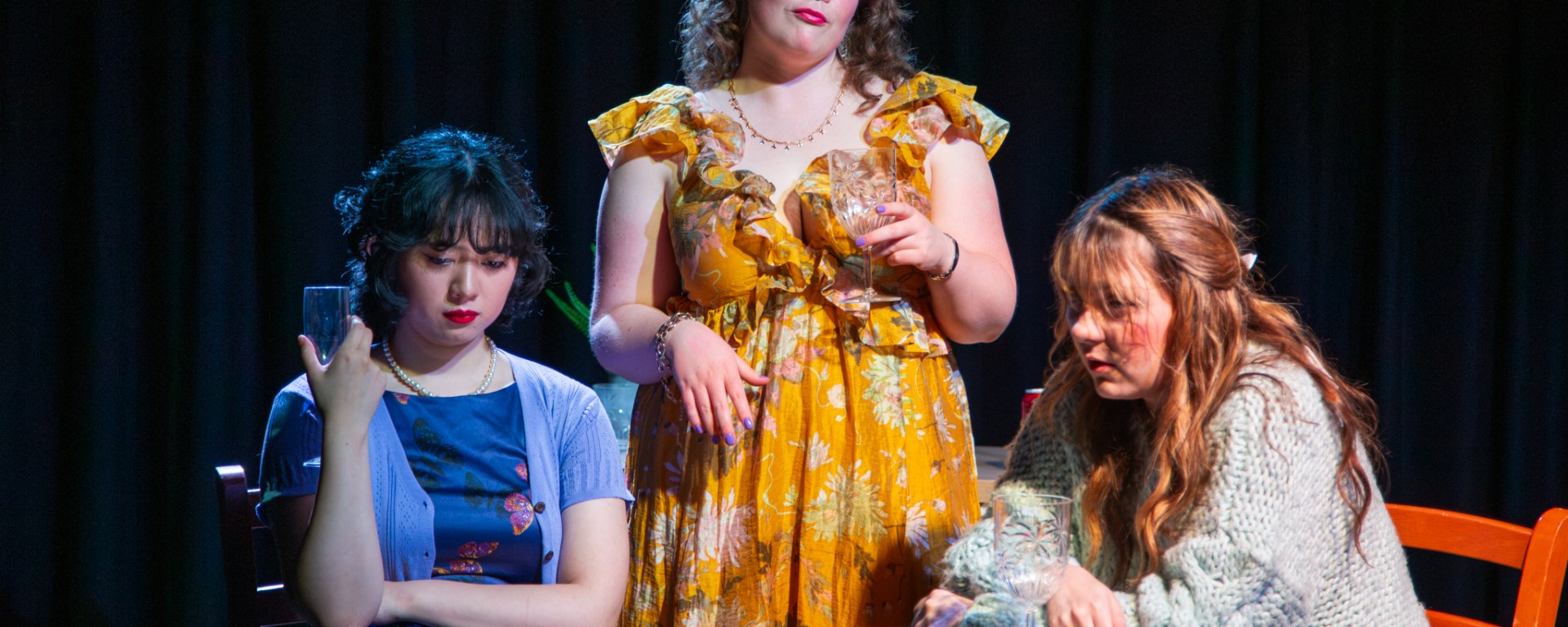
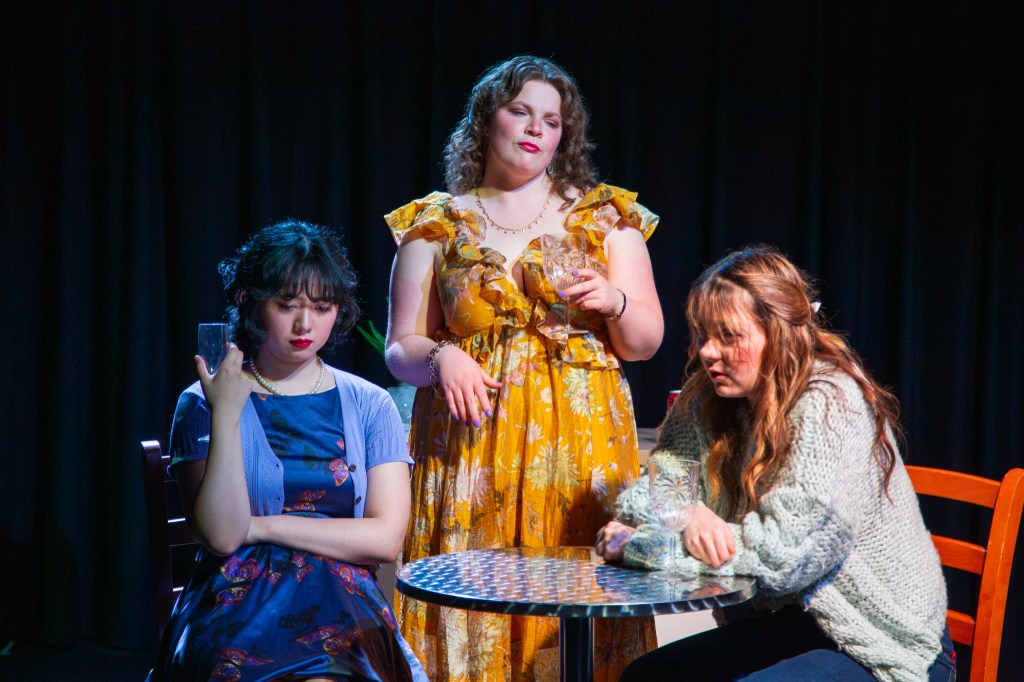
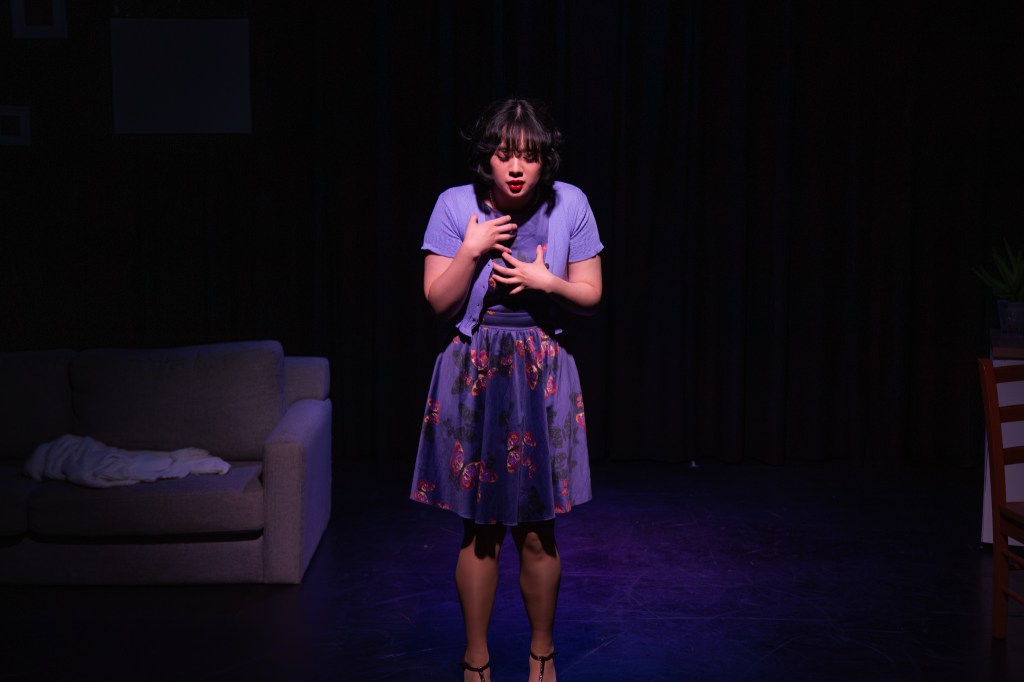
The costume and set design by Ella Barrett and Ciel Giles-Manor respectively, were a massive success. The set was simple but very effective, focusing on the three rooms every house in Arcadia Place would have – a kitchen, a dining room and a lounge room. While there are no set changes, the dialogue signals when we have shifted into a new home, which worked quite well within the contained space of the Showroom. Moreover, a collection of empty photo frames hung behind the lounge’s couch allowing the audience to insert whatever image they believed would accompany the different houses of the play – I found this to be a really smart low-budget theatrical choice. Barrett’s costuming was incredibly faithful to the text and the characters. Each player was effectively given a signature colour, for example Damo wore shades of green and Jill wore purple, providing the play with undeniable visual interest and aesthetic merit which was only bolstered by the lighting design (Irene Lu).
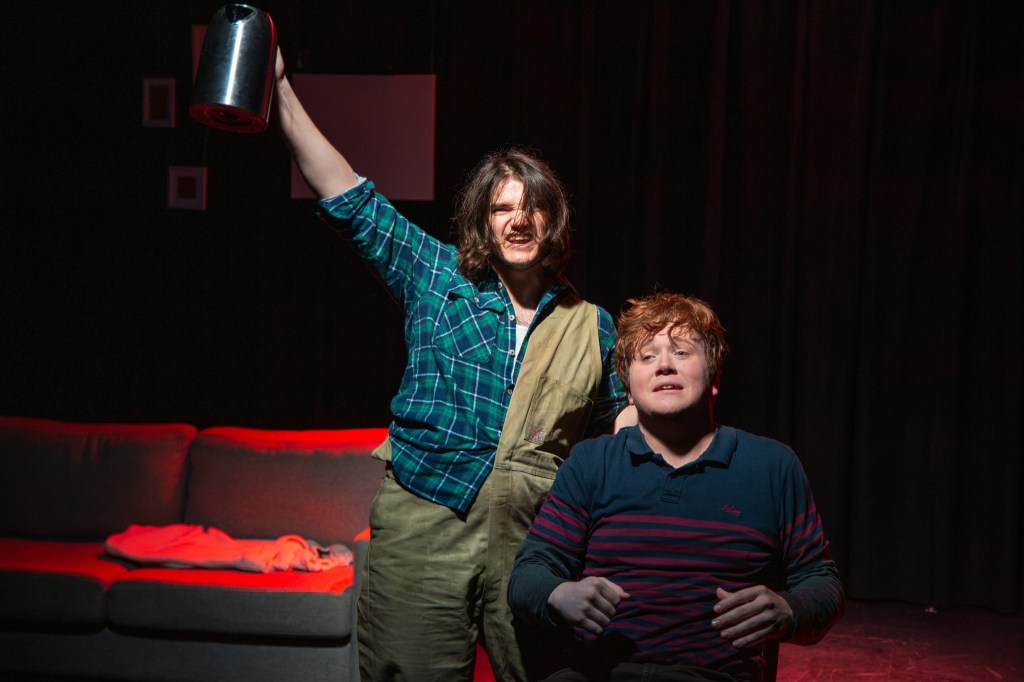
It was hard not to be completely enamoured with Julian Machin’s supporting performance as Rich. Donning tight chinos and a selection of button up shirts or polos, Machin disappeared into the bravado and charisma of his character. His actions were deliberate and authentic, while his tongue seemed to be perpetually pressed down towards his chin creating the appearance of a snake in disguise trying to hide its forked tongue. His measured confidence was a welcome contrast to the consistently jittery discomfort of Ryan McInerny’s James who I felt played the quiet and awkward sides far better than the more disgruntled parts of his character. A stand-off between James and Rich regarding nonconsensual mowing of lawns was a comedic high-point for the play, leaving me genuinely amused and in continued appreciation of Machin’s presence on stage. It was truly an electric performance which unfortunately left me wanting far more from the rest of the cast.
However, I believe the actors leave relatively innocent, with the guilt lying in the underdeveloped nature of Worsnop’s script.
This is where I have problems with Living The Dream. I would genuinely like to ask the playwright how much he knows about his characters and the ‘confronting’ events that happen over the course of the play.
Apart from Rich, who is given the best lines of dialogue in what is a fairly archetypal role, the other characters are far too caricatured. While I understand comedy (particularly satire) is often created through repeated bits and slightly more one-dimensional characters in order to poke fun at specific types of people, there were just too many characters that lacked any semblance of a true personality. This left the actors to ‘ham up’ their character’s one trait often in an attempt at laughter that never came.
Damo (Oliver Quibrosi) works at a garbage facility and drinks beer, while Cluey (Ed Wallis) wears Hawaiian shirts and drinks beer. I wish I could describe them further but tragically that is all the play has to offer which is especially problematic as we spend the most time with this group of male characters. By the end of the show, I did not have much interest in many of the characters because there was nothing for me to be interested by. The biggest crime is the treatment of the female lead, Allison, played by Dempsey Doyle. She teaches PE and French, gets into a relationship with James, has a painting on her wall and recites the lyrics of Keane’s Somewhere Only We Know telling the audience that she wants stability and “something to rely on.” That’s it.
You could argue that the lack of personality in the female lead is merely used to satirically highlight the unequal gender norms of the society that we live in however I’m pretty sure satire is meant to be funny. Any scene with Allison and the wives felt pretty damn lifeless. By shunning the female characters to the side Worsnop has ignored what could have added significant depth to his narrative; you can show the audience that the women of the play have genuine backstories and real personalities while still exploring the repercussions of unchecked gendered dynamics.
Actually, I lied earlier.
The greatest crime committed in the creation of this play is its complete lack of interest in giving the audience any answers. Move over hay fever, this play is severely allergic to payoff.
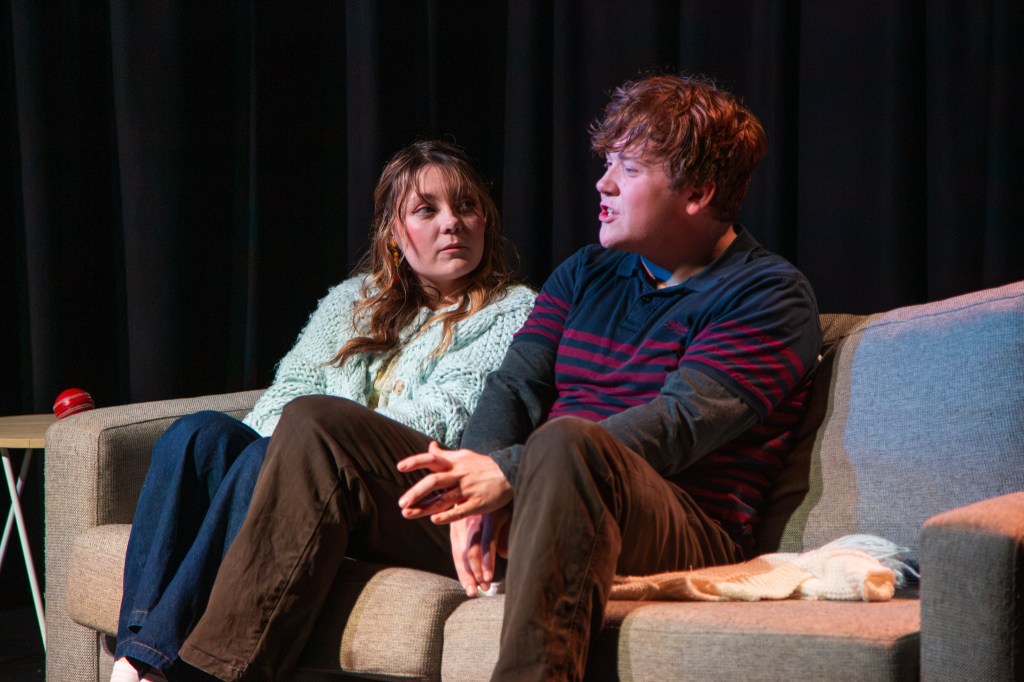
To Worsnop’s credit, he introduces some relatively interesting mysteries such as the residents of Arcadia Place tracking down James’s identity via county cricket statistics, which signals a dark past he is trying to run away from. But then James says “that’s not who I am anymore” without explaining what had happened and then that’s the end of the plot thread. It baffles me why a playwright would rob their audience of going deeper into the mysteries they have set up. Worsnop hints at something interesting, says ‘look at this strange thing that’s happening’, then points at a completely different thing and says ‘but what if we just moved on and didn’t come back to that first thing ever again’.
The same thing happens when the boys of Arcadia Place are watching TV on boxing day and Cluey puts on a ‘disturbing video’ which the girls walk in on. The actors sell the disgust and shock incredibly well which lead to a moment where I was sincerely on the edge of my seat. Then, you guessed it, we never find out what the video was or what any of the repercussions were apart from Damo’s wife asking for a divorce. I have been robbed once again.
I am not anti-ambiguity; in fact, I usually enjoy open-ended questions for the audience to dwell on once the curtain goes down but usually the writer has developed these unknowns throughout the play and knows themselves what these mysteries are even if they don’t explicitly tell the audience. In Living The Dream, it felt like the writer was trying to be mysterious but didn’t know themselves what any of the mysteries were.
An interesting premise was there but an entertaining execution was not. Worsnop clearly has a lot of interesting questions on his mind – dynamics of neighbours, the Australian dream, toxic masculinity, cricket. However, the play doesn’t seem all that interested in any of these ideas as it fixates on creating a weird, uncomfortable yet intriguing mood that ultimately falls very flat. Worsnop wanted me to live the dream, tragically I experienced a nightmare.
Living the Dream played at the MC Showroom 1 – 4 October 2026 as part of the Melbourne Fringe Festival.
ELIJAH VALERY SLAVINSKIS is a first year arts student, looking to major in Screen Studies and/or Art History. After being on stage a lot as a child, he is keen to explore opportunities behind the scenes and in the audience, like writing for The Dialog!
CHARLOTTE FRASER (she/her) is a writer, performer and editor based in Melbourne. She holds a BA in English and Theatre Studies and is currently completing her Masters degree at the University of Melbourne. Charlotte is also the 2026 Dialog Editor.
The Dialog is supported by Union House Theatre

