
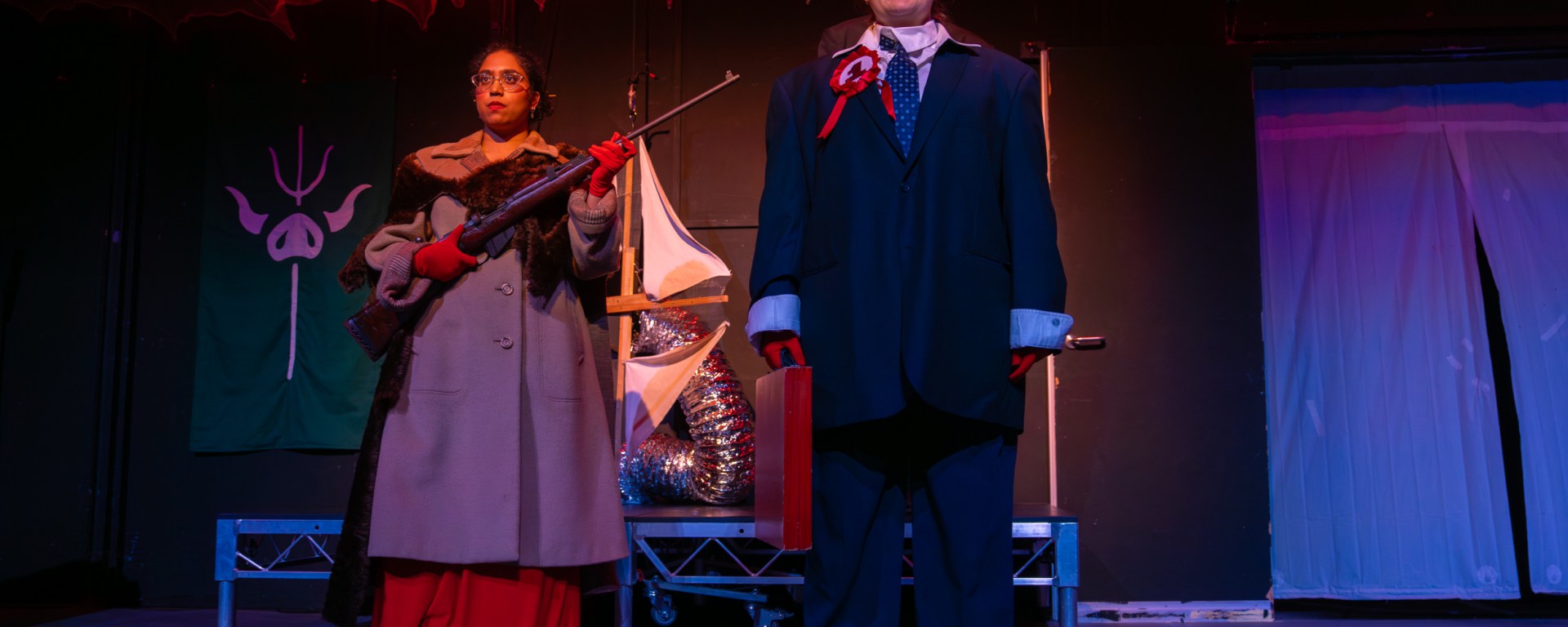
REVIEWED BY ISLA TEAGUE
EDITED BY CHARLOTTE FRASER
“The animals in the play all look like us. The humans don’t look at all like us” (Tatty Hennessy). Going into Monash Uni Student Theatre’s (MUST) production of Animal Farm, the quote projected on the back wall originally confused me. From my previous understanding of George Orwell’s novella, “four legs good, two legs bad” was one of the central motivations of the animals, so how could that be represented by human (and obviously bipedal) actors? However, the performance of Tatty Hennessy’s adaptation, directed by Max Pickering with assistance from Marcus Leder, used the embodiment of animals by humans to create nuance and irony, allowing the audience to further reflect on the parallels between fiction and reality, savagery and dignity. Pickering and Leder’s considered choices of set, costumes, spacing and acting developed a terrifyingly insidious performance that understood the powerful warning of tyranny and propaganda that Animal Farm represents in today’s political climate.
Tatty Hennessy’s adaptation stays mostly faithful to the original novella, where a group of animals living on Manor Farm are suffering under a totalitarian farmer Mr Jones. When their leader Old Major dies, the animals decide to overthrow this hierarchy and run the farm themselves, aptly renaming it ‘Animal Farm’. However, as the play progresses, it becomes clear that “all animals are equal, but some animals are more equal than others”, as the original tyrannical hierarchy is reestablished without human influence.
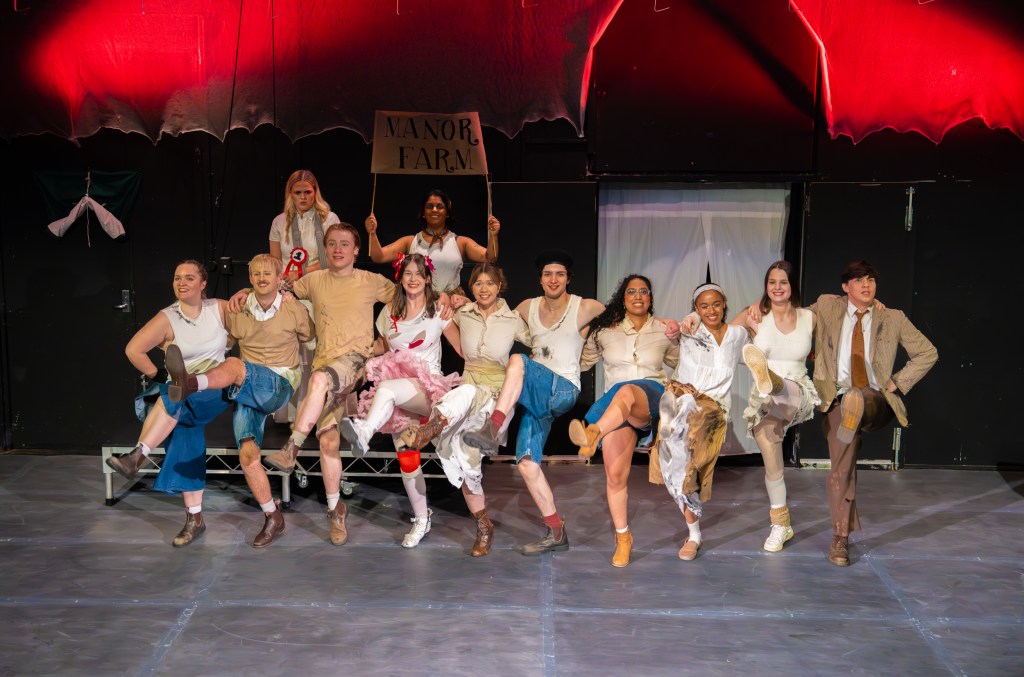
The simplicity of this performance is its success as it doesn’t fall into the trap of spelling out the allusions for the audience and instead allows them to analyse the play for their own understanding. This is enabled through the MUST Space, a black box style theatre, that created a claustrophobic feeling and involved us in the oppression. The masterful use of the simplistic set, designed by Penny McNeill, created moments of dramatic irony and foreshadowing due to their multi-purpose usage. Notably a white, fridge-like box was dually used as a coffin for the procession after Major’s death, which allowed the audience to foresee a later character’s demise in that same box. Similarly, the use of plastic white curtains shielded the door onstage, reminiscent of a butcher which did not bode well for the animal characters. In addition to this exit, there were two others, one in the middle of the stage and two on either side of the audience, enveloping us in the story and making us almost complicit in the action onstage. The lighting (designed by Caitlin Begg) and sound (by Alex Aidt) created a fearful and tense atmosphere as the characters showed their animalistic side by tearing apart the scarecrow representing of Mr Jones, continuing to heighten the stakes of the revolution.
Interestingly, despite an early death, Old Major (Lucy Fraser) almost never leaves the stage. Dressed in ghostly white, she haunts the entirety of the play by manipulating the set and shadowing the new leader Napoleon, continuing to influence the narrative. A bold choice by Pickering that I felt was, at times, distracting from the ongoing plot, however it created poignant parallels through the relationship to Napoleon and his original motivations, that had since become corrupted.
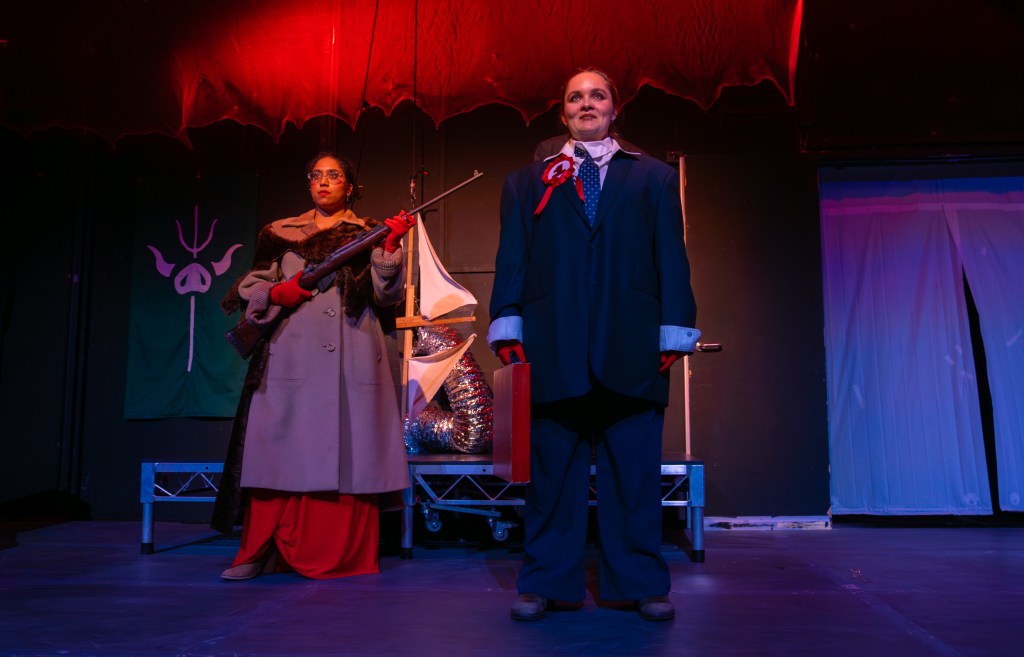
Pickering and Leder worked to relate Animal Farm to the very relevant issues in our modern society, evident in the use of multimedia and contemporary allusions. The seven commandments that outline the rules of Animal Farm are projected onto the back wall, relating the issues of tyranny, violence and propaganda closer to a modern audience’s experience. A stage with a microphone, a flag hanging behind it and anthemic music unsettlingly reminded me of political rallies in the United States. As actors spoke to the accepting – or, perhaps, captive – audience these allusions intensified the feeling of complicity in the events. The subtle costuming designed by Sachiko Metzner in the first act works in favour of this intention, as the use of white and brown street clothes demonstrates the starting point of innocence, humanity and uniformity. However, in the second act, I felt the costuming of the pigs worked against the relation to contemporary tyrannical power structures by dressing them in suits and dresses that resembled stereotypical gangster clothing. While comedic, I felt this drew away from the understanding of the pigs as a dictatorship and instead they more closely related to street crime rather than totalitarian regimes. Nevertheless, political unrest was continually established through the second act as reality begins to deteriorate and the play becomes more abstract. I thoroughly enjoyed the complexity of the scenes as the audience begin to be less sure of what is propaganda and what is truth. A quick flash of early collaborator Snowball (Patrick Leong) in all white, the almost sarcastic yet visceral confession of Clara (Ruby Akinsanya) and the celebratory finale with confetti, glitter and wine created an intensely entertaining performance to decode.
What I felt enhanced the production immensely was the tactful use of humour despite the dark and oppressive tone, advancing the satire within the original novella. Moments of light-heartedness from Francesca King as Milo, a cheeky bird with a propensity for gossip, helped guide the audience’s understanding of the events but also reinforced the warning against falling for propaganda. Will Beechey was also unexpectedly hilarious in his exceptional performance as Squealer – the second-in-command who masterminded the pigs’ succession to dictatorship – his physical comedy and insidious smirks had a very quiet audience chuckling outright.
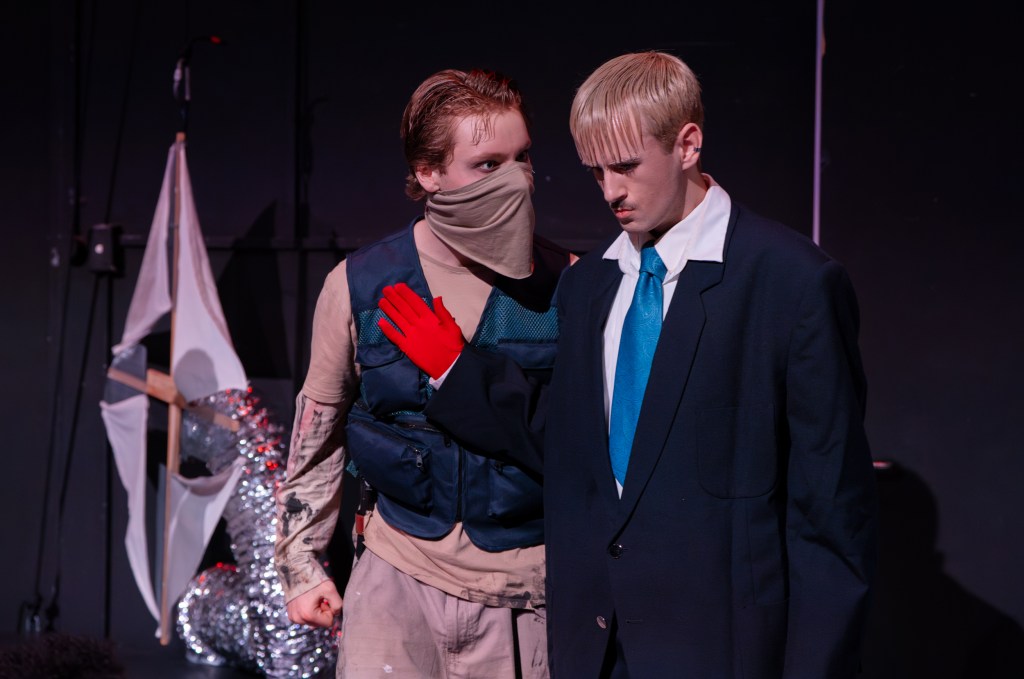
The ensemble had a high level of connection and collaboration which believably created a feeling of family and camaraderie, which was necessary to establish the trust the animals had in one another. A stand-out emotional performance from Jada-Li Crossey as Clover, a maternal and frustratingly sympathetic horse, enabled the story to feel meaningful to the audience and whose relationship with each member of the ensemble felt exceedingly real. The rock of this production was Nethuli Bandara as Boxer, her steadfast and hardworking nature coming through in her strong physicality and blind following. The leader, Napoleon, had an incredible character arc facilitated by Esmé Stripp’s convincing indecisiveness, pride and deception that painted a terrifying picture of a powerful yet immoral leader. The collaboration of the cast was seen in several palpitating action sequences, especially the ambush of the farmer Mr Jones, in which the timing, energy and emotion made the moment feel as important to the audience as it was to the animals.
The result of all these components was a strong and poignant production that forced the audience to reckon with instances of violence, tyranny and propaganda in our everyday lives, and convincingly used anthropomorphised animals to demonstrate the inhumanity of being distracted from what really matters.
Animal Farm was presented by MUST at the MUST Space Monash University 14 – 23 May 2026.
ISLA TEAGUE (they/them) is a dancer and performing artist from Melbourne/Naarm, participating in both community and university theatre scenes. Currently studying a Bachelor of Arts (Criminology) at University of Melbourne, they are in their first year of reviewing for The Dialog.
CHARLOTTE FRASER (she/her) is a writer, performer and student editor based in Melbourne. She holds a BA in English and Theatre Studies and is currently completing her Masters degree at the University of Melbourne. Charlotte is also the 2026 Dialog Editor.
The Dialog is supported by Union House Theatre

