
REVIEWED BY KIERA EDELSTEIN
EDITED BY MYA HELOU
The thing about the Scottish Play is that everyone has read it, seen it, done it and is probably even a little bit over it. It is hard to understand the pervasive nature of such a monolithic play. For many, the lines of Macbeth have subconsciously seeped into our collective lexicon, the themes entangled with our ideas of playwriting, the patterns inseparable from what we perceive good theatre to be. As such, the audience enters the theatre with expectations and preconceived standards.
But if the team behind MUSC’s Macbeth had any sense of inhibition as a consequence of the play’s history, it doesn’t show. Instead, they put on a rereading of the original text that was refreshing, bold and incredibly playful.
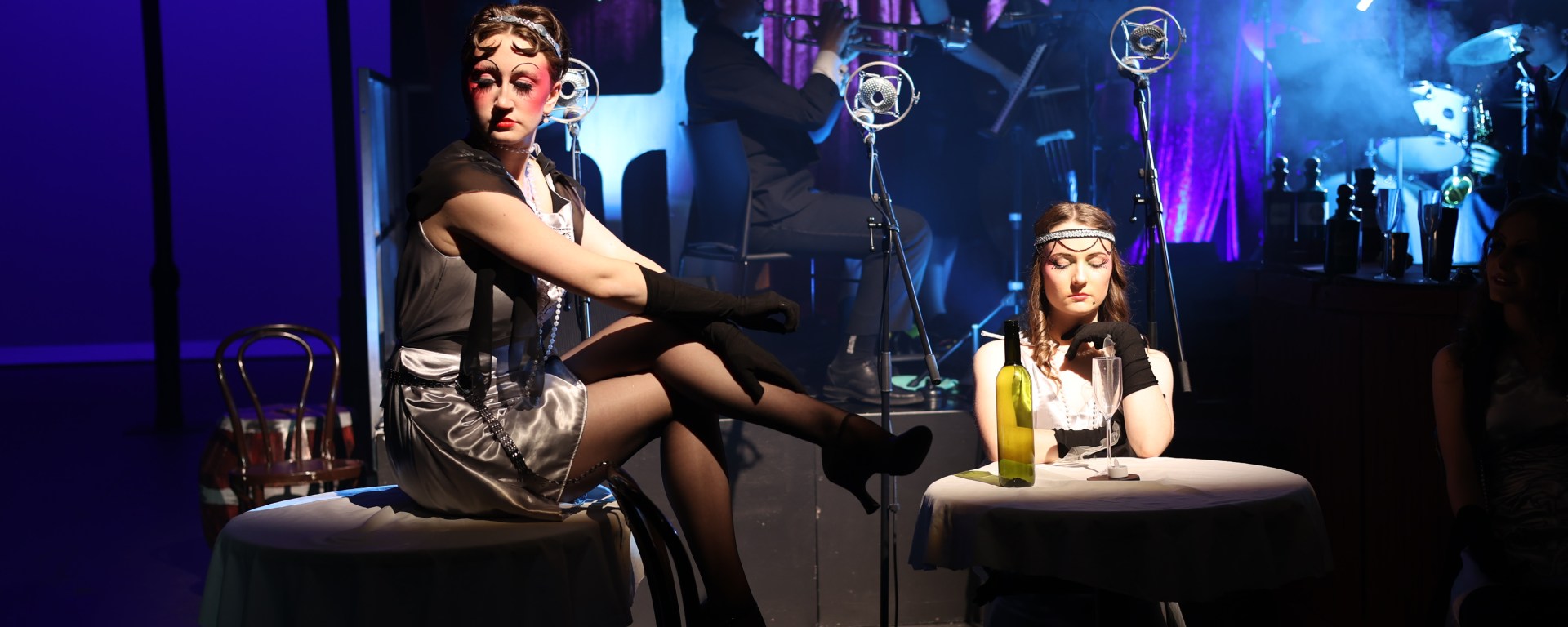
Macbeth follows the story of a lowly man as he kills his way up echelons of power, accompanied by his calculating wife and willed by intervening spirits in the form of three gnarly and conniving witches. Unable to face the overwhelming guilt and strain of his power, Macbeth sees a man fall from grace in the climb towards it. In this reimaging, the setting is fresh; a New York Prohibition Era underground bar, where the door is passworded, the dresses are short and the band swings on till later than you can stay up. The times are different, but many things remain the same. Macbeth, portrayed by Flynn Lhuede, begins as an unknown hitman in the teeming masses of the Mafia looking to rise above his ranks. His wife, Lady Macbeth – Giuila Magagna – a strategic orchestrator pushing to secure her position as Mob Queen.
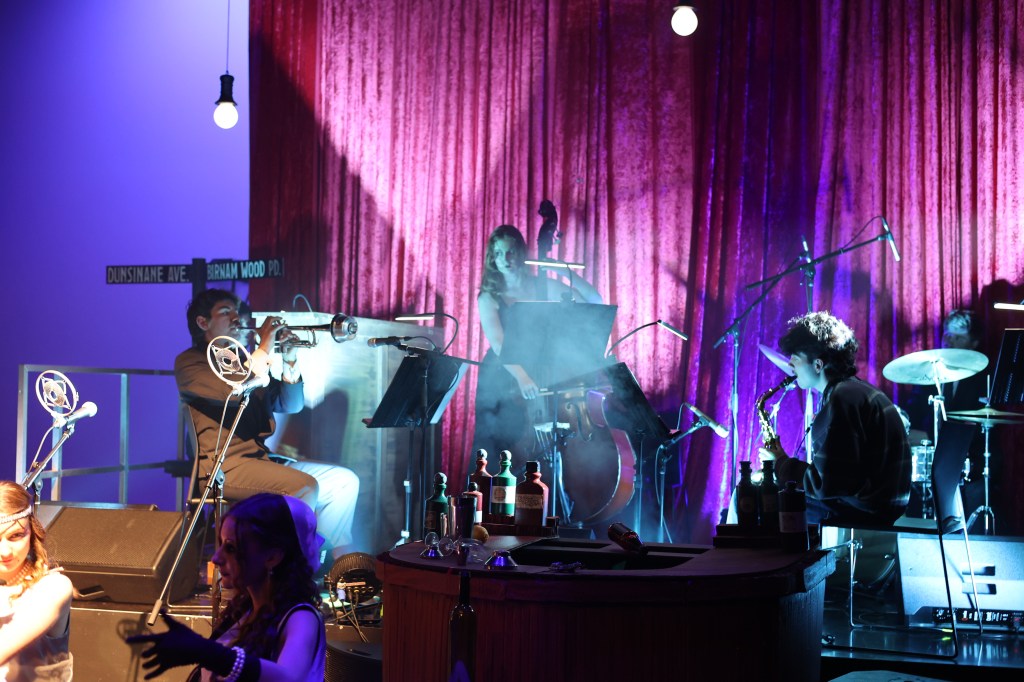
Everything about the production design completely met the brief for creating the world of ‘The Heath.’ Mystique and intrigue were forwarded by the rich tones of Gina Ramsay and Grace Stewart’s dynamic set, with assistance from Emily Botham. Plush velvet curtains, dark wooden accents (including a stunning grandfather clock) and an ominous glowing lamp set a musky veil over the Union Theatre.
Similarly spectacular results showed from Clara Verbeek and Lucinda Carr, with assistance from Sophia Verdnik, who appeared to have a ball costuming the show. The suit get ups were tight, sleek and pin-striped. A particular highlight was the Witches’ multiple costumes, including a truly beautiful wing piece for the 3rd witch. I was also mesmerised by the glowing pink makeup on the witches, sleek eyeliner on the ensemble, and especially the red-lidded interpretation of Seyton (played by Lu Burger). Applause goes to the playful work of Sevval Ergun and Ede Perkins for their efforts here.
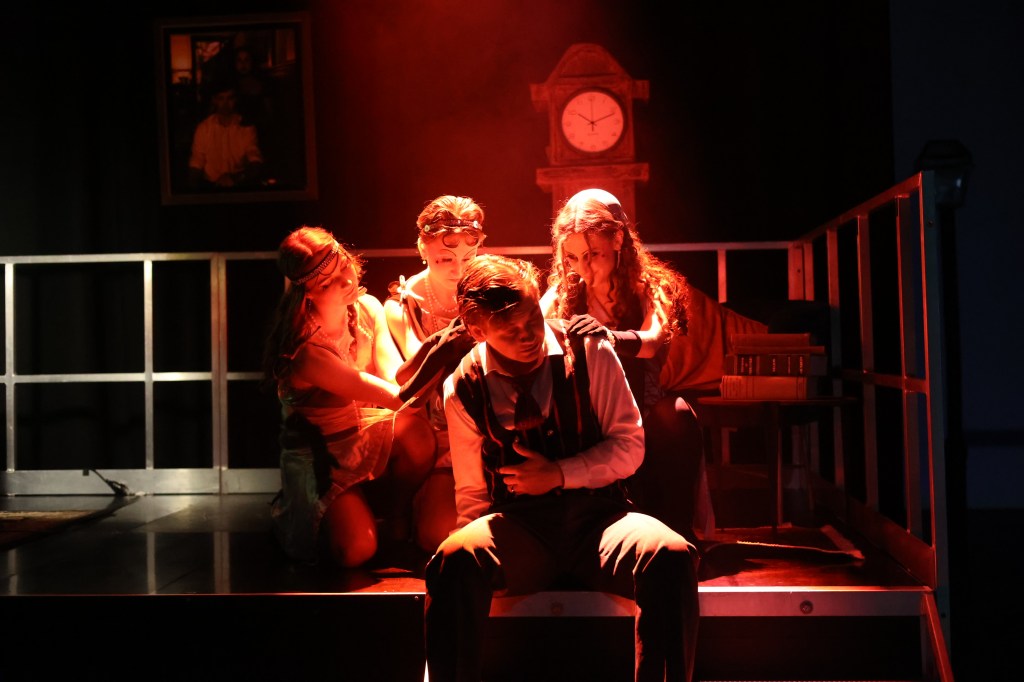
The show was further supported by a well-rounded and neatly executed sound programme from Yani Joannidis, which was especially helpful in creating spatial difference across the various settings. Credible company up in the tech box came from a lighting team headed by Charlie Campbell and Darcy Hersbach. The low glow of late evenings and red underground were a careful signal that something wicked was creeping just around the corner. A particularly stunning moment came with the three witches, who were underlit in front of the house curtains, which created angular shadows which loomed large both visually and conceptually.
Harry Vreugdenburg as Music Director provided an original score for what was a slick jazz quintet, which added a new layer of interest in the show. The music was a well-integrated addition and considerably improved the show’s atmosphere and pace. It of course was most impressive as accompaniment to the singing witches, whose familiar curses were transformed into the songs of sirens. Vreugdenburg’s choice to end the show with an eerie rendition of the vaudeville classic ‘Nobody Knows You When You’re Down and Out’ was a well-considered one, and I left the theatre with a sweet and sour taste in my mouth all at once.
The show was smoothly run – a testament to Tom Diggie’s stage management, even in spite of the many movements which occurred with only partial black-outs.
It is also worth noting that the show was supported by a visually exciting and cohesive marketing campaign, including a moody photoshoot from Saria Ratnam inside a real speakeasy-type bar.
In some places, I felt that the show was forwarded by this incredible design vision, and the conceptional implications were applied overtop of the recontextualization, rather than the other way around. I think the show could’ve explored this recontextualization a little bit further in which the new setting changed meaning in the text to enhance new themes. Macbeth is a challenging retell, but I think the themes and ideas are timeless and could be teased out in an infinite number of directions.
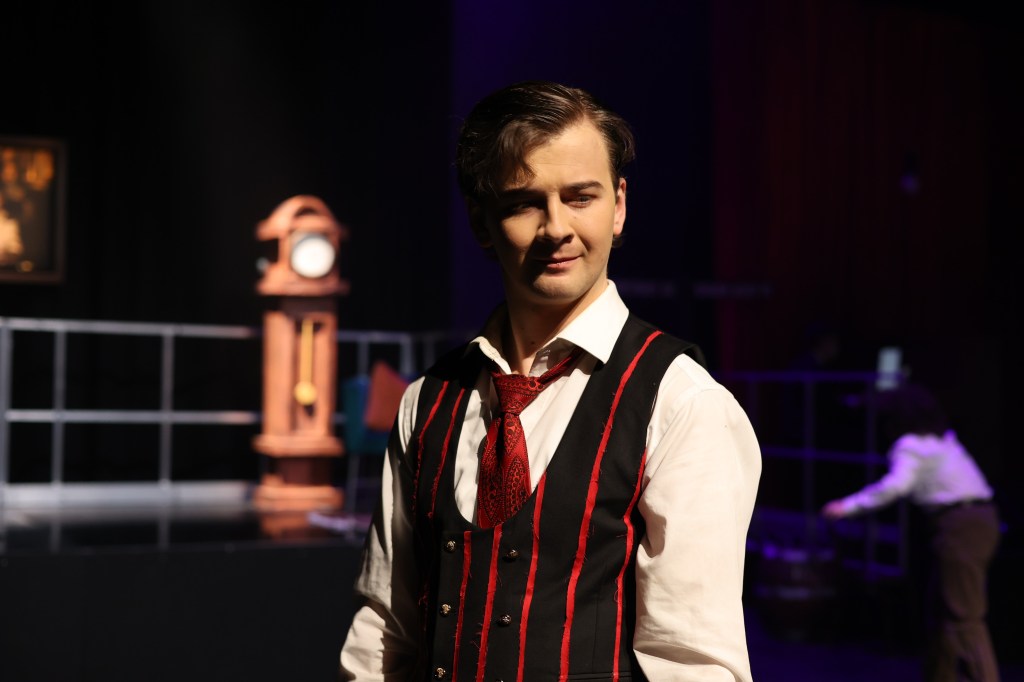
For example, power in the original work is countered by an inbred loyalty to the nation and the tradition of divine right absolutism – of course, the play was Shakespeare pandering to the favour of King James I. Nationalism, however, sits differently in the situation of a gang and perhaps could have been reinterpreted in this retelling. As Act II transitioned away from Macbeth’s twisted plays in vying for the top and towards those trying to oust him, I found that scenes driven by the undercurrent of sincerity to ‘protect the kingdom’ were least cohesive. Perhaps what was most disturbing was the implication with the death of Macbeth the system, which is one implicitly entangled with violence and crime, could possibly be restored to a healthy state
One such example was the stretched-out exchange between McDuff and Malcolm. While both Dylan Gough and Jake Mazzone accomplished heartfelt and humorous performances, in the context of the retelling, it was unclear the meaning and intention behind the inclusion of the scene for character, story and meaning. This diminished the play’s conclusion conceptually. Nonetheless, both Gough and Mazzone embraced the original text with vigour and booming stage presence.
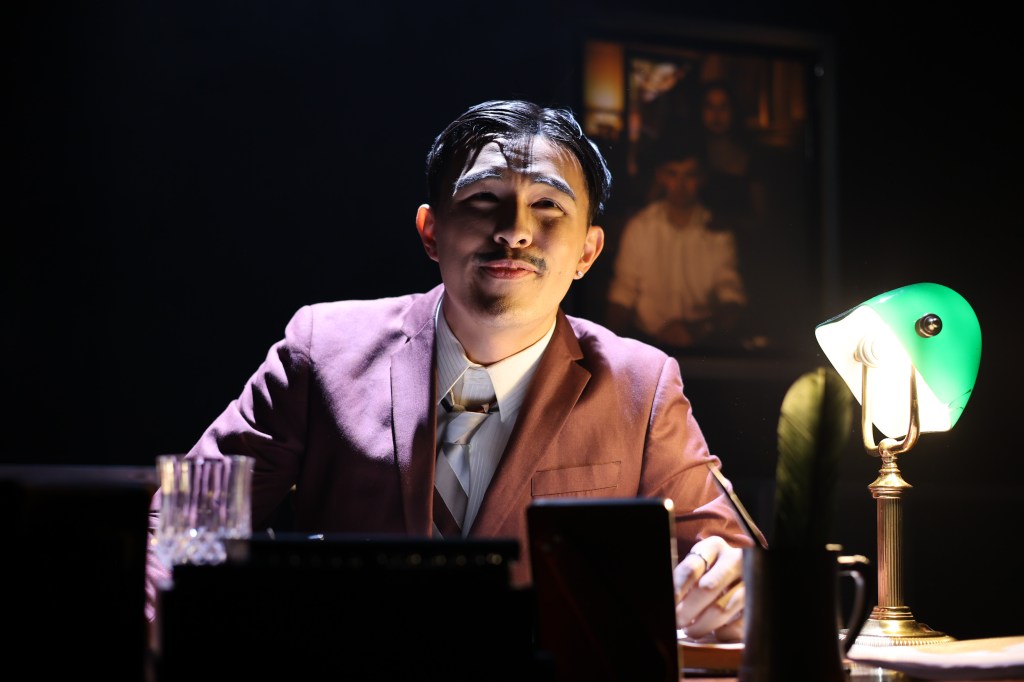
I felt that the show landed strongest when its director Alana Collins, with assistance from Maneka De Silva, leaned into the conceptual ideas of the recontextualisation. Notably, Collins made incredible use of play across the show, crafting inventive and joyful visual pictures, such as by bringing out the ensemble to enact events as they were being described. Heavy lifting in this department was completed by Eleanor Cooney and Diya Zheng as Ross and Angus respectively, whose physicality brought a lot of unexpected but appreciated joy for the audience.
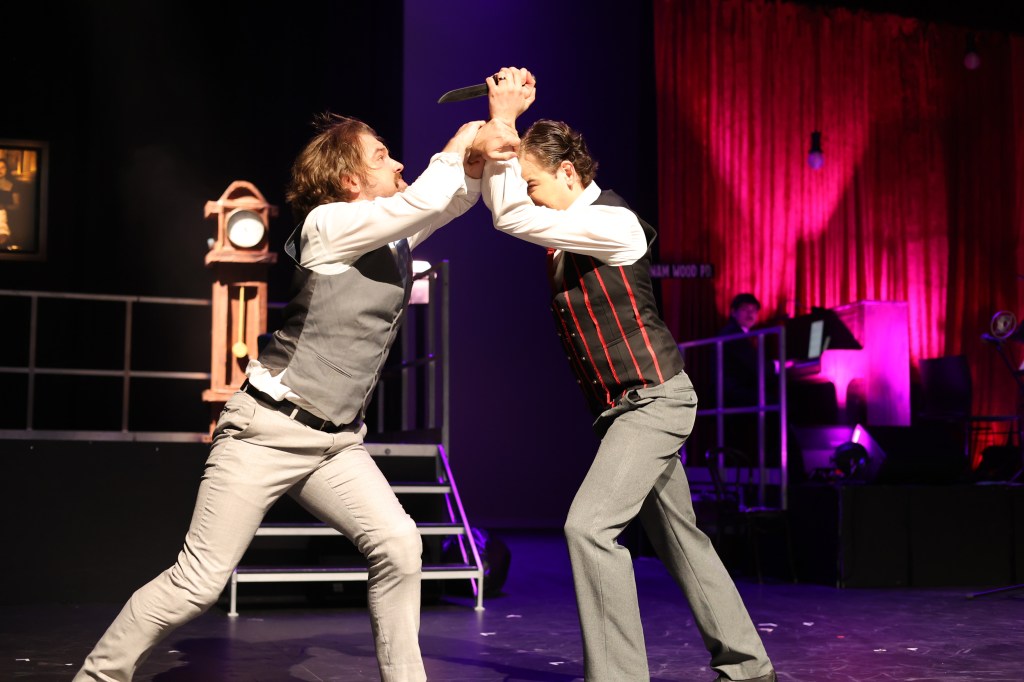
Generally, the violence was exceptionally dealt with and amplified the traditional show, reimagining dislocated and formal sword fighting into hand-to-hand combat with dirty work and daggers. Zani Micallef’s choreography was consistently clean, satisfying and exciting, and absolutely climatic in the final battle scene. With a smooth, vibrant backing from Vreugdenburg’s band, it brought me back to the fight scene in ‘West Side Story’ in the best way. Truly recontextualization at its finest.
The introduction of the ‘Messenger’ as a single character was perhaps the most fantastic creation from the production team. Julian Kong in this role was a shock of light throughout the show, and the Messenger’s death, which was a complete calamity to the audience – accompanied by audible shrieks – was a harrowing symbol of Macbeth’s devolution into cruelty.
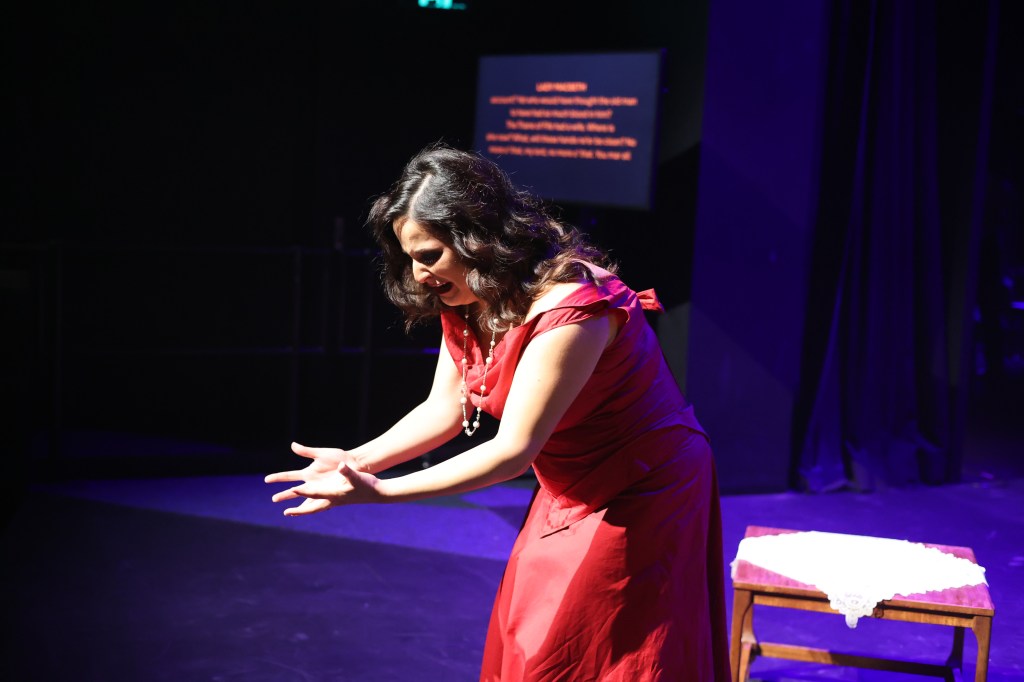
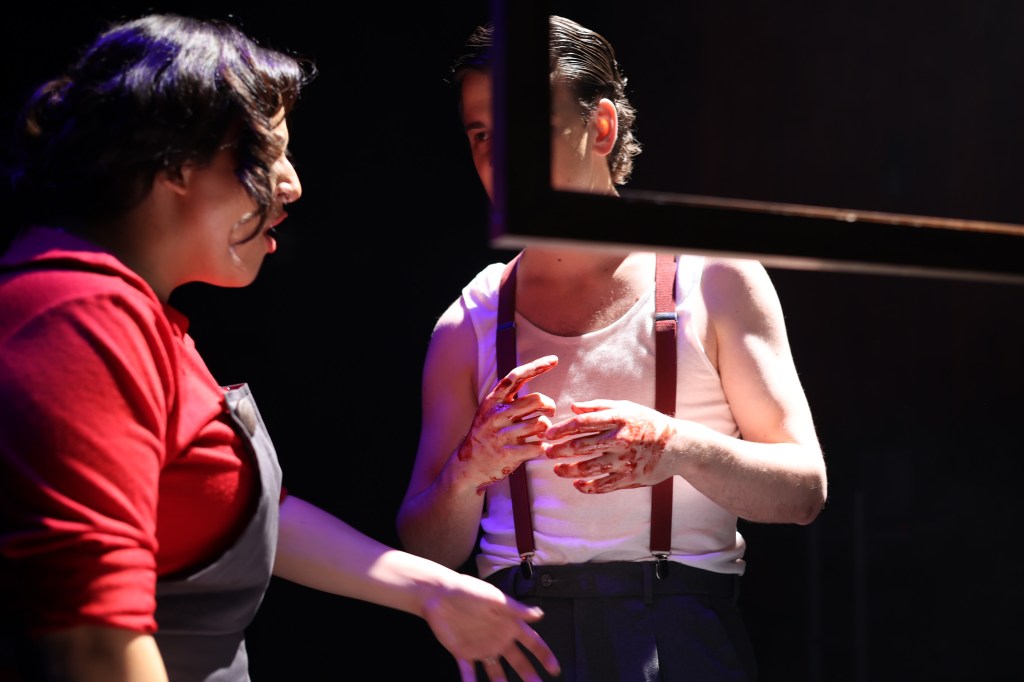
Something else that I felt this new reading really exposed was the role of gender in the play. Matt Ho as Banquo, along with Lheude and the triumvirate of power that was the Weird Sisters (Izzi Jones, Claire Steel and Lucy Sonnemann) provided a particularly interesting reading of Act 1 Scene III, where if felt as if the pair of men were teasing, dismissing and demeaning the witches, as if they were just pretty little things to get their hands on rather than listen too. This was something I have never seen tapped into quite as effectively. The gender play remained a dynamic undercurrent throughout, especially as the Witches, with their controlled physicality and chilling cackles, quickly revealed what happens when powerful women are overlooked. So too was this the purview of Magagna as Lady Macbeth, as she stepped into one of Shakespeare’s most interesting female characters. Magagna’s performance was nuanced, considered and quite commandingly feminine, and shone most in moments of tension and release. One such moment was her performance alongside Lhuede in the ‘bathroom,’ where husband and wife were framed by ingenious fly-in sink piece and united in their scarlet red hands. Compliments also to Alysa Kimpton on this front, who provided a compelling and memorable portrayal of Lady Macduff. I found it moving to watch Kimpton engage with Elise Curry as the Macduff Son in their heartfelt exchange about liars.
Ho across the play provided a standout performance of Banquo. His accent was strong, movements boyish and yet he was still quite convincingly fatherly when he needed to be. This lively performance made his murder scene, which was supported by enlivening chemistry and clean choreography from Jones, Steel and Sonnemann, all the more harrowing when the final gunshot rang out. Micheal Werden as Duncan was a strong pillar also, and his relaxed pacing, booming voice and professional physicality emitted a well-balanced mix of beloved and dominating. He commanded the stage space and simultaneously commanded sympathy for his character in his death.
Of course, Macbeth is nothing without its titular character, a burdensome role which Lhuede carried well. His knowledge of the text read particularly clearly, as he performed a considered and almost incidental fall into the trap of violence and loss. A highlight was his performance during the banquet scene, which with help from Magagna and the whole ensemble, truly felt as though I was witnessing one man’s complete dissent into insanity. His depiction of being caught up in the tide rather than driving the charge himself made for an impactful viewing, as Macbeth felt closer than ever to each and every one of us. I found this take to be nuanced and as refreshing as the production itself.
MUSC’s Macbeth production provided an insightful look into human nature and power, while simultaneously posting future potential for extending the boundaries of the classics through reimaging.
Macbeth was presented by Melbourne University Shakespeare Company 7 – 9 May, 2026
KIERA EDELSTEIN is a First Year Bachelor of Arts student who loves all things reading, writing and storytelling. She doesn’t know what her major is yet but has decided in the meantime to take part in as many parts of the student-theatre that she can.
MYA HELOU (they/them) is an English and Theatre Studies major whose love of theatre was fostered by Shakespeare and classical Greek tragedies. They will take every opportunity to discuss either.
The Dialog is supported by Union House Theatre

