
In conversation with Charlotte Fraser
Content Warning: discussions of sexual assault, gore and mental health struggles.
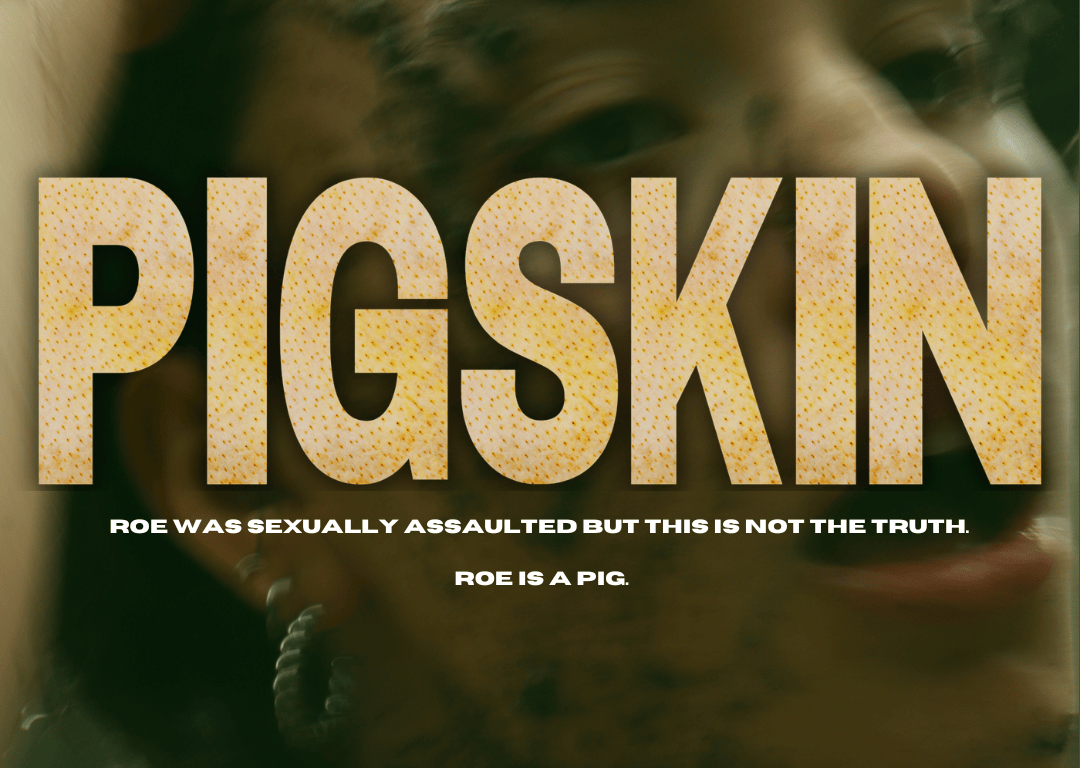
The annual Melbourne Fringe Festival is upon us! Emerging theatre makers are putting on all of their weird, innovative and original works. Lana Rosalea, the writer and performer behind PIGSKIN, sat down with me recently to discuss their work, how the show came to be, the importance of self-care in the arts and the rise of more non-traditional and devised work in the indie theatre scene.
PIGSKIN is playing at Bluestone Church Arts Space in Footscray 7 – 10 October.
Helplines are available at the bottom of this article.
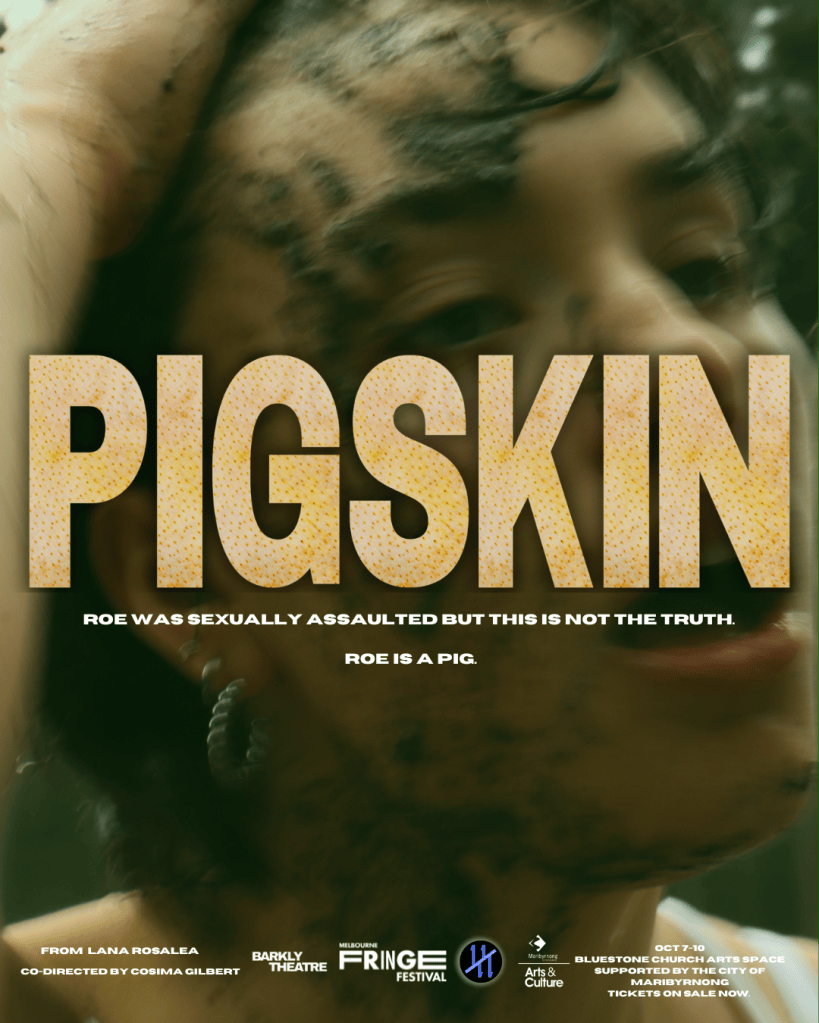
This isn’t the first time PIGSKIN has been performed; Lana and the team did a reading at the Malthouse earlier this year that received resoundingly positive reviews and have also taken it to Sydney. The show, centred around a character called ‘Roe’ who has experienced a sexual assault blends interactivity, elements of butoh (a Japanese body-mind movement/performance discipline) and somatic exercises.
In Lana’s words: “The show is about a character called Roe who turns into a rotting pig after a grey zone sexual assault. We were playing around a lot with the dramaturgy of dissociation because the show is made specifically for victim/survivors and so that dramaturgy makes sense a lot of the time.”
The show works with the body, mind and soul, having elements responding to and engaging with each. The body performs butoh, a dance that comes from within, reinterpreting it over and over. The soul, Lana articulates, recounts Roe’s story to the audience through the use of headphones. And finally, the mind, which gives somatic instructions to the audience – releases of the hands and jaw – keeps everyone grounded in their bodies and in the present.
It’s something I haven’t seen many theatre makers experiment with. Even when shows attempt to tackle intense content, this careful attention to how the audience will react physically rather than just emotionally, is a very thoughtful move.
Lana: Those instructions [are] kind of two-fold. What’s your autonomy within this whole situation? We’re questioning things like, what is the actual truth of this show? What is actually happening to Roe? What has actually happened after this event? And, also, how can you say no? Do you even want to be doing this or are you just doing it because you’re being told?
In my opinion, when theatre makers experiment with form there is an inherent risk of there being a dissonance between the form and content. But considering the heavy themes of this production, the attention it pays to the body and the self, feels incredibly fitting.
Given the intense themes, I’ve been impressed by how upfront and explicit the team has been in their marketing and content warnings. While there are differing opinions on the efficacy of content warnings, for issues like sexual assault and rape, I am of the opinion that it’s always better to flag it explicitly and let audiences decide if it is something they are comfortable seeing. Unfortunately, some shows I’ve seen haven’t been as scrupulous with their content warnings as they ought to be, likely wanting to capitalise on shock factor – a hint that the show itself may not be very well developed.
Charlotte: I think you guys have done a really good job with managing your content warnings and being very explicit about the themes of this production, which I know I really appreciate. I don’t know whether you’ve had this experience where you go to a show and things are not flagged very well. And it’s a tricky line to walk because you I don’t want to spoil what happens, but I think when you’ve got such an experimental form it’s not about the plot it’s about the full experience.
Lana: It’s about the catharsis of the show. We have an instruction at the very end which is “take a deep breath,” and somebody came up to me afterwards and said, “I was so grateful that that was there because I had forgotten to breathe, I totally forgot to breathe.” And that was the release, because watching [everything] happen it’s like ohmigod, ohmigod, ohmigod… it’s actually over now. It’s actually over now.
Just like how theatre can offer artists a catharsis, PIGSKIN offers its audience one too.
Charlotte: I saw on Instagram just now that your childhood toy [pig] – was his name Snout? – is making his theatrical debut.
Lana: The show’s set design is by Kate Carrington and it is incredible. We were talking a lot about bedrooms and how this feels like Roe is in ‘depression bedroom’ but we’re making it magical so we’re going to make it a pig pen.
No spoilers for the set design here but Lana was right in calling it magical, it certainly sounds like it. But the appearance of Lana’s new co-star, Snout, stemmed from Carrington suggesting that it could be nice to have the show end with Roe going to bed and hugging a small toy pig.
Lana: I think it’s quite nice because a lot of [the show is] about like slut-shaming, victim blaming, being called a pig because we’re too gluttonous to take up space that is reserved in the media for something worse, and without realising that things can happen on a spectrum.
Charlotte: I think there’s something… so innocent about that moment. Especially when you’ve gone through such intense stuff, having that moment where you come back to something that is just… from a simpler time. Being able to feel like a kid and just think ‘I’m just going to bed, and I’m tucked in with my teddy.’ I think that’s really cool spot to end.
After our wholesome reflections on childhood toys making appearances onstage, Lana and I discussed the resurgence of puppets in indie theatre at the moment. We both noted how we’re seeing an increasing number of theatre makers experimenting with different types of puppets, what they can do and what draws us to this particular form of ‘poor theatre’.
Despite how interesting this tangent was, I had to bring things back to the question that had been on my mind since reading the PIGSKIN media release.
Charlotte: Did you see The Odyssey? The pig scene? I thought that was the best scene in that entire film. The rest of the film wasn’t good, but that scene I was like, wow.
Lana: It was a great scene, horrible movie. Hated the movie.
Charlotte: It was terrible. But I thought that scene, I was like, this is exactly how I imagined it.
Lana: And it was all practical effects.
Charlotte: Yes! Insane… That’s the one thing I will give Christopher Nolan his flowers for, is that it’s all practical effects. It was just as gruesome and horrible to watch as I wanted it to be, because I really feel Circe in this moment of ‘who are all of these men who have shown up at my door demanding stuff?’
Lana: [PIGSKIN] also took a lot of inspiration from Sofia Isella. Songs like ‘Us and Pigs’ I got a lot of the inspiration from. … Pigs are actually insanely smart and yet they’re [considered] the most gruesome, sub-human… so I though that was like insane. And then seeing the duality of men being represented as pigs it’s just so interesting. And the police being pigs and rich people being pigs. The actual label [can be] entirely flipped on its head so that even the perpetrator or even an oppressor would be like, well, I’ve been called a pig.
Charlotte: Honestly, justice for pigs.
Lana: Justice for pigs!
Charlotte: What did they do? They didn’t do anything.
Lana: Save a pig, eat the rich.
Charlotte: I agree. It’s like that thing on TikTok where a girl will be doing her makeup and it says, ‘if you put lipstick on a pig, it’s still a pig’ and [they’re] literally gorgeous. So, where did the kind of pig thing come from or where did you kind of pull that from?
Lana: I was thinking about language a lot. Specifically, about how we call the police pigs and that it gives them a certain sense of really gross power. Misused power. And I was also thinking about like how… I go to quite a few protests and the people who go up to speak are always explaining things that happened to them and sometimes it makes me feel that I don’t belong there because something that bad didn’t happen to me. And so, I think that it was just the way that people say like, ‘but it’s not actually that bad’ or ‘is that really that?’ or things like that in terms of like, when classifying people as victim/survivors of sexual assault.
For Lana, the intricacies of language and the language we use to talk about power, victim/survivors and justice is a point of clear interest. Even details as small as, in the legal system, a jury determining that a perpetrator is ‘not guilty’ is not the same as them being found ‘innocent.’
Lana: The themes of the show are surrounding invalidating within the system and how people have been socialised to react in a specific way, and how the legal standard for sexual assault and rape in Australia is so insanely high especially when … ‘assumed consent’ is not a thing, it’s not a defence in Victoria. I truly do believe there’s no such thing as a grey zone sexual assault and just that the law is so far behind in that the criminal justice system is so far behind. But this has very much happened.
**
Charlotte: In terms of how the show came to be, what’s your process like? Do you write a script, or do you brainstorm ideas and devise it with a group of people or what’s that process like?
Lana: This script, and a lot of my scripts, they come out in a lot of really weird poetry first. This one specifically came out as really angry and [it was] like I was trying to prove myself. Then I got a mentor, Oliver Ayres – incredible artist – who focuses on access and telling autobiographical stories of queer people. He was like, ‘I don’t think you need to prove yourself; I don’t think that that’s the point of this play. Go back and revisit it.’ Over a few months we kind of like started getting up this script and, in chats with Cos [Cosima Gilbert, PIGSKIN co-producer and co-director] as well, it kind of snowballed into ‘okay this is the script, I think.’
After going off to train in butoh, Lana returned to the show and began to work with their movement director, Matias Nunez. Together, they focused on working out how Lana’s body moves as a performer, what could be ‘choreographed’ in a show like this and what’s the best way to go about that.
Lana: It’s been a really interesting process. And a very slow process and the more that we’ve [done] it, the more we’ve been like, ‘oh this is what needs to happen.’ I think that one of the really important parts of like making this show was that we wanted to keep me safe and Cos safe and our crew safe when listening and performing this show so many times. That text, one of the reasons why it’s in the headphones, is that it’s actually unsafe for me to say, just from an emotional standpoint, I do not have the capacity to say that every night.
It’s an important consideration. Theatre – autobiographical or not – hasn’t always been the best at paying attention to the mental and emotional toll that intense themes and text may have on performers. So it’s certainly refreshing to hear that the team behind this show are taking extra care of themselves and each other.
Lana: It’s been quite a fulfilling process just in the way that everyone wants to keep each other safe. And then, in terms of artist safety, [we realised] after the reading [that] people are going to come up to you and tell you things because you’ve just shared your whole entire soul with them and that was a very relatable experience and that is a very true thing that you’ve said. And they’re going to say truth back to you because they trust you. Which is where the ‘write a note to Roe’ thing came from. People [can] write a note and put it into the Roe puppet so that eventually, one day, I might read it when I feel like I’m okay to read it. And a psychologist to come in and be in the show and sit by ‘write a note to Roe’ and be [there] to talk. And [we worked on making] sure that it feels like a community, and it feels like you still trust us, even though there is like this tiny line of: you can’t talk to us. Don’t talk to us right after this show. So, I feel like those have been the two sides that we’ve been playing of devising and making this show and how to embed that access into this show.
Charlotte: I think it’s something people don’t talk about much in the theatre space is looking after yourself. It’s all well and good that theatre is cathartic and you can really use this space to work through stuff but it’s like… okay what about me? If I have to do this every day all the time, that’s really going to take a toll. I think, for me, I always compare it to [how in] the last show I was in I had to pick someone up and throw them over my shoulder. And I [decided], I’ve got 2 in me [daily]. Like picking this person up, throwing them over my shoulder and carrying them around the stage… I can’t do that 8 times in a rehearsal, right? I’m going to hurt myself. And I think the same concept applies to this, it’s like yeah this is really challenging material, I can’t do this every single day and just be fine. Do you think we’re seeing that kind of movement towards more artists taking care of themselves?
Lana: I’ve been mentored by somebody who has pioneered that. One of the things that Ollie does is that he does little access cards [where] every single audience member gets [a] helpline list and then also a little letter to them. I think that it’s still emerging and it’s still very new. Also, we live in this very shame-based, like specifically with confessional theatre and autobiographical theatre, we live in this culture that’s very shame-based and you have to go and greet the crowd, and you have to go and say these things to people. I think if you have the right producer and if you have the right people around you, then yeah absolutely they’re going to make sure that you’re taking care of yourself and that you’re not going to fall into this pit of having to please everyone.
**
Charlotte: I think we’re seeing a lot more of this kind of work that’s sort of devised in a more atypical way. Like it’s not as much write a script, perform the script anymore, I think that’s becoming less common. And I think we’re also seeing a lot of people really confronting difficult topics in innovative ways, and I wonder whether that maybe has something to do with having the rise of AI and technology being more intense now than ever, and creating art that is really human and honest and something that can’t be replicated through a machine… do you think that you agree with that or that’s something that you’ve noticed?
Lana: We have a tutor called Kate Sulan, she was like ‘I devise because you can only devise in the room, with the people that you’re with during the time that you have.’ And it is one of the most present things that you can do to create community. So, I absolutely agree that we’re moving there because we need it.
Charlotte: Sorry ChatGPT, but you could not write this show.
**
I expect that the theatre scene will be seeing a lot more of Lana and the team being PIGSKIN. Given the intensity and growing reliance on AI and technology, seeing a shift to more devised work like Lana’s gives me a little bot of hope for the theatre industry. The increase in attention paid to artist safety on an emotional and mental level is something I am glad to see. Yes, theatre is cathartic, but if we run ourselves into the ground, we won’t be able to perform our best and give audiences the release they’re looking for. I’m eager to see what comes next for PIGSKIN and Lana. If this conversation is anything to go by, I’m sure it’ll be fantastic.
HELPLINES:
1800RESPECT – 1800 737 732
Lifeline – 13 11 14
Full Stop Australia – 1800 385 578 or online
13YARN – 13 92 76
Beyond Blue – 1300 22 4636
VIC: Sexual Assault Crisis Line – 1800 806 292
ACT: Canberra Rape Crisis Centre – 02 6247 2525
NSW: NSW Sexual Violence Helpline – 1800 424 017 or online
QLD: Sexual Assault Helpline – 1800 010 120
NT: Sexual Assault Referral Centres online
SA: Yarrow Place Rape and Sexual Assault Service – 1800 817 421
WA: Sexual Assault Resource Centre – (08) 6458 1828 or 1800 199 888
CHARLOTTE FRASER (she/her) is a writer, performer and editor based in Melbourne. She holds a BA in English and Theatre Studies and is currently completing her Masters degree at the University of Melbourne. Charlotte is also the 2026 Dialog Editor.
The Dialog is supported by Union House Theatre

