
REVIEWED BY ZENA WANG
EDITED BY AZMY
Directed by Eckard Becker, EDGES forms part of VCA’s 2026 Master of Theatre (Directing) Graduate Season. Written by Benj Pasek and Justin Paul, the contemporary song cycle brings together stories of growing up, romance, identity and human connection. Across the evening, five performers move rapidly between different characters and relationships, returning to the same question: standing at the edge of adulthood, who do we want to become, and how ready are we to live with uncertainty?
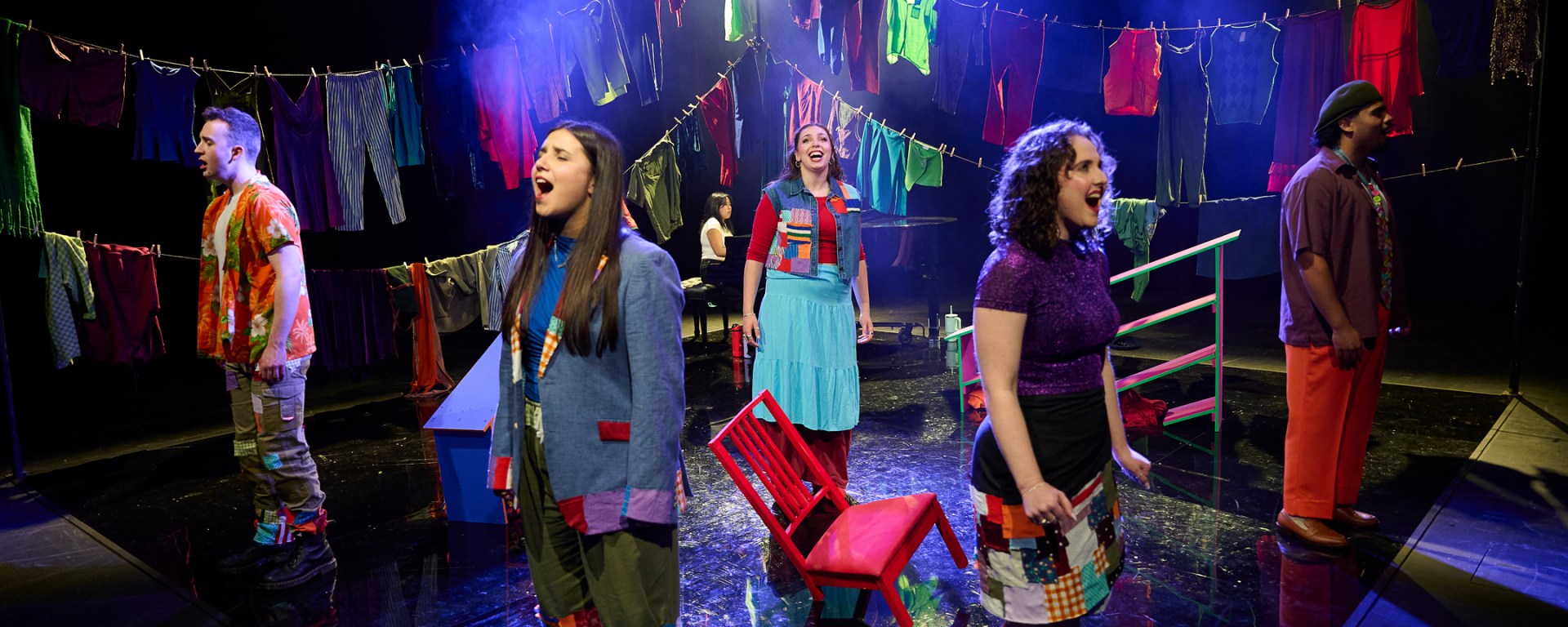
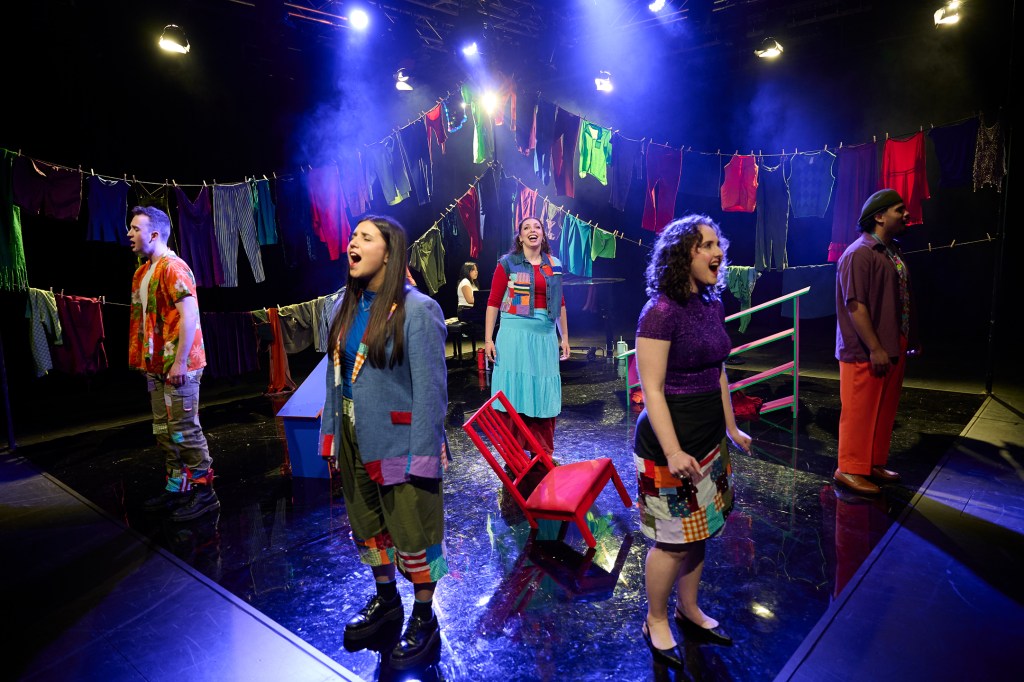
That sense of transition begins as soon as the audience enters. The production uses a corner stage, with viewers seated along two sides of the room. A pianist (Khanh Pham) is already playing softly while four performers move through the space and chat with audience members. The seating feels deliberately informal: classroom chairs, stools, wooden chairs and upholstered theatre seats of different heights and styles. The room carries the warmth of a rehearsal space or shared living area.
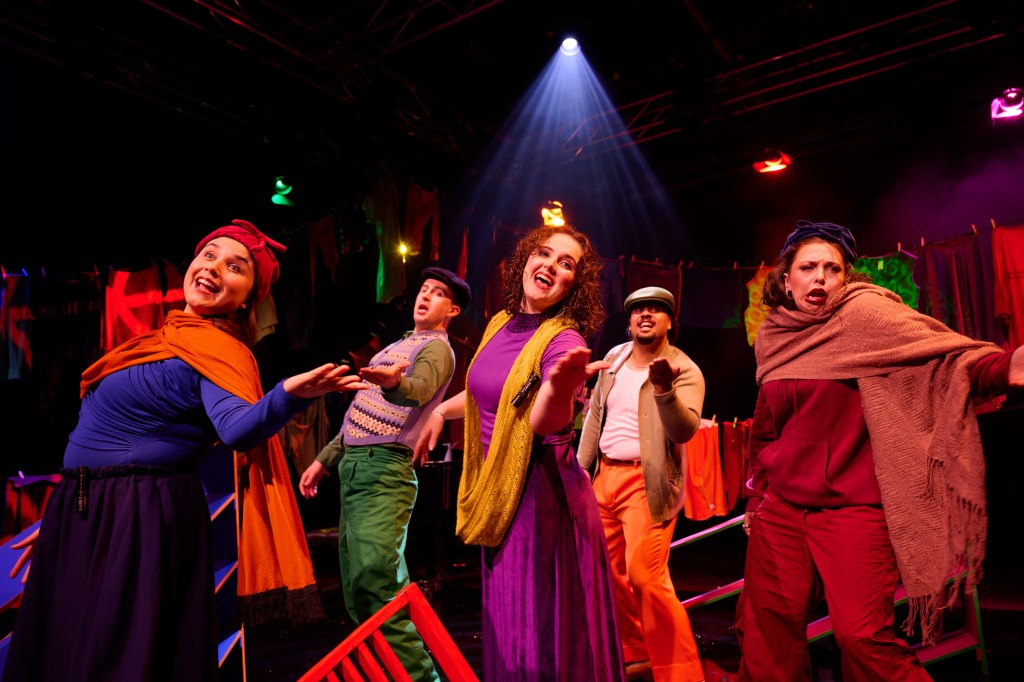
Tom Vulcan’s lighting design extends this atmosphere. A gentle blue wash covers the space while amber lights glow from behind the clotheslines at the back. Through a light haze, the room seems suspended between dusk and night. It reminded me of streetlights beginning to appear at twilight. Many of the characters occupy a similar transitional space, moving between childhood and adulthood, possibility and commitment, desire and certainty.
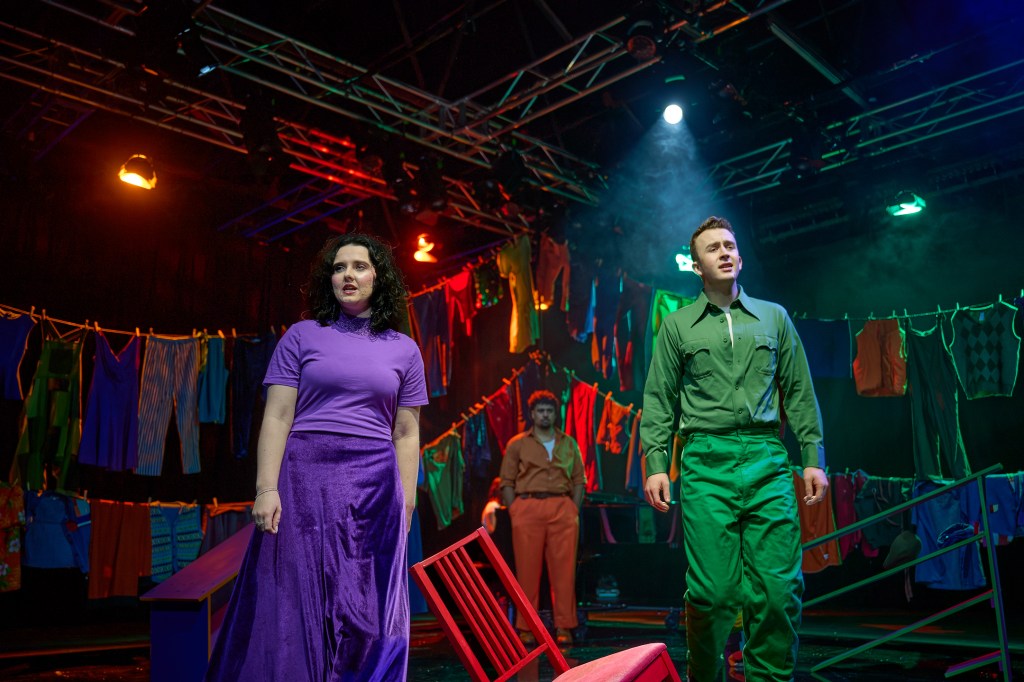
Jade Hibbert’s set and costume design, with Paige Landon as associate costume designer, gives this uncertainty a strong visual language. The performers begin in simple, relatively neutral silhouettes, with their individuality carried largely through saturated blocks of orange-red, green, blue and purple. The same palette appears in the bookshelves, chair and rows of clothing hanging behind the stage.
Several pieces of furniture appear to have been cut in half and placed on reflective vinyl flooring. Their fragments extend through reflection, while the performers and costumes are also doubled across the floor. I found the relationship between fragment, reflection and possible wholeness especially striking. Throughout EDGES, characters imagine different versions of themselves and test the meaning of their current lives. On this stage, almost everything seems to have a second version, slightly unstable and dependent on reflection.
Within this colourful world, the piano and Pham remain almost entirely black and white. As performers shift between characters and costumes, the piano stays visually constant, providing a visual anchor throughout the performance.
The opening number, ‘Become’, establishes the structure clearly. It begins with a single voice, then another, then another, as harmonies gradually accumulate. Georgina Scott eventually enters unexpectedly from the audience, completing the five-person ensemble. Later, ‘who am I?’ and ‘who do I want to become?’ begin as individual thoughts and gradually turn into a shared generational anxiety.
The clotheslines soon become an active part of the storytelling. Performers take down individual costume pieces and complete quick partial changes in full view of the audience. An apron, ribbon, knitwear or jacket can establish a new age, occupation or social identity within seconds. Across the evening, the performers seem to take a new possibility from the line, wear it briefly, then move into another life. They are continually trying on new identities and lives.
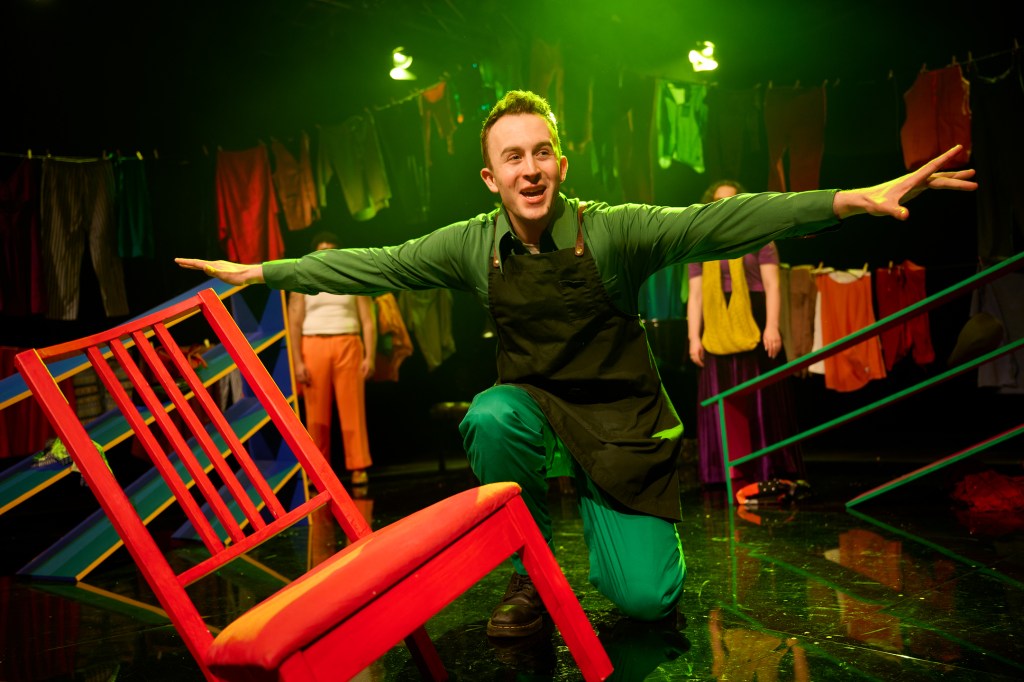
In ‘Boy with Dreams’, a young man (James Macaulay) needs little more than a black apron to become a pizza-shop worker with inventions, ambition and a future much larger than his present circumstances. The gap between the person he is now and the person he imagines he could become captures one of the central tensions of EDGES.
Growth takes another form in ‘Caitlyn and Haley’. Haley (Aana Watts) watches her older sister change as she begins dressing differently, socialising more and moving into adolescence. Caitlyn (Scott) sees Haley as childlike and socially withdrawn. Each sister feels the other has moved away from the relationship they once shared, yet both eventually arrive at the same wish: they want their sister back. The sequence frames growing up as a change in the people around us as well as in ourselves.
The romantic numbers were among the parts of the evening I found most affecting. EDGES presents love as a series of uncertain states: wanting to love someone, struggling to release a relationship, enjoying the possibility of romance, or becoming frightened when love begins to take a definite shape.
In ‘Lying There’, a young woman (Landon) lies beside her sleeping partner and confronts the fact that she cannot feel the love she wishes she could give him. The line ‘I wish I could love you’ stayed with me. Landon’s performance carries strong emotional clarity. Her elegant styling and the quiet night-time atmosphere make the scene feel gentle, while her high notes and vocal turns gradually expose the pressure underneath.
‘In Short’ takes heartbreak in a very different direction. A recently rejected man (Marangai Wainohu-Savage) turns his pain into rhythmic, exaggerated rage, repeatedly imagining terrible things happening to his former lover. The driving tempo, physical movement and repeated ‘No, no, no’ and ‘die, die, die’ give the number a volatile comic energy. For one brief moment he considers trying again, then immediately retreats into anger.
Placed beside each other, ‘Lying There’ and ‘In Short’ form an effective emotional mirror. One feels close to ‘I wish I loved you’; the other suggests ‘I wish I didn’t love you’. One character longs for a feeling she cannot produce, while another wants to escape one that refuses to disappear.
‘I’ve Gotta Run’ introduces another version of romantic uncertainty. Caitlyn (Scott) moves through several relationships that all seem promising until the future begins to look concrete. Then she questions herself and runs. Scott gives the sequence a vivid comic personality, while the repetition reveals a strong sense of hesitation. Watching it, I kept wondering whether Caitlyn is drawn to a particular person or to the experience of pursuit itself. She seems most comfortable while love remains the uncertainty and possibility for future.
In ‘Man of My Dreams’, Landon plays a young woman who is convinced that the unseen Jonathan, repeatedly referred to throughout the song, is her perfect partner, while the ensemble and audience quickly begin to understand the situation differently. Backing vocals, ballet movement, facial reactions and Landon’s determined optimism create escalating dramatic irony. The number also shows the ensemble’s comic timing and their ability to establish new characters through small changes in movement, voice and costume.
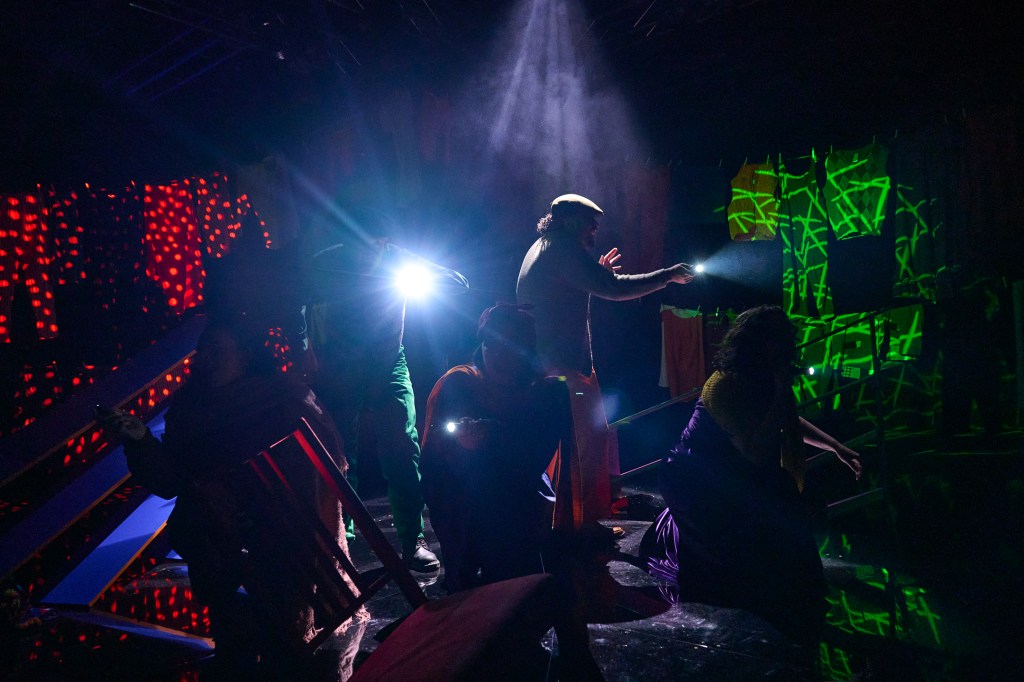
Alongside personal relationships, EDGES also turns towards broader questions of social connection. ‘Be My Friend’ approaches Facebook culture through upbeat, absurd humour. A character proudly counts hundreds of online friends and asks for one more. The repeated numbers are funny, yet the sequence carries a quiet loneliness. An enormous network still leaves open the question of intimacy.
That idea becomes sharper near the end in ‘Coasting’. The performers repeatedly move through ordinary small talk: ‘hi’, ‘how are you?’, ‘good’, ‘keep in touch’. Through repetition, the phrases begin to feel hollow. Each time the cycle begins again, fewer people take part. Five voices become four, then three, then two, until only one remains. The final person completes the greeting and receives no answer. A casual social exchange gradually turns into an image of isolation.
This thinning of the ensemble also echoes the beginning. In ‘Become’, voices enter one by one until five individuals form an ensemble. Near the end, that process reverses. Lovers, sisters, dreamers, workers and social-media personas gradually fall away, returning the production to its original questions: Who am I? Who do I want to become? Looking back, this circular structure became one of the elements I appreciated most. The performers repeatedly take a costume from the line, step into a temporary life, experience a relationship or possibility, then move on. The clothes begin to feel like a row of possible futures waiting to be worn.
By the end, the cut furniture, reflected halves, colour-coded costumes and hanging clothes all carry greater weight. Together they create an unfinished world for people who are still becoming. Becker’s EDGES leaves that process open. The final image stayed with me much like the twilight atmosphere at the beginning: one stage of life is already fading, another is starting to appear, and the direction of the next step remains uncertain.
EDGES: A Song Cycle played at the Martyn Myer Arena 20 – 21 August, 2026.
ZENA WANG is a student at the VCA with a strong interest in theatre and visual storytelling. She loves exploring the intersection of space, performance, and audience experience.
AZMY is a creative studying a Bachelor of Arts at UniMelb. This year, they are making theatre with The Werkz Ensemble and Cipta Theatre company!
The Dialog is supported by Union House Theatre

