
REVIEWED BY KIT WILLS
EDITED BY CHARLOTTE FRASER
Sometimes the upsetting truth about growing up alongside someone is that eventually you can grow apart. Thomas Dallimore and Tarquin O’Toole’s play GAS presented as part of La Mama’s Explorations 2026 explores the messiness and heartbreak of young adulthood, with simmering relationships that inevitably boil over.
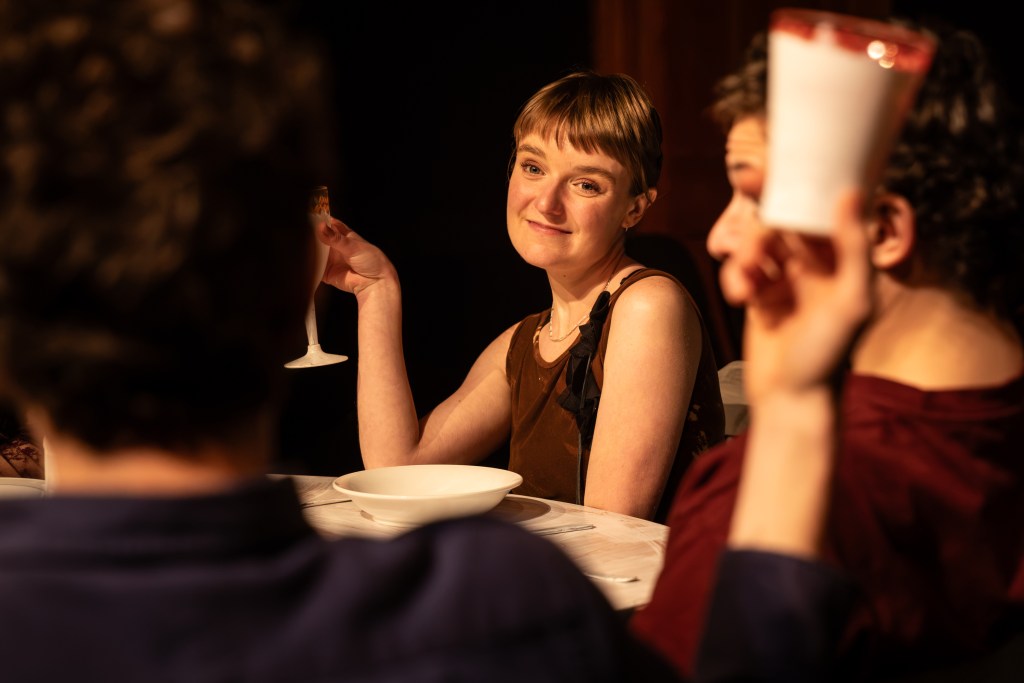
I’d never been to a play at La Mama before. Despite the freezing wind outside, the courtyard was welcoming with warm lights and young people rolling cigarettes, gossiping about ‘last Saturday night’. It reminded me of my own uni share house with its narrow, stone-paved Melbourne courtyard where conversations just like these have unfolded over the years. Carrying that feeling inside, I stepped into a theatre transformed into an intimate living and dining room (set and prop design by Thomas Dallimore). Director Tarquin O’Toole’s decision to stage the work in the round was remarkably effective, drawing the audience into the claustrophobic intimacy and emotional proximity that GAS demands.
As the play begins, a spotlight appears on Lulu (Lainey Drake) — the birthday girl, and the supposed woman of the hour? making a funny announcement into her phone. In stark contrast, Jules (Rosa Ablett-Johnstone) is begging into her phone for someone to pick up. From the opening scene to the end, Dallimore and O’Toole are wonderful at subtle exposition revealing the underlying tension of the play whilst also establishing relationship dynamics. Layering his voice over Drake’s and Ablett-Johnstone’s, Dallimore playing Alex, delivers a monologue in direct address to the audience, spinning around as he acknowledges each person in the audience. Dallimore’s monologue marks the first of three monologues his character Alex makes over the course of the show, effectively removing the audience from their ‘fly on the wall status’ and exposing them as external viewers of intimate, private moments. Though beautifully written, I did find these monologues a little jarring, as they interrupted the flow of the otherwise conversational dialogue. However, as the play progressed, the purpose of these monologues made increasingly more sense. GAS is constantly challenging its audience to consider moments from all angles, resisting the temptation to accept one person’s version of the truth without knowing the full story. Through this, the monologues work against the natural flow of the story in an interesting way, shaping the audience’s perspective on events so they too, by the end, feel manipulated by Alex.
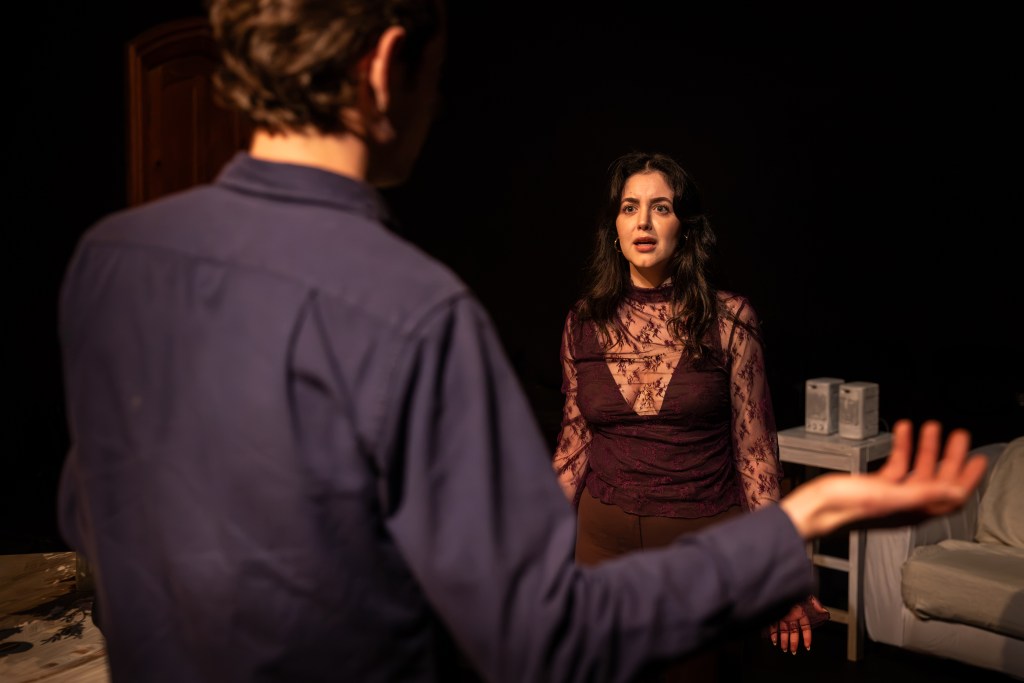
The sound and lighting (designed by Tarquin O’Toole) are used especially effectively during these monologues. A cool spotlight isolates Alex while a warm glow illuminates Jules, encouraging the audience to reconsider the events of the play. In one of the monologues, the constant buzzing of Alex’s phone, layered with electronic textures, further separates these moments from the rest of the play whilst also reflecting Alex’s internal conflict.
Staying with the theme of phone calls, a door onstage opens and in walks Rowan (Daniel Chisholm) asking for directions over the phone as he ‘breaks into’ Lulu’s home to drop off a present. From the instant Chisolm entered the living room, he beautifully captured the youthful, relaxed character of Rowan — a nice alleviation of tension from the opening scene. Dallimore and O’Toole blend the humour of GAS perfectly with conflict; the relatability of young adult friendships felt close to home, with all the actors working together with excellent chemistry to bring the play alive. As Lulu arrives home screaming in surprise when she finds Rowan lounging on the couch, there is a lovely moment between the two actors where they begin preparations for the party; a comfortable energy between Drake and Chisolm offer the audience a moment of reprieve before the tension returns. As Rowan tucks into a bag of chips and drinks his beer it felt very Wilde-like, and added to the realism and authenticity of the play. In fact, every time the characters drink, eat, or even smoke in Rowan’s case, real props are used. Dallimore’s decision to use real food and drink was excellent, as it furthered the audiences feelings of intrusion, as if they shouldn’t be there as these very ‘real’ people were living their lives.
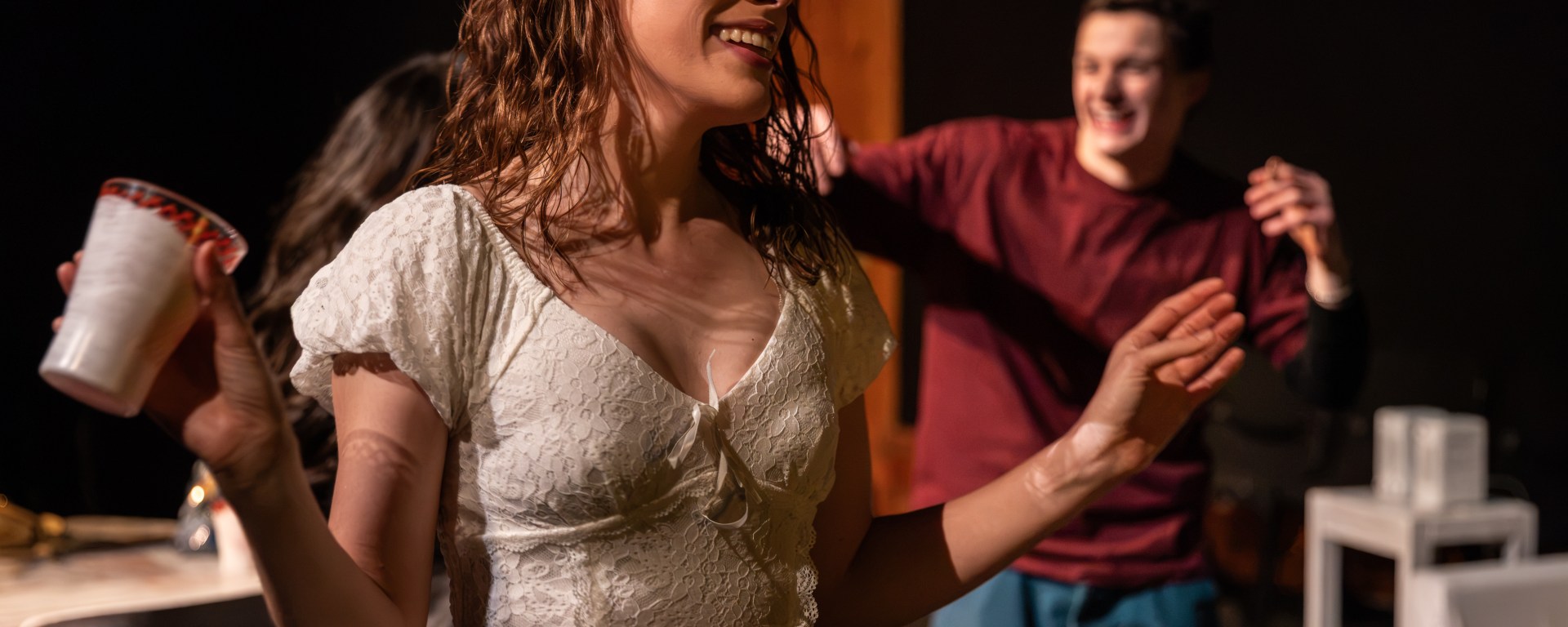
As the door opens again in walks Alex, the mood shifts as Lulu earnestly asks for one fun night to celebrate her birthday. Alex’s phone continues to buzz. The motif of the phone call worked especially well in keeping the audience invested. Its underlying current of deception made me eager to watch the truth emerge. Miri (Amber Louise-Louka) and Jules enter the space with delighted squeals of celebration — the party has all arrived! Miri and Rowan dance together, drinks are opened, and the party starts with a flurry of activity as a tense argument between Jules and Alex arises. Ablett-Johnstone and Dallimore expertly construct a relationship defined by restraint and control: where one pulls forward, the other back, when Jules raises her voice Alex seems to have it all under control; it’s hard to truly know who is telling the truth.
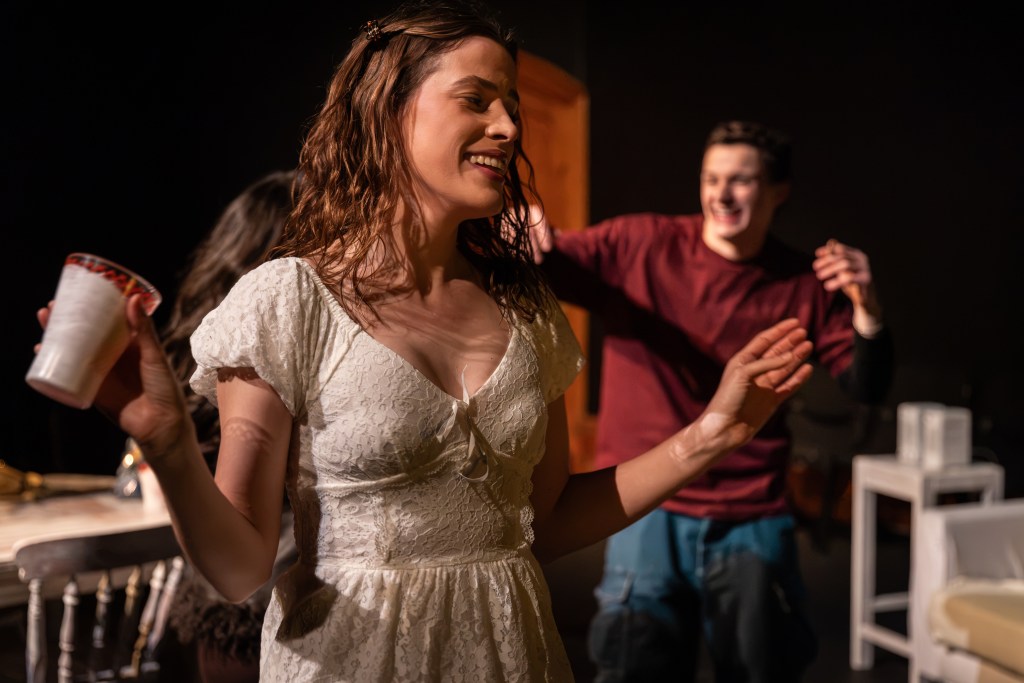
On the other hand, Louise-Louka and Chisolm perfectly contrast the intensity of Jules and Alex. Miri and Rowan have their own complicated relationship where Miri increasingly slips into the role of Rowan’s caretaker to combat his immaturity. In a standout moment of the play, Miri and Rowan sit outside the bathroom — the intimacy of their conversation, which happened to take place directly in front of me, felt so real and vulnerable that I felt as if I was intruding, like I should turn away and give them a private moment. Louise-Louka plays the sensible yet unsettled Miri with wonderful clarity. As Miri decides how to act and what to say — especially after Alex kisses her and downplays her relationship with Rowan, Louise-Louka conveys this internal conflict through her physicality.
GAS does a brilliant job at capturing the highs and lows of young adulthood. Between the yelling and the fighting, we also are given moments of quiet joy, and friendship. A drunken rendition of Billy Joel’s ‘Piano Man’ captured this perfectly. For a brief moment, these young people simply enjoy one another’s company before the inevitable eruption. As the truth of Alex’s actions comes to light Rowan punches him, and all these simmering emotions come to the surface. The chaos is uncomfortable, and wrought with all preceding choices, Dallimore and O’Toole build to this climax perfectly — the audience knows it is coming, and sit anxiously waiting for the Dies Irae to hit. Arguably the most comic part of the show comes when Lulu screams at her friends to shut up, telling them off Aussie-mum style before grabbing the wine and heading to bed. Drake has excellent comedic timing, especially in this moment when she frees the audience from the intensity with laughter. All Lulu wants is a night with her friends to celebrate her birthday, Drake captures these nuances by physicalising Lulu’s disappointment while providing a welcome comic counterpoint to the escalating conflict.
Ending with questions still hanging in the air, GAS culminates in a moment of quiet heartbreak. Jules remains beside Alex, despite everything the audience has witnessed, delivering a final monologue insisting that he will change. As she silently tidies the house and picks up the pieces left behind, the image becomes a powerful metaphor for the emotional labour she continues to shoulder. By refusing Jules any real escape, the play also refuses its audience the comfort of catharsis, leaving us instead with an aching sense of melancholy. Ablett-Johnstone delivers the closing monologue with extraordinary vulnerability, ensuring that GAS lingers long after the lights come up.
GAS played at La Mama as part of the La Mama Explorations 2026.
KIT WILLS (she/her) is a third year UniMelb Arts student majoring in English and Theatre studies. Driven by her passion for performance and writing Kit is excited to be a new reviewer for the Dialog.
CHARLOTTE FRASER (she/her) is a writer, performer and student editor based in Melbourne. She holds a BA in English and Theatre Studies and is currently completing her Masters degree at the University of Melbourne. Charlotte is also the 2026 Dialog Editor.
The Dialog is supported by Union House Theatre

