
REVIEWED BY GRACE DWYER
EDITED BY AZMY
Relative to last year’s mainstage four-show stacked cast extravaganza, UMMTA have taken this year’s Sitzprobe – a showcase of multiple student-written musicals – in a more intimate direction under presidents Nishka Varghese and Josh Drake. This is not to say that the 2026 Sitzprobe is in any way theatrically subdued, or the material any less gripping. Instead of the enormous Union House Theatre, we find ourselves in Trades Hall’s Fringe Ballroom. It’s a neat little theatre with a bar and disco ball, and tonight – closing night – the energy from the audience, band, and tech crew milling around is infectious. The pre-show soundtrack is good, people have drinks in hand, we take our seats and I realise it’s a full house tonight. Excellent.
As we wait for house lights to go down, two actors, dressed in Book of Mormon costumes, are doing some parodic crowd work – to the delight of the audience. When the show properly begins, the Mormons take to the raised stage, where a table is laid for dinner, and introduce themselves: Elder Smith (Jordan Genovese) and Elder White (Julian Kong). Before long, they’re joined by the rest of the cast, and sing the opening number to Paige Thompson’s Sugarbrain, a musical that grapples with a family falling apart, while effectively balancing the narrative’s shifting tonality and modality.
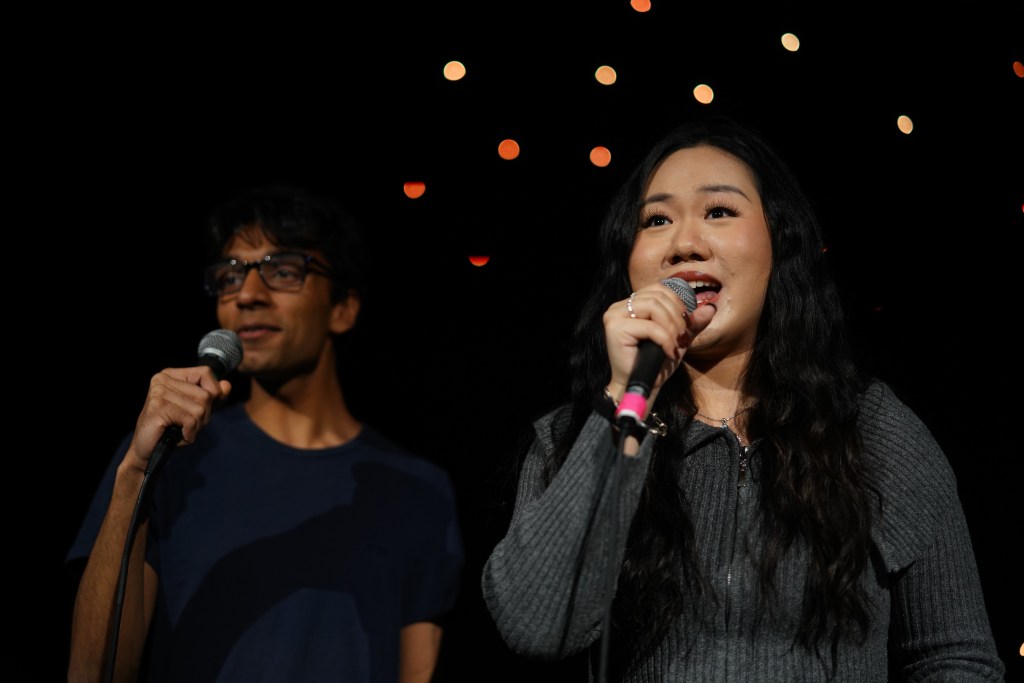
To briefly summarise: Freddi, played with a grounded relatability by Eliza Murdoch, returns home, where it becomes clear that tensions are running high and something is eating away at her family’s relationship. And this is before an onslaught of drunk confessions, uncomfortable conversations, and a devastating tragedy – all delivered with conviction by a talented cast. Highlights include a song by Freddi’s quiet sister, Sophie (Elizabeth Victoria Pardallis), whose gut-wrenching confessional gets riotous applause. Her mother, Julia (Amelia Lau) and brother Noah (Hugh Campbell) both possess a commanding stage presence that is especially strong when their contentious relationship is playing out. Zayd Chaudhry, as the father Mark, rounds out the cast with such empathy and anxiousness towards his family’s well-being that it makes my heart ache a bit.
Most members of the family are granted a monologue, or song, in which their inner turmoil spills out and paints a portrait of a family that tries to get along, but whose fundamentally conflicting personalities leads to fracture. It’s a classic, effectively confronting exploration that is slightly let down by the relative lack of narrative depth given to Julia. As she is, for all intents and purposes, our antagonist, it’s a shame she doesn’t receive as much nuance in her monologues or motivation as her family members – an exception to Thompson’s careful construction of the family’s shades of grey. And I also mean that literally: in perhaps one of my favourite creative decisions of the whole production, Head of Wardrobe and Production Assistant Grace Barnes has dressed the cast and set in brown, navy, grey and black. This grounded, dreary household is then doused with brilliant colour during musical numbers – and Technical Director Charlie Campbell’s lighting is fantastic throughout.
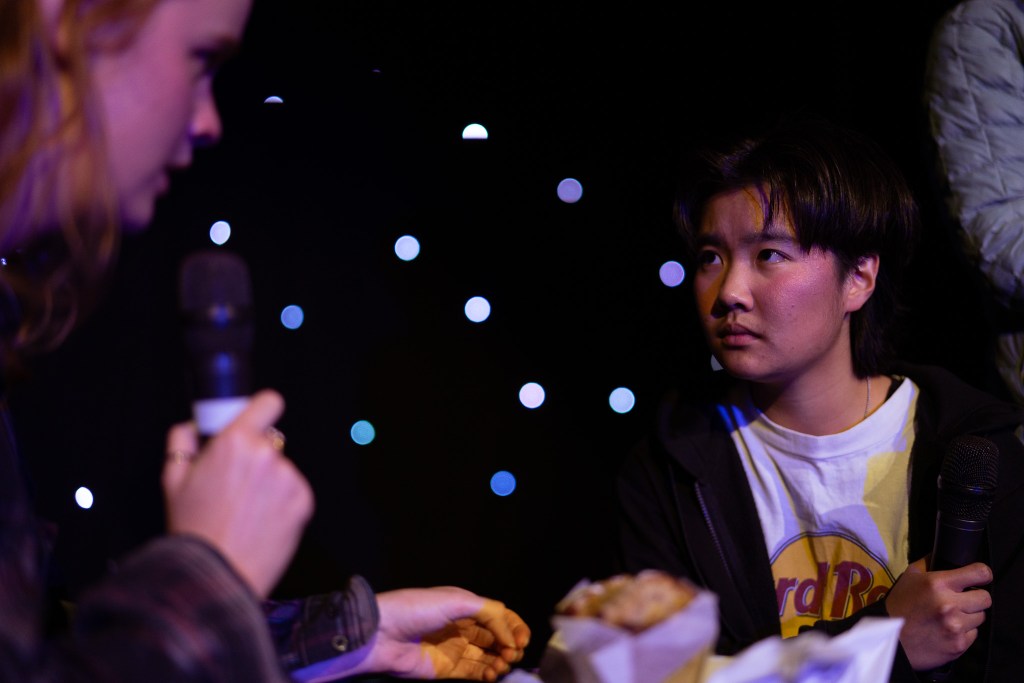
Thompson thrusts upon us a tonal whiplash between sombre realism and unadulterated comedy – the opening number features a Bo Burnham-esque use of sardonic voiceover, or her parodic Mormon characters. As such, we’re on the edge of our seats the whole way through, and breathe out a sigh of relief after Freddi helps Sophie find the courage to stand up to her parents and begin healing after a life-shattering tragedy.
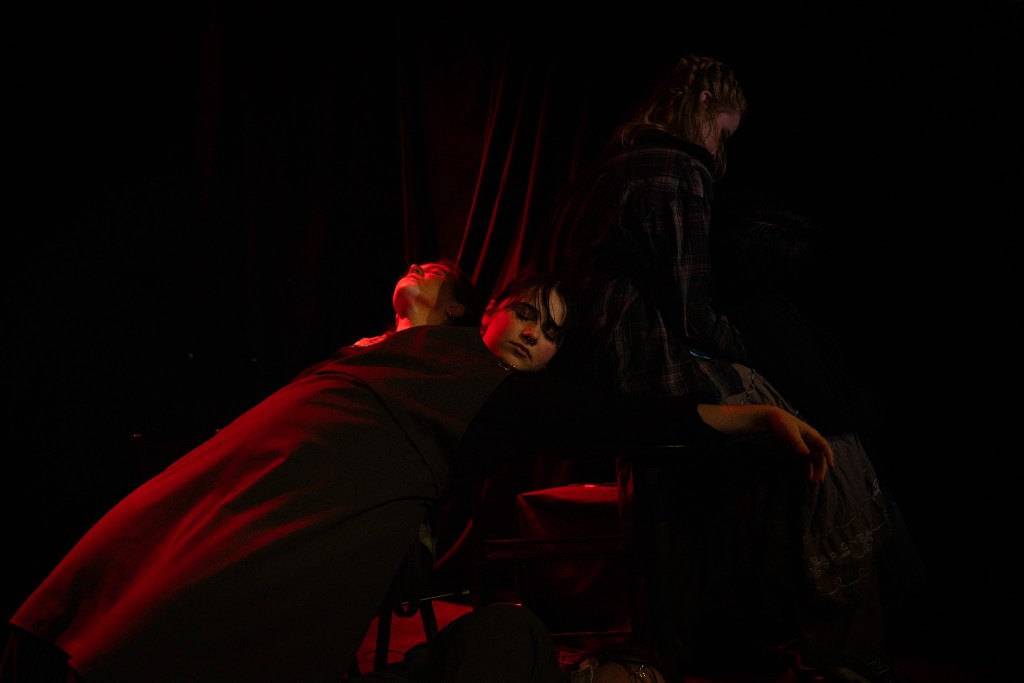
The house lights come back on, letting us chat through what we’ve just seen, and then we shift to The Hills We Die On – co-written by Archie and Brynn Jacka, with the former as director and the latter as composer, and assistant directed by Adrija Dutta. In a suburban cafe that could be just around the corner, a waitress, Ellie, (Pardallis) opens up and an onslaught of coffee orders are delivered in song. As if this wasn’t delightful enough, two young radicals take over the stage and deliver their manifesto bathed in red light. I whisper to my friend, “Oh my God, it’s like Les Mis in Brunswick.” Jokes aside, the co-writers have clearly tapped into the current sociopolitical climate. They are aware of the problem facing creatives today: how do we satirise our society when our current reality is already a caricature in itself? The Hills We Die On answers, I guess we don’t. We just show what’s actually happening.
Rose (Charleah Skye) and Ethan (Kong) are politically active teenagers, preparing to bomb the café as liberal politician Robert (Genovese) begins to do the rounds. The waitress, and the café’s patrons – Kyle (Chaudhry), John (Campbell) and Laura (Murdoch) – are initially just collateral damage, but begin to pull at the teenagers’ conscience. Both Skye and Kong adeptly capture the melancholy intersection between grown-up action and childish conviction. They are smart, driven and believe in what is right: Rose is well spoken and ambitious; Ethan is more obviously still a kid, but similarly enthusiastic about their shared goal of changing the world. The strength of their friendship is obvious. A less central, but still impactful relationship is captured between Ellie and Kyle, who both notice the bomb and attempt to look out for each other. Genovese embodies political corporate sleaziness – although, for such a realist setting, his dialogue is a little exaggeratedly evil.
Jacka’s script is perfectly crafted for the show’s short runtime, leaving enough time for the weight of characters’ decisions to sink in, without ever stalling the action. The fallout is bloody, catastrophic, and ultimately, heartbreaking. In a cacophony of differing reports, we see how the truth is often bent out of shape within a media frenzy – as only one outlet shares that the bomb was detonated, but the teenagers were shot by a policeman. To curb this pessimism, we end on a retroactive conversation between the teenagers, where we see them come to their peaceful decision. As the house lights come up, I can hear people crying.
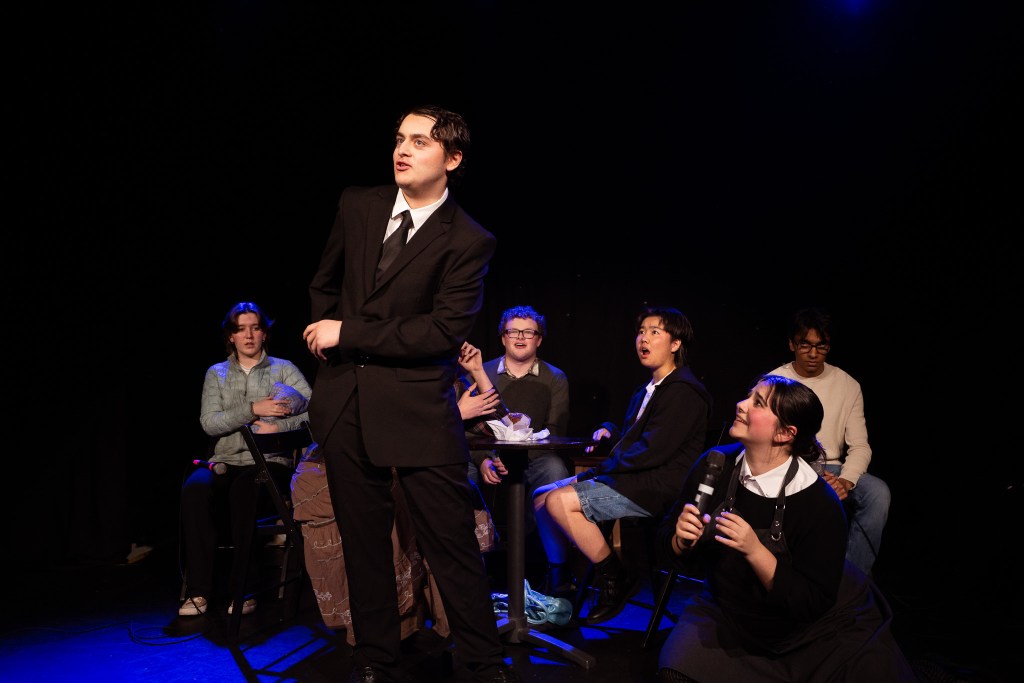
After these two heavy-hitters, we get to something lighter – and at this point we’re all ready for it. The aptly titled The Showmance Must Go On, written and directed by Tiaana Quest, is a major crowd pleaser, following the rollercoaster that is staging a community theatre musical in the span of a few weeks. Not only does its energetic opening number elicit a roaring laugh from the audience because of its hilarity, but because of the age-old truth – no one likes to laugh at theatre kids more than theatre kids themselves. From every auditionee’s wildly varying faith in their own self-worth to the awkward but well-intentioned “I’ve seen you in something before,” Quest nails the peculiarities of our sub-culture. All the actors are similarly having a blast – most have added glittery highlighter to their stage make up.
Showmance thrives off the sheer vibe it creates and the joy in watching this cast and crew handle their particular production’s romantic and theatrical tensions. It’s a predictably insular environment: director Kiwa (Chaudhry) and music-director-slash-understudy Eve (Lau) have feelings for each other, complicated by cast member Carlisle’s (Kong) feelings for Eve; soon-to-be-exes Damon (Campbell) and Nyx (Pardallis) break under Nyx’s new fondness for Amber (Skye); and Jake (Genovese) flamboyantly chews the scenery and is a crowd favourite. We conclude with the eternal truth that the show must go on, regardless of the cast drama, crushing stress and lack of costumes. It’s clear Quest has more to give here – whereas Sugarbrain and Hills are contained in their half an hour runtime, maintaining the tangled web of relationships in Showmance does sometimes overshadow the actual characters in the centre of it. As the show is already slated to go to Fringe, however, its place in Sitzprobe functions more as an enjoyable proof of concept that hints at how we’ll be able to enjoy the story in its entirety later this year.
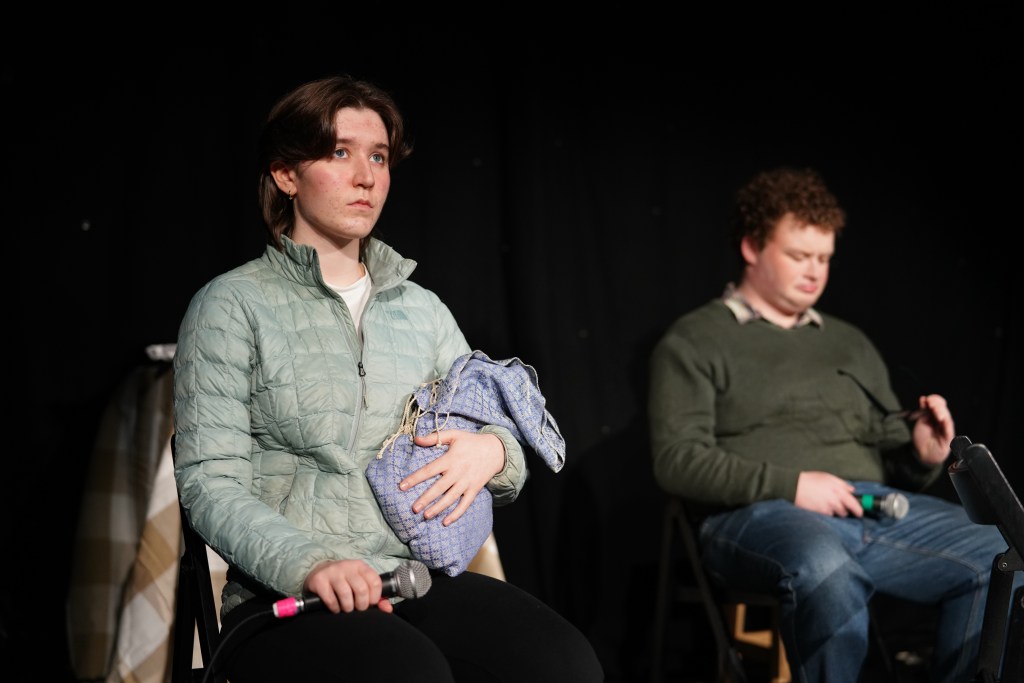
The entire cast, alongside their writers and directors, sing their finale – a banger from Showmance – and take their bows. The tech crew receive well deserved applause as well: Director Charlie Campbell, Assistant Josh Drake, and Set and Props Managers Eleni Gerostamoulos obviously work well under UMMTA’s collective artistic vision. Campbell’s lighting, as previously mentioned, is wonderful, culminating in spotlighting a disco ball during Amber and Nyx’s duet in Showmance that showers the room in pink sparkles. Sound design is seamless, especially commendable as the cast is switching between projection for dialogue and wired or cordless microphones for singing.
Speaking of singing, the cast’s harmonies are flawless under Vocal Director Claire Steel. I’m particularly blown away by a four-part acapella in Sugarbrain and the cluster of melodies in Showmance. All cast members hold their vocal ground spectacularly – especially Pardallis, Skye and Lau. The music is similarly fantastic, thanks to Musical Director/Producer/Keys player Harry Vreugdenburg, Music Assistant Enje Hazia, and each show’s talented composer. The rest of the band – Luca Rocco Cirillo on Bass, Ryder James Howell on Guitar and Jack Hadlow on Drums – flow between musical styles and numbers effortlessly, playing us out in style.
While smaller in size and runtime, the three shows we’re presented with during UMMTA’s 2026 Sitzprobe are thought-provoking, emotionally compelling, funny, and above all executed with a technical and creative cohesion that speaks to the talent of this production’s company.
UMMTA’s Sitzprobe played at the Fringe Ballroom June 16 – 18, 2026.
GRACE DWYER is currently completing her Honours in English and Theatre Studies. She fell in love with student theatre during her first year at college, playing a frog prince – and loves watching and talking about productions almost as much as she loved hopping around the stage.
AZMY is a creative studying a Bachelor of Arts at UniMelb. This year, they are making theatre with The Werkz Ensemble and Cipta Theatre company!
The Dialog is supported by Union House Theatre

