
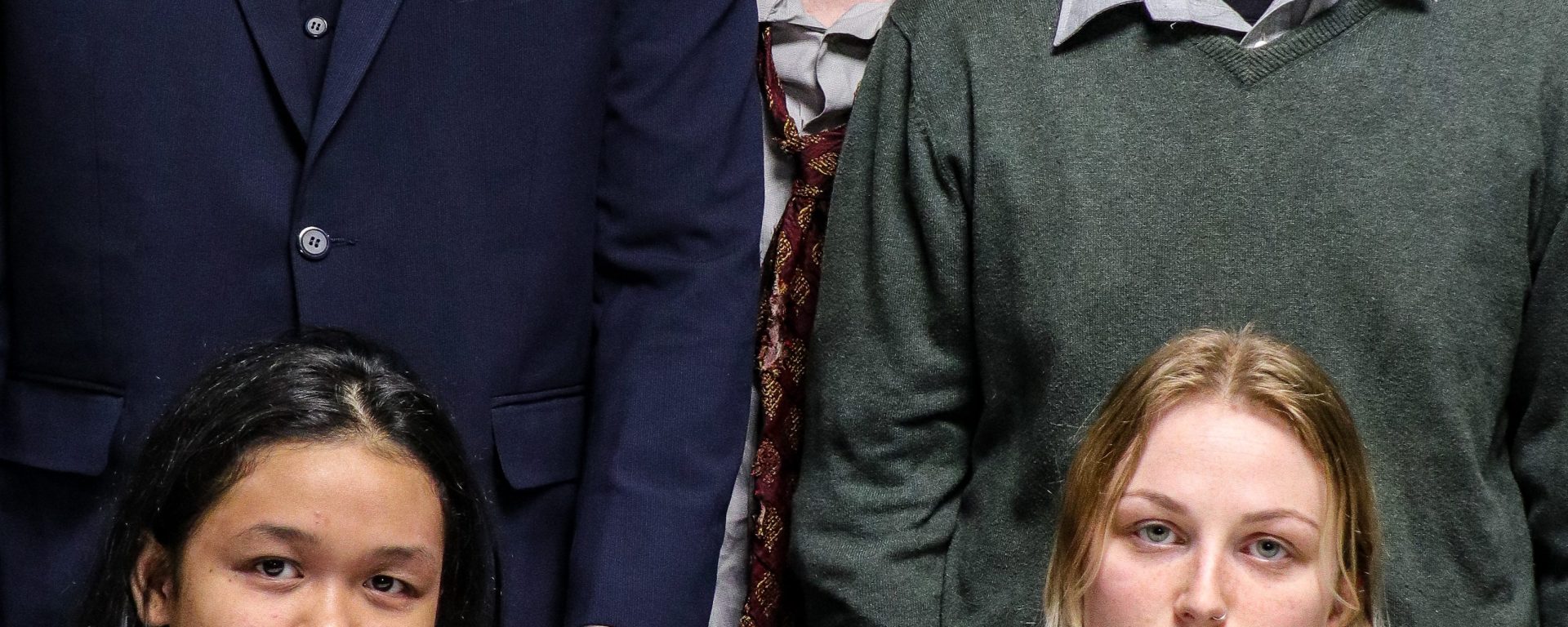
Cipta Theatre serves up a dramatic debut to die for.
Written by Michelle Yu, and edited by Hallie Vermeend.

As The Dialog returns from its holiday hiatus, we look forward to once again bringing you the freshest takes on UniMelb’s theatre scene. First up, a compelling read from our own Michelle Yu:
Content warnings: death, mentions of suicide, knife violence, partner disputes, parental dispute, antagonistic parent-child relationships
“The end is coming, and there’s nothing we can do.”
Cipta Theatre’s inaugural play, The Last Supper by Elizabeth Browne, closely traces the labyrinthine relationships between the introspective and misunderstood main character Judy, her husband and her parents. The show is set within the context of an impending nuclear explosion which will end their country’s existence, thus saving its citizens from the further degeneration of the world. The audience are served a table full of gut-wrenching relationship dynamics, betrayal and regret. The show also explores the complex subplots of artistic identity, parental disappointment, the inexorability of fate, the potential existence of higher powers, and superhuman forces. The show’s success is a credit to all cast and crew members at Cipta Theatre Company, and playwright Elizabeth Browne.
The Last Supper provokes deep thoughts about our tendency to be friendlier towards random strangers than our close friends and family, who have supported (and perhaps disappointed) us more than anyone else. For example, Judy’s high-performing, ‘creme-de-la creme, summa cum laude, corporate law sister’ gave away her life-saving aeroplane tickets to two homeless strangers, rather than her doting parents. Humorously, the video of her doing so went ‘viral’ in their apocalyptic world, which reflects the nonsensical and sometimes comedic internet trends we experience in real life.
The show also explores the complex and compelling relationship dynamic when one is dissatisfied with a partner’s efforts, and the feeling of always needing to supervise their level of effort and competence. In the play, this ranged from glaringly obvious things like everyone obsessing over Judy’s husband’s incompetent lawn mowing skills, to the tiniest details like Judy’s father stacking plates incorrectly before handing them to his wife (putting the plate on top of the cutlery, so the plates didn’t sit properly). These are the sorts of trivial domestic issues that pile up, drive us crazy, and which are by no means ignorable.
Playwright Elizabeth Browne deserves commendations for her vision and never-ending supply of devastatingly funny lines, like the mother’s skit over chugging the absolutely dreadful wine. The comedy was also amalgamated with tragedy, such as when the neighbour recounted the fact that his wife ‘didn’t even tell [him]’ that she would rather end her life than spend her last night with him. The characterisation and dialogue – which condensed a whole lifetime of family drama and unresolved issues into a mere two hours – opened a familiar can of worms while managing to weave in references to contemporary politics and ideological polarisation.
The seamless transitions from one conversation to the next were masterfully written, and carried out coherently by the cast. Oftentimes, two conversations were happening in the same scene and interweaved with each other perfectly. For example, Judy’s confrontation with her parents about her marriage was interrupted by her husband threatening murder; and Judy’s husband enters just at the moment that Judy’s parents are harping upon his lawn-mowing skills. This recurring technique of using background characters to distract and defuse escalating tensions between sparring character pairs also contributed to the humour of the play.
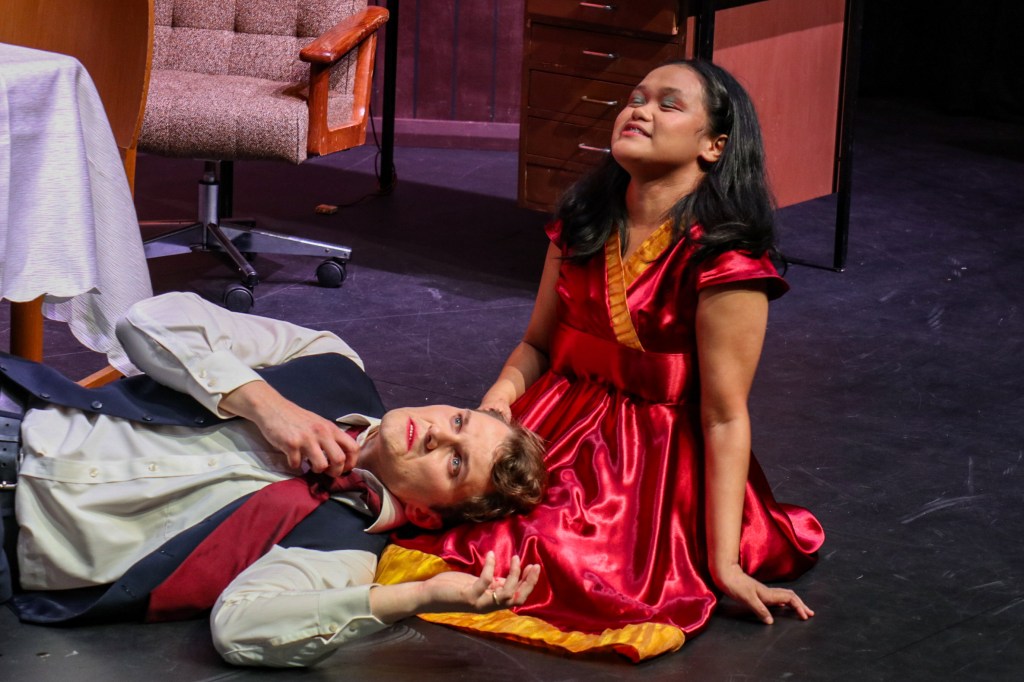
Sofia Lumo played Judy –the character around whom the play was centred – and was, undoubtedly, a star. The night of this particular performance started out with massive demands from Lumo’s talent and composure, with technical difficulties seeing her potter about on stage for over fifteen minutes, in full audience view, improvising and critically thinking to maintain her character. It is difficult to be on stage with nothing to do but wait for a fix, yet Lumo played a character doing nothing so perfectly that I was convinced that this opening scene was a creative choice designed to pull the audience into the very act of waiting for the end. Additionally, Lumo’s convincing portrayal of Judy – from her sad and contemplative beginning, to realisation, anger and hopefulness – embodied the complex and pivotal nature of the character.
Michaela Lattanzio, who played Judy’s mother, owned her character and provided a thread of human interest and comedic relief the moment she sauntered onto stage. Her characterisation was believable and maintained well throughout scenes which didn’t involve her directly, as in one scene where she lounged discontentedly on the floor by the cabinet and nursed a cup of wine while action played out in the foreground. Also to be saluted is her dedication to the role – she must have drunk upwards of four cups of watered-down cordial, or ‘wine’ (yes, I was counting).
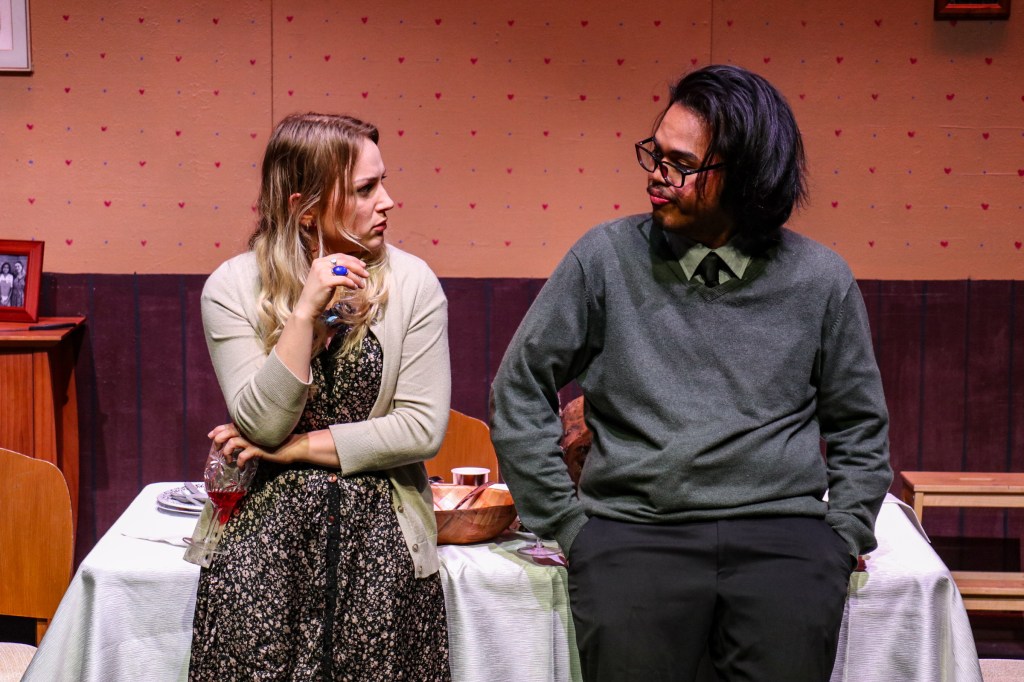
Farhahn Miraj played Judy’s father, a staid character whose baritone voice provided crucial seriousness to juxtapose the humour and balance out the dialogue. Miraj perfectly played the role of a slightly uninvolved father nurturing a marriage’s worth of pent-up anger towards his derogatory wife, giving deadpan commands for ‘civility’ in the most dramatic of situations. In one of the acts, he gave a straight-faced request to end the neighbour’s life in the bathroom rather than the kitchen for the sake of ‘politeness’. It was a comedic moment.
Lochie Dew was a great match for the role of Judy’s husband. His confidence was perfectly suited to the act of holding a large knife to another character’s throat. Also greatly appreciated was his eight-minute death scene, pretending to choke and vomit to death for such a long time is no easy feat. He gave it his all, keeping the tension up till the very last moment, and preserved the impression of a lifeless body until the curtain closed. His thoroughly condescending and patronising behaviour towards Judy also earned clenched teeth and distaste from the audience, just as the plot demanded. Dew played off the energy of the raving neighbour, played by Lockie Carmichael. This neighbour character was possessed by a frantic, fervent and disturbing passion, maintained by Carmichael throughout his long and challenging monologues. Carmichael’s high energy embodiment of unrestrained grief, anger, and – as his character put it – ‘vengeance’ was carried out in a way that not any actor could have done easily. His nervous trembling, disturbed manner and jerky movements escalated tension to the point where the audience felt that he posed a serious and unnerving threat to Judy’s family.
These adept casting choices resulted in a dynamic group of actors who created sparks when they were put together. It was truly an explosive combination of personalities and acting styles.
Interesting stage decisions which cemented audience engagement were made by co-directors Elizabeth Browne and Olivia Di Grazia. The show started with the fervent neighbour wearing an instantly recognisable plague doctor mask. As he traced slow, lumbering steps up the stage and took a seat within the audience, the show kicked off with the recognition that death was among us that night. Also appreciated was the staircase scene where the neighbour approached the door to beg for entrance, the tension played out right before our eyes rather than hidden away offstage.
The play used a beautiful original song, ‘Oh my – what a beautiful day’ by James Carolan and Olivia Di Grazia. The repetition of the word ‘goodbye’ set a perfect tone and motif at the beginning and end of the play, expressing Judy’s great emotion at saying goodbye to her world and life. The singer, Di Grazia, had a beautiful voice, and Carolan’s production style perfectly captured the nostalgic longing we have for the past.
A wonderful atmosphere for the play was also provided by set designer and assistants Stephanie Nguyen, Aminah Afeey and Shuo (Kim) Ma. Careful attention was put into the wall design and imitation wood panelling. Concrete details such as the picture frames on the wall, the old-school radio, and the tiny, false mirror helped to ground what was at times a deeply philosophical play that explored the abstractions of life. The animated projection of the clock on the wall to remind everyone of the impending end of the world was a necessary element, and was made by Nathan Dinh, who also assisted in bump-in and bump-out. Furthermore, Judy’s shiny scarlet dress, which clearly marked her as the central character of the show, was designed and hand-sewn by costume designer Ella Barrett. They were assisted by Charlotte Henderson, who was also the make-up artist for the show. Lighting Designer/Mentor Dom Katsikas helped Assistant Lighting Designer/Operator Sam Stumbles use spotlights and ambient light to steadily direct our attention to the most moving parts of the play, such as Judy’s parents deep-seated discussion of the meaning of life.
Overall, what I most appreciated about the play was the exploration of the complex relationship dynamics between parent and child – the common perception of children as having been let down by their parents, and on the other side, the parents’ perception that even what they have done has been challenging enough. This theme was summed up in a hard-hitting line from Judy’s mother: ‘You do what you can, and you end up being hated all the same – it’s cruel.’ This line so powerfully portrayed the tragedy on both sides of a parent-child relationship, where each feels let down by the other.
A round of applause for the playwright, actors, and all supporting crew involved in the creation of The Last Supper whose effort, passion and talent supported Cipta Theatre Company’s first play. I look forward to seeing everyone’s continued involvement and explosive growth in the theatre scene, from cast to crew and support team!
Thanks must be given to Production Consultant Nabila Malik who mentored this emergent theatre group. Also indispensable was Union House Theatre for their help and advice throughout. Recognition also goes to Estella Koce for mentoring the stage managers Zijun Li and Kavya Pahwa, who played irreplaceable roles in the rehearsals and performances. Everything was coordinated smoothly by co-producers Jessica Fanwong and Jessica Tran.
I appreciated the flawless captioning for the entire duration of the play over multiple performances, headed by Stuti Ghosh and Matthew Chan. Equity Officer Teresa Iskandar also ensured inclusivity and accessibility throughout the production. Furthermore, Co-Publicity Officers Weiying Lu and Sana Singh helped to ensure a sold-out opening night. UMSU Women’s officer – Akanksha Agarwal – also promoted the show with a The Colour Purple movie and craft session. And Julian Del Marco helped with printing.
Thanks to Front of House Manager Chatarina Hanny Angelita Teja for coordinating the friendly and efficient team of ushers who made the visit to the theatre welcoming and congenial: Esther Luk, Isabella White, Enje Herbert, Chloe Tran, Victoria Winata, Marcie Di Bartolomeo and Stuti Ghosh. Finally, thanks also to Farrago Magazine and Radio Fodder for reviewing The Last Supper, and Dimple Malhotra for interviewing the directors.
Michelle Yu is one of The Dialog’s staff writers, currently studying at the University of Melbourne. Her journalistic work has been featured in Farrago and elsewhere, with over 30 non-fiction articles published.
Hallie Vermeend is an aspiring editor currently studying a Master of Creative Writing, Publishing and Editing at the University of Melbourne. She graduated with a Bachelor of Design in 2023, majoring in Theatre Design, and in her spare time enjoys writing for the stage and screen. In 2023 she was lucky enough to attend the Prague Quadrennial of Performance Design, which has enriched her understanding of international theatre. Hallie’s background and continued interest in theatre pairs well with her passion for editing in her role here at The Dialog.
The Dialog website is sponsored by Union House Theatre.
 The Dialog