
REVIEW BY CHARLOTTE FRASER
EDITED BY EMMA PARFITT
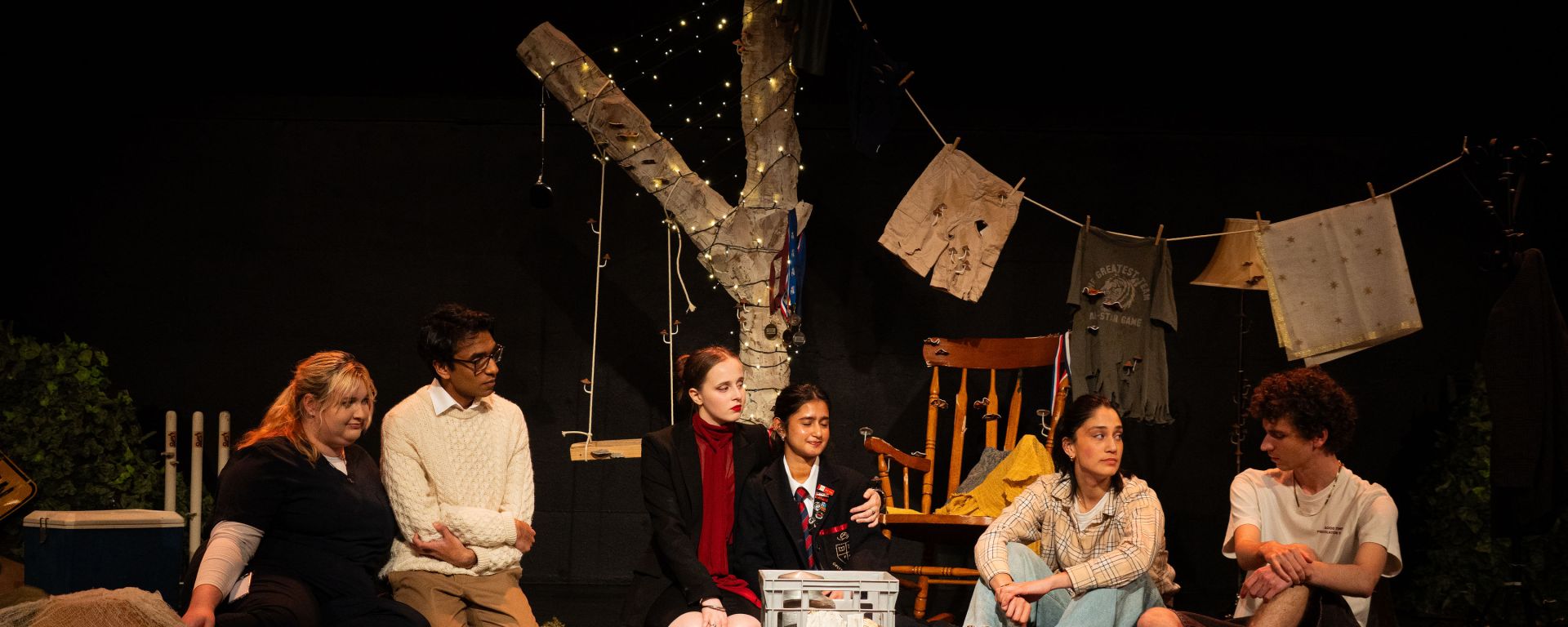
Sitting in the Kaleide Theatre looking at an eclectic mesh of lamps, fairy lights, CDs, mushrooms, rugs, a swing and a barren tree – an unfamiliar image that sparks a sense of nostalgia. Music plays softly, a folk indie mix that matches the scrapbook-esque staging before me. ‘Fable’ by Gigi Perez plays and I know that I’m in for a tear-jerker.
Ashes Ashes by Eadie Milne and Charlotte Fels is an emotional, nostalgia-inducing story of five siblings all being reunited to spread their mother’s ashes. What seems a simple task is anything but for the Marlow family. The siblings – Cian, Finlay, Scout, Siobhan and Doran – are estranged. All but Cian have left the family farm, and Scout is being raised by her father away from her half-siblings. Doran has moved to Melbourne. Finn has been in prison and then traveling. Siobhan married Perry, the brother of the man who got her pregnant as a teenager and is working as a vet. Five siblings (plus Perry) all in the same place for the first time in years. What could go wrong?
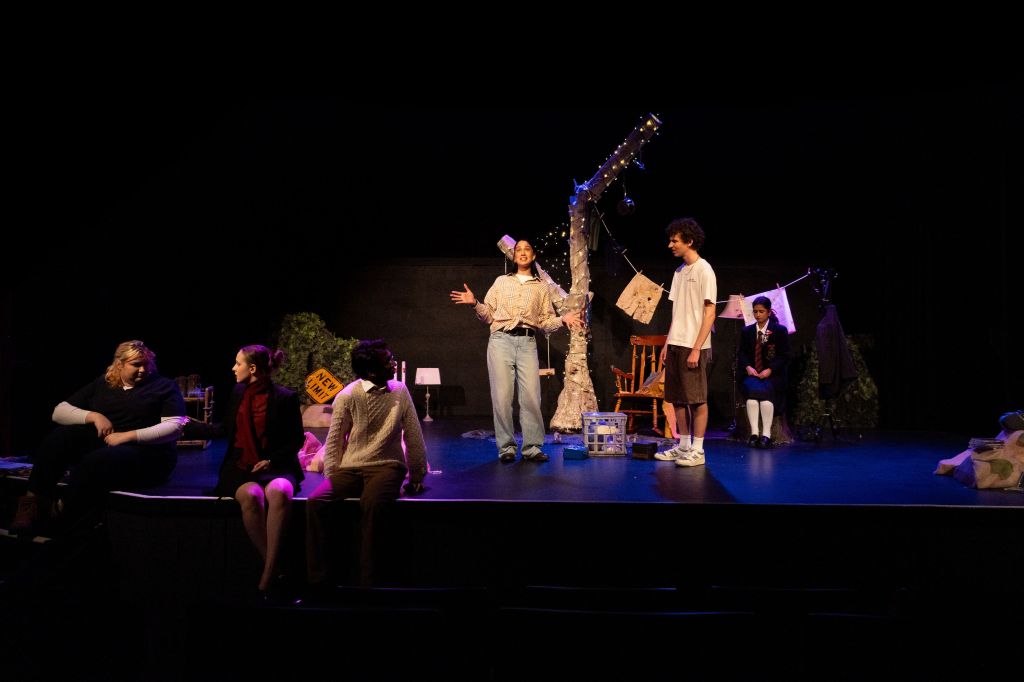
After getting stranded in the middle of nowhere with no signal, these characters are forced to confront their differences and how their experiences with their mother affected them.
The plot of this show was incredibly engaging. Each character was so well-written and complex. The play touched on nuanced issues like domestic abuse, death, abortion, drugs and alcohol, each of these themes was treated with care and none of them came across as tokenistic. This is a true compliment to Milne and Fels’ work.
The first half of the play saw scenes of comedic arguments between the siblings and subtle hints at the dark revelations to come. This is certainly where the play was at its strongest, with the ensemble cast all working together and giving a convincing performance of an extremely dysfunctional family.
The second half of the show was largely monologues and small vignettes between one or two characters. Each monologue was poetic and well-crafted, but they did get repetitive, often having similar staging and structure. I would have loved to see more kinetics in the second half, or more full-cast scenes, especially since Milne and Fels have created such interesting and engaging characters, I missed seeing them interact as an ensemble towards the end. The tension was high but stagnant at times, and there were many moments that felt like they could have served as the climax of the show, and it was unclear to me exactly which one was supposed to be.
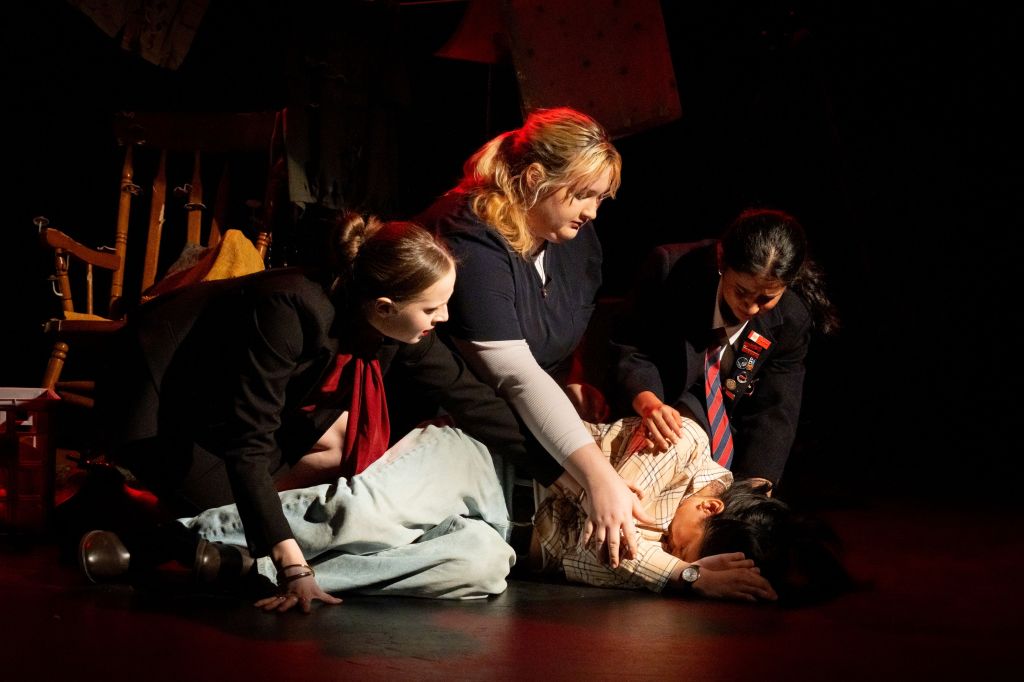
This is not to say that the second half wasn’t incredibly emotional and raw, because it was. All of these characters were forced to be vulnerable with one another, and we saw relationships slowly starting to mend.
Additionally, I felt some of the events got a bit mixed. There were references to ‘Rosebud’ – which we do eventually learn the full truth of – but there is also reference to another accident involving Perry’s brother. I wonder whether there could have been more to distinguish these two events and, since Finn was implicated in both, perhaps it would have worked better to just have one. Regardless of these small things, though, Fels and Milne’s play is certainly one of the most nuanced and well-conceived original student shows I have seen.
The cast was powerhouse after powerhouse. Perry and Siobhan, played by Zayd Chaudhry and Marney Noonan respectively, gave performances that were rich and emotive. The doting and protective husband, Perry, was often the voice of reason amid the Marlow family antics, and Chaudhry gave a heart-warming balance to the tension of the show. Siobhan was sweet despite the hardships she had faced, and Noonan balanced the turmoil and selflessness of this character skilfully. Amaya Martinez-Doyle as Doran – the rural girl turned Melburnian – embodied eldest daughter guilt in a masterful performance. Her presence onstage was electric and she expertly let the façade crack and Doran’s more vulnerable side seep through as the play went on. Pacey Dunshea’s embodiment of the black sheep, Finlay, was hilarious and devastating. From the start, Dunshea’s comedic timing and dedication to this character was superb, and he carefully moved through the tense moments with an excellent level of restraint.
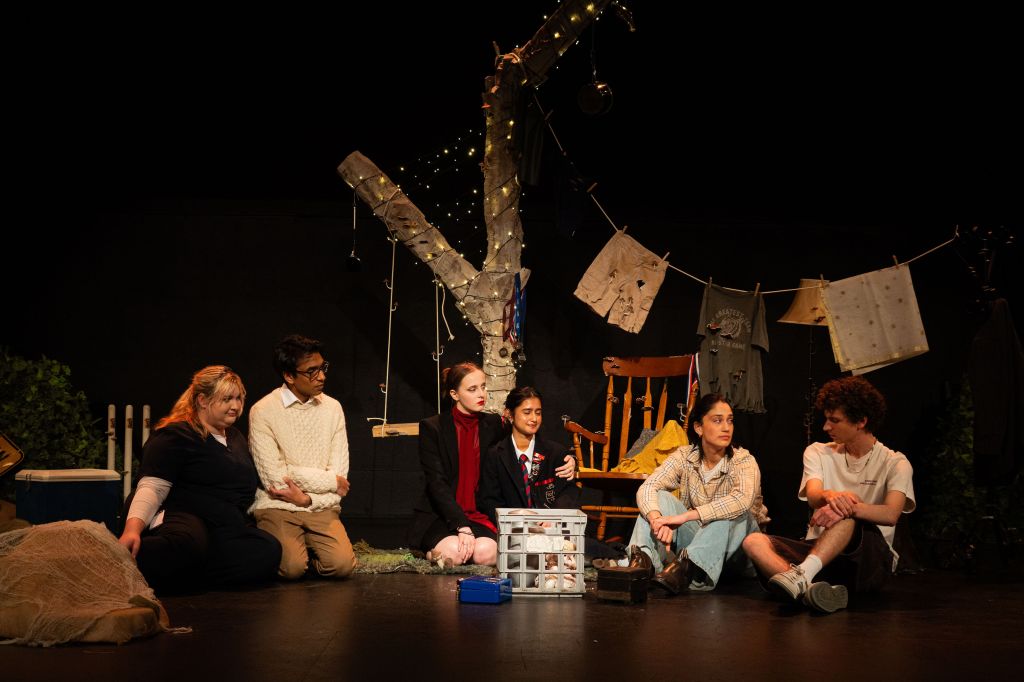
Anaya Sircar as the youngest Marlow – well, half Marlow – Scout, gave an exemplary performance. Scout was constantly on the outside looking in, wanting desperately to be included in on the secrets and lives of her siblings, and Sircar embodied this desperation and innocence. Finally, Emma Boyce as Cian. The daughter who remained by their mother’s side until the end, enduring years of torment. Boyce brought a raw realism to this character that hooked me in from the beginning. Going from the dry and detached version of Cian at the start to the distressed image of her we see at the end, clawing at Siobhan’s leg while she’s dazed from hitting her head, begging for her mother’s forgiveness, was more than impressive. That moment stands out for me as one of the most impactful, and Boyce delivered. Every single one of these performers gave everything to their roles and what resulted was a beautiful blend of comedy and gut-wrenching tragedy.
The set – conceptualised by Joshua Drake and Charlotte Fels, designed and constructed by Ciel Giles-Manor, Max Arnold and May O’Connor – was one of my favourite elements of the show. It evoked a sort of rustic early 2000s nostalgia. The CD player, mis-matched lamps and furniture all gave the production a homey lived-in feeling. The perfect backdrop for the emotional journey it takes.
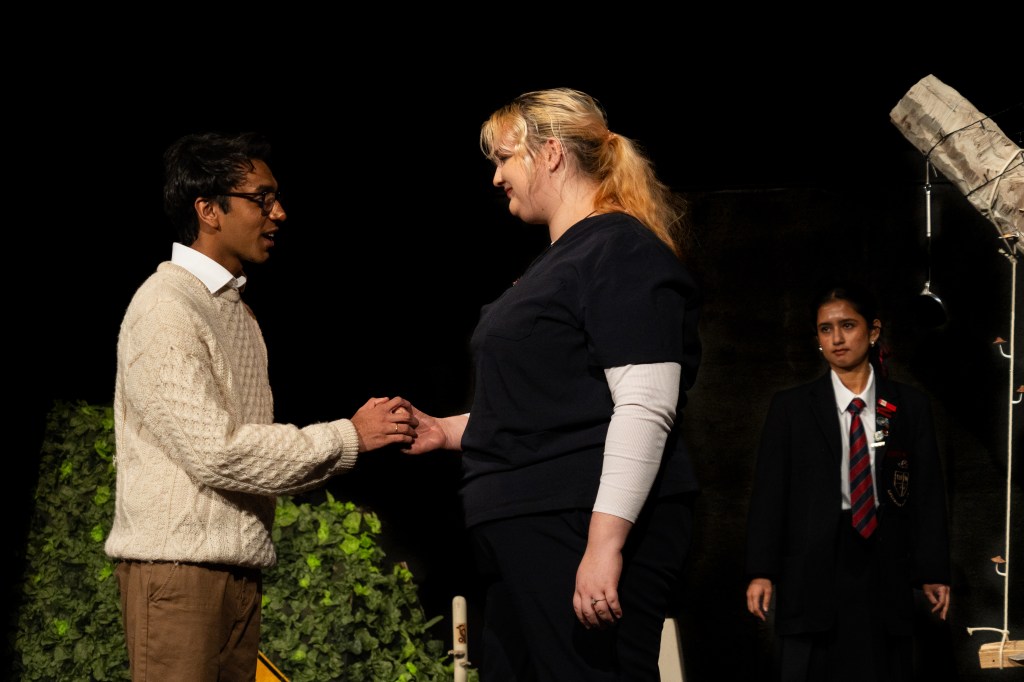
Isabella Troise’s costume design matched each character perfectly. Doran’s sleek suit and blouse, Scout’s school uniform, and Siobhan’s scrubs were highlights. They were different enough to suit each character but also blended together to form a cohesive ensemble.
The technical design by Edward Wilding worked in perfect sync with the tension of the play. A standout moment that exemplifies this would have to be when Cian first enters the stage and flinches away when someone tries to touch her. The lights dim and flicker and we know that we’ve hit a sore spot. This flicker motif continued throughout the performance to great effect.
Ashes Ashes presents a dysfunctional set of siblings who, at their core, all just want one another again. They long for family and love that isn’t conditional. The play is rich with tension and weaves in difficult topics with care. An Irish Hymn that their mother used to sing is the first thing that unites the siblings. Scout recalls it first, despite having more limited time with their late mother, and the other siblings slowly join in. It gives us the sense, in the midst of all the turmoil, that things might work out. There’s another Irish saying that I’ve come across that I think condenses the core message of Ashes Ashes:
Ar scáth a chéile a mhaireann na daoine.
“Under the shelter of each other, people survive.”
RMIT Redacts’ Ashes Ashes played October 30th – November 1st at the Kaleide Theatre.
CHARLOTTE FRASER (she/her) is a writer, performer and student editor based in Melbourne. She holds a BA in English and Theatre Studies and is currently completing her Masters degree at the University of Melbourne.
EMMA PARFITT (she/her) is the Dialog’s head editor and has written Dialog reviews alongside studying towards her science degree for the past two years. She is a production manager, stage manager and producer on the Melbourne indie theatre scene and a veteran of student theatre at Union House Theatre.
The Dialog is supported by Union House Theatre.

