

REVIEW BY POPPY ELFICK
EDITED BY CHARLOTTE FRASER
I walk into the Carlton Scout Hall and find my seat in front of the quaint stage. Before us are two sets of door frames – one full sized on the stage and a smaller set on the ground in front – and a tree wrapped in fairy lights. Here is the beginning of our trip down the rabbit hole in Janet Clarke Hall’s Wonderland.
The play’s plot sticks true to Lewis Carroll’s Alice’s Adventures in Wonderland with an exceptional adaptation written by Hannah Crompton and beautifully directed by Isobel Whitehead. Just like the novel, we join Alice (Moyia Vidler) as she follows the White Rabbit (Toby Kingston-Brown) down the rabbit hole into Wonderland, where she meets a host of characters through a series of strange meetings before it comes together in the final trial before the Queen of Hearts (Harry Poole).
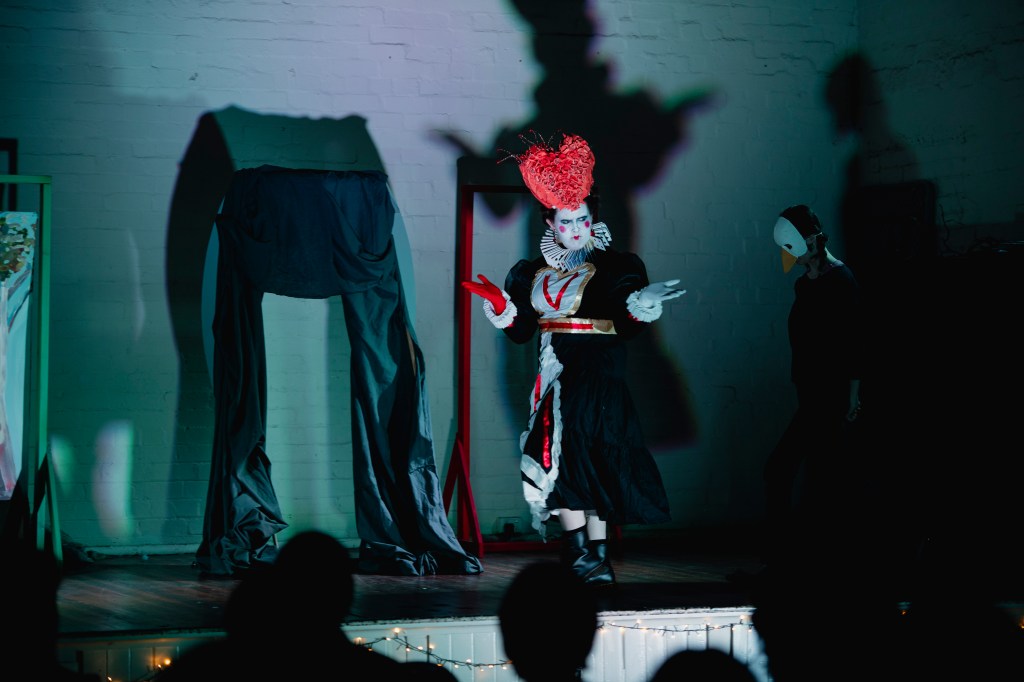
Once we travel to Wonderland, a slew of characters is brought to life by the ensemble. The whole cast should be commended for their commitment to the bizarre whimsy of the production, with each ensemble creature and kooky character entirely dedicated to the performance. Every performer adds to the wonderful world and there are a few characters that stand out to me. Toby Kingston-Brown’s White Rabbit has an earnest rush about him. The Mock Turtle and Gryphon (Dan Duell and Lucas Dell) are utterly ridiculous in the best way, perhaps only beaten in absurdity by Hal Porter’s Scottish Mad Hatter complete with kilt and accent. The Cheshire Cat (Roman Newall) has a grin that rivals even the cartoon cat himself, and Harry Poole commands the stage in a way perfectly fitting of the Queen of Hearts. Of course, Moyia Vidler’s performance as Alice ties this crazy concoction together, playing the character with a sincerity that grounds the play against the magnificent nonsense.
Whitehead’s decision to have each minor character double as an ensemble animal creates a fuller stage that also allows each performer more time on the stage. But speaking of time, perhaps the only criticism that comes to mind in the performance is the pacing. At times scenes felt as if they dragged longer than necessary, and the timing between some lines could have been shortened. Tightening up some of these moments could improve what is already a brilliant piece of theatre.
Visually, the standout of the show is the costumes (a credit to the work of Olive Kipping, Anna Tsuchida-Gorbal, Molly Harris and Rosie Dore) particularly the incredible headpieces. I was lucky enough to get a closeup look at the headpieces after the performance and the intricacy in each curl of paper in the Queen’s wig, and carefully considered detail in the White Rabbit and Mad Hatter’s hats are truly unbelievable. To go with the beautiful costuming is the set by Angus Taylor, Khadija Klein, and Leni Severin. The series of colourfully painted doorframes are the constant set pieces that move around the stage. Other pieces including tables, large rocks and a bush are brought on and off stage with the charming choice by Whitehead to have members of the ensemble become part of the set changes with a ‘strong man’ act carrying off the boulder, or someone in a bush get-up crawling across the stage. These small moments work very well within the context and are a creative way to work within the constraints of the performance space.

Lighting by Nancy Yang made the best of a very basic lighting rig which consisted of 2 color-changing LEDs and a string of fairy lights. With minimal lights, which limit the different spaces light is typically able to create Yang successfully uses colour to show shifts in location and mood. Yang doesn’t shy away from bold saturated colour which keenly reinforces the absurd reality Wonderland creates. The world building is furthered by sound design by Jordan Overs and original score composed by Stella Byrne. Overs and Byrne work seamlessly together to create the flowing ambience of Wonderland. With nothing but a large Bluetooth speaker and a QLab file, the whimsical world is audibly heightened, and with the rain the venue was graced with on opening night a cosmic coincidence I honestly thought was part of the design.
In addition to the ambient and scene transition music, Byrne also provides two musical numbers to the play. With lyrics adapted from the source material by Crompton, Byrne both choreographed and composed a rap by the Duchess (Myra Doval) about her pig baby (a fan favourite amongst my friends) and a song for the Lobster Quadrille. The decision by Whitehead to add the whole ensemble to the number was I think a genius one. It was evident that the cast were enjoying themselves immensely and this song in particular, with all cast members dancing together emitted palpable joy to the audience. Byrne is also seen as Tweedledum alongside Anna Ryley as Tweedledee. The pair work together in synchrony finishing each other’s sentences perfectly.

Overs takes charge of the video and projection in addition to audio, which so happen to be part of some of my favourite moments in the play. A PowerPoint presentation played hysterically earnestly by the Mock Turtle (Duell), whilst seemingly out of place from the rest of the performance, brought about bubbles of laughter from myself and my friends at the absurdity of it. Which, upon reflection, is perhaps the point in this moment; the absurdity of the world of Wonderland makes it so a random PowerPoint or rap fits into the play because it doesn’t make sense.
But my favourite part of JCH’s Wonderland by far is the way the changes in Alice’s height are handled. On my walk over to the Scout Hall, I found myself wracking my brain on how they could possibly show the growing and shrinking of Alice throughout the play, for something so prominent in the story I couldn’t work out how they would achieve it. I was enthralled by Whitehead’s implementation of what I would categorize as 3 distinct methods for changes in Alice’s size, all 3 involving cunning use of Taylor, Klein, and Severin’s set. One features the interplay of Overs projection and a white-screened doorframe to project a silhouette of Alice’s changing size; another uses the ensemble in the final scene to cleverly cover a set piece that Vidler stands on. However, my favourite method brings us back to what audiences first encounter when they walked into the venue: a series of doorframes on the stage mirrored by miniature counterparts on the floor below. This simple shorthand of Vidler moving between the floor and stage perfectly illustrates Alice’s change in size in a way that set a high standard for the rest of the performance. One JCH certainly lived up to.
Editor note: This production also wouldn’t have been complete without the work of Creative Director/Production Manager Faryal Hasan, who headed the costume, set and props teams; and Production Assistant Eliza Wallace who created the Queen of Hearts headdress!
JCH’s Wonderland played at the Carlton Scout Hall on the 11th and 12th of October 2025.
POPPY ELFICK is a 2nd year performance design and production student with an affinity for all sides of theatre-making. Getting her start in university theatre performing at residential college, she has since directed, designed, and seen as much student theatre as she can.
CHARLOTTE FRASER (she/her) is a writer, performer and student editor based in Melbourne. She holds a BA in English and Theatre Studies and is currently completing her Masters degree at the University of Melbourne. Charlotte is also the incoming 2026 Dialog Editor.
The Dialog is supported by Union House Theatre
 The Dialog