

REVIEW BY BRONTE LEMAIRE
EDITED BY CHARLOTTE FRASER
Before I even walk into the Blue Stone Church, I’m already curious on how Wit Incorporated has decided to stage Alice Birch’s Revolt. She Said. Revolt Again. The venue provides an amazing space, but with no raised seating I’m keen to get a seat in the front row so I don’t have to worry about losing sight of the actors. However, as I walk past the FOH I’m incredibly pleased to see that won’t be an issue here.
Already I’m greeted with the intelligent collaboration between Emily O’Brien-Brown’s direction and Silvia Shao’s set design. It mimics a traverse stage, though not cleanly as instead of neat audience rows facing each other, we’re sat in pockets broken up by three stages. To my left is the dining table setting, cluttered with household objects and food. To my far right is an L-shaped runway with fake grass and an office water cooler. Against the wall in front of me are three raises stacked precariously on top of each other, able to lift actors well above the audience. The space between them is empty of any set pieces and props aside from the actors already wandering on stage. Two are dancing together to the pre-show music, laughing and greeting any friends that come in. One is sitting quietly by herself on the runway. The fourth and final wanders around the space doing vocal exercises, looking at her highlighted script. An intimacy is immediately developed with the ensemble that the actors and O’Brien-Brown will come to exploit.
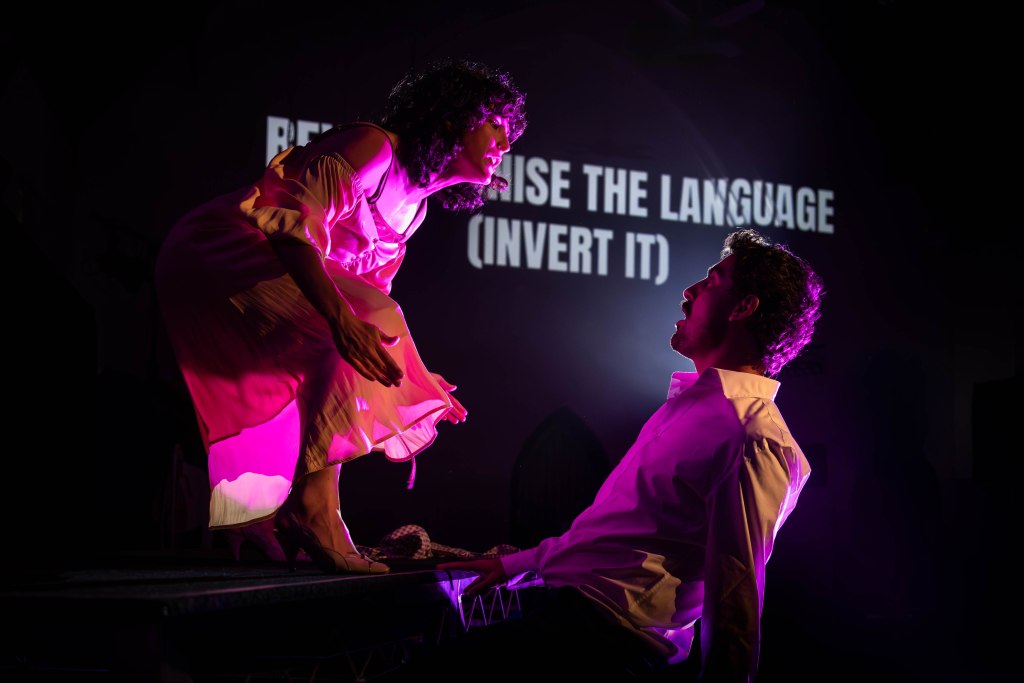
The play is structured through vignettes where each tackles a revolutionary idea, displayed aggressively through its projection on the back wall e.g. REVOLUTIONISE THE LANGUAGE (INVERT IT). STOZ’s sound design gives me a jolt every time it changes, drawing my eye to the new message as well as giving me a disruption to my nerves. STOZ’s sound design switches from subtly underlying an entire scene to being the joke itself like a reactive sound board in the best way possible.
We’re first introduced to a couple editing their dirty-talk in real time played by Madeleine Magee-Carr and Jack Twelvetree. Their sexual chemistry and desperation make me flush despite them not touching once in the entire encounter. I must applaud Magee-Carr and Twelvetree in particular for their challenging range of roles that switched from caricature to extreme subtlety.
Lansy Feng is in the next scene, monologuing to her exasperated boyfriend about the dangers of marriage and how it’s essentially a bomb. Feng’s humour is infectious and gets the audience laughing at everything she says or does. Though Feng has an aptitude for comedy we also were gifted with her dramatic skillset in her heartbreaking performance as a jaded older woman suppressing her trauma.

Finally, we see AYA in conflict with their boss due to just wanting to have Mondays off. Despite not moving from their chair, I’m enraptured by AYA’s control and poise. It will feel remiss to not highlight their standout performance in the fifth vignette, where their angry and grief-stricken delivery make the audience glued to the scene or flinching away.
O’Brien-Brown’s direction is razor sharp: no pause is too long; no breath is too quick. The stage is on fire from beginning to end. From the first scene to the last, I’m held captive by the electric energy and timing of this cast. To be up front: I’m obsessed. Each actor embodies an incredible stage presence and an impressive range that allows the audience the pleasure of watching great actors at work.
Throughout the show, O’Brien-Brown’s lighting design is as blunt and direct as the script. The lighting set up itself is simple yet incredibly stylised and sharp. Using colour and spotlights to lean in on strong lighting choices instead of subtle which is cohesive with the tone of the play. Additionally, by solely focusing the lighting on each of the three stages, the ground between becomes a limbo space where actors who aren’t in the scene can watch or where the actors can step out of the scene to ruminate on what they’re doing. One of my favourite examples of this was when AYA physically steps off and out of an incredibly traumatic scene where they have been yelling the details of their mother’s abuse and asks the audience if it’s too sexualising. The choice to not light AYA in this moment amplifies the limbo between character and actor.

It’s the final act where I truly appreciate the separate stages. As each actor stands on a different one, they call out to the audience, overlapping each other. I’m constantly forced into deciding where to look, who’s message to prioritise. The stages’ distance becomes a physical challenge of how fast these actors can change costumes and get where they need to be while somehow doing continual burpees. I found myself in an open grin through this entire sequence, grateful to be seeing it all unravel. This show is truly a magnificent spectacle.
Revolt. She Said. Revolt Again. first debuted in 2014 through Royal Shakespeare Company commissioning Alice Birch. I do often get sceptical when I walk in to see a self-proclaimed feminist play. Even more so when it was written over a decade ago. Often the concepts are outdated or simplified, not truly reckoning with the messiness of having a fem body in the world. I was glad to see I was wrong in worrying as Wit Incorporated has clearly thought the same. Revolt. She Said. Revolt Again. is as relevant as when it was written if not more so. Feminism was a punchline at the time and though it may have now settled more gently in the mainstream, women’s rights are getting rolled back and questioned around the world at an alarming rate. With conservatism on the rise and trad wives as our new influencers we need this play more now than ever. Wit Incorporation clearly has their finger on the pulse.
Revolt. She Said. Revolt Again. won’t give you the answers to your questions, but Wit Incorporated’s production is raw and unyielding in its examination. We might not have figured out our revolutions yet, but at least we have good art.
Wit Incorporated’s Revolt. She Said. Revolt Again. played at the Bluestone Church Art’s Space on the 25-29th of November and will play at The Bowery Theatre on the 13th of December.
BRONTE LEMAIRE is a writer and theatre maker who loves witnessing what emerging artists can achieve. Bronte loves analysing and picking apart what makes art work and function (or not!) in order to learn and steal some inspiration for herself.
CHARLOTTE FRASER (she/her) is a writer, performer and student editor based in Melbourne. She holds a BA in English and Theatre Studies and is currently completing her Masters degree at the University of Melbourne. She is also the incoming 2026 Dialog Editor.
The Dialog is supported by Union House Theatre
 The Dialog