
REVIEW BY ELLA CALLOW-SUSSEX
EDITED BY EMMA PARFITT
Punk Rock is a play by British playwright Simon Stephens, best known for The Curious Incident of the Dog in the Night Time. First performed in 2009, it follows the lives of seven private school kids in sixth form – their equivalent of Year 12 – as they prepare for, or neglect, their A level mock exams. They love each other and loathe each other; they are thoughtful and in the same breath endlessly cruel. You’d think these are normal teenagers, however there is abnormal violence festering in more than one of them. Without spoiling too much of the shock, it is a play that necessarily comes with a host of content warnings, along with a empathetic pre-show message that audiences take care of themselves throughout the night. Punk Rock has had three Australian casts since it first arrived on our shores in 2012. The play is shocking, alarming and depraved – the sorts of things that make for a lively night at the theatre.
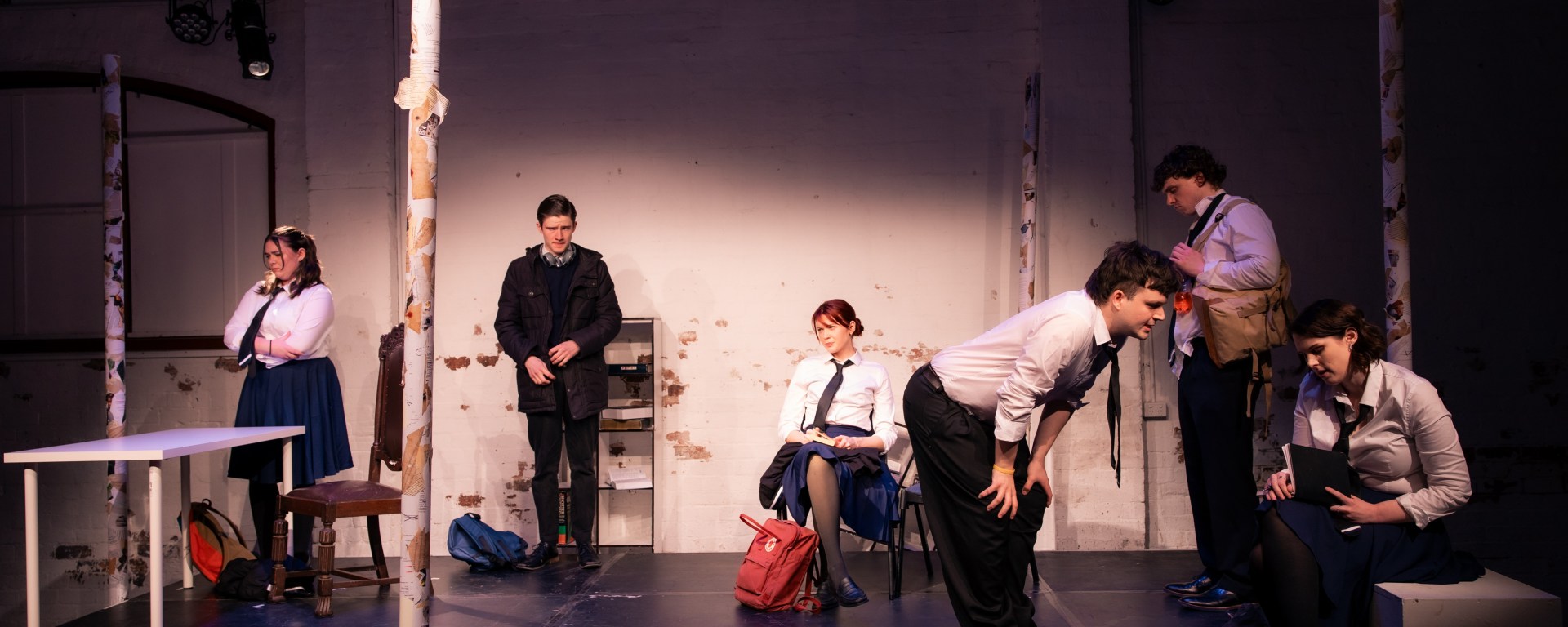
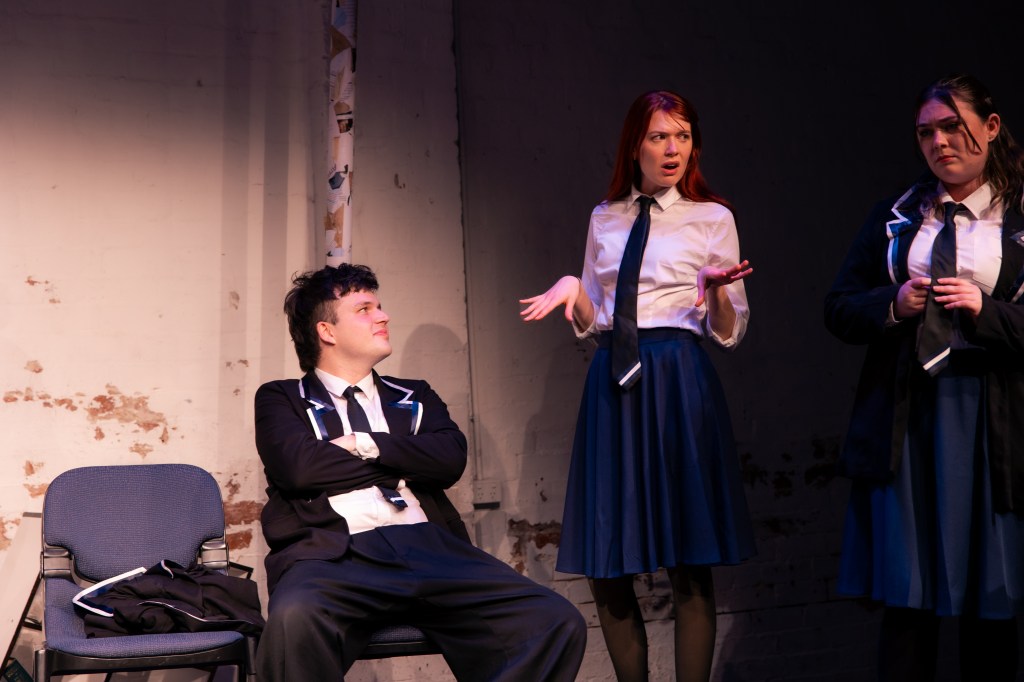
The creative team, led by director Jay Wood and assistant director Danielle Smith, took on a mammoth task with this play. Specifically, depicting gun violence onstage in today’s fear-stricken political climate with the stories that pour out of so many places is a fraught and inherently tense pursuit. I was also taken with the costuming, which was appropriately varied between all the different characters. It is easy in shows set in a school to assume that everyone should look the same, but by allowing small alterations to uniform the costumes communicated much about the characters.
The set design by Sarah Ryan navigated the challenge of the oblong Meat Market Stables with a raised platform to represent a tight library at the top of the school. Raising the set isolated the performers which added to the intended pressure cooker of the original text. The furniture placed around the set allowed the actors just enough space to move as if it was genuinely a school space and at times effectively pushed the performers together. However, as the platform was hollow, whenever the performers stepped onto the stage the whole structure squeaked which – in the echo filled stables – sometimes overwhelmed the opening lines of dialogue. Similarly, I was perplexed by the additional pole attached to the edge of the stage and placed almost directly centre at the front of the stage as despite sitting at the centre only one row back, the pole obstructed my view of more than one critical moment.
One of those moments was the final lighting state of the show. Cale Dennis’ lighting was minimal and used a lot of emphasis and stark colours and quick shifts to cover transitions. I would have appreciated a more integrated and nuanced set of colours or dynamism as the sharp changes from natural washes to overwhelming blue, red or green, while appropriately disorientating, were also a distraction and pulled me from the story.

While the industry at large can often neglect intimacy and fight coordination, in these details there was strength for this performance. Intimacy coordinator Jessica Stanley and fight choreographer Bailey Griffiths have done a force of work with a script that is overtly violent and sexual. The safety and consistency that would be required from the contributions of these two for actors to perform this night after night is not to be underestimated. As the play is essentially many long and intimate scenes, this is of the utmost importance, and I am glad to see them credited highly. Similarly, I was very impressed with the accent work, led by Alexandra Whitman. It is often a stumbling block of performances in Australia to have the entire ensemble sound believably like they are from the same part of Britain.
As an ensemble, the team of actors was strongest in their reactions to each other. Performing a script for over two hours with no intermission, in accent, is a feat of focus for both performers and audience. I was impressed how in a scene that centres on something as small as a wasp, the whole ensemble worked together with energy and spark.
Columbus Lane played William Carlisle and will keep you on your toes until the end. He remained skilfully off beat and blunt, extracting many an uneasy laugh from audience members who believe him a socially anxious boy. Lane’s use of proximity, being very close to characters and then distancing himself was wonderfully uncomfortable.

As Lilly, Maddie Richards was able to showcase her dedicated focus and wit. A spitfire of a character, Lilly plays confrontational and confident but isn’t nearly as cynical as she wants you to believe. It is in her final monologue about how most people aren’t all that bad that the meaning I chose to take away from the play really shone. She shared scenes with Matthew Poggi who played Nicholas. Poggi was poised and grounded in his performance. He was fighting against a somewhat limited character as written but really came alive when given some witty dialogue in his flirtation with Richards.
Luke Hill Smith as Bennet was terrifying and cruel. Violently infantile and physically domineering, I jumped more than once as he terrorised his friends. As Chadwick, Lachlan Herring is endlessly empathetic and whip smart. He evokes a vast majority of the pathos from the audience as he just tries to get his exams over with. The pair create some of the greatest tension of the performance. I held my breath every time Bennet realised Chadwick had entered the room. Herring’s monologue explaining how little Bennet’s taunts mean in the face of the world’s suffering was a highlight of the night and appeared to be the only thing that got through to Bennett.
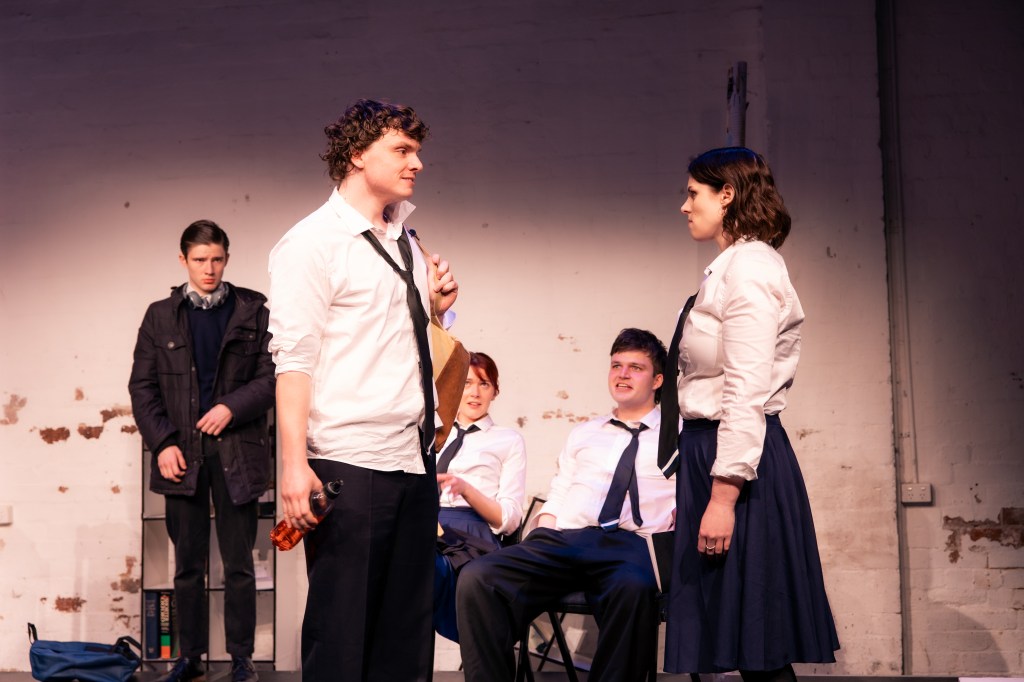
Grace McLaughlin as Tanya and Kaitlin Devine as Cissy were believable as teenage girls with all the mess and fuss that comes with growing up. McLaughlin has a strong focus and command of her body. As the moral centre for the group of ‘friends’ she is heartening and passionate. Devine makes a complicated and layered character out of Cissy where it would have been easy to play her as nothing but shallow. Watching Devine express Cissy’s turmoil at not standing up for her friends even when she knows she should and finding herself stuck with no allies and a terrible boyfriend was heartbreaking and a highlight.
Simon Stephens does not write easy plays. In his director’s message, Jay Wood astutely asserts that Punk Rock can mean a lot of things to different people. The actors undoubtably did an admirable job tussling with a constantly shifting set of power dynamics and status. However, I was left wondering about the larger purpose of shows like this beyond keeping the audience on their toes.
Lunatix Theatre Company’s Punk Rock played September 17th – 21st at the Meat Market Stables.
ELLA CALLOW-SUSSEX is a theatre maker and reviewer for the Dialog. She is currently completing a Bachelor of Arts majoring in English/Theatre Studies and Creative Writing.
EMMA PARFITT (she/her) is the Dialog’s head editor and has written Dialog reviews alongside studying towards her science degree for the past two years. She is a production manager, stage manager and producer on the Melbourne indie theatre scene and a veteran of student theatre at Union House Theatre.
The Dialog is supported by Union House Theatre.
 The Dialog