
REVIEW BY AZMY AZURITE
EDITED BY EMMA PARFITT
“Are you sure you’re
ready for the backlash?”
“Of course!”
“He’s not.”
Numa and Karl: The Extraordinary Man That He Was is the story of Karl Henrich Ulrichs, the first man in history to ever come out as gay. He invented his own word for the phenomenon—urning, its roots in Aphrodite’s epithet Urania, which emphasises Aphrodite’s more heavenly and divine aspects.
The show is produced by Joshua Strachan (he/they), written over eight years by Em Chandler (she/they), and directed by Alanah Guiry (she/her). Chandler’s long writing process here paid off remarkably and I quite admire how she stayed with the concept over all that time.

Even just being in the foyer I could feel the immense reverence that Sevenfold Theatre have for the story of Ulrichs’ life. The foyer contained a careful curation of Greek Literature and a heavily annotated, highlighted, and dogeared copy of The Correspondence of Karl Heinrich Ulrichs, 1846-1894 by Douglas Ogilvy Pretsell (accessible here via institutional login). It took tremendous effort not to totally hog this copy of the text, which has been so clearly loved and analysed.
I start this piece talking about the foyer because I am nervous about putting this play’s emotional richness into words, but I will do my best.
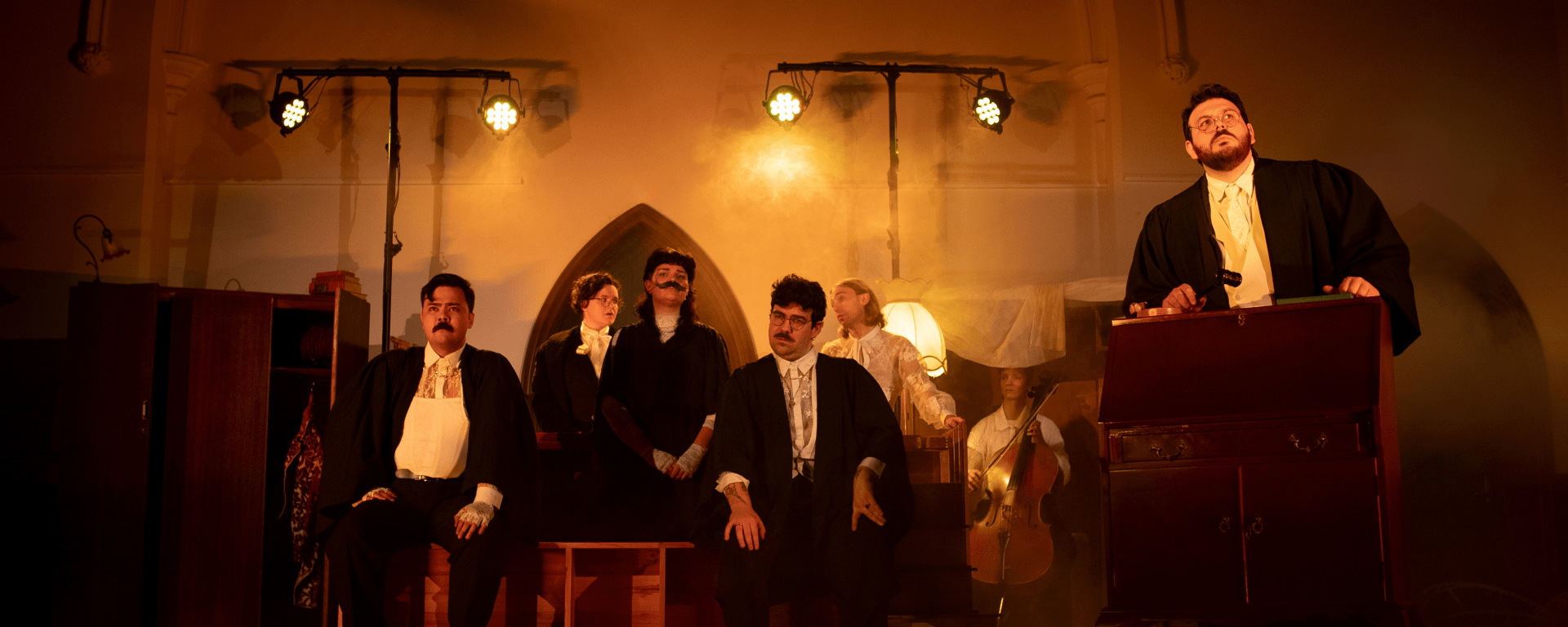
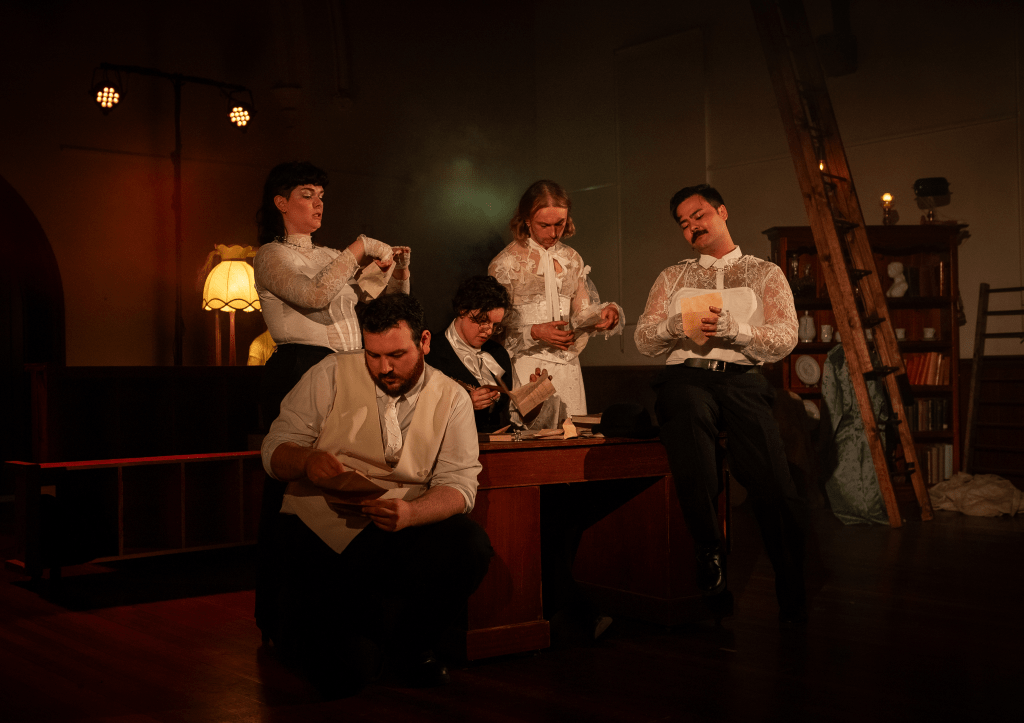
As you move from the foyer and into the theatre, you will be met with a stage beautifully designed by Leonie Leonida (she/her). The air is full of mystery, furniture draped—everything hidden, filling the audience with curious energy as we wonder what could be underneath, waiting to be revealed, a nod to Karl’s hidden sexuality. Two ladders reach to touch the high ceilings of Bluestone Church Arts Space. The set perfectly complements the space, providing a rendering of 19th century Prussia that positions us within the darkly academic world which Karl inhabited.

The play follows the life of Karl Henrich Ulrichs, played by Sarah Hartnell (he/she/they). It begins with him talking with his sister (Emerson Hansford, they/them), who is trying to convince Karl to put down his treacherous scholarship of what we now call homosexuality. Karl grapples with revealing the truth of his nature, desperate to publish his work yet worried about what that will mean for his family. He ends up publishing his work under the fictional name Numa Numantius, represented physically by Nicholas J. Carr (they/he). The play follows Karl as he tackles the consequences of his writing, falls in love, and is imprisoned.
The costumes, designed by Zachary Dixon (they/them) are flamboyant and memorable; their playful use of corsetry creates an excitingly fashionable sense of genderfuckery. My favourite example of this is in Numa’s costuming, where Dixon implements a fantastical all-white costume to accentuate Numa’s fictionality and mischievousness.
Lore Burns’ (they/them) musical compositions for the cello were wonderfully haunting, a welcome mix of chords and sustained notes that brought the performance to life. I hope that they release the music someday as it would be perfect for a late-night caffeinated study session.

Hartnell brings genuine emotion to his portrayal of Karl, utilising a style of acting so authentic it was easy to forget that I was watching a rehearsed performance. Nicholas J. Carr’s (they/he) portrayal of Numa was brilliantly loaded with energy. Their performance juxtaposed Hartnell’s in a way that elevated them both.
Every member of the ensemble did a fantastic job; they were a wonderfully diverse group who each brought their own energy, embodying exciting dynamic movements across the stage.
The final scene was striking. The ensemble positioned in a V like birds in flight, reading aloud with growing fervour the names of famous figures who have come out. It’s desperate and freeing: the notion that we continue to exist, thanks to Karl’s transformative dedication to his work. I hope that he feels proud at how far we’ve come since the 19th century, and I hope that queer people learning of his story are emboldened to continue the long yet rewarding journey onwards.

Numa and Karl is such an affirming and powerful watch as global politics shifts to conservatism. Now, expressions of queer joy and resistance are increasingly necessary, and as such I felt lucky to be in the room on opening night—August 28th—as Chandler and the team celebrated Karl’s 200th birthday. But I also felt strangely isolated — I was sitting there, post-show and alone, on the opening night of someone’s eight-year-long project. I felt out of place but so thankful to be there. Numa and Karl was made for queer people who feel out of place. I hope the cast and crew could feel my awe and admiration for the work.
My first thought when the show ended was that I needed a copy of the script immediately. Many of my notes from the night read as reverent gibberish, as I wrote the word “beautiful” at least half a dozen times in relation to each aspect of the performance.
It’s so important to have historically grounded queer texts these days, and the love put into Numa and Karl was incredibly palpable. This performance had such a deep and profound effect on me, and I do believe that every queer person should come down to watch it. Numa and Karl is an incredibly welcome history lesson that deserves global recognition for its dedication to queer joy and resistance.
Sevenfold Theatre’s Numa and Karl: Extraordinary Man That He Was plays at the Bluestone Church Arts Space til September 13th.
AZMY AZURITE (they/them) is a 2nd year Creative Writing student at the University of Melbourne. In their spare time they enjoy watching theatre, playing video games, and thinking about studying.
EMMA PARFITT (she/her) is the Dialog’s head editor and has written Dialog reviews alongside studying towards her science degree for the past two years. She is a production manager, stage manager and producer on the Melbourne indie theatre scene and a veteran of student theatre at Union House Theatre.
 The Dialog