

REVIEW BY KATYA EWING
EDITED BY MYA HELOU
Don your necktie and prepare your cucumber sandwiches, for this is not one to miss. RMIT RedActs have knocked it out of Hertfordshire and brought to Kaleide Theatre a slice of Wilde with their rendition of The Importance of Being Earnest.
The plot is simple. Jack Worthing (Bodhi Keech) is attempting to live a double life. As Jack in the country, he is the strait-laced, morally conservative guardian to his young ward Cecily (Charlotte Fels). As his fictional brother, ‘Mr Earnest Worthing,’ he is free to a lavish life in the city.
Catching onto this double act, the irrepressibly suave and cunning Algernon (Tom Worsnop) decides to get in on the fun. Always up for some ‘bunburying,’ the ever-charming ‘Algie’ quickly adopts his own Earnest alter ego to visit Cecily.
Both men descend on Jack’s country house. Two women quickly find themselves engaged to the two men, both purporting to be one man named Earnest. Over tea, Cecily and Gwendolyn (Ash Houghton), at first ‘the best of friends,’ soon become arch enemies with the discovery that they are supposedly engaged to the very same ‘Mr Earnest Worthing.’ Oh, and if that wasn’t enough, there is also the case of the handbag, discovered at midnight in the coat room at the train station.
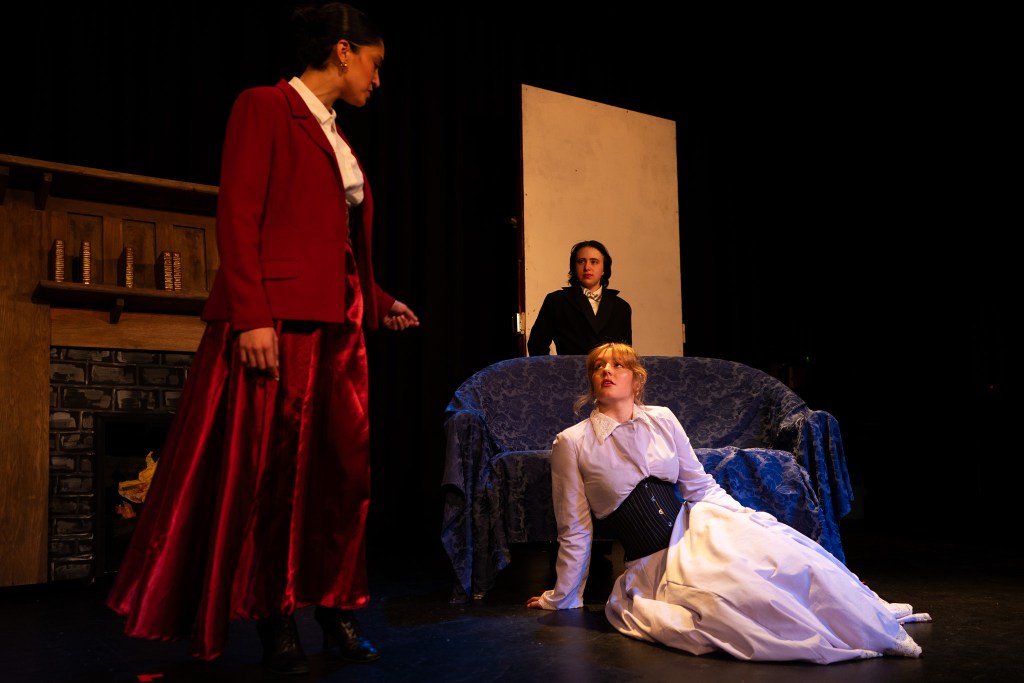
Set designer Emily Botham, assisted by Minh Mai and Ciel Giles-Manor, brought us a dynamic set. In the first act, an obscure and colourful frame arrangement, layered blue satin and lace curtains alongside well-chosen matching chairs and couch place us in Algernon’s Victorian living room with a delightful twist. These set features were then easily flipped to become an English rose garden and a country drawing room in the later acts.
Lighting, led by Angus Purtell and Edward Wilding, was warm and simple, with soft lightbulb pings for realisations delivering an added comic element.
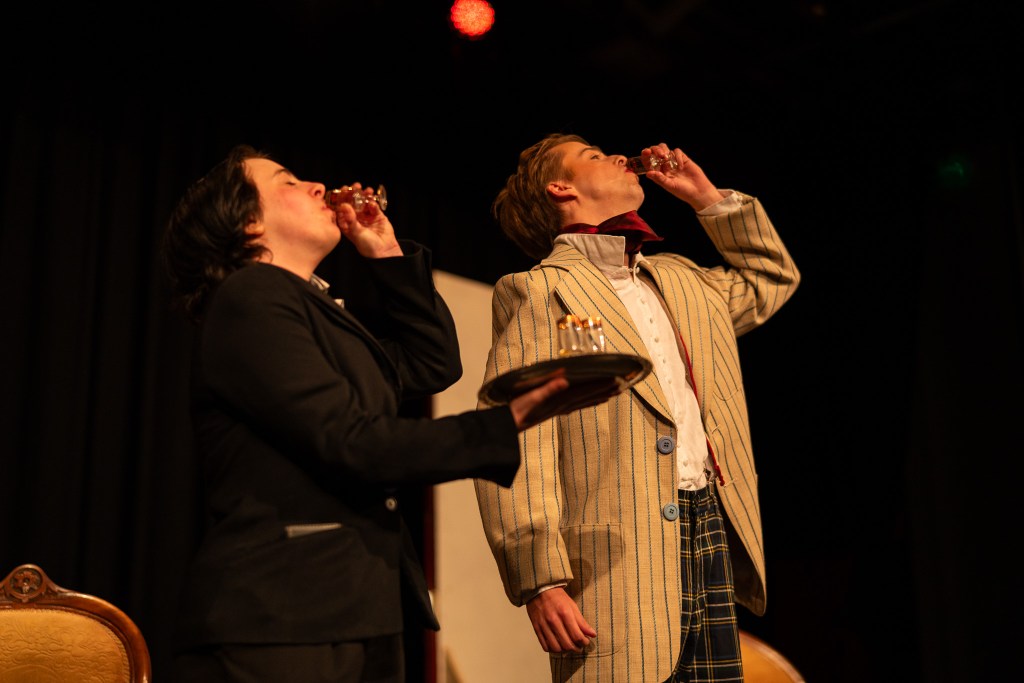
With a wonderfully quaint Wes Anderson like beginning, the audience are eased into Oscar Wilde’s ‘trivial comedy for serious people.’ Algernon’s butler, Lane (Percy Mangiafico), delivers cucumber sandwiches and tea to the table with perfect precision, backed by an aristocratic piano track, orchestrated by sound designer Laura Wilson and sound assistant Soyuun Bang. With a delightful eye roll in the direction of the piano player, Lane gives the audience a window into the flamboyant gestures and facial expressions to come.
Then, in slides Algernon. Tom Worsnop as Algernon brought energy from the top. Dressed in a delightfully jarring clash of patterns (credit must go to Catherine Thomson and her costume team), he bursts onto the stage. Indeed, he pranced, kicked and seemed to moonwalk at some points. He even flirted with the furniture as he reclined on the sofa like it was an extension of himself. Worsnop’s patter of movement could be likened to a dressage horse as he lifted his leg high, stood in his signature wide leg stance, munched open mouthed on cucumber sandwiches, or seduced the couch with a snappy kick of the leg.
Bodhi Keech (Jack Worthing) the straight man to Algie’s funny man, was brilliantly tight and wound in a dapper navy suit. Hunched and exasperated, his gestural flare as he banged hands against his knees in exasperation, awkwardly sat with Gwendolyn, slowly melted to the floor and gesticulated for all made him the perfect hard done by straight man to Algie’s flirtatious flouncing.
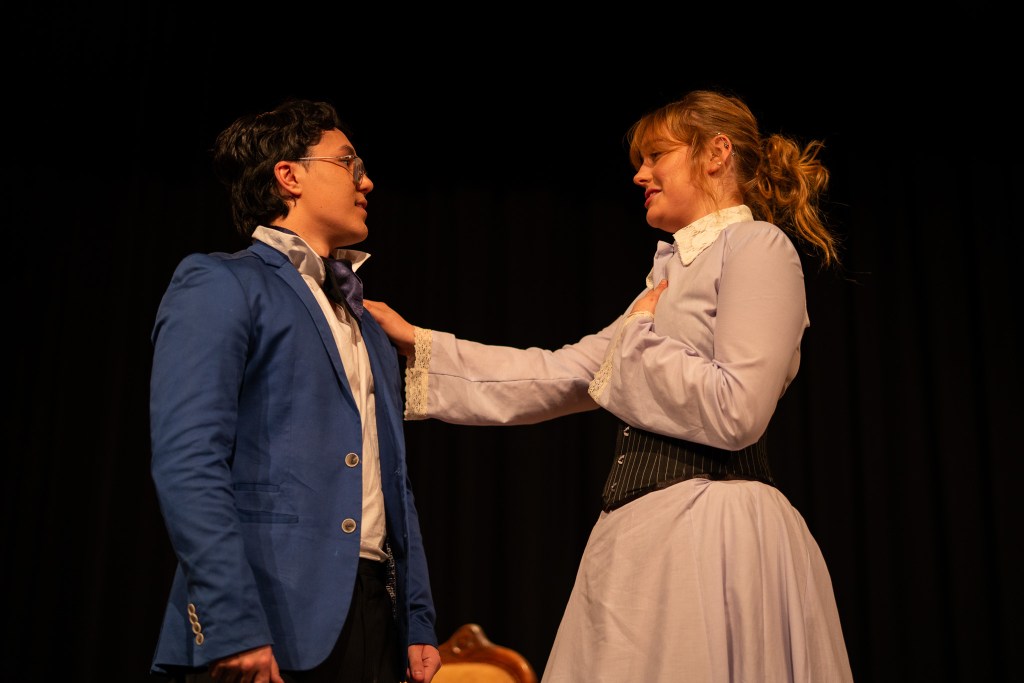
Parallel to this ‘bunburying’ pair was Gwendolyn and Cecily. Charlotte Fels as Cecily was delightfully cheeky and flouncy – prancing around the stage in what seemed to her a fantastic game. For me, Fels brought the Gen Z to Herefordshire, treating her diary like a day in the life (with added fictions) and her hair swishes like a Glambot moment.
Ash Houghton as Gwendolyn acted brilliantly as the daughter to her imposing mother. Assertive and impatiently expectant for Worthing to propose, Houghton held her own in a lavender dress and corset.
Cecily and Gwendolyn’s bitchy cream tea was a particular standout. Women, as Wilde wrote, ‘only call each other sister when they have called each other a lot of other things first.’ They brought fun and freshness to this scene with a power play seating dance starting what was to become a full-blown war. The scene became a tennis match, the women firing shots at each other over the comfort of teacups and cake as they discover that they are allegedly engaged to the same man. Cecily’s upturning of the sugar pot into Gwendolyn’s tea and lumping of cake onto a plate was fantastically slapstick, and indeed the props here, delivered by Grace Stewart and May O’Connor, elevated the scene.
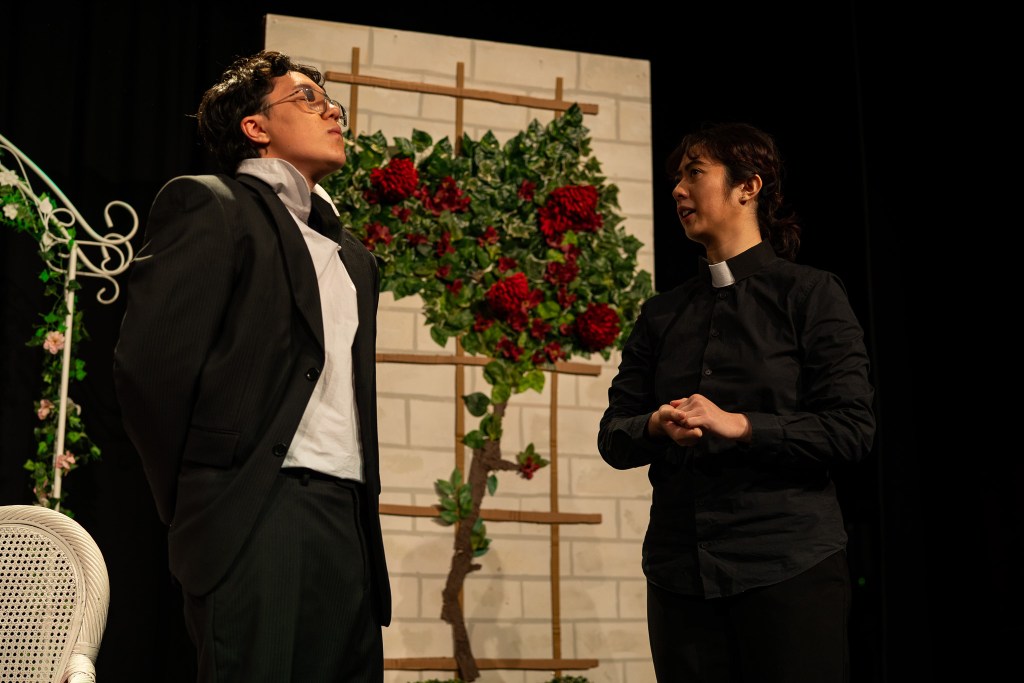
Following this, Algernon and Jack’s stress eating muffin mukbang was brilliantly entertaining. With just a cake stand of muffins and an open stage, they perfected the straight man/funny man double act. ‘I can’t eat muffins in an agitated manner,’ Algernon said as they sparred over their deception gone awry. ‘I wish you wouldn’t yell at the muffins there’s only one left,’ he then whined, spit firing his mouthful across the stage. Two men with a cake stand has never been so amusing.
For the final act, the main curtain was swept back to reveal a stately drawing room. The couches acted as bases for warring factions as Lady Bracknell and Jack Worthing clashed over engagement arrangements. With a piercingly posh English accent, chin held high and posture like an ironing board, Emma Boyce was perfectly composed, hypocritical and pompous as Lady Bracknell. Meanwhile, Miss Prism (Kit Wills) remained square-shouldered and unflustered as she delivered her final revelation.

Hamish Box and Holly Douglas’ direction ensured that, even with the whole cast on stage, no one overpowered. Each character brought their own flair and comedic touch to the final revelatory scene.
Warmth, humour and a sense of fun radiated from all corners of the theatre: not only from the actors on stage, but the lighting team, the production crew at the door and audience members darting across seats to greet friends and cheer on the performers. This production is a reminder not only of the Importance of Being Earnest, but the importance of great theatre!
RMIT RedActs’ The Importance of Being Earnest played June 12-14 at the Kaleide Theatre.
KATYA EWING (she/her) is a third year English and Theatre studies/Media student. She loves immersing herself in the theatrical world whether it be acting, watching or reviewing!
MYA HELOU (they/them) is an English and Theatre Studies major whose love of theatre was fostered by Shakespeare and classical Greek tragedies. They will take every opportunity to discuss either.
The Dialog is supported by Union House Theatre.
 The Dialog