
REVIEW BY POPPY ELFICK
EDITED BY OLIVIA DI GRAZIA
CIPTA’s Exit the Boy plays in the realm between humour and horror to shine the lantern-light on religious trauma in a captivating tale of spirits and sleeping bags.
At Father Kirk’s sleep-away bible camp, two boys find themselves confronted by an unknown force they believe to be a demon while sleeping, for 4 nights in a row. Performed by a cast of six who should be the stuff of storytelling legend, Exit the Boy follows Jonah and Wilhelm as they fight to capture and dispose of the demon that haunts them – but what or who is this creature? Playwright and director Blue Jordan weaves humour and folklore into a tale that gestures to child sexual assault in the church and religious trauma. Jordan’s metaphors to describe the demon attacks hauntingly match the poetic lyricism of the fairytales she weaves into the play. A notable choice is the use of Father Kirk (Poppy Treadwell) as the narrator of the story, signposting scenes, overseeing the action, and delivering long monologues that, through Treadwell’s voice, manage to reflect, twist and distort a priest’s sermon.
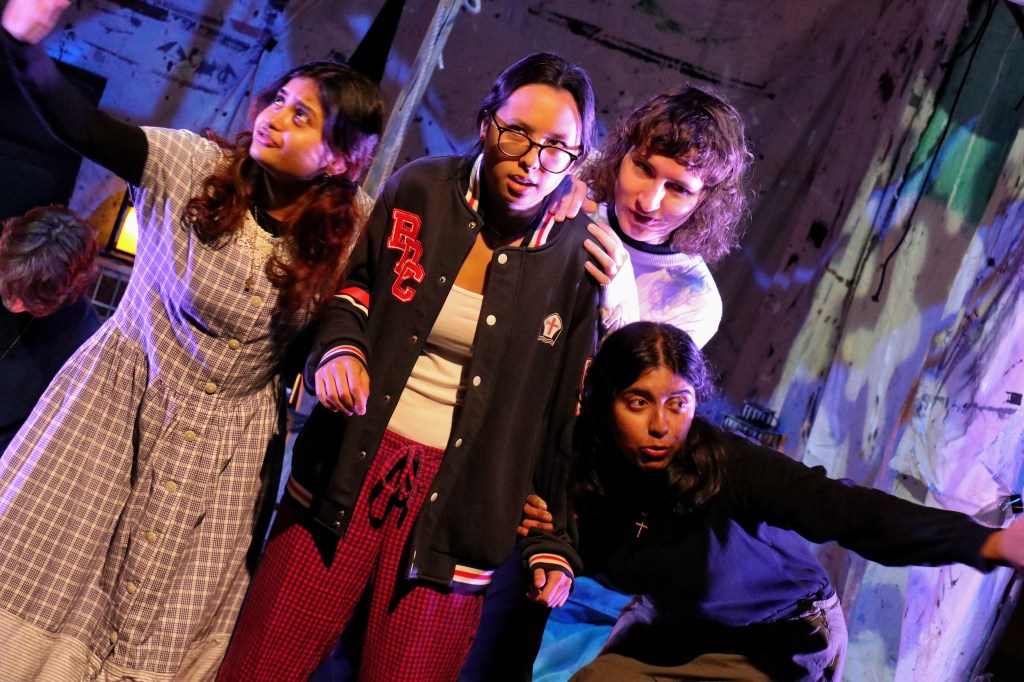
Wilhelm (Chai Duncan) is an ultra-religious boy who refuses to believe that he could be facing a demon in a world where he is good. Duncan did an exceptional job at portraying the slow acceptance of his circumstances and his mustering of the courage to fight it. Wilhelm’s counterpoint is Jonah (Abbey Oshlack), pronounced Yonah, a German-Australian boy who is clearly an outsider, not friendly with the other kids at the camp. At first, I was confused about the importance of his German heritage, but the effortless weaving of German folklore into the story explained that quickly enough. Oshlack displayed an insane ability to quickly change between hilarious physicality and gut-wrenching breakdowns when talking about Jonah’s home life, leading to a devastating realisation about who the demon really is.

When travelling through the play, my assumptions about what or who the “demon” really was changed; each line had me questioning my answer. But as the show progressed and information about the boys – especially Jonah – was slowly released, it solidified for me the demon as something more sinister than I could have imagined. I think Jordan should be commended for her ability to leave the audience questioning each line, acting choice, and movement while trying to make sense of the world she has created. I think, for me, where the story was slightly difficult to comprehend was understanding the relationship between Wilhelm and Jonah at the beginning. At their first interaction, it was difficult for me to decipher how, or even if, the characters knew each other before the play takes place. Have these two teenage boys already met, or are they perfect strangers, sharing a tent by chance and forced to bond as they battle a demon? I think as the play progressed their shared experiences made it so this detail didn’t matter as much anymore, but this backstory detail could have helped provide context for the situation at the beginning of the play.

I also think that the mystery of the demon was further heightened by the choice to have this malevolent force portrayed by each of the three ensemble members (Krishitaa Purusothaman, Laura Wilson and Akshita Benny) for the first three nights. I was thoroughly impressed by the ensemble’s range. From camp kids, to demons, to rose bushes, each cameo by these talented performers brought me such joy. As demons, the three had amazingly creepy physicality, each with a distinct take on the movement, differentiating the night phases and bringing a new piece to the puzzle.
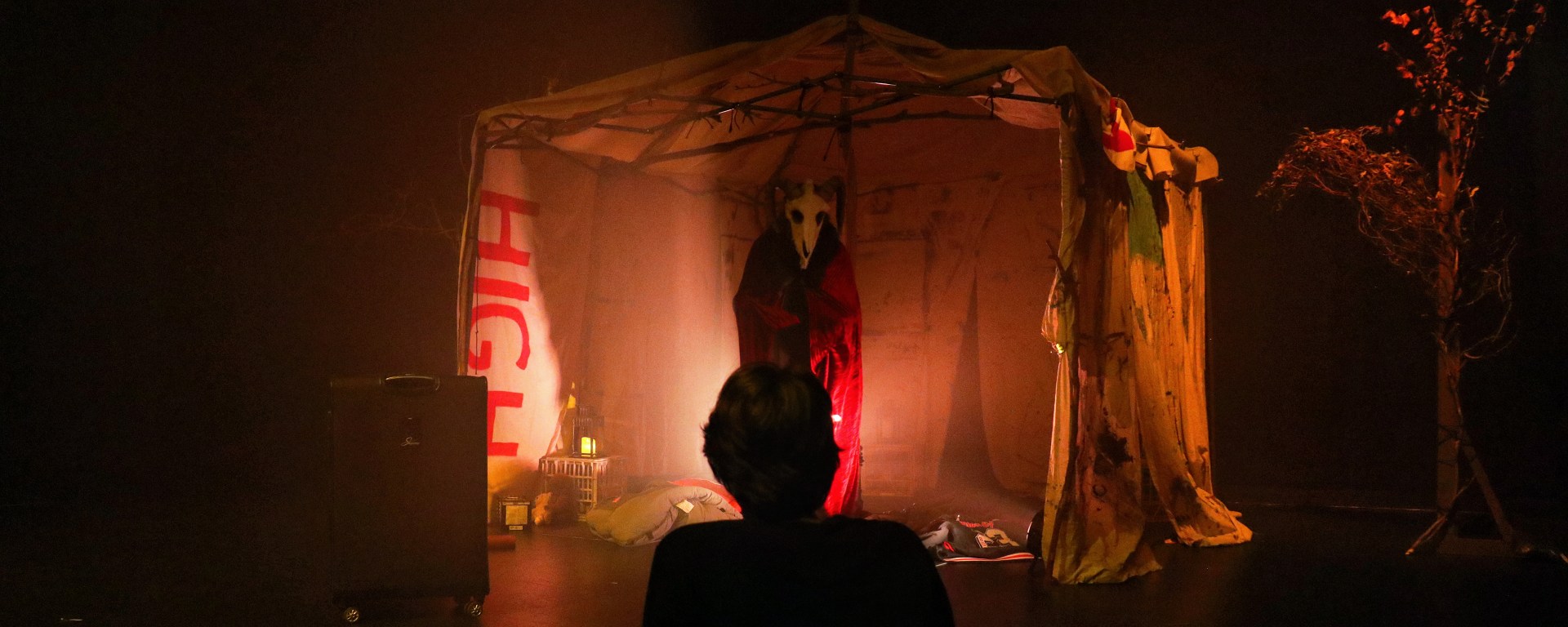
The costume design by Ren Richards assisted in the creation of a creature that was both one and multiple at the same time. The use of different animal masks to portray the demons at night – and the climactic transformation of Father Kirk – helps us to understand that they are one and the same, whilst simultaneously keeping us on our toes until the big reveal. The donning of the cape and animal skull on Father Kirk’s head was such an a-ha moment in the play. All the pieces of the story connecting, and the extravagant velvet cape billowing were so dramatic in such an enticing way. I was mesmerised by Poppy Treadwell’s ability to stand still for such a long time; I was almost convinced she had left and been replaced by a statue! Mind you, she had not left the stage once this entire time, as Father Kirk oversaw the entire camp throughout the whole play. This staging choice gave the character a very oppressive aura, knowing that he could see and hear all as the narrator (and villain) of the tale.

The interplay between the set, lighting, and sound in this production left me speechless. Mia Ramos miraculously took us from the Guild Theatre and dropped us directly into an Aussie bushland campground. The canvas tent that took up the majority of the stage was dressed in such a way that it seemed so very part of its natural surroundings, whilst also being so other. The suitcases and sleeping bags gave the space a lived-in feeling that transported me into the world. The incredible lighting design by Oscar Lanigan also helped us move around the space. I was especially impressed by the ability to transition from inside the tent to completely outside it simply through lighting. The sound design by Alina Konovalov created such an ambience; the ability to blend the sound so flawlessly that the woodsy atmosphere became so natural I forgot I was listening to a pre-recorded sound was incredible. These technical elements merged so well and played off one another to build a very immersive, intimate setting.
60 minutes of laughter, mystery, and sadness, Exit the Boy was the first CIPTA show I have had the privilege of seeing, and I can’t wait to follow along for what comes next.
CIPTA Theatre’s Exit the Boy played May 7th-10th at the Guild Theatre.
POPPY ELFICK is a 2nd year performance design and production student with an affinity for all sides of theatre-making. Getting her start in university theatre performing at residential college, she has since directed, designed, and seen as much student theatre as she can.
OLIVIA DI GRAZIA is a University of Melbourne student and sub-editor for the Dialog.
 The Dialog