
REVIEW BY GRYFF CONNAH
EDITED BY RACHEL THORNBY
Few emotions hold the primacy that fear does. It is both our greatest strength and greatest weakness as a species: our central driving counsel; and the force that keeps us paralysed and stagnating.
When entering the Above Sea Level’s production of Far Away, it is clear that fear has metastasized in this space. After a disorienting greeting by ushers in zany, Dada-esque headware, we are faced with a set dominated by imposing floor-to-ceiling rope-ties, with a troubled Charlie Fraser (as Joan) staring out beyond the arriving audience.
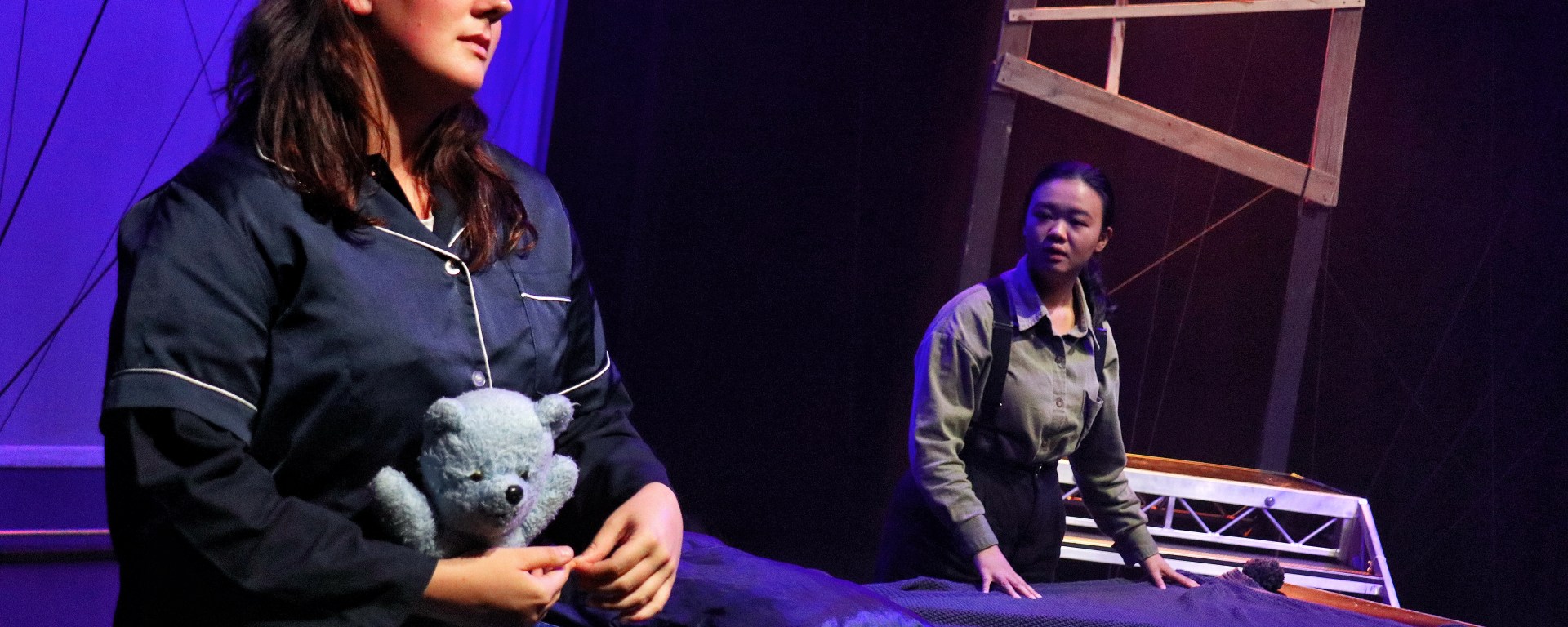
As soon as the house lights dim, the mood ripples with menace – a clear directorial choice from co-directors Saskia Powles and Campbell Jordan. Fraser and Cecilia Liu (Joan’s aunty, Harper) take us through a disquieting duologue, in which Joan suspects ill of her uncle whom she has just witnessed trafficking and beating innocent peoples. Liu’s performance is beautifully stilted, giving Harper an air of uncanniness and perversion. There is skilful dissonance in her evocation of Harper’s façade; she comforts Joan with plausible explanations to the contrary and assures her that all is well. There is a threatening undertone, signalling to us that nothing about this is well. It is here that we first begin to glimpse the hidden meanings in Caryl Churchill’s pared-back script; ‘Far Away’ stages an interrogation of “the truth”, and the myriad ways in which it can be fabricated and manipulated.
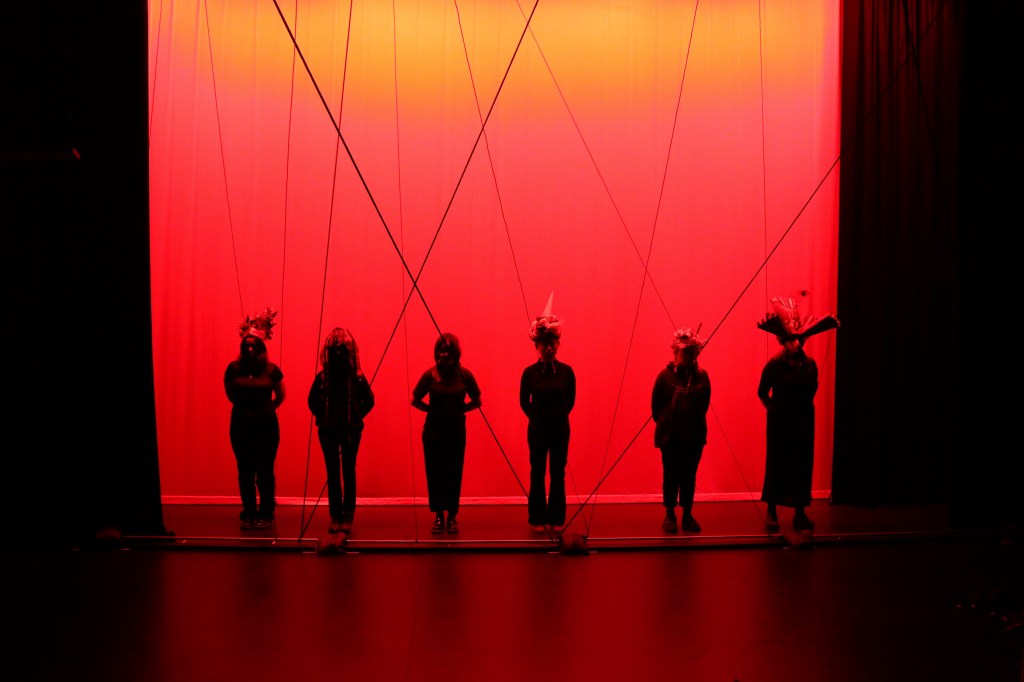
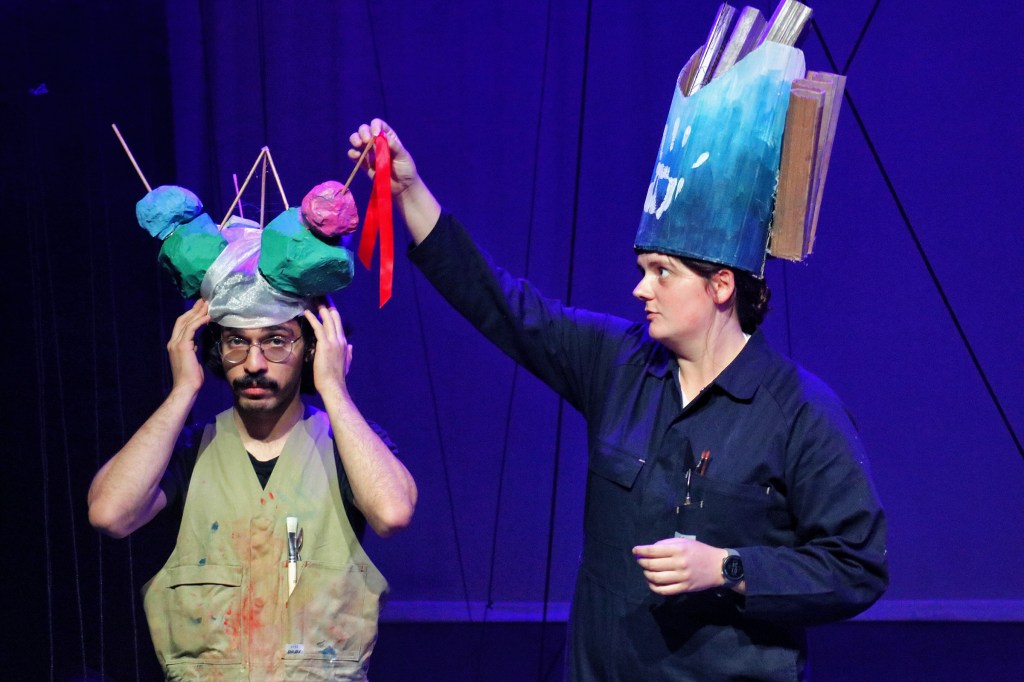
Fraser responds to this with acuity, delivering lines that prod, whilst maintaining a child-like obedience and deference that churns the stomach. Joan’s character is then brought into Act 2, 15 years on, where she meets Todd (Rouzbeh Nadjar). These two hold a connected dialogue, navigating disagreements, frustrations and moments of painful vulnerability all whilst crafting some pointedly garish hats. These hats (skillfully designed by Shannon Yeung) serve as a discordant focal point; their frivolity belies their real purpose, as adornments for prisoners with a capital sentence. Nadjar takes the floor in this Act, as a diligent milliner who either does not know better or who chooses not to acknowledge the ends to which his craft is set; these ambiguities are nuanced and expert.
Finally, in Act 3, we fling further afield to a time when war is ostensibly being waged between humanity and nature itself. Harper and Todd dispute the allegiances that aspects of the natural world (like the deer, the crocodiles; even light and darkness) have taken with enemy nations. Now, propaganda has progressed to divorce us from the sanctity and neutrality of nature. The absurdity of this conversation is staggering at first glance however, upon a closer listen, it becomes redolent of conspiracy and reeks of misinformation. Fraser sees us out with a powerfully poignant monologue where she recounts her journey home and the horror she felt for not knowing what “side” the river, the livestock, the grass were on. There is something deeply wrong with the fact of someone being so viscerally averse to nature, so as to forsake it and treat it as an antagonist.
This production is prescient indeed. Over the course of these acts, we see the world descend into paranoia and chaos, as the foundations of truth are eroded and fear takes a vice grip to the throat. Far Away holds a sharp mirror to the political landscape of today. We are entering a world where social media and generative AI warp what is real with lethal efficiency; where world leaders actively obscure their actions by firehosing and touting glittering generalities; where a glut of information has led to mass suspicion and harmful conspiracy. This production addresses this reality head-on, with strong performances from all three main actors.
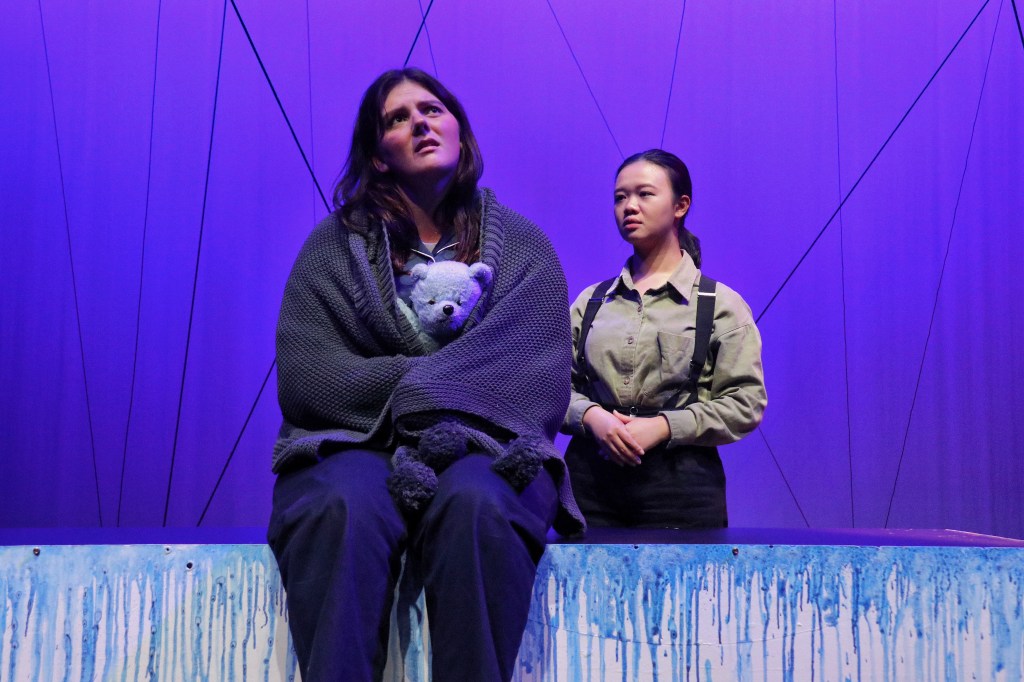
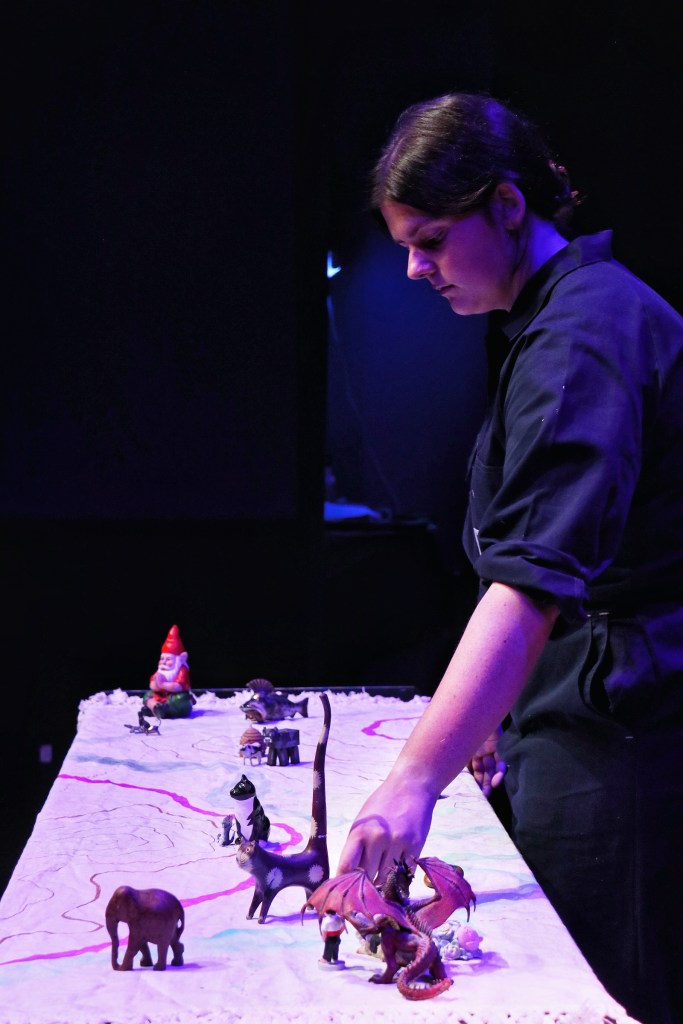
In terms of the set, I’m more than impressed. The design is masterful, evocative, and a real feat of engineering. Rope-ties arc from corner to corner, creating a web-like superstructure that offers us anything other than comfort. Ashleigh Shearman’s lighting sequences complement this expertly, with moments of nauseating pulsation and stark wash adding to the sense of dread. Of course, it is the brooding sound design that caps this production off. Nick O’Brien’s audioscape brims with faceless malice and feeds nicely into moments of tension, realisation and testimony.
At times, the pacing of this production struggled to hit its stride. The march of the prisoners was a strikingly devised sequence; however, it may have benefited from a from a slightly quicker beat. There were moments where the energy of the performance slipped slightly, leading to some unintentional lulls. I wonder whether this was the production finding its feet opening night; in any case, a bit more pep might have given what were already amazing scenes that extra draw-in power.
In all, Far Away does what any good theatre piece should do: it forces us to confront reality face-first, so that we begin to change it for the better. We are not “far away” from Churchill’s microcosms, and Powles and Jordan do an excellent job of foregrounding the urgency inherent in this. When I next see this production, I hope we have made steps as a society to uphold what we believe to be true, and to stare fear down the barrel. Fear may hold primacy, but hope will hold us in our hearts.
Above Sea Level’s Far Away played May 1st to 3rd at the Guild Theatre.
GRYFF CONNAH (he/him) is an emerging, Naarm-based performer and theatre-maker who is currently studying a BFA in Theatre at VCA. His written, directed and devised works aim to disrupt the inertia that is imposed by capitalist hegemonies, and to explore environmental activism, stories of neurodivergence and disability, and queerness.
RACHEL THORNBY is a media and communications and creative writing student currently studying in Melbourne.
The Dialog is supported by Union House Theatre.
 The Dialog