

REVIEW BY BRONTE LEMAIRE
EDITED BY EMMA PARFITT
A man lays on a hotel bed with his wrists bound. He’s still. He doesn’t shift when she enters, when she stalks around the edges of the bed, or when she gulps down the champagne. He doesn’t even make a noise when she creeps on top of him peering. She claps once. Loudly. Twice. Then again and again and again. The audience flinches, too scared to draw a breath. She grabs onto him by the collar and screams.
How did we get here?
It’s hard to go into any piece of trans media without the weight of the current political climate walking through the door with you. In the wake of trans rights being systematically revoked and eradicated in the USA, you can feel the culminating pressure in the room, sneering at the queer defiance trans art brings. And now with the questioning of trans rights leaking over into Australia where Queensland has paused gender-affirming care for trans kids, it’s starting to feel closer and closer to home. Djuna is well aware of where the world is heading, and it is angry.
In the midst of political turmoil where protests need to be planned around and curfews come in, the play centres an affair through a series of vignettes between Marcus (Dion Mills) and Djuna (Jay Gold). Djuna is a young trans girl who can’t sit still and is coming to terms with who she is, whilst Marcus is ready to exploit that.

Eva Rees’ writing gives a masterclass in tension and mystery. Predictability is a stranger to this show; at no point did I feel sure of what was going to happen next or even what was happening right at that moment. The characters lie every other sentence, and sometimes even they seem to believe what they’re saying. They’re impossible to pin down, in one moment I’m terrified for Djuna’s safety, the next I’m worried what level of destruction her twitching hands are capable of.
Mills acts with a devilish grin and somehow achieves the difficult job of making this awful man feel empathetic and in rare moments endearing. Full of flaws, full of violence, full of a desperate need to connect. Mills commands the stage. Our first vignette after the foreshadowing beginning has Marcus preparing for Djuna’s arrival. He doesn’t speak but he doesn’t need to. The space and our attention are his to consume. Like Djuna, we are drawn into Mills’ magnetism, like a fire you can’t help but want to touch. The anger that erupts out of Marcus is so suffocating it made me want to curl up and close my eyes or jump up to become a human shield between him and Djuna. I had forgotten I was watching a play.

Gold is fascinating to watch in their depiction of Djuna. The audience, like Marcus, is desperate to poke and prod her to find out what she wants, why she’s here, why she is clearly lying about her age and why she secretly wants him to catch her out on it. We watch her grow more comfortable in the space, initially stiff and dropping items like a robot given an instruction, to walking around like she owns the place, somehow convincing Marcus to let her put eyeliner on him. And then sometimes she slides into some form that’s a bit more disconcerting, a bit too big for the confines of her own skin or the stage like she’s come from another world with unpredictable impulses – she felt like a
wild animal. Barred in, circling her cage, waiting for the zookeeper to slip up just one more time.
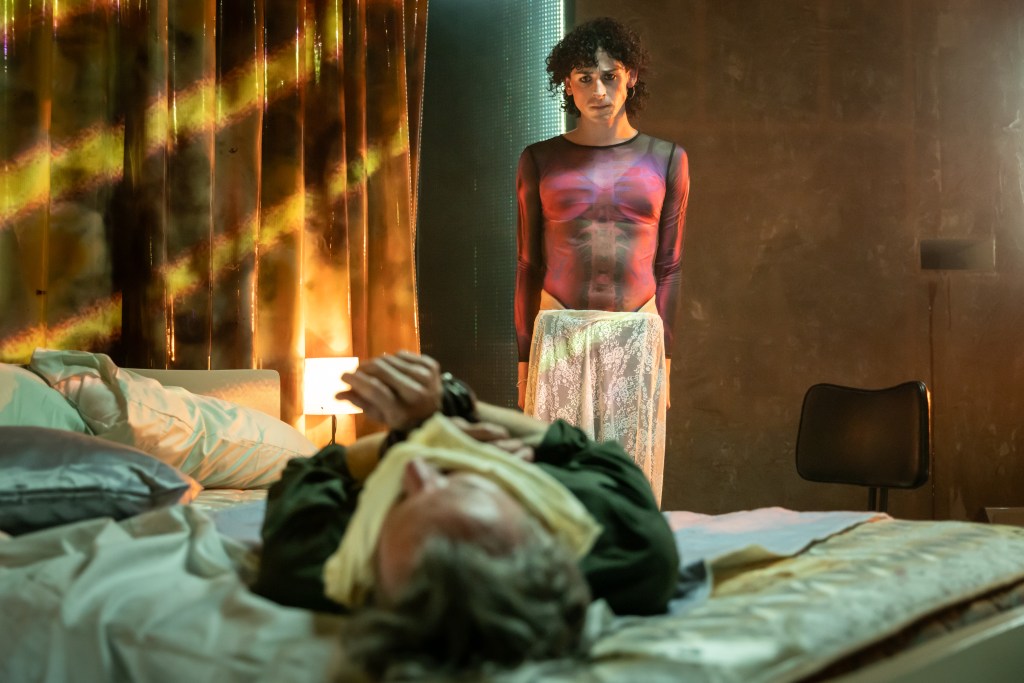
Credit must be given to the director Kitan Petkovski for making the actors look so natural in their environment, in how they situate themselves on the chairs and bed, taking a second to readjust their clothes to look sexier while the other has turned their back. His direction maintained the pacing the show needed a meticulous grip on to not let these two strange people slip away from us.
The sound by James Paul was excruciatingly bone chilling to add to the anxiety that pulsated through the theatre. Every time a vignette ended, I had to brace myself for the overwhelming drones that would pair with Tim Bonser’s ability to create a complete blackout in an instant. When the lights were brought up, I would be jump-scared by the actors’ new positions with the sudden pullback of sound.
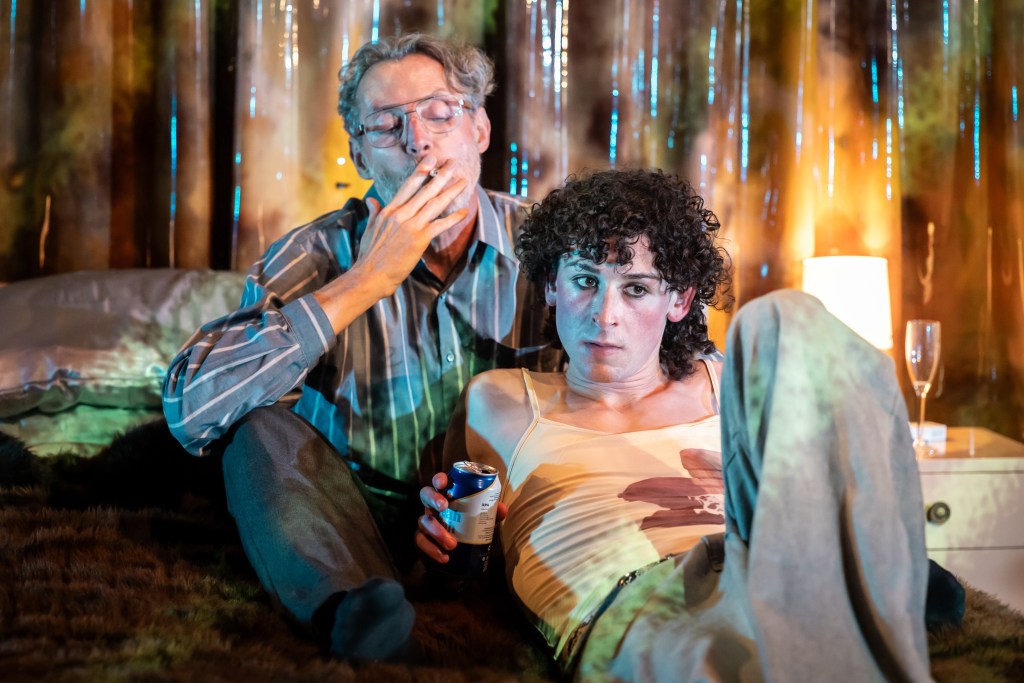
As the show continues, Marcus’ tactics become gut-wrenching and life changing opportunities for Djuna, leaving both the audience and Djuna stranded between what to do. It’s the dynamic that is core to the show, a man in power knowing he can give you exactly what you want, but at the price of ownership. Rees understands intimately that power is not just the ability to hurt and take away, but to the power to bestow gifts, especially when it comes to our governments and whether they’re chivalrous enough to give people rights. This exact power is what makes Marcus a grotesque and twisted god.
However, even power can overstay its welcome, or reach too far into a territory it has deemed weak enough to use. It can be so laughably easy to accidentally lock yourself in the enclosure.
Djuna is a play that I will be orbiting around in my head for a long time to find new connections and layers to peel back. No punches are pulled and Djuna instead twists the knife whether you’re ready for it or not, keeping you on the edge of your seat as you ask how did we get here?
Bronte Lemaire (any pronouns) is a writer and theatre maker who loves witnessing what emerging artists can achieve. Bronte loves analysing and picking apart what makes art work and function (or not!) in order to learn and steal some inspiration for herself.
Bullet Heart Club/Darebin Arts Speakeasy’s Djuna plays at Northcote Town Hall Arts Centre until March 23rd.
The Dialog is supported by Union House Theatre.
 The Dialog