
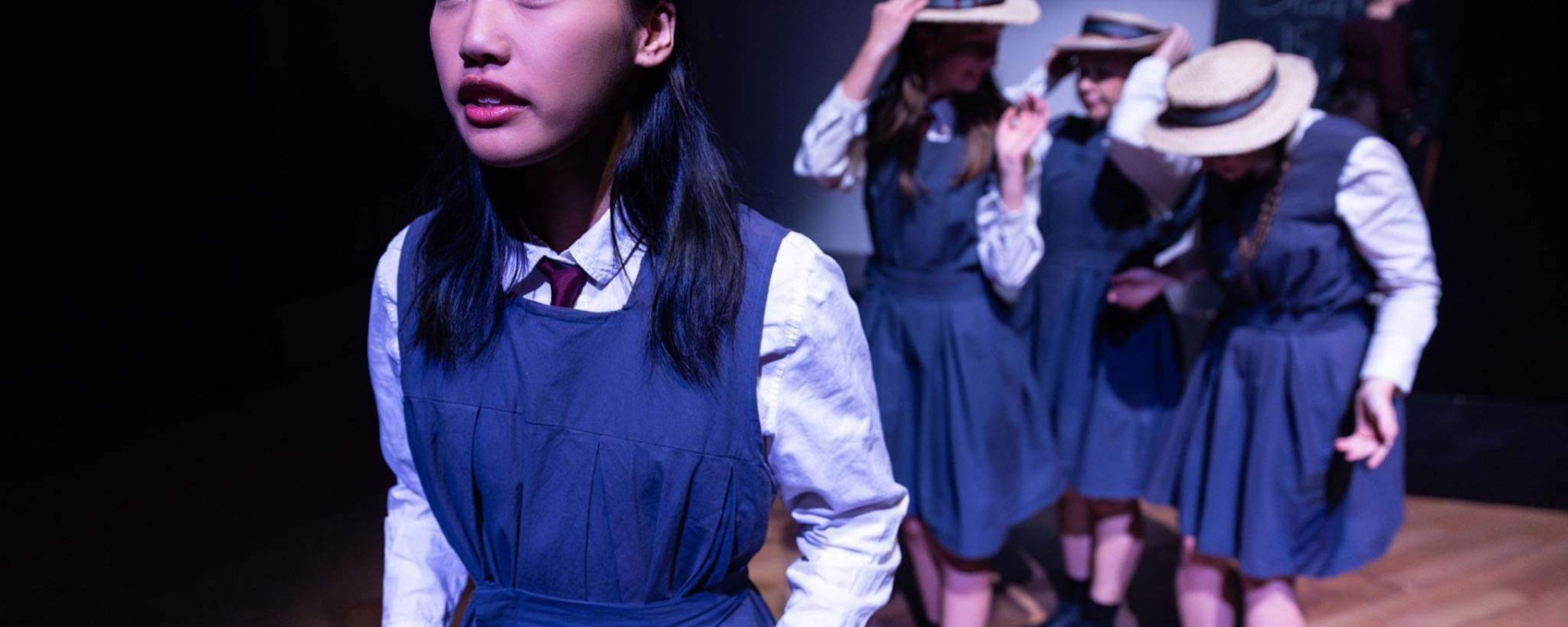
Barkly Theatre gets off to a sinister, spell-binding start with their debut production.
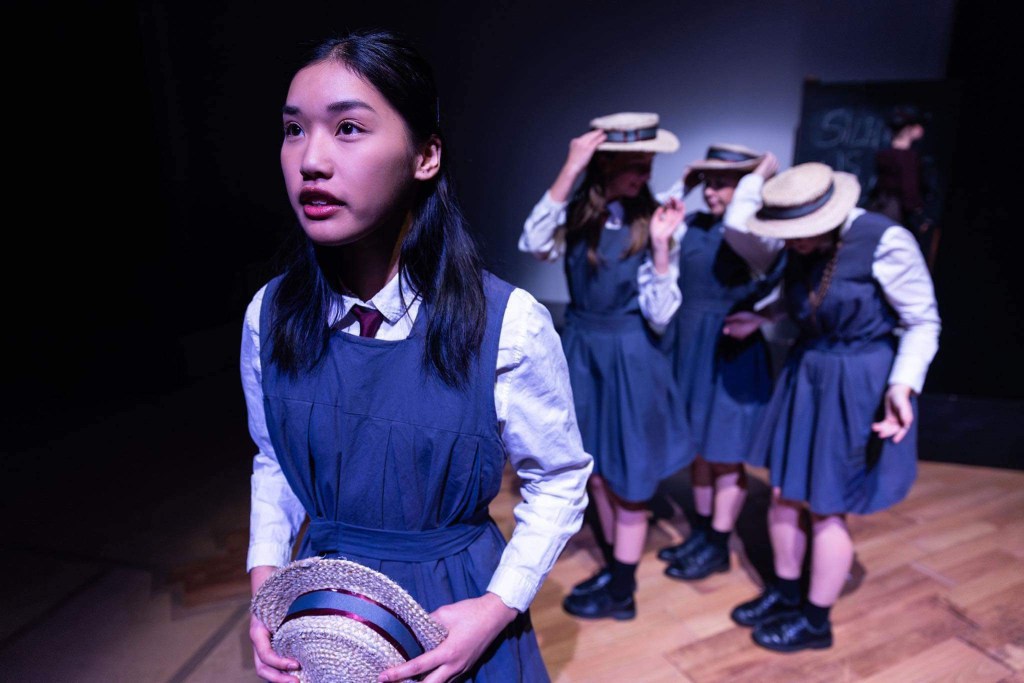
Picnic at Hanging Rock would be a bold choice for any debut. Published coinciding with the 1967 First Nations referendum, Joan Lindsay’s carefully manicured novel sculpts a world in turmoil. Four schoolgirls, perfect Anglo-Australian citizens, disappear from a Valentines’ trip to Hanging Rock; two are never found.
Lindsay’s curlicued prose chronicles the aftermath of this mysterious disappearance, as the settler society struggles to maintain control over a hostile environment. Picnic thus takes place in a vexed colonial landscape, where no amount of poise and British pretension can save its characters from a reckoning.
Today, living as we do under the shadows of the ‘No’ vote, a reckoning still looms. The spider’s web of Picnic at Hanging Rock continues to expand, its uncompromising atmosphere informing our contemporary political climate. Now more than ever, our population is grappling with the tension between ‘us’ and Country – and, in Barkly Theatre’s eerie new production, that tension takes centre stage.
‘[Barkly’s Picnic] examines the relationship of these ‘picnic girls’ with the country and the land [to] which they do not belong[:]’ with these girls as refining lens, Michaela Lattanzio and Oscar Lidgerwood – Picnic‘s directing dyad – cast a light on the British colonial mission, that frantic tussle to triumph over an alien, barbarous landscape. The echoes of this tussle are latent throughout the entire production, although they manifest perhaps most strikingly in Solène Bonheur and Campbell Jordan’s pared-back set design.
Under Bonheur and Jordan’s creative vision, Picnic‘s stage is literally bisected: one half floorboards, the other the arid dirt of the desert. Although their design is, at points, somewhat confusing [Hanging Rock is bush, not scrubland], but its thematic weight cannot be overstated. There can be no fusion of these two worlds, natural and imperial, nor any quarter; we are watching a fight to the death.
Fortunately, death matches make for good entertainment. Barkly’s Picnic instills every scene with tense, brooding eeriness, its characters propelled like marionettes towards their inevitable conclusion. The first act, during which the four girls [played by a five-pronged cast, each taking on and shedding roles like the girls cast off their shifts], is filled with a looming dread.
Credit here must go not only to the actors but to the directing team, as Lattanzio and Lidgerwood choreograph the scene with a superb instinct. The girls walk together, synchronised; they sit as a single entity, a Greek chorus narrating their own tragedy. Together, they create a theatrical experience at once disorienting and stunningly, bitingly clear. Whatever is happening on the Rock is fundamentally unknowable, both to the characters and to us, the audience. These girls aren’t characters; rather, they’re symbols.
This initial abstraction is, frankly, enchanting – and yet, in its later moments, Picnic begins to pall. Part of this, admittedly, is a fault of Tom Wright’s over-florid script. His purple prose may work for the ethereal mysticism of the Rock, but in the aftermath of the girls’ disappearance such lyricism loses its savor.
© Kai Clews
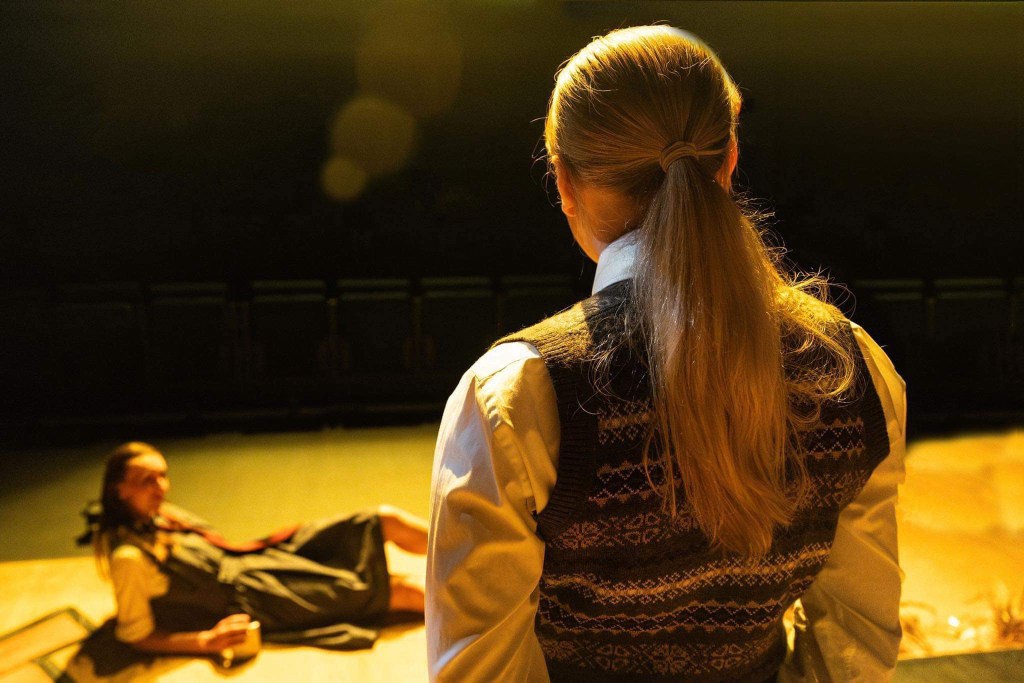
However, Barkly’s Picnic is also limited by its ideological constraints, rooted in a fundamental mischaracterisation of the English characters. Cosima Gilbert, while excellent in her chorus roles, plays Michael – the British expat, a typical county lord – with a bitter edge, his perpetual grimace a reaction against the Australian landscape.
Michael, in Lindsay’s novel, is charming if clueless, equally enamored with Australiana, the schoolgirls and his valet Albert. His likeability powers the second half of the text, luring us [and Albert] back again to the Rock. The rationale behind stripping him of this charm is clear; British colonialism has scarred this country, and sympathising with Michael feels like endorsing it. Instead of sympathy, therefore, Barkly’s Picnic aims at alienation.
Costume designer Ellie Dean – whose consistently stellar work lies embedded throughout Picnic – distinguishes Michael visually, dressing him in a sweater vest and tie: almost aggressively English. In a production where the majority of other characters wear no prescriptive costumes, the five actors playing coach-drivers and policemen in school dresses, the effect is damning.
Michael – along with Mrs. Appleyard and Irma, two other stalwart beacons of European civilisation – have become the Other, alienated from the playscape in a blatant reversal of British colonial tactics. This fiercely post-colonial interpretation of Picnic is commendable – but it comes at a cost.
If we have no sympathy for these British characters, the integrity of Lindsay’s entire narrative suffers. Michael’s fraught ascension of the Rock, his aborted courtship with Irma, his happy ending with Albert, all of it loses its pathos. If Michael is hollow, a mere spoiled aristocrat, then why am I invested in this story? Why, frankly, should I care?
This lingering apathy, however, comes nowhere near to violating Picnic‘s dramatic spell. For the most part, Barkly’s production is a chilling delight, its icy detachment and uncanny environments luring the audience into other-worldly reverie. Only in certain moments does narrative malaise set in, and any boredom is brief and easy to overlook. When a picnic is this sumptuous, it’s hard to be put off by a few stray ants.
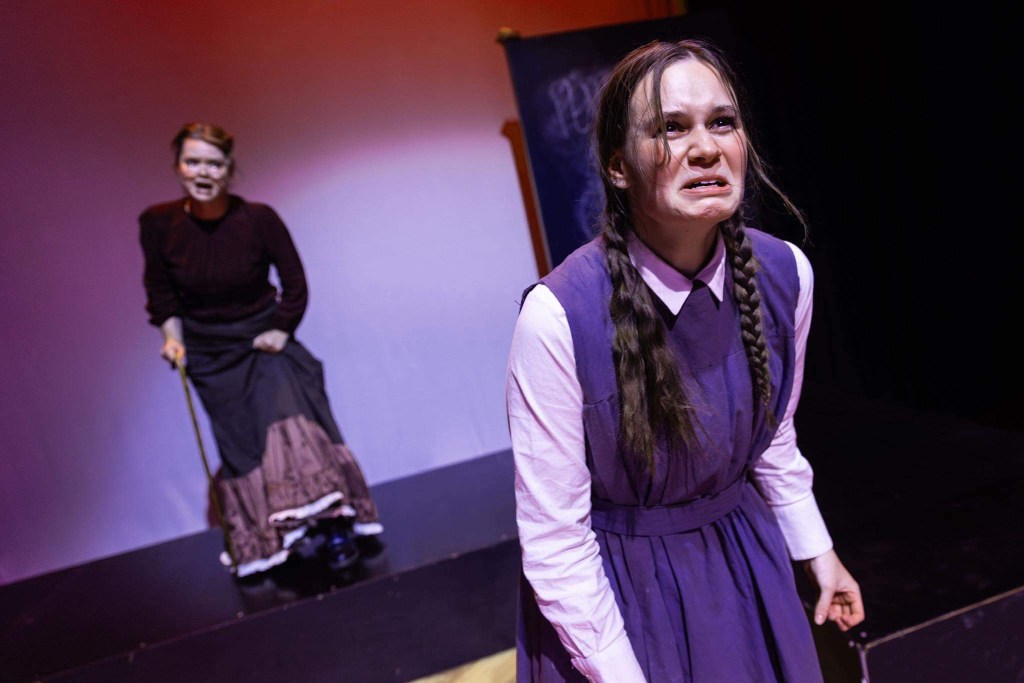
The scene to which I keep returning is about a third through the play: Edith, a plain, loathsome girl rejected by the Rock, is being interviewed by the police. Transported to a fugue state, she returns to the fateful outing, re-enacting the events of the picnic in a dynamic stream-of-consciousness monologue. The moment is tense, and strange, and profoundly disquieting.
Here, Lattanzio and Lidgerwood’s gripping post-colonial vision comes to full fruition. Piper Jones-Evans, in Picnic‘s stand-out performance, instills Edith with the crassness of the colonist: perceiving without understanding, unmoved by the intense natural atmosphere that surrounds her. Under that ignorance, we feel the hypnotic pulse of the bush, as James Carolan’s droning aural landscape and Jomar Inot’s vivid lighting design combine to create a timeless liminal space.
As Edith wanders, eyes closed to the transcendence of Hanging Rock, we catch a glimpse of infinity. Pre-colonial Australia is vast, and insurmountable; British colonialism, in comparison to such a monolith, is truly inconsequential. That moral lies at the core of Barkly Theatre’s Picnic at Hanging Rock, and their creative team has brought it to stunning life. This debut performance has set a considerable bar for Barkly; we’ll all be watching to see what they do next.
Barkly Theatre will be staging Romeo and Juliet as their Semester 2 performance.
Lola Sargasso is a playwright, poet and theatre critic based in Melbourne. Her writing has been featured with Farrago, and excerpts of her playscripts have been performed with Arts Centre Melbourne and KXT.
The Dialog website is sponsored by Union House Theatre.
 The Dialog