
Reviewed by: Emma Parfitt
ICARUS, an original work by Tulipa Rodriguez-Quin, takes the timeless myth of the same name to new heights. The legend of Icarus is a textbook one of hubris – with Icarus’s wings formed of feathers and beeswax melting when he becomes too arrogant and flies too close to the sun, having lethal consequences. Corpus Machina Collective’s ICARUS follows this story almost to a tee, but set in a modern world with a range of challenges and complexities that the Icarus of Greek mythology never could’ve imagined.
This retelling of Icarus follows Alex (Jonnie Kuch), a young modern day Icarus (complete with stunning wings), living in a share house with his partner Sophie (Emmaline Vagg) and housemates Frankie (Karissa Chowdary) and Benny (Oscar Lidgerwood). Beginning with an innocent peer into the hilariously relatable, party-filled lives of this tight-knit quartet, the story takes a turn as Alex’s secrets gradually unravel and Sophie begins to discover what he’s been hiding.
Walking into the Guild theatre truly felt like walking into a share house. Designed by Bianca Galvin and Grace Lucas, the set was, in principle, simply Alex’s bedroom. The attention to detail is what really elevated this set, giving the audience a clear idea of Alex’s character from the outset. From clothes tossed across the floor and draped across the dresser to posters and crinkled red bull cans, it was clear whose life we were walking in to. A rug added a soft homeliness to the setting, tying in to the warmness of the interactions between the characters at the start of the show.
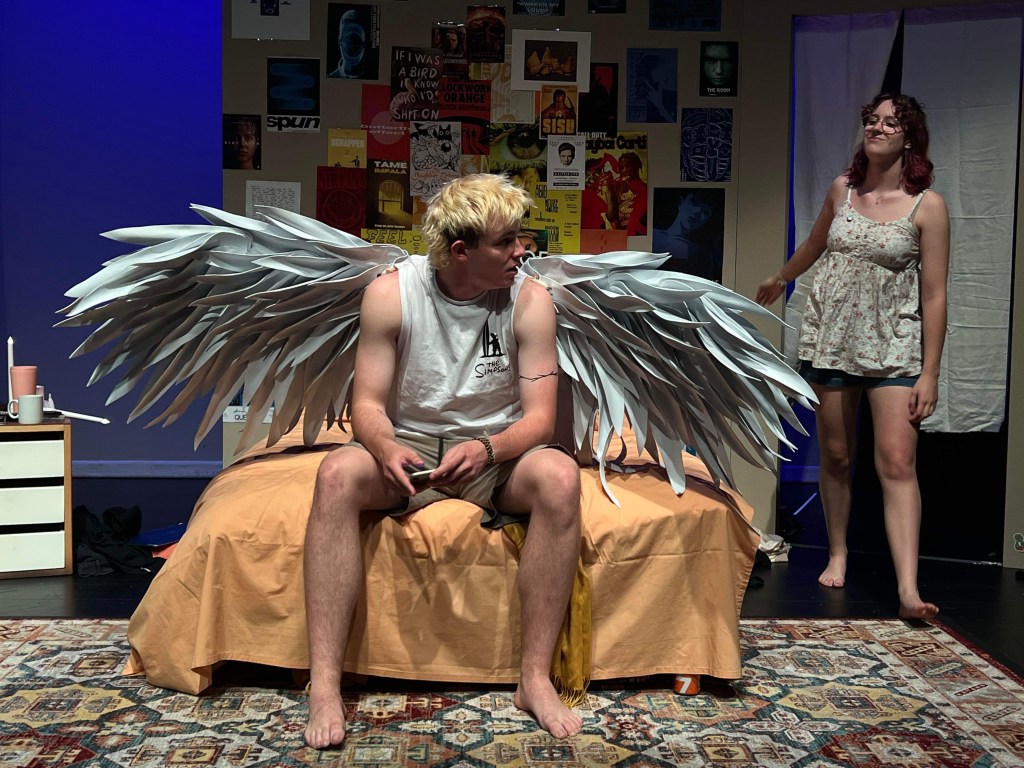

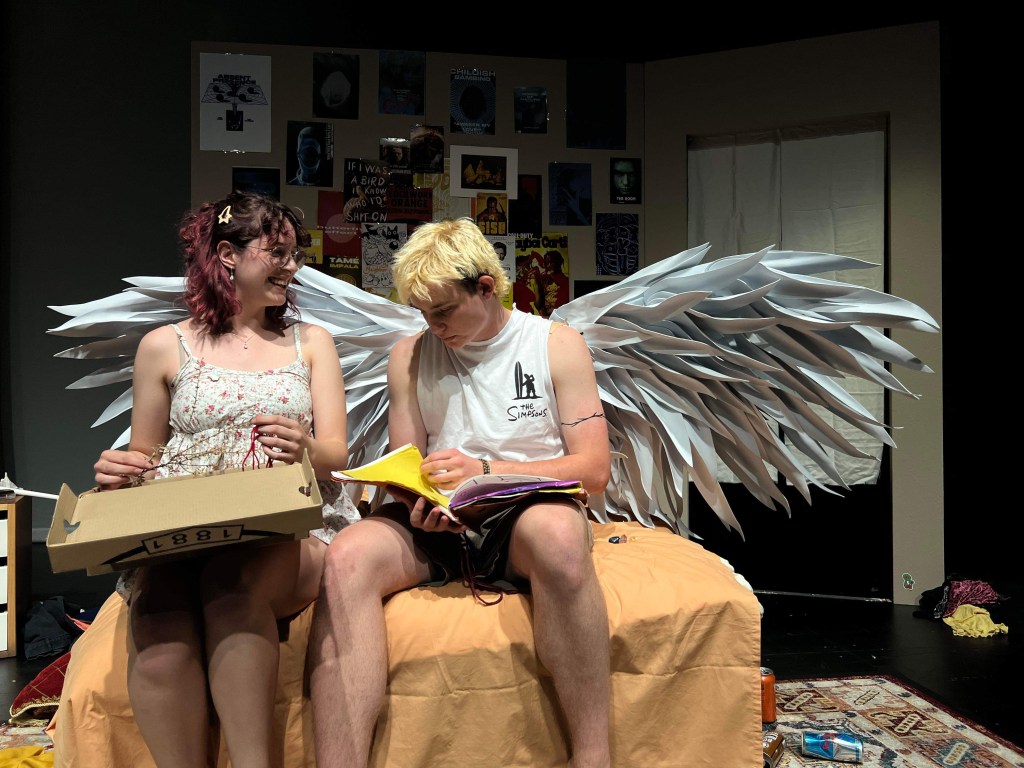
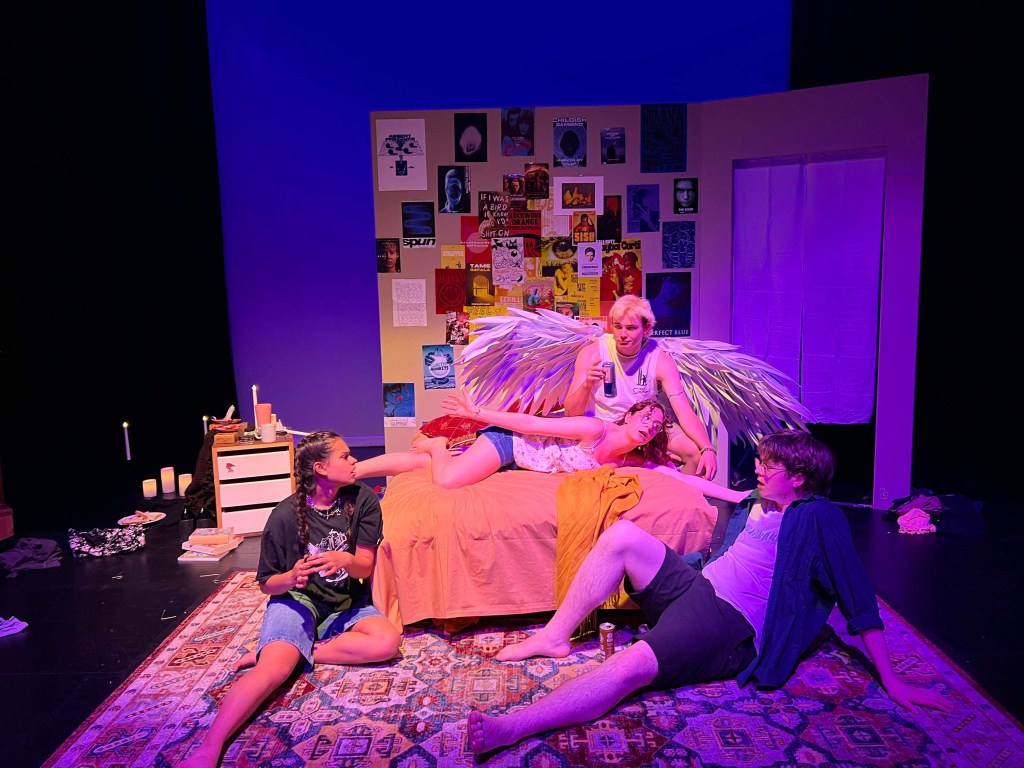
These four performers were formidable – indeed in their own right, but most superbly as an ensemble. At every instant, they were intensely connected to one another and the story they were telling. They each expertly navigated the emotional portraits of their characters, resulting in grounded and profound performances from each. Each character felt genuine – credit to both the writing and the performances – and achingly relatable. Lidgerwood’s Benny was wryly hilarious, delivering perhaps the most relatable monologue about hospo work I have ever seen (and the cheeky humour of Benny working at Ben and Jerry’s was not overlooked). Chowdary’s Frankie was the ultimate party animal, but also gave the impression that she was the glue of the sharehouse. Vagg’s Sophie was innocent yet strong-minded, often delivering heart-wrenching insights into what was really going on in her mind in comparison to what she could say. The thing that stood out about all of these characters was just how down-to-earth they were, and the space they lovingly accommodated for one another.
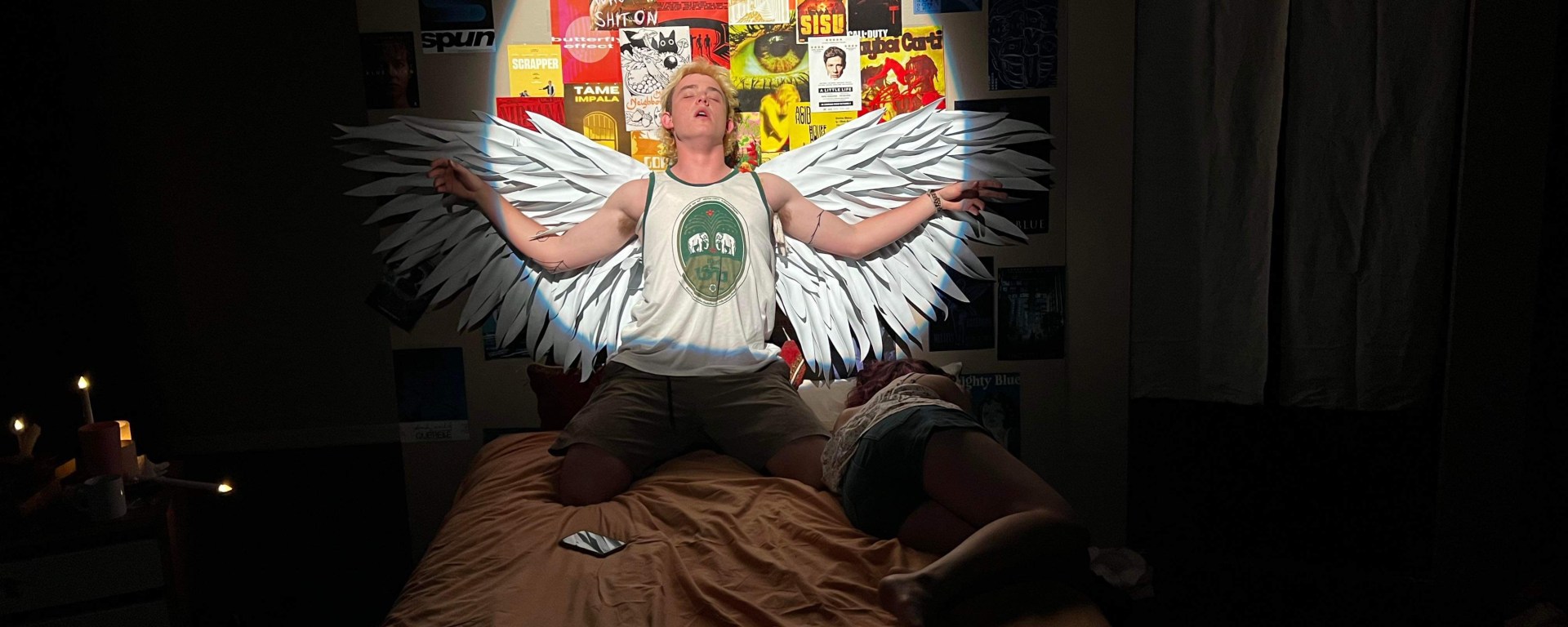
Kuch’s Alex, on the other hand, was sky high. While the people around him were deeply attuned to the world and nature, he was constantly dissociated – evident not only in performance, but through cleverly crafted projection showing an almost out-of-body experience and starkly coloured abstract lighting (by Banujee Samarathunga). The sound, lighting and projection complemented Kuch’s performance, portraying his alcohol and drug addiction-induced haze with poise. His performance was gut-wrenching when he came crashing down to earth. Additionally, Alex’s wings were a remarkable piece of costume. More than a nod to the myth, these wings embraced Alex and shielded the other characters from his actions, becoming a tool of tension and secrecy.
Overall, the production elements of this show came together seamlessly to tell this story and emphasise the characters and their emotions. I would only critique the levels of the sound, with it being difficult at times to make out the dialogue over music. The structure and staging of this show were simply stunning. There were many moments of beautiful tableaus, with effortless intimacy in the cast’s bodies and clever use of a space that at first glance seems too big to work as a share house bedroom. Rodriguez-Quin’s script is an intriguing
tapestry of myth and fact, ancient and refreshingly new – complete with effortlessly natural dialogue (an all-too rare occasion where young people are written like they actually speak). Contrasting with a natural, welcoming warm wash of the apartment as the characters exchange dialogue were abstractly-lit movement sequences. These were devised and performed beautifully, showing intimacy and distance as well as dynamics of friendship and power. There were times when the play felt disjointed and jarring – a bold decision that could have felt accidental, but was manipulated and executed so well it fit. It was to Rodriguez-Quin’s credit that she explored this way to invite the audience to delve into Alex’s complex and dissonent mind. This was just one of the many ways through thoughtful writing and direction she developed the characters in creative ways.
ICARUS marked Corpus Machina Collective’s bold entry onto the student theatre scene, cementing them as a group to watch for innovative pieces – as well as ending the student theatre season with a bang. ICARUS was a true triumph, and a celebration of young people making exceptional original theatre.
ICARUS played at the Guild Theatre from October 19th-21st, 2023.
You can follow the moves of CMC through their instagram, including the upcoming ICARUS Adelaide Fringe season in February of 2024.
The Dialog Theatre blog is supported and sponsored by Union House Theatre. Check out more upcoming student theatre shows, events and workshops.
 The Dialog