
REVIEW BY TOM WORSNOP
EDITIED BY CHARLOTTE FRASER
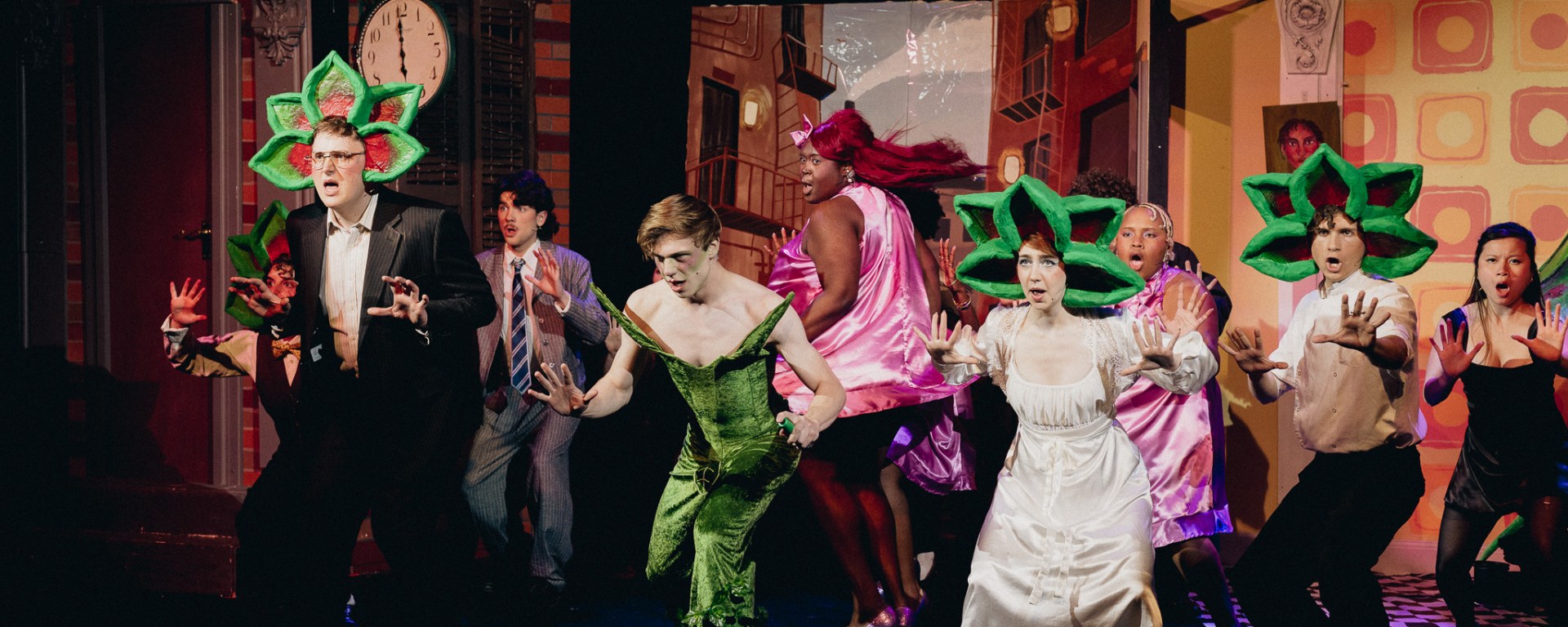
RMIT Red Acts rounds off a strong year of student theatre with a production of the classic 1982 musical Little Shop of Horrors by Alan Menken and Howard Ashman. It tells the story of Seymour Krelborn (Sol Summers) who turns the fortunes of his struggling flower shop around by growing a strange alien plant – one that feeds on blood.
As an ensemble, the cast really conveyed the campy and fun tone of the musical. The trio of Crystal (Diana Mawusi Quarshie), Ronette (Shalom Wekisha Ogunde) and Chiffon (Hannah Emeagi) gave fantastic attitude with every line delivery, with an infectious chemistry. Each time one of the ensemble members (Conor Boussioutas, Pacey Dunshea, Ava Ruljancich, Keona Siaw, and Mia Sugiyanto) took on a new character, they injected great energy into the role, displaying strong variety in their acting skills. Together, the ensemble sang with wonderful clarity and harmony, which is a testament to the Music Direction by Mia Mazzarella and Vocal Direction by Khan Pham.
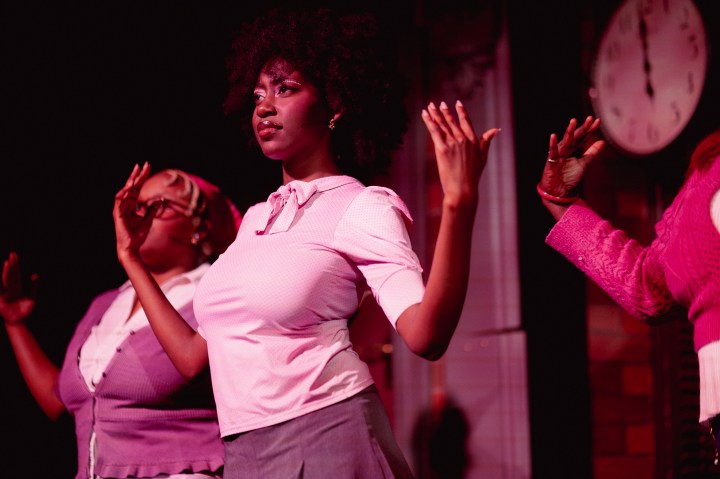
Leila Edelstein gave the character of Mr Mushnik a wonderful elasticity of movement, and a freneticism that was infectious. Her moments of dance were particular highlights of choreography (by Elena Stuckey) meeting incredible talent. Joshua Drake gave a strong performance as the sadistic, abusive dentist Orin Scrivello. He is hilarious to watch, and his depiction of Orin’s nitrous-oxide addiction is a great mix of funny and unhinged. Drake’s charismatic stage presence and natural comic timing shines throughout, and he also played an excellent homeless wino with terrific physicality. His diving headfirst into set pieces elicited immense joy from the audience. Sol Summers’s depiction of Seymour Krelborn really captured the naivety of the character, with a physicality that gave the vibe of a gentle klutz. It was a slight shame that the naïve unassuming characterisation did not develop and evolve throughout the show as much as it could’ve. Nevertheless, he was a delight to watch and really gained the audience’s sympathy and attention early and kept it throughout.
Kudos must go to Eadie Milne’s performance as Audrey, Seymour’s co-worker and love interest. Eadie’s vocal performance was beautifully nuanced and showed a breadth of dynamics throughout that elevated the production. Her acting gave a tenderness to the character, as well as an edge of gruff humour at times, which accentuated Audrey’s toughness of spirit. Bradley Watson’s performance of Audrey II, the monster plant, was another particular highlight. His vocal range and tone were immense, and his onstage persona fit the seductive menace of the character. One of the many savy choices by the director Finn Corr (assisted by Ava Morrison) was having both a puppet and Watson playing Audrey II simultaneously. The effect was absolutely wonderful, and I only wish he could’ve been used more throughout the show.
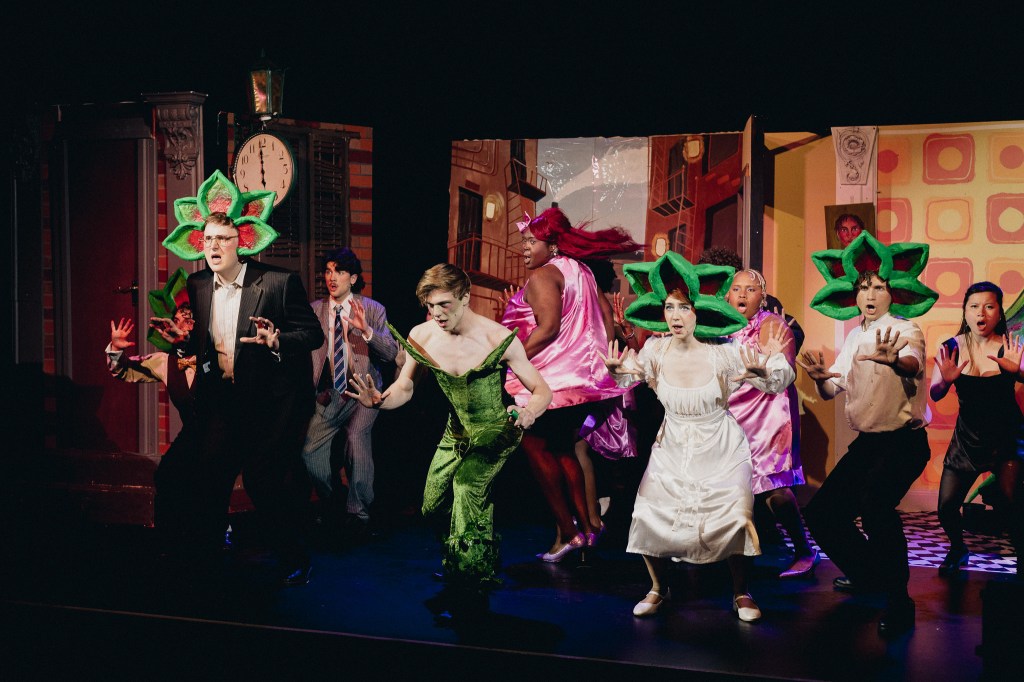
The wonderful cast were all elevated by some lovely costume design, by Jamilla Deighan-Smith, with assistance from Emily Botham and Emi Ciccarelli. Having to costume a period piece is always a challenge, but the costume team did really well in capturing the 1960s style. Particular highlights include a lovely, checkered dress for Audrey (Eadie Milne); a perfectly dad-vibe outfit for Mr Mushnik (Leila Edelstein); and stylish suits for the businessmen offering Seymour contracts (specifically a stunning pink blazer worn by Ava Ruljancich). The star of the costume line-up was absolutely the drag-inspired jumpsuit worn by Bradley Watson as Audrey II. Watson’s hair and make-up was divine (designed by Effie Mastrantuono) and the overall costume, featuring the actor emerging out of a Venus flytrap mouth, looked stunning. It gave the character a fierceness and allure that fit perfectly.
The set design (by Max Arnold with assistance from Avey Nguyen) felt as though it had a lot of elements to juggle and that sometimes took away from the overall quality. A flat that showed a road and city block felt superfluous, and unnecessarily literal, as the street corner set piece captured the gritty nature of the location perfectly on its own. The shop ‘renovation’ scene was cleverly done with the false walls giving way to a vibrant wallpaper pattern that fit the time period. The scope of the set overall seemed to be stretched perhaps more than was capable of the production, as there were clear moments of set dressing falling and breaking, and an incident where one of the walls of the shop set seemed to almost collapse onstage where we were concerningly close to a show stop, which did occur on another night of the show run.

The lighting (by Angus Purtell) was beautifully done, with a lovely use of colour mixed in with contrasting moments of a stark follow spot. The sound design (by Jake Vreudenberg) was well done in a difficult venue for musicals, the mics were well balanced and easy to hear alongside the music. There was a brief issue that led to voices backstage being heard, and around thirty seconds of an empty stage, but after fixing this issue there were no others during the show.
The whole cast had great chemistry together, radiating a sense of fun onstage, as their incredible joy was thoroughly felt by the audience. The tone and feel of the original classic are alive and well in this production.
RMIT RedActs’ Little Shop of Horrors played at the Kaleide Theatre 18 – 20 December 2025.
TOM WORSNOP is a performer and writer, and has been involved in Unimelb theatre since 2019.
CHARLOTTE FRASER (she/her) is a writer, performer and student editor based in Melbourne. She holds a BA in English and Theatre Studies and is currently completing her Masters degree at the University of Melbourne. Charlotte is also the incoming 2026 Editor of The Dialog.
 The Dialog