

REVIEW BY ZENA WANG
EDITED BY EMMA PARFITT
English version below.
《驴得水》是一部由中华剧社出品,田晨凯(及团队)导演,王圣霏、夏天齐、田晨凯联合编剧的现实主义讽刺剧。故事以民国时期的一所乡村小学为背景,通过一场由“善意谎言”引发的连锁反应,揭露理想与现实、道德与利益之间的荒诞冲突。该剧在舞台上以喜剧的外壳包裹悲剧的内核,通过极具黑色幽默的笔触,刻画出一群在体制与欲望夹缝中苟且求存的小人物。
由Xinyue Ji(及团队)设计的舞台布景充满怀旧气息。观众入场时,首先映入眼帘的是一间细节考究、极具时代感的教室:写有“三民小学”的木牌、孙中山的画像、墙上绘制的“三民主义”标语,以及陈旧的课桌与讲台。灯光设计(Geneta Lo及团队)巧妙运用了侧光与 Gobo ,区分室内与室外空间,也增强了叙事的流动感。
故事开始,几位教师围坐在这间简陋的教室里,商量如何应对学生流失与经费短缺的问题。校长孙恒山(老皮 饰)是整个学校的主导者。作为一个曾怀抱教育理想的知识分子,他在体制的荒诞中选择装疯卖傻,用场面话掩饰对现实的妥协与无奈。科学老师周铁男(李苏童 饰)性格莽撞、脾气火爆,是校长的忠实支持者。后来观众将得知,他暗恋着校长的女儿孙佳佳(Jalynn Yao饰),这份情感让他的忠诚更显复杂。唯一的女教师张一曼(Dishan Shao 饰)甜美活泼,常附和他人的决定,在几位男教师之间充当情绪与立场的缓冲。历史教师裴魁山(卢骏骁 饰)乍看老实厚道,实则谨慎而小气。他第一个提出学生流失严重的问题,却反对校长用奖学金贿赂学生回校,这种原则中混杂着自利的算计,也成为他后续背叛的伏笔。
这场看似平凡的会议,议题不过是“如何让学校继续运转”,却在不知不觉间揭示了全剧的核心矛盾,一场建立在谎言之上的理想主义。他们虚报了一名从未存在的英语老师“吕得水”,借此骗取教育经费。而这位所谓的“老师”,其实只是一头为学校拉水的驴。

当教育局的一封电报突如其来,平衡彻底被打破。特派员即将到访,要求所有教师必须到场,如果了不让吃空饷的事实暴露,陷入恐慌的众人只得在一夜之间找人顶替,最终盯上了替铝棚修锁的铁匠。由Francis Zhou饰演的铁匠操着河南方言,为全剧注入了鲜明的地方色彩与生活质感。他被迫顶替那位虚构的“吕得水”,在一场由善意谎言演变成集体欺瞒的闹剧中,成为众人共同维系体面与利益的牺牲品。
在此过程中,裴魁山对张一曼的态度转变尤为耐人寻味。起初,他的态度带着敬意与理想化。他说话语气柔和、克制,那种“文人式的距离”一度让观众误以为他是全剧中唯一仍保有良知的人。然而,当众人多次劝说铁匠无果,为了维持骗局,张一曼选择以身体挽留铁匠时,裴魁山的态度骤然转变。他无法容忍理想女性的形象被打破,仰慕转为失望、怜惜转为厌恶。这种转变恰恰印证了 Gilbert 与 Gubar 所指出的男性叙事陷阱:“每一个贤妻良母背后,都藏着一个阁楼里的疯女人(Behind every Angel in the House lurks a Madwoman in the Attic.)” 当女性不再符合“纯洁”的标准,便会被迅速归入“疯女人”或“堕落者”的阵营。在舞台上,演员卢骏骁完美的通过神态与气质饰演出裴魁山的转变。原本温吞的语调变得冷漠、甚至讥讽,当他提出要与校长“谈谈这件事”,那并非出于道义上的愤怒,而是夹杂着报复与对金钱的渴望。
在成功糊弄过特派员之后,剧情回到了与开场几乎相同的教师会议场景。孙校长哼起京剧《定军山》的开场曲。这一瞬间极富巧思,原曲讲述老将黄忠奉命出征、立功报国,而此处的唱词恰与剧情中的“教育局电报”形成呼应,那封象征命令的“书信”,正对应现代官僚体制下冷漠的电报通知。唱腔的雄壮与现实的卑微形成强烈反差。孙校长不是黄忠,而是一个在谎言与体制夹缝中苟且求存的教育者;那份英雄气势既滑稽又悲凉,一封“得功劳”的电报背后,实则是一场虚伪的胜利。由老皮饰演的孙校长在台词节奏与身体行动上展现出极高的掌控力。他的语调、停顿与动作节奏层次分明,准确地捕捉了角色在理想与现实之间逐渐消解的精神状态。演员赋予角色一种复杂的人性张力,让观众在讽刺与同情之间反复摇摆。这次会议的结构与开场产生呼应,形式上几乎一致,同样的桌边、同样的誓言,却指向截然不同的精神状态。

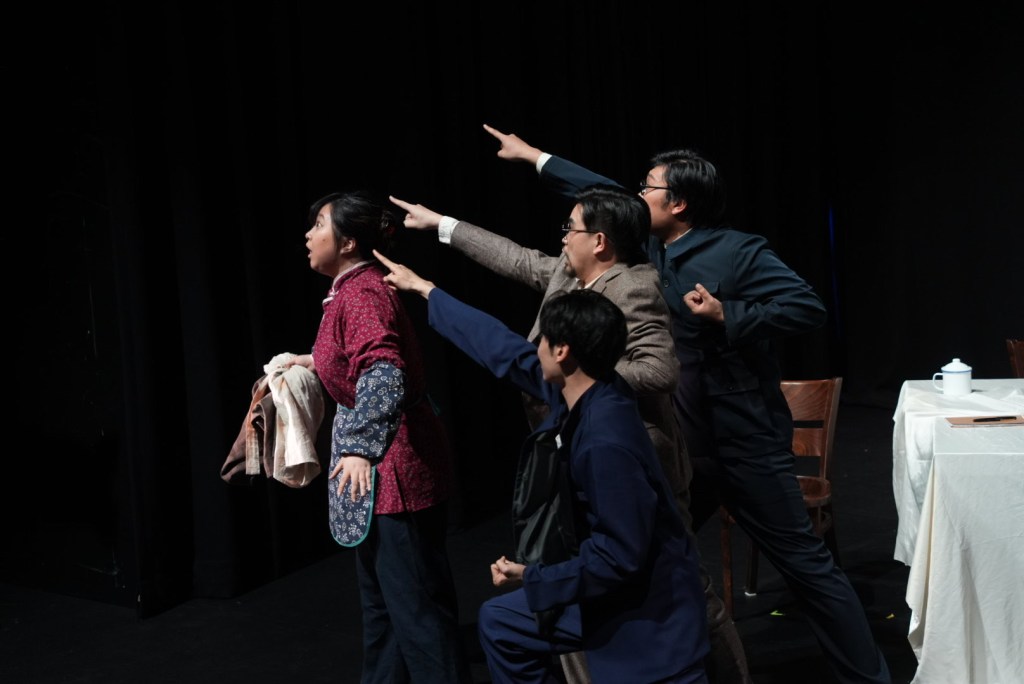
剧情随特派员的第二次到访急转直下。他宣布资助了吕得水老师的美国慈善家罗斯先生(闻乐 饰)将亲临考察,拜访这位中国教育的典范。原本的谎言因权力与利益的介入彻底失控。Andy Li饰演的特派员极具压迫感,表面上他代表教育局前来监督,实则意在维护体制的既得利益。教育局早已从罗斯先生的捐款中中饱私囊,一旦真相曝光,整条利益链都将崩塌。他不再伪装为“正义的代表”,而是直接拔出手枪,用暴力逼迫众人就范。压迫在这一刻不再披着体制与道德的外衣,而以最赤裸的形式出现。张一曼遭到猎巫式的羞辱,铁匠与裴魁山落井下石,而连周铁男也被吓得魂不附体,原形毕露。人性的崩塌,不再来自欺骗本身,而是来自对权力的屈服。
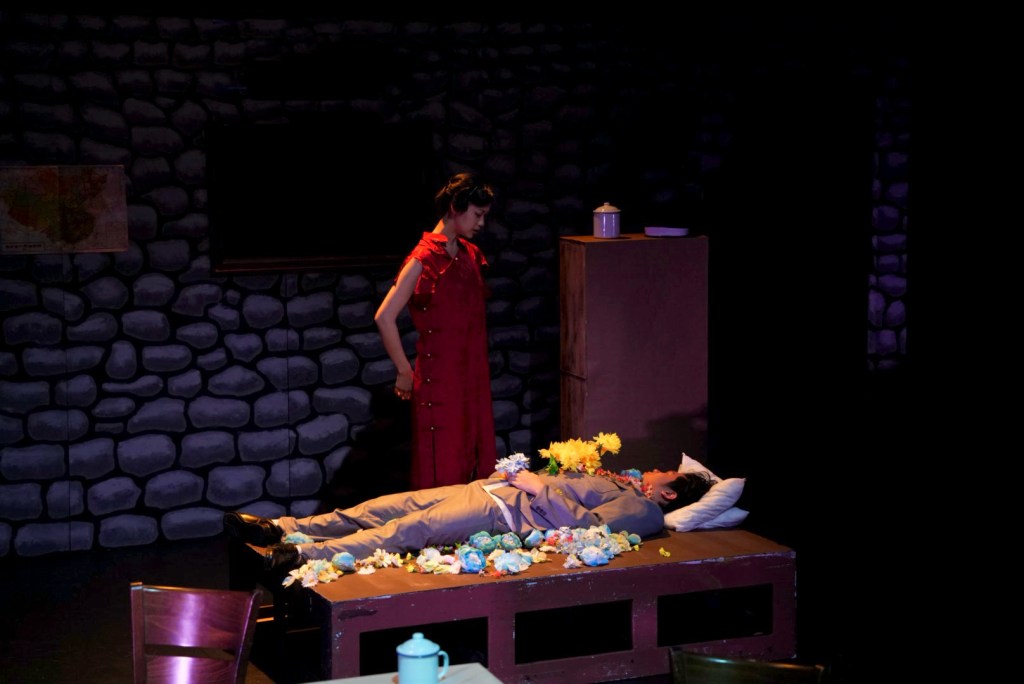
结尾的改编堪称全剧的点睛之笔。导演巧妙地重复了教师会议的场景与前两次的音乐动机,形成强烈的结构性呼应。孙校长、周铁男与裴魁山三人再次围坐在教室一角的桌旁,仿佛回到了故事的开端。然而,此时的“会议”早已不再是理想主义的象征,而是一场赤裸裸的分赃仪式。三人兴奋地打开罗斯先生留下的捐款箱,箱中却装满了黄色与白色的中式冥币。他们脸上流露出夸张的喜悦与亢奋,伴随高亢轻快的音乐节奏,整个场面在荒诞与讽刺之间达到了顶点。与此同时,舞台的另一侧,疯癫的张一曼呼唤着铁匠,用天真的语气问他为什么还在睡——那个原本要假死应付慈善家来访的人,却再也没有醒来。这一幕成为残酷的暗示:阴阳两隔,舞台空间似乎同时存在于现实与冥界。那些仍在分赃的教师,与被噤声的死者,共同构成了一个“阴间式”的结尾。这一收尾不仅带来了强烈的视听冲击,也延续了全剧的戏剧性讽刺——当教育、理想与良知都被贪婪吞噬,舞台上剩下的,只是一场死人般的狂欢。
导演与编剧在这一版《驴得水》中无疑进行了许多大胆而有趣的尝试。整体上,作品仍以现实主义剧作法为基础,却穿插了大量布莱希特式的戏剧间离与电影化的叙事节奏,例如场景转换常通过频繁的黑场与锐利的剪切完成,模糊了时间的线索,不断打破观众的沉浸感,这种有意识制造的间离让观众得以从故事中抽离和反思。

类似的电影化切换在全剧中多次出现,最具代表性的片段出现在张一曼被羞辱、精神崩溃的过程中。导演插入了一段极具电影质感的梦境叙事。黑暗中,张一曼独自唱着民谣《我要你》,在她梦境中,每个人衣服上都带着红色。在中国文化中象征喜庆与吉祥的颜色此刻却成为她悲剧的反衬。三民小学的众人微笑着招呼她去拍合照,她正要起身加入,梦境戛然而止。下一幕回到现实,她已从一名代表知识与理性的数学老师,变成一个衣衫褴褛、疯疯癫癫的女人。
另一个印象深刻的片段出现在铁匠被众人拦住,劝说他假扮英语老师吕得水以应对特派员的访问。铁匠坐在舞台中央的小板凳上,而观众席的House light也在此时被打开了,整个剧场瞬间被照亮得无处遁形,仿佛连带观众也被卷入这一场虚伪的“集体游说”,成为众人伪善的一部分。
不懂英语的特派员要求听吕得水讲课的,吕得水老师的胡言乱语中穿插着大量时下的网络流行语,如“哈基米”等,并配合投影屏幕上的表情包。这种突兀的小品式幽默打破了正剧的严肃节奏,引起观众们的会心一笑。不论如何,这些实验性处理中的巧思与勇气无疑让作品焕发出新的可能性,也在熟悉的文本中打开了意料之外的缝隙。
然而,在讽刺与批判之下,剧本的性别意识问题仍令人无法忽视。
当铁匠媳妇(张佐彬 饰)抓着铁匠闯进三民小学,质问老师们谁勾引了她的老公时,整个剧目最难堪的部分赤裸地暴露在观众面前。舞台上的情境逼迫观众直面某种不愿承认的残酷:这不是一场喜剧,而是一场彻底的荡妇羞辱。
张一曼是受过教育、独立、敢于表达自我的女性,但叙事却将她牢牢框定在性诱惑与堕落的符号中。她的性经历成为剧情转折的炸药包,她的悲剧性结局成了男性角色道德崩塌的催化剂。铁匠媳妇则被冠以农村悍妇的刻板印象:粗鲁、蛮横、不可理喻。她的愤怒,本可以成为对婚姻背叛的正当回应,她的不驯与不美成为嘲讽的依据,转化为男性秩序所恐惧的“失控女性”的象征。二人最终都成为了“阁楼里的疯女人”。
在这场冲突中,孙校长的女儿孙佳佳被呈现为“天使”的化身:天真、善良、情感单纯。她的存在始终是被动的,在铁匠媳妇闹场时,她被周铁男支开;在美国慈善家到访、众人生命受威胁时,她又被推上前台,伪装成“吕得水老师”的未婚妻。她是被操控的纯真,是被使用的理想。更令人不安的是,在遭遇铁匠媳妇捉奸时,她的台词重点被放在反复追问“什么是破鞋”上,而非对混乱本身的担忧,频繁重复的台词失去原有的象征意义与力度,让沉重的词汇沦为一种轻薄的笑料,更让她从原本的纯善与同理心,滑向一种无知的天真。最令人震惊的是,在演员谢幕时,“破鞋”一词竟被再次当作笑料和彩蛋回收。这一轻佻的“彩蛋”让女性的屈辱被彻底消费,成为供人娱乐的符号,而非反思的契机。
这三名女性角色共同构成男性叙事的“镜厅”。《驴得水》或许试图揭露人性的复杂,但在舞台上,这些人性似乎只属于他者。女性的身体成为叙事的消耗品,她们的命运成为道德的试金石。而同样的,三名女性的结局也被轻描淡写地抹去了。这种“消失”比任何悲剧都更具暴力性。作品在无意识中延续着对女性最深的压迫,也因此动摇了它原本引以为傲的讽刺锋芒。
总体而言,《驴得水》是一则关于荒诞、贪婪与虚伪的寓言。创作团队在讽刺现实、揭露人性方面用力甚深,许多表演段落与节奏设计都极具冲击力。但当故事将所有焦点都集中在人性与体制时,这种讽刺的锋芒也显得略为片面。整场演出让观众徘徊在笑与不安之间——陷入一种“反思”而非“解答”的状态。或许这正是《驴得水》的力量所在:它拒绝给出简单的答案,却勇敢地将一面镜子举向我们自身的矛盾。
Mr. Donkey is a realist satire presented by the Chinese Theatre Group, directed by Chenkai Tian (and the team), with a co-script adapted by Alex Wang, Tianqi Xia and Chenkai Tian. Set in a rural primary school during China’s Republican era, the play traces a chain reaction triggered by a benevolent deception, exposing the absurd tensions between ideals and reality, morality and survival. The story uses dark humour to portray a group of ordinary people trapped between bureaucracy and desire.
The set design is filled with a sense of nostalgia, created by Xinyue Ji (and the team). The play begins in a remote rural school, Sanmin Primary School, where the audience is greeted by a historically detailed classroom: a wooden sign of the school name, a portrait of Sun Yat-sen, the Three Principles of the People painted on the wall, and worn desks and podiums. The lighting design (Geneta Lo and the team) makes clever use of side lighting and gobos to distinguish indoor and outdoor space, lending fluidity and rhythm to the narrative.
In the opening scene, four teachers sit around the shabby classroom, having a meeting about how to cope with shrinking enrolment and the school’s financial crisis. The Principal, Sun Hengshan (Laopi Chen), is a once-idealistic intellectual now reduced to playing the fool, masking compromise with official rhetoric. Zhou Tienan (Sutong Li), the science teacher, is hot-tempered and blindly loyal to the principal. Later, the audience learns he is fall in love with Principal Sun’s daughter, Sun Jiajia (Jalynn Yao), which adds a layer of conflicted devotion. The only female teacher, Zhang Yiman (Dishan Shao), is bright and good-natured, often smoothing over tension between the men. The history teacher Pei Kuishan (Junxiao Lu Jeffy) appears honest and mild but proves calculating and petty. He is the first to raise concerns about the loss of students, yet he rejects the principal’s idea of offering scholarships, revealing a moral façade concealing self-interest and a foreshadowing of his later betrayal.
What begins as a simple meeting about how to keep the school running soon exposes the play’s central paradox. The teachers fabricate an English teacher named Lu Deshui to siphon funds from the education bureau. In reality, “Teacher Lu” is nothing but a donkey used to haul water for the school.
A sudden telegram from the education bureau shatters their fragile balance: a government inspector is coming, and all five teachers must be present. To prevent exposure of their fraud, the desperate group recruits a local blacksmith to pose as the fictitious English teacher. Francis Zhou, playing the blacksmith, speaks in a Henan dialect, adding vivid regional texture and humour to the production. Yet this reluctant impostor soon becomes the sacrificial lamb in a collective deception sustained by fear, pride, and greed.
Among the ensemble, the shifting relationship between Pei Kuishan and Zhang Yiman is particularly revealing. At first, Pei treats Zhang with respect and idealized admiration. His gentle, cautious tone suggests a ’scholarly distance,’ giving the impression that he might be the play’s last moral conscience. But when Zhang, pressured by the situation, uses her body to persuade the blacksmith to stay, Pei’s attitude turns sharply. His admiration collapses into contempt. Unable to reconcile his fantasy of purity with the reality before him, he redirects frustration into cruelty. This mirrors what Gilbert and Gubar call the male narrative trap: ‘Behind every Angel in the House lurks a Madwoman in the Attic.’ Once a woman steps outside the boundaries of purity, she is cast as the fallen or the insane. Jeffy Lu captures this transformation brilliantly, shifting from mild unease to bitter sarcasm.
After successfully deceiving the first inspector, the story circles back to the school meeting. Principal Sun hums the opening aria of the Peking Opera Ding Jun Shan, which is a brilliant touch of irony. In the opera, the line celebrates a general’s triumph in battle; here, it echoes the bureaucratic telegram from the education bureau – a letter of command drained of nobility, reduced to a symbol of mechanical obedience. The grandeur of the melody clashes with the triviality of reality. Principal Sun is no hero, but a weary educator surviving within a system of deceit. Laopi Chen’s delivery is masterful, his every pause and sigh calibrated, balancing irony and empathy. His performance imbues the character with a tragic humanity that keeps the audience oscillating between laughter and pity.
The plot takes a sharp turn when the inspector returns, announcing that Mr. Ross (Le Wen), an American philanthropist funding Teacher Lu’s education project, will soon visit the school to meet this celebrated Chinese educator. The farce, already teetering on collapse, spirals into chaos. The inspector (Andy Li) exudes an unsettling authority, outwardly representing the education bureau, yet secretly protecting its corruption. The education bureau has long embezzled Ross’s donations and the truth emerges, the entire chain of profit will crumble. Thus, the so-called supervisor becomes the real oppressor. He draws a pistol and coerces the teachers into silence. Power sheds its mask of morality, exposing pure violence. Zhang Yiman is humiliated in a witch-hunt; the blacksmith and Pei Kuishan join the accusation; even Zhou Tienan, once the righteous “man of principle,” cowers in fear. The audience sees with painful clarity that the real collapse does not come from deception, but from submission to authority.
The final scene is the production’s crowning stroke. The director reprises both the opening meeting and earlier musical motifs (by sound design team VE and Eric), creating a haunting structural echo. Sun Hengshan, Zhou Tienan, and Pei Kuishan once again sit around a small table in the classroom corner – as if the story has come full circle. But now, the “meeting” has turned into a grotesque ritual of greed. They gleefully open the donation chest left by Mr. Ross, only to find it filled with yellow and white joss paper, the traditional Chinese funeral money. Their exaggerated joy and the brisk, upbeat music push the irony to its peak. On the other side of the stage, the deranged Zhang Yiman calls out to the blacksmith, asking in a childlike voice why he is still asleep – the man who once pretended to die now lies truly dead. It is a cruel metaphor: the living and the dead share the same stage, the world of the living no less spectral than the underworld. Those still dividing the money, and those forever silenced, together form a macabre tableau, an underworld of conscience. The ending delivers both a visual and emotional shock, sustaining the play’s dramatic irony: when education, ideals, and morality are devoured by greed, what remains on stage is only a dance of the dead.
Director Chenkai Tian introduces numerous inventive ideas. The production retains a realist framework while incorporating Brechtian alienation effects with filmic pacing. Scene changes often dissolve through abrupt blackouts and sharp cuts, blurring temporal continuity and breaking immersion so that the audience may step back and reflect. One of the most striking sequences occurs during Zhang Yiman’s breakdown: she sings the folk song I Want You in a surreal dreamscape, where every character’s costume bears a trace of red, a colour of festivity turned into tragedy. Just as she rises to join a group photo, the dream ends. In the next scene, she reappears broken and mad.
Another notable moment comes when the blacksmith is coerced into impersonating the teacher: he sits centre-stage on a stool as the house lights suddenly rise, illuminating the audience, turning everyone present into silent accomplices of hypocrisy. Later, when the inspector demands an English lesson, “Teacher Lu” fills the air with nonsense peppered with internet slang like “Hajimi!”, while memes flickering on the projection screen suddenly elicit a knowing smile from the audience. These experiments testify to the directors’ creative courage and willingness to re-open familiar material in unexpected ways.
Yet beneath the humour and critique lies an uncomfortable silence: the question of gender.
When the blacksmith’s wife (Zuobin Zhang) storms into the school accusing someone of seducing her husband, the play’s most uncomfortable truth surfaces. What unfolds is not a comedy of misunderstanding but a scene of public humiliation. Zhang Yiman, an educated and independent woman, is confined within the symbols of sexual temptation and moral fall. Her body becomes the narrative’s detonator, her downfall a convenient catalyst for the men’s moral collapse. The blacksmith’s wife, meanwhile, is caricatured as a coarse, hysterical village shrew. Her anger, which could have been a justified outcry against betrayal, is rendered laughable, a grotesque reminder of the ‘uncontrollable woman’ feared by patriarchy.
In this confrontation, the principal’s daughter, Sun Jiajia, is portrayed as the embodiment of the ‘angel’: pure, naïve faith and fundamentally passive. When the blacksmith’s wife storms into the school, she is sent away; when the American philanthropist arrives and the teachers’ lives are at stake, she is pushed to the front to pose as ‘Teacher Lu Deshui’s’ fiancée. She becomes a symbol of manipulated innocence and appropriated idealism. What is more troubling is that, during the blacksmith’s wife’s outburst, the focus of her line is placed not on worry or concern, but on repeatedly asking, ‘What does Po Xie (slut) mean?’. The question is stripped of its original weight and symbolism through comic repetition. Sun Jiajia’s empathy and purity thus slide into a kind of ignorant naïveté. The most disturbing touch comes at the curtain call, the word ‘Po Xie’ is revived once again for a light-hearted callback, a careless ‘easter egg’ that trivializes and commodifies female humiliation, turning misogyny into entertainment.
Together, these three women form a hall of mirrors within a male narrative, reflecting male desire, ideal, and fear. Mr. Donkey seeks to expose the corruption of human nature, yet on stage this human nature seems reserved for men. The women are denied complexity, reason, and agency. Their bodies become instruments of story and their fates, the testing ground of male morality. Their quiet erasure at the end of the story is a violence greater than death.
Ultimately, Mr. Donkey is a parable of absurdity, greed, and hypocrisy. The creative team delivers sharp satire and compelling performances; many scenes pulse with intensity and wit. Yet by centring entirely on the darkness of human nature, the play’s moral lens narrows. The production leaves the audience suspended between laughter and discomfort — a state of reflection rather than resolution. In this tension lies the strength of Mr. Donkey: its refusal to offer easy answers, and its courage to hold a mirror to our contradictions.
Melbourne University Chinese Theatre Group’s Mr. Donkey played October 25th at the Guild Theatre.
ZENA WANG is a student at the VCA with a strong interest in theatre and visual storytelling. She loves exploring the intersection of space, performance, and audience experience.
EMMA PARFITT (she/her) is the Dialog’s head editor and has written Dialog reviews alongside studying towards her science degree for the past two years. She is a production manager, stage manager and producer on the Melbourne indie theatre scene and a veteran of student theatre at Union House Theatre.
The Dialog is supported by Union House Theatre.
 The Dialog