

REVIEW BY TOM WORSNOP
EDITED BY OLIVIA DI GRAZIA
Telling three different yet interlinked stories from a far-off future, Control – written by Keziah Warner and presented by flatpack with Theatre Works – offers a powerful dissection of moments where the brutality of control meets the fragility of memories.
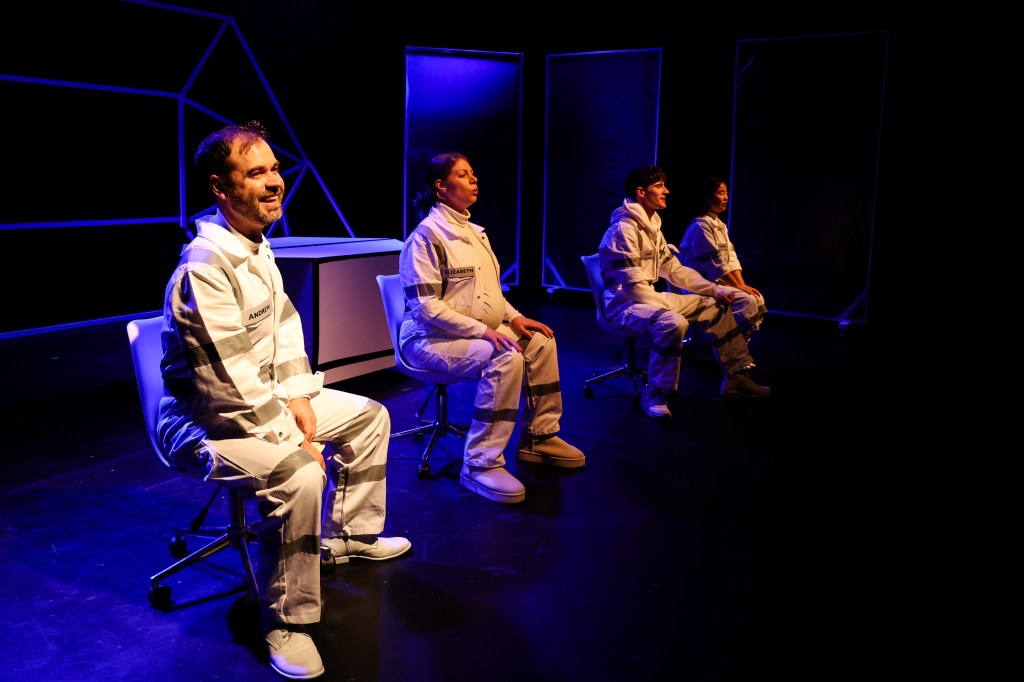
Translating a vision of the future into something fit for theatre is a challenge, but flatpack achieves this through Silvia Weijia Shao’s clever production design. The costumes draw on fairly conventional ideas of the “future”: an android is draped in an avant-garde dress that looks like a white cloud, and a pod of reality-TV-stars-turned-interstellar-travellers are all dressed in white jumpsuits (albeit with nice touches that differentiate each character). What elevates the costume design is the tempering of the speculative elements with more familiar ones: an android boss still wears a suit and tie, and the vagabond trying to erase his worst memories is dressed in casual wear that could easily pass today. This mix grounds the stories, connecting their aesthetics to our own. If the production had fully committed to sci-fi stylings – prosthetic robo-arms or cyborg eyes, for instance – it risked shifting into camp, which may have undercut the gravity of the topics Control deals with. The prop design is also effective in the way that it suggests futuristic technology without trying to replicate it. For example, small earpieces allow call-line operators to ‘think’ to customers, and Perspex circles stand in for futuristic computer screens, interacted with via styluses and small magnets that can be shifted by hand like a keyboard. In this way, the props are simple in their design, yet they invite audiences to imagine what the real thing could look like. I think this is a really smart way of working within the scope of the production while still creating a sense of witnessing ‘the future.’ The set design (again by Shao) was also well done, especially the use of moving walls made from translucent film. As the walls shifted closer and closer to the audience with each new act, it really felt as though everything from the previous scenes had faded and become obscured, like a vague memory lost to time.

The sound and lighting (by Lili Wymond and Tomas Gerasimidis respectively) were excellent, particularly in the way they interacted with each other. In the first act, contestants’ answers were met with either a green or red light, accompanied by a positive or negative siren, which highlighted the artificial nature of the reality TV show and the emotions it created. I also found that when the space pod went into shutdown, the solitary yellow floor light created the sense of an industrial, mechanical environment. The music generally was ethereal, with synths appropriately evoking a technological future, while the inclusion of more conventional songs helped smoothen the transitions.
The actors’ performances were strong throughout, with each performer being given a variety of roles in which to shine. Alex Duncan perfectly realises the character of Andrew, a kids’ TV host who has grown cynical and dabbles in conspiracy theories. Such is Duncan’s performance, matched with the claustrophobic and oppressive environment of the space pod, that Andrew’s theories on why the team are really sent out to space become all the more convincing. He balances this beautifully with the role of Alex, the android boss, in Act Two. The rigid movements and stiff facial expressions create a striking effect that tap-dances between funny and unsettling. Lachlan Herring cleverly contrasts his characters between Acts One and Two, playing Jake in the pod and his younger half-brother Xavier, later in the future. While the former is an upbeat, quintessential ‘Aussie bloke’, the latter is a deeply troubled man, haunted by the ‘what could’ve been’ moments of his life. By establishing the half-brother in Act One and revisiting him twenty years later in Act Two, the play highlights the chaotic effects of time, and the ways in which peoples’ actions and choices can be completely reframed through the prism of memory.
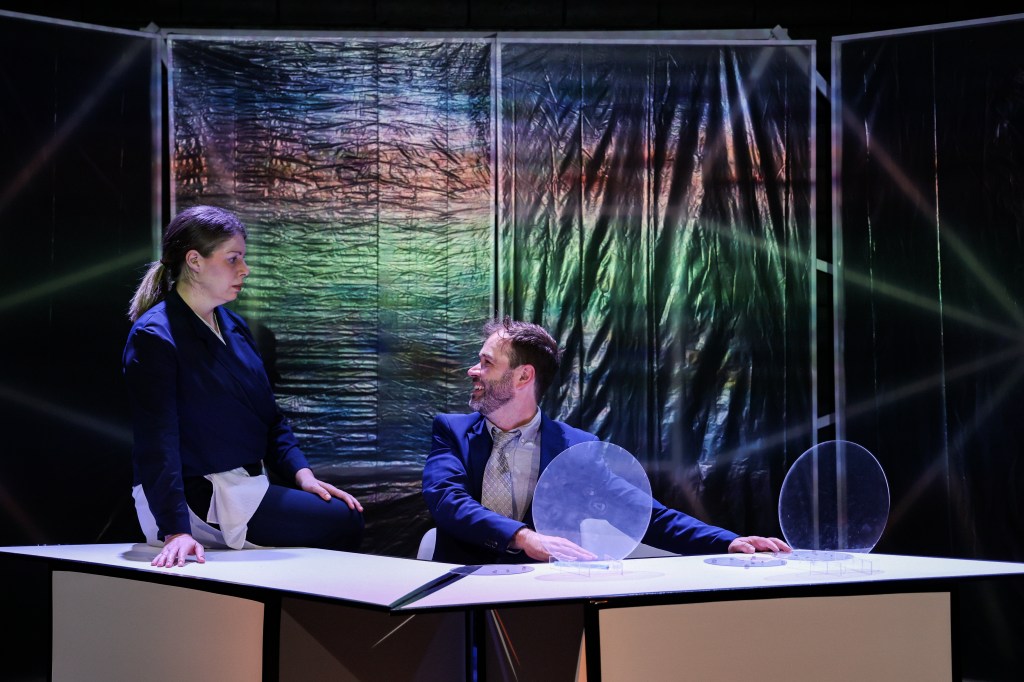
Faran Martin displays an incredible breadth in her roles across all three acts: first as Elizabeth, a pregnant former ballet dancer desperate for a fresh start, then as Nicki, a struggling single mother, and finally as Isabelle, a technician both challenged and comforted by the android she’s supposed to train. There is a wonderful flow as she moves from an expectant mother to a mother raising a young child, and finally to that very same child now in her thirties. Across each character, Martin conveys a palpable sense of moral ambiguity and underlying anxiety. The pregnant mother repeats prepared phrases about her child to the camera, contrasting with the single-mother, who repeats her ongoing concerns about raising her daughter – a pattern she eventually uses to coax a colleague at work into deleting her most unsavoury memories of the past. This produces an impactful effect of seeing two mothers, each grappling with very real anxieties about raising their children, leading both of them to morally dubious choices. Similarly, Martin beautifully balances the genuine unease and excitement of witnessing an android begin to grow emotionally with an underlying sense of manipulation, as her character continues to control and shape the android, often for her own emotional comfort.
Lastly, Seon Williams shines with arguably the greatest variety of characters across the three acts. As Laura, her faded pop princess in Act One feels utterly relatable in her growing disdain for the reality TV show, yet remains unflinching in her ability to ‘switch on’ for the camera to elicit a positive response from the ‘Big Brother’ Astro Lady (Emily Shelmerdine). In Act Two, she embodies the office gossip as Caroline, highlighting the fatigue that comes from working a bureaucratic job. As she clings to any rumour, it feels almost as if she is seeking relief from the drudgery. This is further complicated by the slow reveal that she is actively deleting people’s memories – for a price. Williams makes this shift feel like a natural extension of the character’s interest in gossip, probing clients attempting to delete their memories with questions. Finally, her role as the android Esta, who grows increasingly human across the third act, is beautifully performed. Her rigid movements and speech reinforce the audience’s expectations of an android, before being gradually undercut by her increasingly personal statements and questions. The character gains a tragic, child-like innocence as she declares that she has begun to have dreams and that she wants to learn how to fall in love.

Overall, Control is an incredible work. Olivia Staaf’s direction gives the actors the space to really embody the text, with palpable silences throughout the piece that feel deliberate and focused in building the tension of each act. Warner’s dialogue feels authentic, drawing realistic human attitudes and emotions out of futuristic situations. Furthermore, the play offers a fascinating exploration of how organisations attempt to enforce their will on people, and why individuals allow themselves to be controlled. The play seems to suggest that the greatest victims of this process are our memories. Be they mined for sympathy on television or locked away behind bureaucracy and paywalls, the past becomes precious in our march towards the future.
The third and final act ends on an intriguing and powerful note, featuring only two actors: a programmer, holding an inordinate amount of power, and an android to be programmed. Act Three distils the power dynamics of the entire show into one very small yet clear-cut interaction, and through it, we witness the emergence of memory rather than its denial. Through the android’s curiosity, the programmer’s memories come alive, turning the past into a source of wonder for the one character that has none. In this way, Control suggests that to be human is to have a past. Combined with the moral quandaries of Act Two – as people attempt to avoid and delete their worst memories – the play ultimately calls on us to accept and take control of our own pasts, while we still have the memories to do so.
flatpack’s Control plays til November 1st at Theatre Works Explosives Factory.
TOM WORSNOP is a performer and writer, and has been involved in Unimelb theatre since 2019.
OLIVIA DI GRAZIA (she/her) is a passionate director, writer and performer in her third year at the University of Melbourne. She is a sub-editor for The Dialog, and is developing a disability initiative for Union House Theatre to ensure student theatre is accessible to everyone.
The Dialog is supported by Union House Theatre.
 The Dialog