

REVIEW BY JESSICA FANWONG
EDITED BY RACHEL THORNBY
We might all be familiar with Neil Armstrong, the first man to step on the Moon, and his famous line – “That’s one small step for man, one giant leap for mankind.” But amid the political power play of the Space Race at the height of the Cold War, where were the women in the equation?
Written by Natalie Frijia and launched to life by directors Felicia Lannon and Tess Walsh, GO/NO GO shines a spotlight on the feminist fire reduced to a footnote, in a cosmic celebration of the strength, resilience and defiance of the women history chose to forget.
It is little known that before NASA’s famed Mercury 7, there were thirteen barrier-breaking circus women who undertook and passed the same gruelling tests in the hope of going to space. However, their space dreams were grounded by misogyny and their contribution forgotten by archival injustice. Frijia’s vibrant and daring new circus performance, presented as part of the Melbourne Fringe Festival, gives a voice to each of the thirteen women in a rousing reclamation of women in the space race.
Walking into Theatreworks with Pat Benatar’s Hit Me With Your Best Shot blaring through the blackbox, I was at once immersed in the female defiance and girl power of the performance. Although, given the story is set in 1961, I do believe choosing a more year-appropriate song would have better grounded the story. However, thematically this song was the perfect foray to set the tone and energy for the rest of the show.
This song carried into the performance by Lucy Knight as NASA astronaut Eileen Collins and the ringmaster of this circus show. Knight commanded the stage with her vocal prowess and larger than life personality. Her costume was also phenomenal, a silver metallic suit bedecked with purple resembling a rocket. A fitting symbolism for the trailblazer that she was, as the first American woman to pilot a space shuttle, and for her achievement after all the years of resistance faced by Nasa’s thirteen first lady Astronaut trainees.
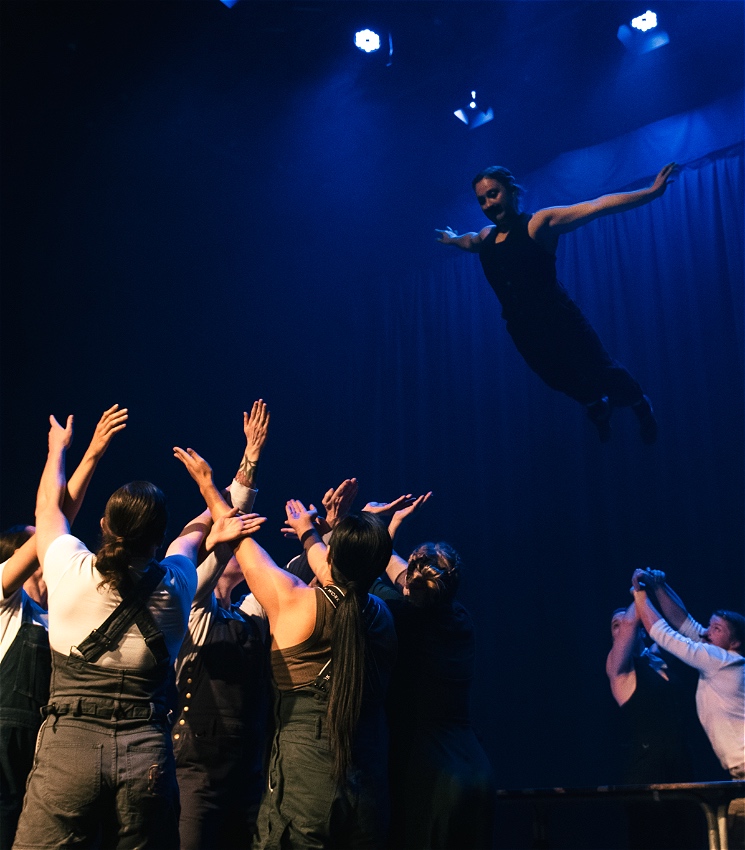
As ringmaster of the show, Knight introduces the other thirteen trainees that the show is centred on, giving them not just a voice, but also a story, a body, and the chance to own the stage. Each of them does this through a different awe-inspiring circus act that reveals the unique personalities and ambitions of each trainee. Despite the separateness of each story, directors’ Lannon and Walsh did a spectacular job tying together the stories into a single shared narrative that felt cohesive and never lacked energy.
Jerry Cobb (Robyn Glowacki) started off the first act with a dazzling burst of hula hoop tricks. As she narrated her trying journey from circus performer to NASA trainee, she agilely whirled and orbited across the kaleidoscope of neon pink and blue lighting that danced across the stage.
Sarah Gorelick’s (Rindi Harradine) balance pole act set a powerful metaphor of the high expectations placed upon women working in a male-dominated industry – to be “proper and prim”, “scientist and sweetheart”. Both literally and figuratively the slightest quiver can lead to a dangerous tipping but Harradine, performing with exceptional stability, refuses to be toppled.
The Dietrich sisters’ duo act (Cassia Jamieson and Nina Robertson) showcased the strength of synchronicity. In perfect coordination with each other, they told their story through a triumphant series of flips and spins to mark the power of sisterhood – when women hold each other up, even the sky is not the limit.
This is followed by a soaring trapeze work by Amy Nightingale Olsen as the graceful Irene Leverton. In a poised position, floating high above ground she elegantly remarks “when I touch down, I need to touch up” – exhibiting the beautiful but perilous nature of defying gravitational pull in a society that preferred women to have their feet on the ground and in the house.
Wally Funk (Sophia Bohlson) broke the emotional gravity of the earlier acts with a comedic and energetic Cyr wheel act. Bohlson shared Funk’s boisterous journey of achieving her childhood ambitions on a disco-esque stage sprinkled with little circles of rainbow light that is easily the most visually appealing scene in the show.
The performers later reappear as multiple other figures in a range of routines to collectively tell the stories of all thirteen of the trainees. These include Geraldine Sloan Truhil’s (Jamieson) strongwoman act, challenging the concept of strength and endurance with the message that true strength lies in a person who keeps going when everyone is saying no. Myrtle Cagle’s (Harradine) audacious aerial rope act boldly challenging the rules women must play by in a game designed by men, declaring “I’ve always been two steps ahead on what women are allowed to do”.
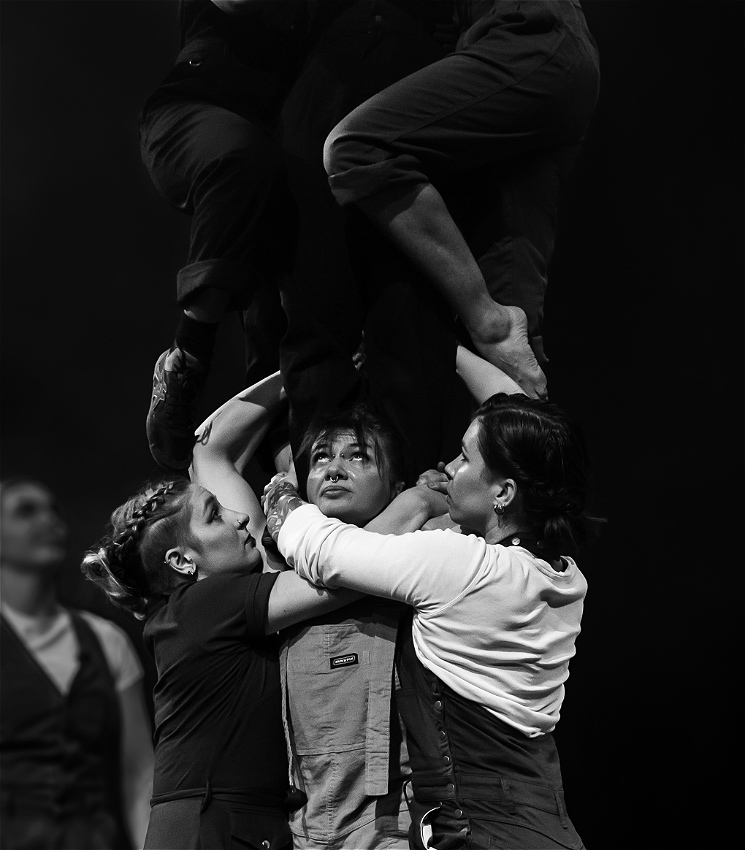
The dazzle and spectacle of the acts, however, is abruptly and sadly interrupted by the announcement that the program was cancelled, as misogynist attitudes, fueled by political motivations forced the women trainees to “return to your regular lives.” Seeing the power and drive of the trainees being grinded to a sudden halt was saddening to witness and a slap of reality of mid-century misogyny.
Something that I thought was very well done was the choice to have male characters be physically absent from the show. While none of the men are depicted onstage, which is commanded by the prowess of the women, their influence is nonetheless ever present. From the interspersed radio announcements commenting on the inconvenience of women’s menstrual cycles, to Dr Lovelace’s scientific defence of women as suitable for space, their institutional control is constantly felt. Despite this, sexism was never the focal point of the story and, in spite of setbacks, it is the women who are the focal point and their resistance and eventual triumph is always at the centre.
Weaving historical detail with dense scientific knowledge, interspersed through a series of stellar circus performances, Frijia’s script is gripping and defiant. However, there were times where I thought the message of female empowerment came across as overly didactic – especially towards the end. Having such bold, breath-taking circus performances, the message of rebellion, struggle and victory is already loud and clear that the final scene repeating the hardships the women trainees faced felt repetitive and if anything reduced the impact and momentum the previous hour had built up.
GO/NO GO is a colourful celebration of the legacy women left behind in a traditionally male-dominated field. It also offers a glaring eye at pervasive sexist attitudes that restrains any woman who dares to dream big: “unless what you want out of life is a stack of dirty dishes, someone will tell you no.” At its heart it asks: what will happen when we stop saying no? What if we said instead “go break barriers!”
Theatre Works’ GO / NO GO played October 14th – 18th at Theatre Works as part of the Melbourne Fringe Festival
JESSICA FANWONG (she/her) is a Naarm/Melbourne based writer, theatremaker and creative arts enthusiast currently studying Masters in Arts and Cultural Management. Her work can be found on Farrago and the independent theatre scene.
RACHEL THORNBY is a media and communications and creative writing student currently studying in Melbourne.
The Dialog is supported by Union House Theatre.
 The Dialog