
REVIEW BY JESSICA FANWONG
EDITED BY OLIVIA DI GRAZIA
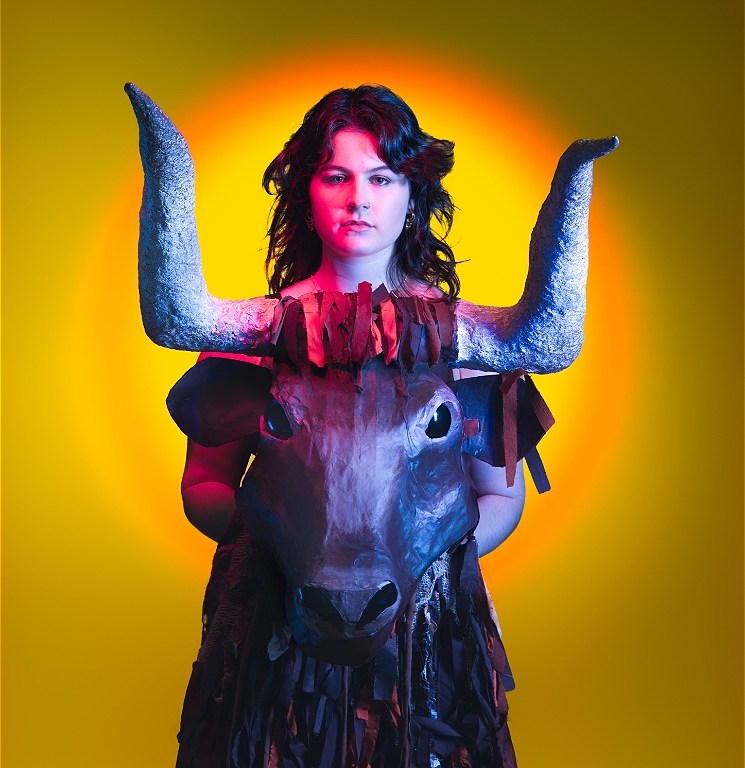
Written and directed by Bronte Lemaire, Medusa is an evocative reclamation of the popular Greek myth, illuminating the gendered violence and macabre power plays often obscured in the age of gods and heroes.
The overarching story remains fairly faithful to the canonical tale: at the show’s outset, Medusa (Ruby Grinter) serves as high priestess in Athena’s (Emmaline May) temple alongside six other priestesses. After she is sexually assaulted by Poseidon (Finn Corr) at the king’s celebratory feast and subsequently banished and cursed by Athena, Medusa lives out the rest of her days in an isolated cave until Perseus (Teige Cordiner) ultimately fulfils her fate. However, the most powerful aspect of this show is its recontextualisation of the myth, centring the iconic ‘monster’ and the women long silenced. Medusa holds a harrowing mirror up to the audience to reveal the voices we choose to suppress in our creation of legendary myths.
This is actually the second time I have had the honour of seeing this production; the first was during its premiere season at the Union Theatre. I was surprised and curious to see Four Letter Word Theatre – who have, in recent years, built a name for themselves producing campy, large-scale, original musicals – expand their repertoire to stage a play dealing with heavy topics. The first staging left me dazzled and completely awe-struck by the richness of the storytelling, and the power of the performances was far beyond what I expected from student theatre. Suffice to say, I walked into this production with high expectations.
What struck me as I walked in was the use of space. Presented at the Explosives Factory as part of the Melbourne Fringe Festival, this production is far more pared-back and bare bones compared to the sheer immensity of the 400-seat Union Theatre. The minimalist set by Julian Machin and Charlene Yong featured a naked stage with only four mirrors and white drapes, giving full, unadorned attention to the actors themselves.
This smaller-scale venue, I believe, works better for the show, enhancing the connection between actors and audience through more intimate, up-close storytelling. Lemaire’s direction is meticulously considered, driven by a blend of heart, anguish and hope, and executed with near unfaltering prowess. The result is a truly beautiful piece of theatre that both confronts and awes. Sitting in the centre of the front row, I was often just centimetres from the action onstage, creating an unsettlingly visceral, almost immersive experience. There were moments, however, when I felt the choreographed proximity felt unsafe for the audience. Particularly when Perseus was spinning the spear toward the audience, I actually feared it might strike me if Cordiner lost control even slightly. That being said, Zani Micaleff’s fight choreography is masterful, bringing the violence at the heart of the play to life with a biting realness.
Space restrictions also impacted the effectiveness of certain scenes that felt designed for a larger stage. One scene in particular – my favourite during the Union season – was when Eurayle (Harper Tierney-Hunt) played with the mirrors and lighting. At the Union, the mirrors reflected the lights onto each other, creating a ricochet prism of light that looked celestial. Unfortunately, this effect did not carry over to the Explosives Factory. The single spotlight was not strong enough to recreate the effect, despite the scene remaining in the production, which left me feeling somewhat unsatisfied. Additionally, some scenes contained a large amount of background action, which, while engaging on a larger stage, I found at times to be distracting from the main action in such a clustered space.
The small space, however, placed the audience closer to the characters, who never failed to impress with how well-crafted they were. Jacinta Klassen did a spectacular job depicting the inner turmoil of Thoosa. Thoosa represents the high expectations imposed on women: be responsible but not too ‘uptight’, a good daughter and also a loyal friend. While it would be easy to write off a character like Thoosa as unlikeable, Klassen brought out her nuance, portraying her as just a girl navigating parental neglect while being manipulated by figures larger than herself.
The triplets were a delightful comic relief in a show weighted with heavy themes. Each has a very distinct personality and is in constant friendly squabble with the others. The eldest, Deino (Chloe Sykes), is the bold and feisty ringleader of the trio. Pemphredo (Mya Helou), the smart and calm middle sibling, offers nuggets of wisdom and caution. Enyo (Milo Pennefather), the youngest, is frequently teased by their older siblings. The actors created a strong and inseparable sisterly dynamic, whose overlapping dialogue and vivacious interplay sustained the energy of the show.
Tierney-Hunt presented a top-notch embodiment of the innocent child, one that was agonisingly realistic. From the spring in her step to her hopeful optimism, Euryale is a character audiences will sympathise with and desperately wish will survive this tragedy.
Jaimi Sfetcopoulos’ Stheno is a less attention-grabbing but no less powerful character. Her unwavering love and support of Medusa, no matter what, is heart-wrenchingly beautiful, and their final, fatal look at each other is an image that will stay with me forever.
The relationship between Corr’s Poseidon and Cordiner’s Perseus was engaging but frightening to watch. As we watch Perseus transform from the awkward, dorky farm boy to the conniving, brutal gorgon-slayer under Poseidon’s tutelage, I see stark parallels with the corrupting influence of the modern-day manosphere, especially when women – like Athena – become complicit.
Emmaline May takes over the role of Athena from the previous staging (Dahlia Karam), making it interesting to see the contrast between two very different interpretations. Compared to Karam’s formidable, frightening Athena, May brings out Athena’s elegant coldness and her desire to be respected by Poseidon and the other gods. This is highlighted by Eden Mclean’s immaculate costume design, which truly captures the essence of each of the characters. Athena and the priestesses initially wore very feminine outfits – the priestesses in white to signify purity, and Athena in a rich gold dress, bedecked with jewellery to elevate her beauty and status. After Medusa’s exile, Athena’s outfit changes into a more masculine-looking power suit that seems to align her with Poseidon (and later Perseus). Likewise, the priestesses in exile gradually shifted their colours to match their animal masks during the king’s celebration feast, reinforcing the symbol of hunter and prey. Medusa’s switch to her signature green, echoed by Allira Smith’s lighting, is disconcerting, visually signalling a direct rebellion against Athena’s white hues of chastity.
The heart of the show, of course, is Medusa herself. Grinter delivers a masterfully raw and commanding performance of the titular monster, martyr, mortal. What I found particularly striking was the contrast Grinter brought out in Medusa’s personality before and after the assault. Beforehand, she was witty, crass, and flirty with a strong stage presence. Following the tragedy, the traumatised Medusa becomes more withdrawn and pensive, delivering some of the most beautifully written fourth-wall-breaking monologues with fervour, anger and heart. Grinter’s performance was gripping, moving quite a few audience members to tears. Her desperate cry, “I don’t want to be a martyr, I want to live,” poignantly pointed a finger at the audience, accusing us of our own complicity as passive bystanders watching Medusa’s tragic life unfurl.
While what resonated with me most about the show was its powerful storytelling, I did feel that this was undermined by its ending. The choice to give Corr the final word, with Athena left with outstretched but powerless hands, I feel, undermines the show’s entire concept of reclaiming the patriarchal story of sexual assault for its victims and survivors. Though I understand the cycle is necessary in portraying that assault is an ongoing issue where silencing still occurs far too often, ending the story here shifts the balance of power back to the perpetrator.
Nonetheless, Medusa forces us to face up to the reality and cost of glorifying violence when crafting legendary myths. For every Perseus we exalt, a Medusa is also degraded. We may be quick to create riveting monster stories, but what horrors can we truly uncover when we finally remove our blindfolds? Medusa asks this very question.
Four Letter Word Theatre’s Medusa played October 14th – 18th at Theatre Works Explosives Factory as part of the Melbourne Fringe Festival.
JESSICA FANWONG (she/her) is a Naarm/Melbourne based writer, theatremaker and creative arts enthusiast currently studying Masters in Arts and Cultural Management. Her work can be found on Farrago and the independent theatre scene.
OLIVIA DI GRAZIA (she/her) is a passionate director, writer and performer in her third year at the University of Melbourne. She is a sub-editor for The Dialog, and is developing a disability initiative for Union House Theatre to ensure student theatre is accessible to everyone.
The Dialog is supported by Union House Theatre.
 The Dialog