
REVIEW BY EMMA PARFITT
EDITED BY AZMY
St Kilda is battening down the hatches as the hot and sunny day breaks into wind and rain. It is blowing an absolute gale as I enter Theatre Works and it is clear a storm is brewing. It’s a storm that continues right on through the doors and manifests in The Weathering.
The haze is thick; the lights are dim and cold. The faces of performers, who sit solemnly along both sides of the stage, are barely visible. It’s a cast that is twenty-strong, plus a live band of two. This is more than a cast: this is a devising ensemble, and one that is made up predominantly of artists with a disability. With co-directors Darcy McGaw and Jo Raphael, they have woven stories from their lived experiences, their hopes and fears for the future and their creativity into an utterly unique piece of theatre.
Weathering is the changing of the climate, bringing more extreme weather events. It is feeling weathered down by the physical and mental challenges that brings, especially for people living with a disability. It is weathering out the storm, persisting. This is a piece of theatre that thrives because it lives and breathes – it is created by a group of people who are persisting through heightened challenges of environmental changes that are happening right now. A group that are chronically underrepresented in the power structures that make the decisions that disproportionately affect them. A group who are raising their voices by making art. This is the very best of theatre – new perspectives being brought to the world in incredibly bold and creative ways.
This is a formidable ensemble cast that is obviously strengthened by the connection they have fostered in their collaborative devising process. I was particularly moved by their ability to move swiftly between the dichotomies of isolation and connectedness. There are many moments where the full ensemble occupied the stage, and in each of these moments it is abundantly clear whether they are there alone or together. The times they came together were truly beautiful and poignant. A particularly gorgeous example is in Simone Bremen’s monologue about the trees and the wind. They stand centre stage, posing the question of a future on a ‘Planet B’, where manmade conditions are perfect but the trees cannot survive without wind. A group of ensemble stands either side, swaying together in unison, together as two trees flanking Bremen’s delivery. “We are all just nature,” says Bremen, before being enveloped by one of the trees.
The ensemble follows through, creating an image of one unified tree by moulding their bodies across the entire stage. They are physically connected, banding together to create this striking stage image. Not only is this a terrific use of space and levels, but it is a beautiful image of togetherness. Like this ensemble, trees are a dynamic, living entity. They allow us to sit with them in the peace of this image for a while, and it is a wonderful moment.
These quiet moments occur throughout the show, with each transition between scenes allowing a chance to reflect. Whilst conventional theatre strives for quick and swift transitions, this show invites us to sit in the stillness as performers move quietly in the space, readying for the next scene. Each performer moves differently, a subtle celebration of individuality and diversity. In a show that smashes theatrical conventions to the ground in many ways, this is a poignant little thing that reminds us again that rules are best broken.
Serene moments of togetherness are contrasted sharply by stirring moments of isolation. Sometimes, this is a performer alone on stage as others watch them struggle from the sidelines. For me, the most devastating part of the show when the entire ensemble paces through the space, utterly alone in their own chaos as projections and sounds of headlines of climate disaster play. These are headlines of the climate crisis that we have experienced and are living now, bringing us back to the 2019-2020 bushfires among other major weather events attributed to anthropogenic climate change. As one performer watches, transfixed, everyone else moves around the space, ignoring. They move quickly, but in no particular direction, creating a stage space that echoes the chaos of everyone’s own personal lives that they are trying to persist through. On top of that, who has the time and capacity to worry about the climate crisis? It continues until the headlines grow so loud and the images so upsetting that everyone has to look. Maybe that moment is too late.
Though the show deals heavily with the grimness of climate change, there is an overarching theme of resilience. People with disability have to exercise resilience in different ways to what many of us can comprehend to get through: discrimination, the mental and physical challenges of their disability, and navigating a society that is often not built to be accessible for them. These are things that can weather people down, but this ensemble celebrates how difficulty shapes them. Like trees need wind to strengthen their fibres, people grow through hardship.
The show also handles the exhaustion that comes with this incessant need to be resilient. With a disability, this can be exacerbated physically and mentally. Sometimes, as Zoe Barwise addresses in a moving monologue by Ray Adcock against the backdrop of a turbulent sea, it’s impossible to “just keep swimming,” and it’s okay to just float by for a bit, so you can swim again tomorrow. It’s a message that also addresses the exhaustion of activism and reminds us of the importance of looking after ourselves, so that we can fight for our planet.
The monologues and movement are complemented by a gorgeous sound design by Darcy McGaw, alongside an incredible original score by Ross Atrill and Lilith Becker. They also perform parts of this live. It’s a soaring score, and the strumming guitar is a wonderfully uplifting sound that contributes to the overarching feeling of hopefulness in the show. A highlight is Suzanne van Rooy’s lovely performance of The Weatherlings – an original song by Atrill that reminds us that we are all shaped by nature and our experiences.
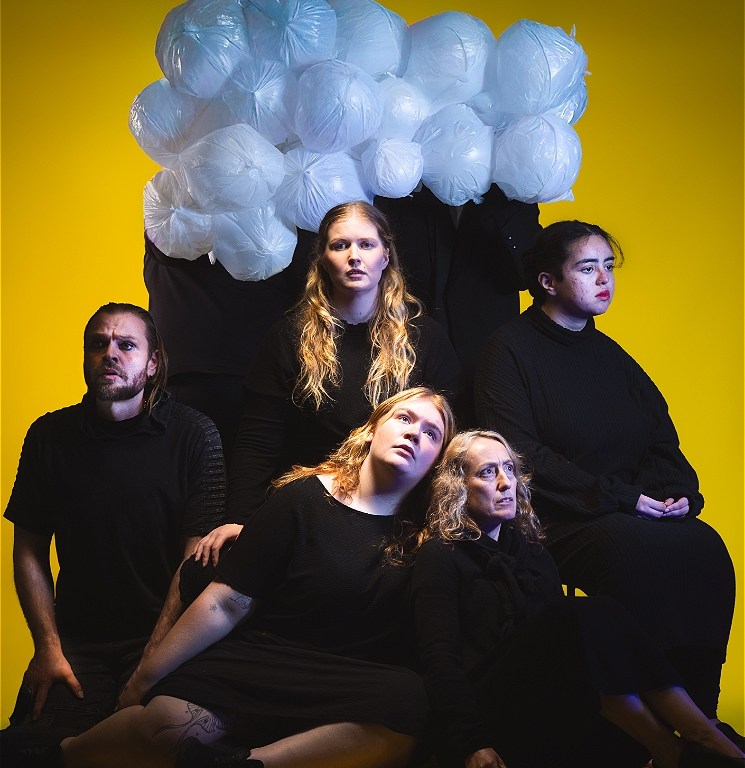
The lighting by Justin Heaton works seamlessly with the staging. It’s simple, but the angles that are created are striking and the use of colour is clear and impactful. I was also very partial to the way the lights reflected off the plastic sheets that made up most of the minimal set. The plasticky set is versatile and interactive, with plastic sheets forming oceans and clouds, as well as a suffocating trap.
The innovative use of basic materials was at its peak when umbrellas were used as a backdrop to shadow puppetry. This deceptively simple sequence was a gorgeous exploration of the devisors’ hopes and fears for the future. It looked brilliant, the meaning was clear, and the live guitar strumming contributed to a homely and comfortable feeling, like a casual yet meaningful exchange between friends.
The final image of the show is the ensemble, together on the stage in a stunning movement piece, basking in the sunlight to Djarimirri (Child of the Rainbow) by Gurrumul, a blind Indigenous Gumatj artist. It’s a gorgeous piece of music that could not be more fitting, and this conclusion leaves us with a heart-warming sense of hope in connecting to and protecting Country.
I had been excited to see The Weathering for a while. As a theatre-maker about to graduate from an ecology degree, I am always keen to see the environment and our relationship with it explored in creative ways. Still, the impact I felt from this show was unprecedented. It’s been a struggle to write about because it’s hard to put into words. Thank you, Fusion Theatre, for making my job here very difficult in the very best way.
Writing about The Weathering brings me back to the moment that the house lights came up and I realised I was in tears. The show just felt like a big, cathartic hug in the midst of a burning world. This is theatre like I have never experienced before and it felt like a privilege to share in this story. Not only is this show an affirming exploration of our place as humans within nature and a call to act to protect our planet, but it is a true celebration of diversity and inclusivity. This is essential theatre, and it is art doing what it does best – making us think, feel, and go out and change something.
Fusion Theatre’s The Weathering plays til October 18th at Theatre Works as part of the Melbourne Fringe Festival.
EMMA PARFITT (she/her) is the Dialog’s head editor and has written Dialog reviews alongside studying towards her science degree for the past two years. She is a production manager, stage manager and producer on the Melbourne indie theatre scene and a veteran of student theatre at Union House Theatre.
AZMY (they/them) is a 2nd year Creative Writing student at the University of Melbourne. In their spare time they enjoy watching theatre, playing video games, and thinking about studying.
The Dialog is supported by Union House Theatre.
 The Dialog