
REVIEW BY BRONTE LEMAIRE
EDITED BY EMMA PARFITT
Content warning: this review contains mentions of suicide and sexual abuse.
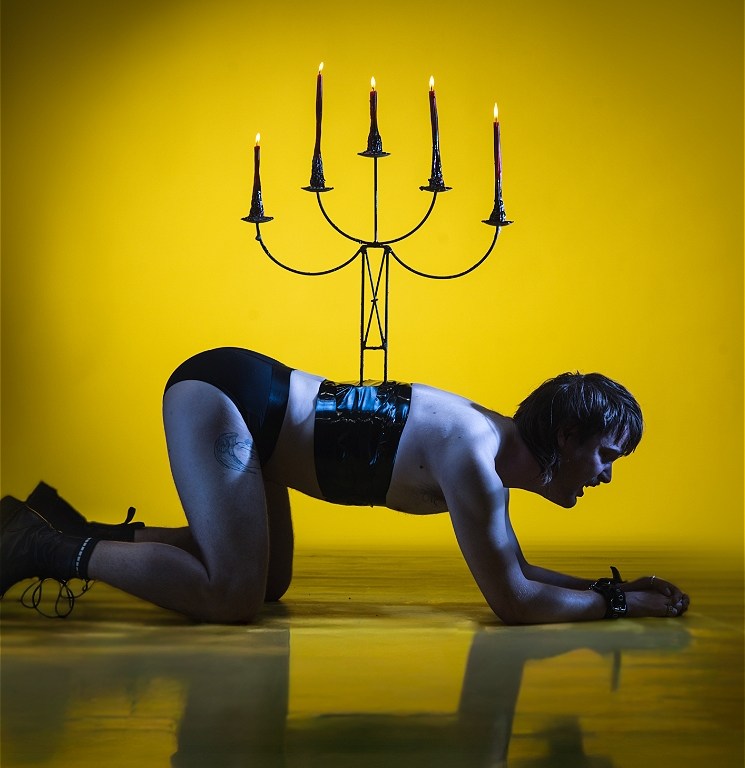
I’m not sure exactly what I expected when I walked into Theatre Works to see Beauty and the Beast. It looked kinky. It looked gay. So somehow, I didn’t see the 15-minute video of a man masturbating projected onto the back wall coming. It was very much not censored, very much not simulated, and due to being corner to corner on the giant back wall, very hard to miss. It gave everyone a laugh of shock as they came in — we always want provocative theatre but we’re always surprised when we’re finally given it. The homemade porno continued to play as the rest of the audience filed in, letting us get used to the imagery and laugh whenever he took a hit of his vape or started nodding off to sleep before he had even ‘finished.’
After the film ends and the audience have settled in, we’re introduced to Cassidy Gaston (Columbus Lane) and Beau Cocteau (Jake Stewart). They meet each other at an extravagant event that Cassidy, who has been especially hired for his looks, is working at, and they begin a match of antagonistic flirting. It’s cute, it’s incredibly endearing, and the chemistry is already off the charts. We time skip and meet their adopted son Chip (Gabriel Jarman) as they journey to meet Cassidy’s secluded uncle who lives deep into the woods in an intimidating manor. Here they meet Lumiere (James Hardy) who gives them the grand tour and tells them to please ignore the decapitated head they have – it’s not important – before introducing us to the beastly Uncle Orlo (Nicholas Reynolds) and his beautiful brother Hastings Rose (Jack Stratton-Smith). What proceeds are sexual taboos, difficult choices, and explosive desires.
The ensemble is truly to die for. It feels ridiculous to call a cast quick-witted for delivering an already funny script written by Stewart, but each line is delivered to extort the most laughs possible. The ensemble complement each other perfectly. Hardy’s Lumiere gives flamboyance in droves, all whilst giving us the funniest French accent I’ve heard in my life. Stratton-Smith in contrast portrays a more uptight and polished gay man, whose concessions give just as many laughs as his cruelty. Jarman and Reynolds play Chip and Uncle Orlo respectively in a way that allows for them to both be outsiders and powerless within the narrative, yet in differing ways that highlight the lifetime of experience between them.
Lane has excellent sexual chemistry with the other actors, ready to turn from firm parent to horn-dog in the blink of an eye that doesn’t undermine his character. Despite Stewart understudying at the last minute, I truly wouldn’t have known if no one had told me. It’s one thing to know your lines, it’s another thing entirely to deliver them with such precision and snappiness. Stewart’s Beau and Lane’s Cassidy Gaston have a tumultuous relationship that lets each bounce off the other in ways that reveal their unexpected similarities and stark differences. The darkness of Reynolds is played hauntingly against Jarman’s innocence, creating such an uncomfortable space of pathos that gained us sympathy and horror for each of them.
There isn’t any set despite the intimidating size of the theatre. It’s rare that you get to see such a stripped back production that relies so heavily on its actors, and rarer still that it’s actually able to get away with it. There were, however, a couple of chairs upstage on either side of the theatre that the actors sat on between scenes. It is an extremely smart play with voyeurism; we as an audience are let into the part of the show we shouldn’t be privy to; watching the undress and redress. And due to the themes, you can’t help but feel it to be sexually charged.
The staging directed by Stewart was simple, incredibly evocative and even beautiful in moments. The scene that comes to mind is when Uncle Orlo finds Chip looking out Orlo’s midnight window that he goes to when he feels melancholic. Reynolds is staged right at the back of the stage while Jarman is in arm’s reach of the audience. A pinpoint spotlight illuminates each of them, somehow reducing the massive stage to this small and static moment.
There were times I was a little unsure about what we as an audience were meant to be feeling about some of the confrontations and the ending due to the dark subject matters such as suicide, sexual predation and implied rape that were either heavily implied or explicitly discussed. There were times half of the audience would laugh while the other half were still, breathing in discomfort. I can see the argument being made that this exact tension was what they were trying to achieve — which I can get behind. I don’t think there’s any subject matter that can’t be joked about if it’s done with precision and consideration, but I do also wish they had listed some additional warnings on the site.
All in all, Beauty and the Beast is a kinky, gay extravaganza that utilises the immense skill of its cast to the utmost limits of comprehension. I’m now completely hooked on seeing what Kissing Booth Productions will create next, and wonder if it will somehow find a way to top this masterful show.
Kissing Booth’s Beauty and the Beast played October 7th – 11th at Theatre Works as part of the Melbourne Fringe Festival.
BRONTE LEMAIRE is a writer and theatre maker who loves witnessing what emerging artists can achieve. Bronte loves analysing and picking apart what makes art work and function (or not!) in order to learn and steal some inspiration for herself.
EMMA PARFITT (she/her) is the Dialog’s head editor and has written Dialog reviews alongside studying towards her science degree for the past two years. She is a production manager, stage manager and producer on the Melbourne indie theatre scene and a veteran of student theatre at Union House Theatre.
 The Dialog