

REVIEW BY GRYFF CONNAH
EDITED BY OLIVIA DI GRAZIA
There is always performance in the act of confession. It is an outpouring, a thing to be heard by another. Perhaps it is offered the hopes of receiving forgiveness, or better yet, absolution. It is deeply personal, and yet it has bubbled, boiled, and roiled to the point where it must jump from the confines of the self and into the lap of the other. It is a staged thing and, for better or worse, it is always absorbed by its audience.
Cipta Theatre Company’s The Confession Booth Showcase is a scintillating concept piece examining just that.
This showcase charts the working scripts of three gripping plays: Snakes and Straights (by Fynn Zagari, dir. Taylor McGuinness), Look to Your Left, Look to Your Right (by Jayden Alexander, dir. Abbey Oshlack), and Headlights (by Lilla Gutteridge, dir. Maddy Hatch). Each approaches the subject of confession from its own unique standpoint and context, and each seeks to shed light on the rumination and shadow that prompts these disclosures.
I enter the Guild and the tone of the night is set. An arrangement of four chairs greets show-comers under gobo shading, and I’m already intrigued and anticipating the first confessors. It’s not long before a motley crew fills these seats.
The lights – skilfully operated and designed by Irene Lu – dim to reveal interrogation-esque spotlights, and we’re quickly drawn into the world of Zagari’s Snakes and Straights. It’s anyone’s guess at first, but between rapid-fire statements and febrile declarations, it becomes clear that a murder has taken place: the murder of none other than ‘Ace’, the ostensible ringleader of Kingsley (Harrison Pinner), Quin (Tam Tran), Jackson (Ben Fox), and Tennison’s (Azmy) gang. Zagari’s script is fast-paced and witty; the actors spout white lies and half-truths, all the while interrupting one another and finishing each other’s sentences without hesitation despite their obvious separation (a nice dramaturgical touch).
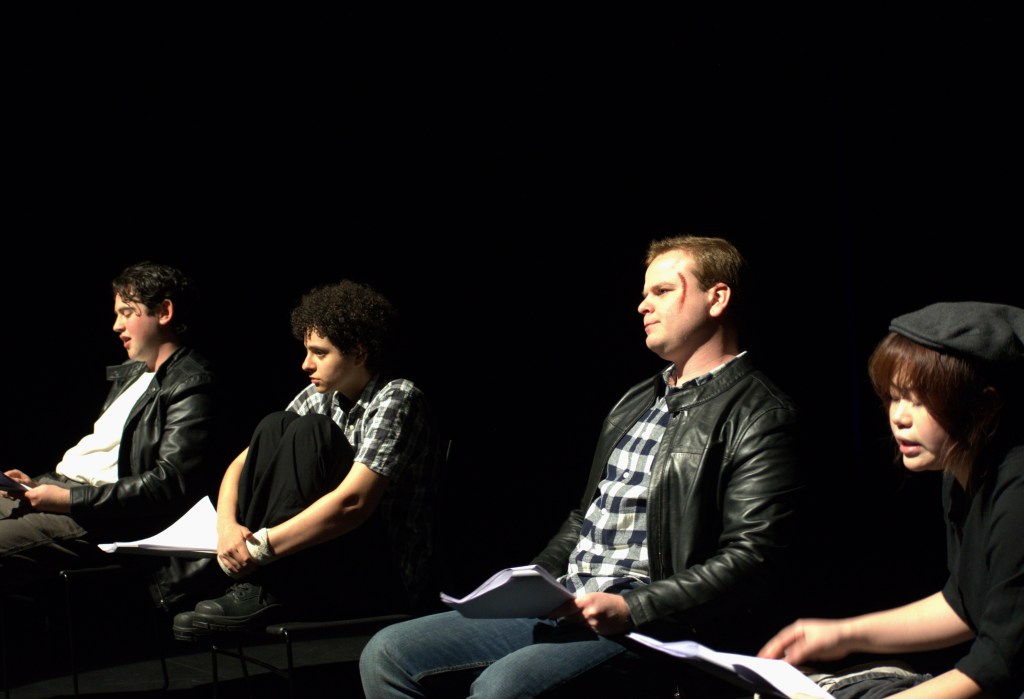
Fox’s Jackson is cocky and does everything in his power to circumvent the hard questions. He’s a veteran of the interrogation room. Quin and Tennison are more green, possibly newer members to the fellowship; Tran and Azmy convey this well. And Kingsley – likely the second-in-command – is tough, but decidedly honourable. He’ll take the hit if it means protecting his own.
The four suspects reach their boiling point in a clamorous climax that is both jarring and satiating. Zagari’s storytelling is excellent; he holds the audience in a vice-grip, and the carefully planted tidbits and red-herrings that precede it make the reveal of Kingsley’s confession all the more exceptional (and all the more powerful considering it’s sacrifice). McGuiness tears this text open with the powerful front-facing chair formation, casting these criminals before the jury we have all but become.

After some adjustments to the chair arrangement (two are taken, two remain), we enter the world of Look to Your Left, Look to Your Right. Oshlack conjures a much more introspective atmosphere as we meet the next two characters: protagonist ‘Boy’ (Samuel Pruscino) and the ‘Ensemble’ (Joe Mangan).
Much like in Snakes and Straights, context is revealed gradually, but this time with a more gnawing, leering tilt. Boy discloses that he has recently been hit by a car at a pedestrian crossing, and we follow along as he recounts and relives this traumatic experience. Pruscino’s performance is exemplary – he knows when to tell, and more importantly, when to show. Mangan switches roles with touchscreen ease to great effect. From therapist to family member, he maintains a certain composure that appears almost artificial – an detached, unemotional quality in stark contrast to the overwrought and reeling Boy.
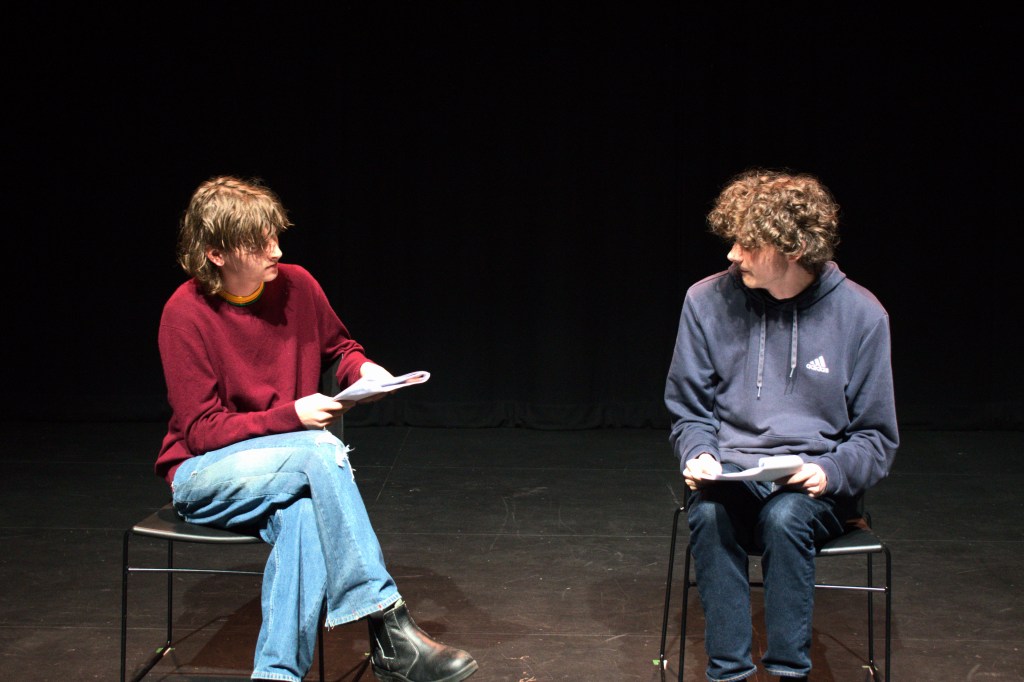
Towards the end, it all sinks in. Although not explicitly stated, it becomes evident that we have been privy to Boy’s reality through the conduit of a very powerful analogy. Sexual assault is a difficult topic to charter; however, Alexander approaches it with care, nuance, and great intelligence. I applaud the writing behind this script in motion – it’s that gruesome ‘a-ha’ moment that leaves the audience wondering and wanting of a deeper understanding. As Alexander suggests in the program, an analogy can allow the audience to reflect on their own lives without unnecessary traumatisation, and the subtle (though brutal) depiction of a pedestrian accident achieves this perfectly.

Finally, we move to Headlights, with two chairs in tow. However, only one is filled – a strong choice by Hatch – as we meet our last protagonist Jessie (Claudia Scott). Scott plays Jessie as characteristically detached and indifferent to her own life; she has lived her life with the help of various medications and is, for the most part, dissociating regularly. But things are about to get a whole lot more complicated.
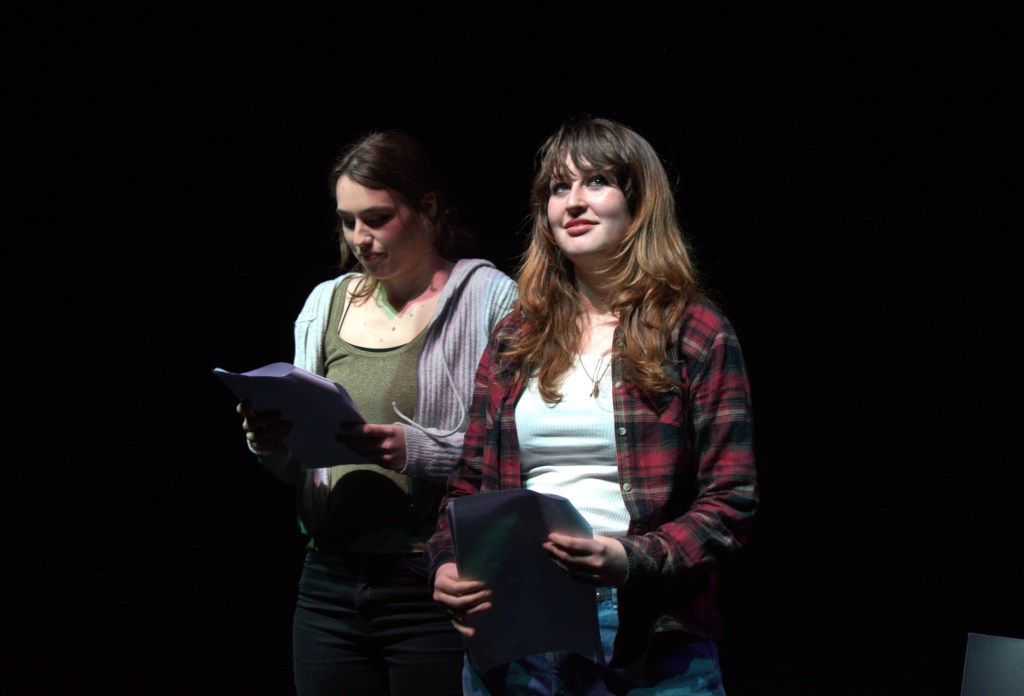
Scott masterfully recounts that fated night when the mysterious Clara (Sunday Williams-Starkie) takes a knife to a man in Jessie’s front yard. Clara smiles at Jessie and disappears. But something deeper has been formed in that brief moment of eye contact and it won’t be easily shaken off. When we meet Clara, Sunday is deliciously nonchalant – a classic killer-with-no-thriller type – and she confesses that in that blood-soaked moment she kind of fell for Jessie. The next few sequences trace the Bonnie-and-Clyde-style romance that ensues between the murderer and their accomplice, as they travel great distances to escape the trappings of their past. It’s conspiratorial and confessional, and I am in awe of the chemistry struck between Scott and Williams-Starkie. Gutteridge’s voice thrives in the realm of intimacy, and their unmuted evocation of queer love on the run speaks to something far beyond the crime itself. It’s smart, seductive, and grotesque – everything I want to see in queer representation!

As I leave the theatre, we are shown a QR-code for feedback. These works are very much in development, and feedback is important in helping inform the next steps and further iterations. However, I’m stuck on what I can impart apart from applause. All I want is to see each of these works blossom in their own right, and I await the day(s) these pieces bloom with bated breath!
This showcase foregrounds the experiences of those with a secret, those living with shame, and those living for the hope of something more. In the end, what we want is freedom – from ourselves, from others, or even from the world – and to this end, we confess. We clear, we clean, we come closer to the truth.
What a privilege to witness all three of these works in one sitting – I must confess, it was truly a pleasure to watch.
Cipta Theatre Company’s The Confession Booth Showcase played September 24th – 25th at the Guild Theatre.
GRYFF CONNAH (he/him) is an emerging, Naarm-based performer and theatre-maker who is currently studying a BFA in Theatre at VCA. His written, directed and devised works aim to disrupt the inertia that is imposed by capitalist hegemonies, and to explore environmental activism, stories of neurodivergence and disability, and queerness.
OLIVIA DI GRAZIA (she/her) is a passionate director, writer and performer in her third year at the University of Melbourne. She is a sub-editor for The Dialog, and is developing a disability initiative for Union House Theatre to ensure student theatre is accessible to everyone.
The Dialog is supported by Union House Theatre.
 The Dialog