
REVIEW BY JESSIE WILLIAMS
EDITED BY EMMA PARFITT
Staged in the intimate confines of the Louis Joel Arts and Community Centre in Altona — a site rich with history, once housing the very hospital that inspires its narrative — Ivy and Sylvia offers a compelling, quietly radical exploration of women’s roles in early twentieth-century Melbourne healthcare. It’s written by Mia Boonen, directed by Azmy Azurite and Amelie Barham and performed by local artists Scarlett Rose and Mia Boonen in collaboration with their community theatre group. This two-woman play weaves together historical documentation, creative storytelling, and living memory to bring to life two figures: Ivy, the first matron of Altona Hospital, and Sylvia, a community midwife and holistic healer. The result is a work that is both moving and provocative, blurring the boundaries between past and present, fact and fiction.
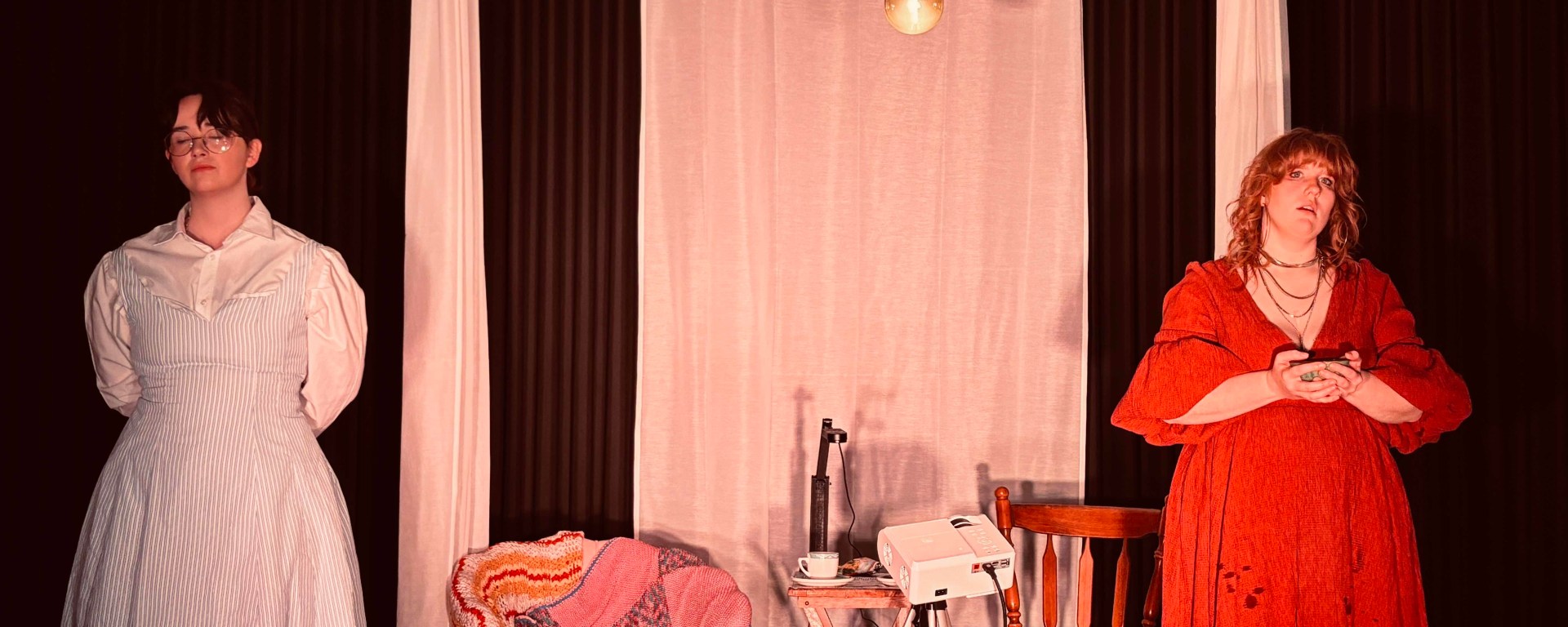
From the outset, the play announces its theatrical conceit: an imagined posthumous conversation between Ivy (Scarlett Rose) and Sylvia (Mia Boonen), their ghostly presences lingering in the very space they once served. The absence of a fourth wall makes the audience companions in their remembrance; observers and participants alike. Real news articles, archival records, and first-hand accounts are projected onto a white sheet using an old-school projector, transforming historical fragments into living dialogue. The simple staging (chairs, a tea set, and shifting pools of light) creates a sense of intimacy and immediacy. With only around forty seats, each performance feels like a confidential exchange, a séance of sorts, where memory and theatre intertwine.

The heart of Ivy and Sylvia lies in its portrait of two women bound by care but divided by circumstance. Ivy, tightly wound and impeccably dressed, represents the emerging professional class of nurses, bound to serve under male doctors yet essential to the running of hospitals. Sylvia, by contrast, embodies the lineage of traditional healers; women who learned midwifery through apprenticeship and community wisdom rather than medical schooling. Their conversation reveals shared frustrations and quiet admiration: both sought to heal, both faced dismissal, and both found their work defined by the limits men imposed upon them.The emotional and political core of the play centres on a tragedy: the death of Maggie, a young mother who dies from an ectopic pregnancy under Sylvia’s care. In one of the most powerful sequences, Sylvia recounts the event with heartbreaking candour. Her trembling hands, her disbelief, the creeping horror of realising she could not save her patient. The room stills. Several audience members close their eyes. The performance transcends theatre and becomes an act of communal mourning, a recognition of pain that once rippled through the very neighbourhood where the play is now performed.
This moment crystallises one of the production’s most profound insights: that women like Sylvia, who were once celebrated as healers, were easily recast as ‘witches’ or ‘murderers’ when things went wrong. Ivy’s sympathy for her friend is tempered by her own entrapment within institutional hierarchies. She, too, laboured endlessly in the shadows while Dr. Louis Joel; whose name now adorns the arts centre, received most of the recognition. The play refuses to vilify him entirely, presenting him instead as a man shaped by the same patriarchal systems he upheld. The true antagonists, it suggests, are bureaucracy, prejudice, and the rigid machinery of early twentieth-century medicine.

What makes Ivy and Sylvia remarkable is its deft intertwining of the historical and the contemporary. While the main conversations were about the world following World War I, its concerns feel painfully current. Discussions of reproductive rights, abortion, and women’s autonomy resonate with ongoing debates in Australia and beyond. References to modern legislative shifts subtly underscore that the struggles faced by Ivy and Sylvia; over recognition, control, and credibility are far from relics of the past. The play’s ghosts, it seems, are not the only ones haunting us.
Performance-wise, both Rose and Boonen deliver nuanced, deeply felt portrayals. With minimal props and staging, they shift seamlessly between characters and time periods, embodying Ivy, Sylvia, and the shades of those who surrounded them. Their chemistry anchors the show, creating a rhythm that feels spontaneous, conversational, and authentic. Occasional pauses or stumbles in dialogue feel less like mistakes than lived moments, proof of the fragility of memory being relived aloud.
The technical design enhances this delicate atmosphere without overshadowing it. Lighting plays a vital role in guiding the audience through time and emotion. Ivy, measured and institutional, is bathed in cool blues that echo the sterility and restraint of hospital life. Sylvia, freer and more instinctive, glows in warm yellows and oranges, her scenes pulsing with the energy and danger of birth, loss, and survival. These visual cues, paired with subtle shifts in tone and gesture, lend the performance a cinematic fluidity, allowing viewers to slip seamlessly between realism and reverie.
The projections of archival newspaper clippings and hospital records not only ground the dialogue in factual history but also act as silent witnesses, reminding the audience that these were real women whose work was recorded, though rarely celebrated. The combination of modest lighting, minimalist props, and the physical closeness of the performers and spectators turns the room into both theatre and memorial.
In such a small space, emotion reverberates. Every flicker of grief or humour is shared collectively. Many attendees are local community members, some with personal ties to the hospital’s history, and their presence lends the evening an added resonance. Their quiet tears and murmured recognitions reveal how deeply Ivy and Sylvia touches on a communal wound—the erasure of women’s labour from the stories we tell about progress.

Boonen’s writing, too, deserves special note. Balancing historical exposition with vivid natural dialogue, it draws audiences in gradually. Early passages ground the narrative in Altona’s social history, while later scenes flow freely between recollection, confession, and reconciliation. The text resists sentimentality, instead finding poetry in understatement. Its ghostly premise—two women meeting beyond death—might have felt contrived in lesser hands, yet here it becomes a profoundly human lens through which to view remembrance and regret.
If there is one drawback, it is that such a powerful piece may never reach as many audiences as it deserves. With seating capped at around forty, each performance remains an intimate encounter rather than a wide-reaching spectacle. Yet perhaps that is fitting. Ivy and Sylvia, a play about listening to those who were silenced, about giving voice to the forgotten healers and caretakers who sustained their communities long before they were recognised as professionals. Its smallness mirrors its message: history often happens in rooms like this one, between those who care enough to remember.
Ultimately, Ivy and Sylvia is a triumph of local theatre: beautifully acted, inventively staged and politically resonant. It proves that performance art need not be grand to be transformative. In a simple room in Altona, history, empathy, and imagination converge to remind us that the past is never truly past. The ghosts of Ivy and Sylvia remain, asking not only to be remembered but to be understood.
Dramawerkz’s Ivy and Sylvia plays til October 12th at the Louis Joel Arts and Community Centre as part of the Melbourne Fringe Festival.
JESSIE WILLIAMS has been involved in theatre for over 10 years in many different areas, including directing, acting and production management which has been a huge part of their life. She is finishing up a major in media and communications, so this combines two big passions.
EMMA PARFITT (she/her) is the Dialog’s head editor and has written Dialog reviews alongside studying towards her science degree for the past two years. She is a production manager, stage manager and producer on the Melbourne indie theatre scene and a veteran of student theatre at Union House Theatre.
The Dialog is supported by Union House Theatre.
 The Dialog