
REVIEW BY ZENA WANG
EDITED BY RACHEL THORNBY
In contemporary theatre, exploring how to present the complexity of social structures through everyday narratives is an extremely challenging task. Mr. Inkleigh, written by Ben Jamieson-Hoare and directed by Katherine Bragagnolo, is precisely such a work — it uses an ordinary apartment building as a vehicle to weave a modern parable about loneliness, surveillance, paranoia, and the desire to be seen.
From the moment the audience steps into the theatre, the performance is already quietly in motion. A thin haze fills the space, as if we were walking through the corridor of an old apartment building, with an atmosphere of oppression and mystery in the air. On every seat lies a booklet designed to imitate a real tenant’s guide, listing tenant instructions and community rules in detail, making it difficult to tell whether we are simply audience members or new residents of the building.
Even more cleverly, small handwritten “neighbour messages” complaining about noise or smells are placed on the audience’s seats before the show begins, allowing us to step into the world of the play before the show start. These props become the first layer of the narrative text. They directly break the boundary between the stage and audience, pulling us into the story from the moment we sit down. This was a particularly clever choice, which gave me a strong sense of participation right from the start and made me feel like I was already part of this closed community.
At the start of the story, the brisk main melody — part of sound designer Victoria Angelique Mertzanidi’s carefully crafted soundscape — brings a deliberate sense of chaos. The rhythm is lively, yet the different layers of sound and music are slightly misaligned, creating a subtle polyrhythmic tension. On the surface the music still moves forward together, but the underlying dissonance shaped by Mertzanidis’s nuanced design foreshadows the superficial harmony and internal divisions of neighbourly relationships.
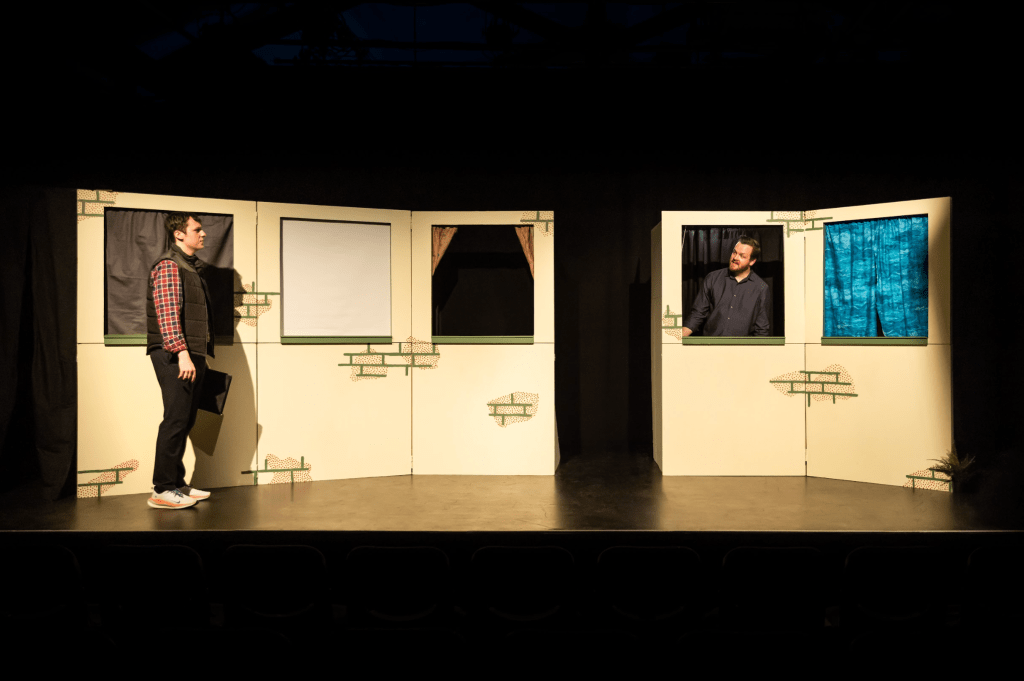
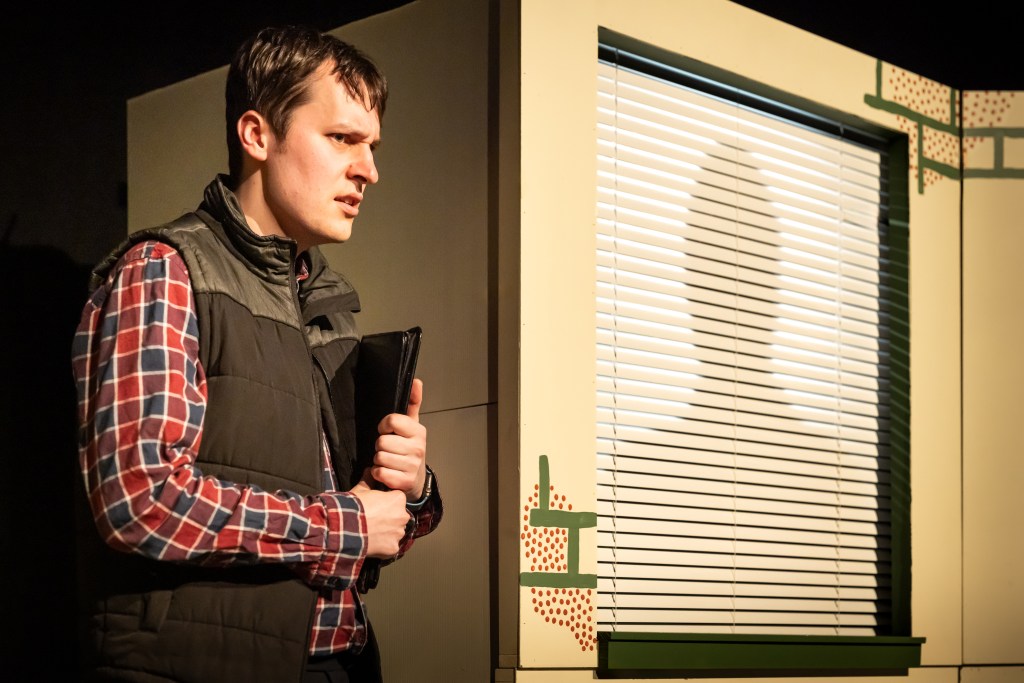
The stage design (Ben Jamieson-Hoare) echoes this theme: the façade of the apartment, composed of countless small windows divides the stage into separate apartments. At the start of the play, all the tenants pull back their curtains simultaneously, presenting character-defining first appearances — some make tea, some smoke, some drink, with emotional states ranging from calm to restless. These contrasts feel deliberately heightened by the director, as if different lives are being forced into the same piece of music. On the surface, everything appears orderly and harmonious, but beneath it I could sense tension, friction, and a quiet instability. It left me with the impression that, even though everyone shares the same building, they are all moving to completely different rhythm.
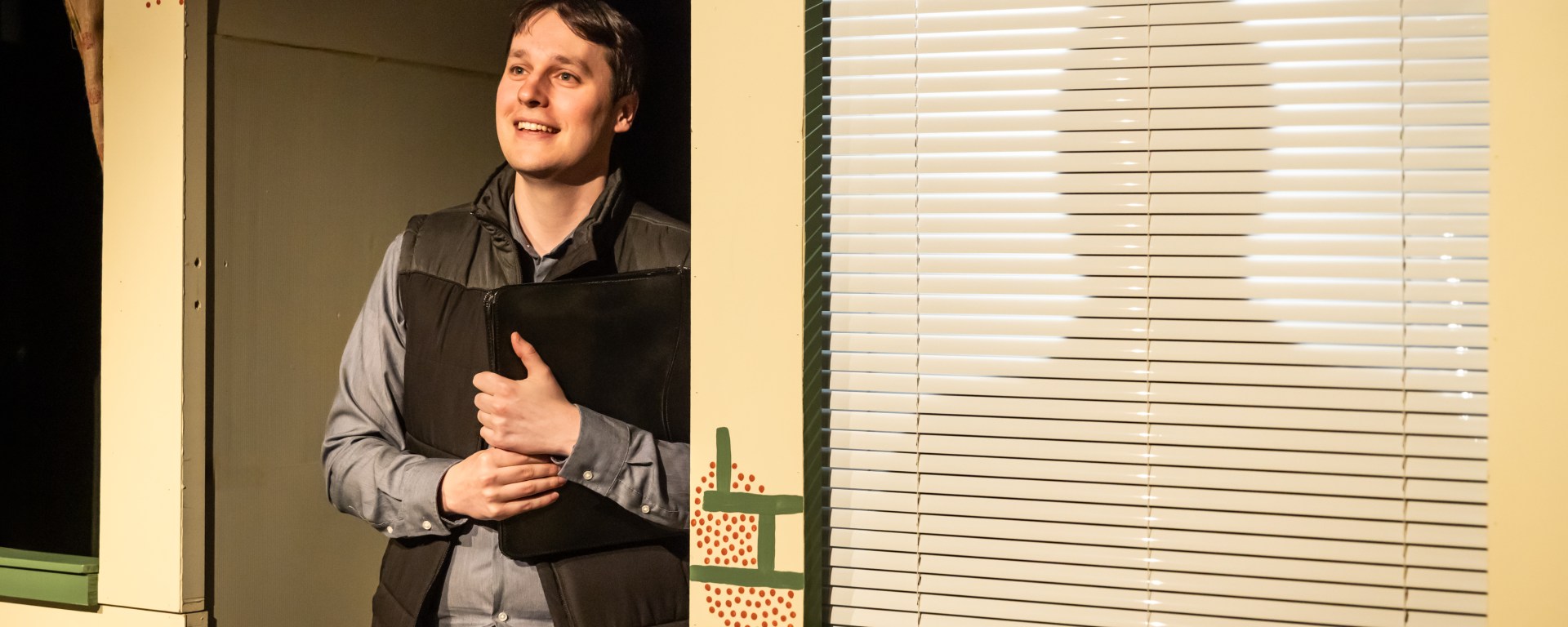
Greg, (Ethan Back) the building’s manager, appears first as the spokesperson for surface level order. His fast-paced speech and enthusiastic attitude initially seem welcoming to new tenants, but the warmth quickly gives way to a cold list of regulations: parking, driveways, bicycle storage, communal spaces, bird feeding, and more. Greg is an agent of the system and a “coordinator” of conflicts, but he never truly engages with anyone’s pain. When he holds a “tenants’ meeting” and addresses the audience, we are no longer observers but tenants ourselves — silently accepting the rules. Ethan Back delivers this duality with precision, and his performance captures both the charm and the underlying indifference of the character.
One of the tenants, Erin, is brought to life by Verity Wood, whose calm and elegant performance captures the character’s self-contained world. She names the people around her after animals and regularly performs “full moon cleansing” rituals to try to remove negative energy from her life. These rituals are both self-protection and self-hypnosis — seemingly selfish, yet a strategy for maintaining a sense of meaning in isolation.
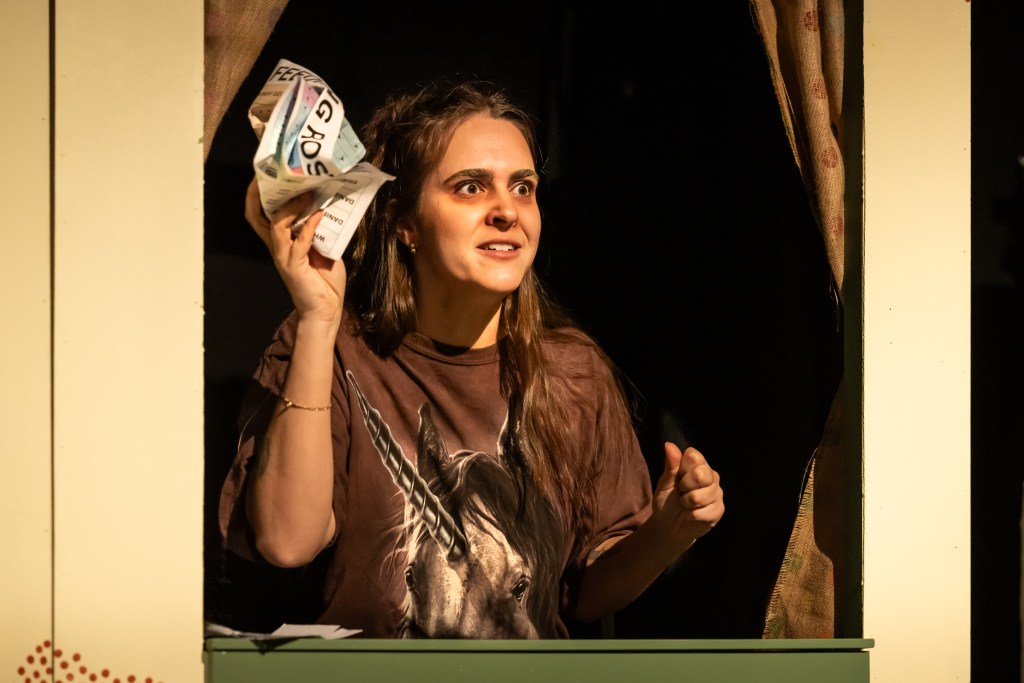
Jess Robinson delivers a compelling portrayal of Charlie, perfectly capturing the essence of adolescent obsession — from the two braided pigtails to the phone that never leaves her hand. She repeatedly places ferns at her door, and although they are stolen time and again, she continues this behaviour. Behind this compulsion lies a desire to be seen — a hope that someone will stop and say, “Your plant is beautiful.” Her fixation on discovering “who stole it” gradually becomes a need for control but never turns into a real connection with others. She does not even know who Greg is — because what she seeks has never been other people, but rather the moment when her existence is acknowledged.
Danielle (Elsa Caruso) is perhaps the most heartbreaking character in the play. She is burdened with an unfair bird-feeding schedule yet chooses to compromise because she does not want to disappoint others. She is always dressed in pyjama-like clothes, suggesting social withdrawal and isolation. Her anxiety shows in her rapid speech, stammering, and difficulty expressing herself. When a bird dies after crashing into a window, she blames herself and breaks down, crying, “It’s because I fed the birds that it died.” Greg’s response is only a cold, bureaucratic question: “Which bin did you throw the body into?” — no comfort, no empathy, only the chilling echo of the system.
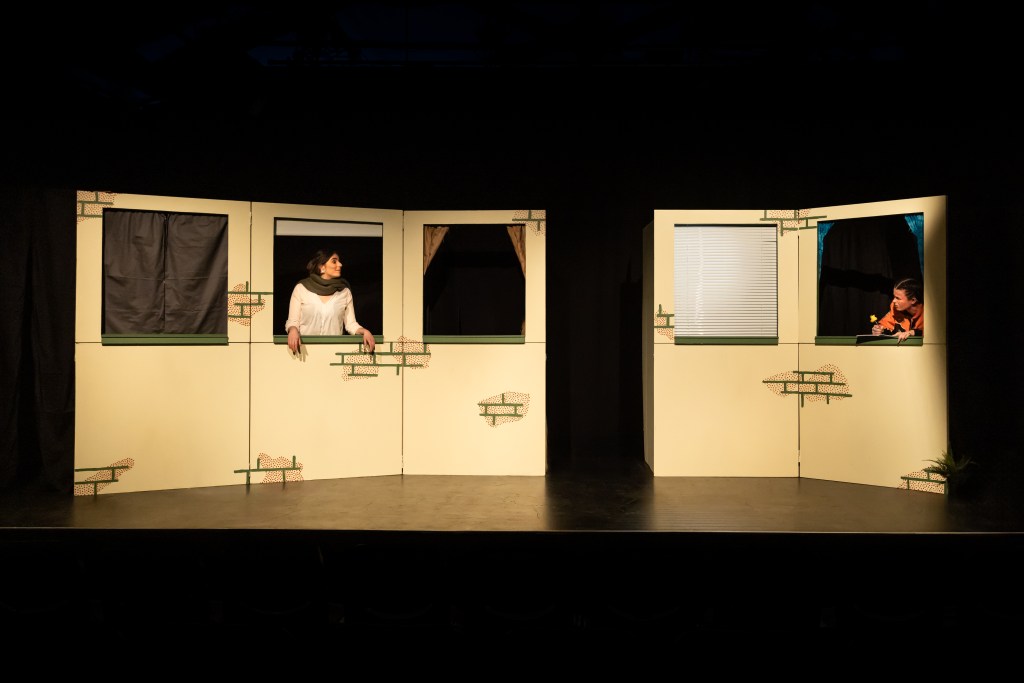
The director’s choice to keep these characters emotionally distant and let their storylines run in parallel works beautifully on stage. Rather than intersecting in conventional ways, their separate paths come together to form a powerful portrait of isolation, alienation, and disintegration. Through this fragmented approach, the production dissolves the sense of time and conveys a striking idea: destruction is not a single violent event, but the slow accumulation of countless small indifferences.
Two invisible forces also run throughout the play.
The first is the never-seen landlord (Saxon Evans) whose voice knock at tenants’ door: “you’re disturbing my sleep,” “your sex is too loud,” “are you killing someone?” These are not merely personal complaints, but a condescending, irresistible discourse of power. Even in moments of emergency, such as a fire, the landlord merely issues orders, never showing empathy. This dramaturgical choice is highly effective. The disembodied voice introduces a sharp sense of dramatic irony with its blunt sarcasm often landing as humour while simultaneously exposing the imbalance of power. What begins as petty grievances gradually escalates into intrusion and aggression, becoming increasingly unsettling beneath its comic surface.
The second thread revolves around the unseen, mystery tenant, Mr. Inkleigh (Ben Jamieson-Hoare), who always appears as a silhouette, seemingly omniscient. The venetian blinds on his window hint at surveillance and separation, and his light has been on continuously for sixteen months — a source of neighbours’ complaints over the shared electricity bill. His explanation is simple yet devastating: “I just want people to know I’m still alive.” Existence is no longer an active state, but something confirmed only through “being perceived” by others. Yet such confirmation is ultimately meaningless — no one cares who he is, or whether he is alive.
Mr. Inkleigh uses delicate portrayals of everyday life and layers of underlying dissonance to construct a contemporary parable about human relationships. However, this fragmented narrative is both a strength and a limitation. The play consists of loosely connected episodes, with conflicts presented as given rather than developed over time. As a result, the eventual story collapses feels less impactful than it could be. The repetition of topics and slow build up in certain scenes desalinates the thematic progression, and the absence of a strong through-line can leave audiences searching for focus. Nevertheless, the production remains engaging and thought-provoking, and its unconventional structure adds a distinctive texture to its exploration of isolation and connection.
Mr. Inkleigh is a mirror, reflecting the truth and absurdity of modern human relationships: isolated yet interconnected, watchful yet indifferent, existing yet unnoticed. Through detailed observation and symbolic metaphor, it builds a suffocating and ironic portrait of communal life. At the same time, its loose and repetitive structure weakens the rhythm and dramatic impact. Nevertheless, the work, with its complex social analysis and precise characterisation, offers a profound examination of contemporary neighbourly relations and existential anxiety.
Mr Inkleigh played as part of the Melbourne Fringe Festival at the Meat Market Stables from September 30th – October 4th.
ZENA WANG is a student at the VCA with a strong interest in theatre and visual storytelling. She loves exploring the intersection of space, performance, and audience experience.
RACHEL THORNBY is a media and communications and creative writing student currently studying in Melbourne.
 The Dialog