

REVIEW BY ELLA CALLOW-SUSSEX
EDITED BY EMMA PARFITT
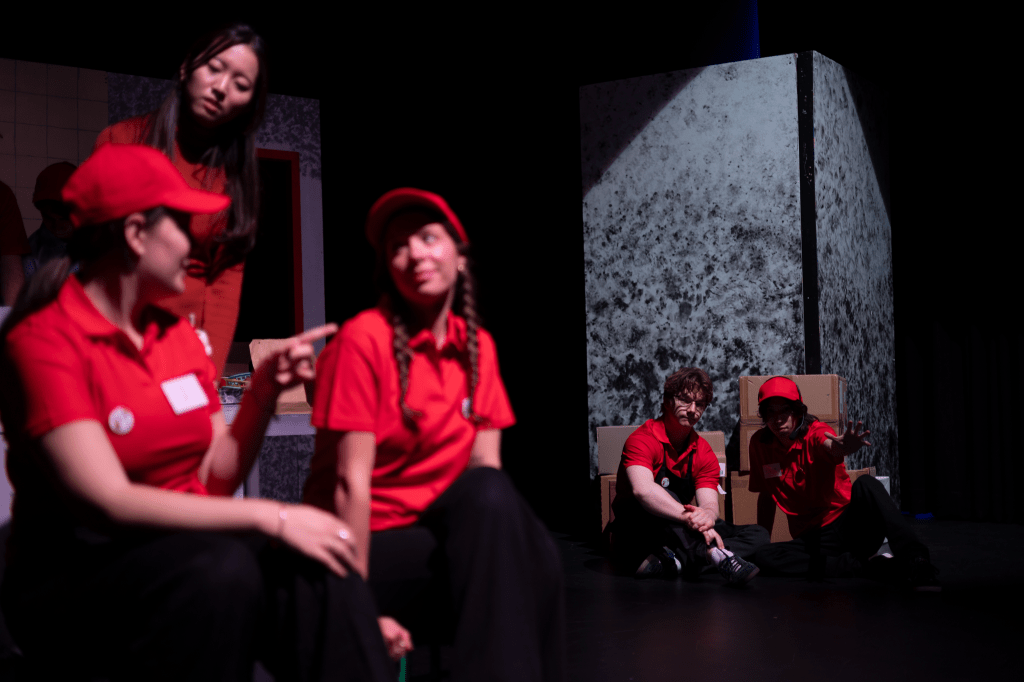
It started immediately. From the moment the audience walked into the Guild Theatre, the performers were already onstage. Droning lobby music filled a fast-food store in all its grease-stained life sucking glory. Performers were flipping burgers, making Tik Toks behind the counter and playing stack cup all while hiding from a roaming manager. It is an environment many university students would have worked in at least for a bit.

Work But This Time Like You Mean written by Honor Webster-Mannison was the winner of the 2022 Emerging Playwright Commission and was originally performed in Canberra. The playwright herself reportedly attended Little Hall’s production on opening night and loved it – praise can’t come much higher than that. It is billed as a darkly surreal comedy about young people’s first experiences in the workplace. Set entirely in an ‘unidentified’ fast food chain that just so happens to be “finger licking good,” Work But This Time Like You Mean It follows a cast of seven workers and one regular who all have different roles at the store. Acknowledged in the program as Register One, Drive and Deep Fryer amongst others, their names are less important than who they represent. Who they represent is anyone who has had a service job at any point in their life from the indignant 13-year-old Fifi to desperate-for-a-promotion Manager Mike. The play spans a day… or maybe months? Or maybe it all happens in ten minutes. It is presented in repeating vignettes signposted with the changing of the menu board on the side of the stage. This surreal treatment of time intelligently mirrors the mind-numbing boredom that can set in on hour eight of a hospitality shift.
I was immediately struck by the set design by Leo Gorrion. Despite being the smaller theatre, it can still be a real struggle to fill up the Guild Theatre with a set that feels appropriate and proportionate for the space, but Gorrion achieves this with apparent ease. Using very simple tricks and a masterful use of space, the run-down fast-food store takes up most of the theatre so the audience can be fully immersed while also ensuring there is appropriate playing space for all the performers and their blocking. What I was most impressed with, however, was the attention to detail – the kid style cash registers at the front desk and Mike’s certificate of achievement on the wall were hilarious and really added to the style of the show.

As the director, Jace Futuro takes this wonderfully absurd set and leans in. His blocking worked with the set to create dramaturgically sound and clearly demarcated locations within the establishment that made watching as an audience member easy and entertaining. If I were to give any feedback on the directing, I would just politely request more mess! When the cast was given the ability to mess up the place and be chaotic, some of the most joyful moments were found – I wonder what could have happened if the sauce bottles were actually full? Futuro managed to create steadily building tension and hilarity despite the repetitive nature of the script; having the entire cast act out a scene with rubber chicken masks on was a particular highlight. This is a fierce directorial debut, and it was evident that Futuro was able to establish a playful and lively cast culture that was clear in every second of the performance.

The uniforms worn, designed by Aiesha Kilgannon, balanced the line between copyright and being tongue in cheek lithely and with great skill. Drawing on the well-established uniforms of many fast-food chains, the caps, polos and primary colours were unmistakeable. I was also very taken with the sound design by Jason Sridher, who utilised recorded voice and leitmotifs really effectively throughout the piece. There was a point in the performance where I had listened to the same song over and over and I thought I was deeply annoyed by it and started plotting to write it as a criticism but then it dawned on me that in a play about the repetitive nature of hospitality work and the absurdity of feeling like you are stuck in a sort of limbo it was actually a truly inventive call. I felt similarly about the lighting design by Kenway Sheridan. Sheridan thought beyond the conventional when constructing the design which gave life to the show in just the right moments. Also, it takes true skill to know when to turn all the lights off and let the actors be illuminated solely by their phone screens during a quick break to achieve maximum comedy.
The entire ensemble was dynamic and playful. I was charmed by their interactions in moments they were not directly speaking, such as making paper planes out of paper bags to throw out of the drive through window. For a lot of the show, most of the cast has to remain on stage and so it wouldn’t have been a surprise to see people dropping out of character when they thought the focus was off them, but I didn’t see it once. Lauchlan Kentish, Gabriel Moore and Ivan Sokolov as Food Prep, Deep Fryer and Drive respectively are an incredible comedic trio. They are larger than life and support each other through having fingers and losing them. As a group they were the ultimate bros and were buoyant and exciting to watch. Dhruv Rao as Manager Mike is suitably terrible at his job and useless in a crisis but his monologue about finally having an office job showed incredible stage presence and had the audience in stitches. Jesse Cooper as Kiosk Fifi did a very impressive job of being a thirteen-year-old at their first job but my favourite moment from him was as the weird boss general manager. I see very few actors commit so fully to acting that wild onstage, but it paid off tenfold. Audrey Mueller, Mia Sinosic-Cass and Misaki Sakai as Register One, Two and their friend Regular were a wonderful audience in for the entire show, and especially for me. When Mueller pulled out a gasoline can and started screaming about burning the whole place down, I was reminded of some of my own daydreams as I worked my first hospitality job.
If I were to offer some things that could have further developed the performance, I felt that there were two or three dramatic beats in the script that I personally would have loved to have been hit a little harder to further extend the wider social/political point of the show. This production clearly committed to comedy and joy and play which is truly infectious but some of those characters had quite heartfelt and powerful monologues that were made less impactful by playing them mostly for laughs. However, this is a personal dramaturgy preference – the calls that were made were very consistent with the show that was presented.
Essentially – I was deeply impressed. For a cast and team filled with self-confessed ‘first timers,’ Work but This Time Like You Mean It had all the markers of a team that has worked together for years and is a well-oiled machine. Even to have the foresight and intelligence of picking a show that is accessible for the performers, understandable for audiences and works in the space shows incredible planning and understanding of theatre. The rapturous applause at the end of the night felt special and warm, there was a real sense of community that is being built in the room. For a debut production, Little Hall shows incredible promise, and I hope I will have the opportunity to be in the audience for many shows to come.
Little Hall’s Work But This Time Like You Mean It played September 18th – 20th at the Guild Theatre.
ELLA CALLOW-SUSSEX is a theatre maker and reviewer for the Dialog. She is currently completing a Bachelor of Arts majoring in English/Theatre Studies and Creative Writing.
EMMA PARFITT (she/her) is the Dialog’s head editor and has written Dialog reviews alongside studying towards her science degree for the past two years. She is a production manager, stage manager and producer on the Melbourne indie theatre scene and a veteran of student theatre at Union House Theatre.
The Dialog is supported by Union House Theatre.
 The Dialog