

REVIEW BY OLIVIA DI GRAZIA
EDITED BY EMMA PARFITT
Standing shoulder-to-shoulder in the compact Theatre Works foyer, a crowd of buzzing theatre-goers gather for the sold-out opening night of Colour and Light: The Art of Sondheim, the newest offering from Watch This, Australia’s first and only Sondheim repertory company. Weaving a beautiful tapestry of the theatre giant’s immortal contributions to the musical theatre canon with his lesser-known treasures, this ambitious revue is an unadulterated celebration of Sondheim’s singular artistry and towering legacy – and it most certainly strikes a chord.
Order
Divided into five sections – Order, Design, Tension, Balance and Harmony, the artistic principles cited by the titular character of Sunday in the Park with George – Colour and Light opens with a stunning rendition of “Putting It Together”, establishing art itself as the show’s thematic core. The backbone of the performance is featured performer Dr Trevor Jones on piano, who acts as the show’s musical director, arranger and sole accompanist. With virtuosic precision and arrangements that soar, Jones guides us through the emotional and musical arc carefully crafted by co-directors Melanie Hillman and Dean Drieberg.

Hillman and Drieberg’s evident respect for and understanding of Sondheim’s storytelling allows them to weave a cohesive story out of disparate musical numbers, harnessing the composer’s unmatched ability for emotional resonance. A subtle yet thoughtful detail was the use of the pointillistic musical motif that opens Sunday in the Park with George to indicate the end of one section and the beginning of the next. “Every moment makes a contribution; every little detail plays a part” indeed. Though I knew that Sondheim’s lesser-known works would be spotlighted, I was still surprised by how few of the songs I was familiar with. But because so many of the songs were new to me, hearing a recognisable tune felt like a prize, especially as they were delivered by such masterful vocalists.
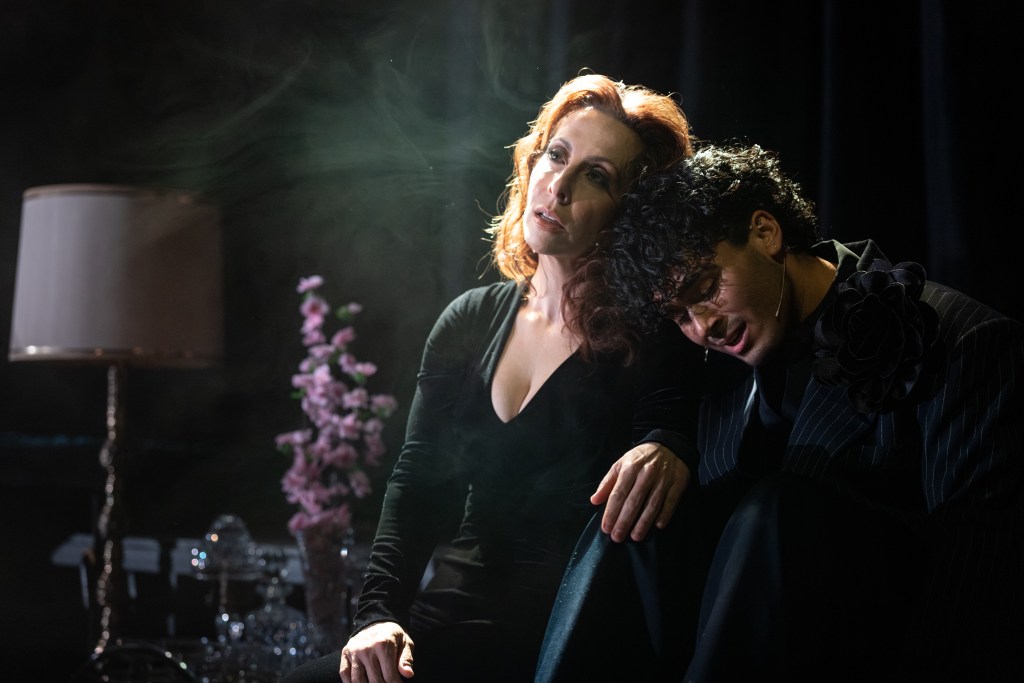
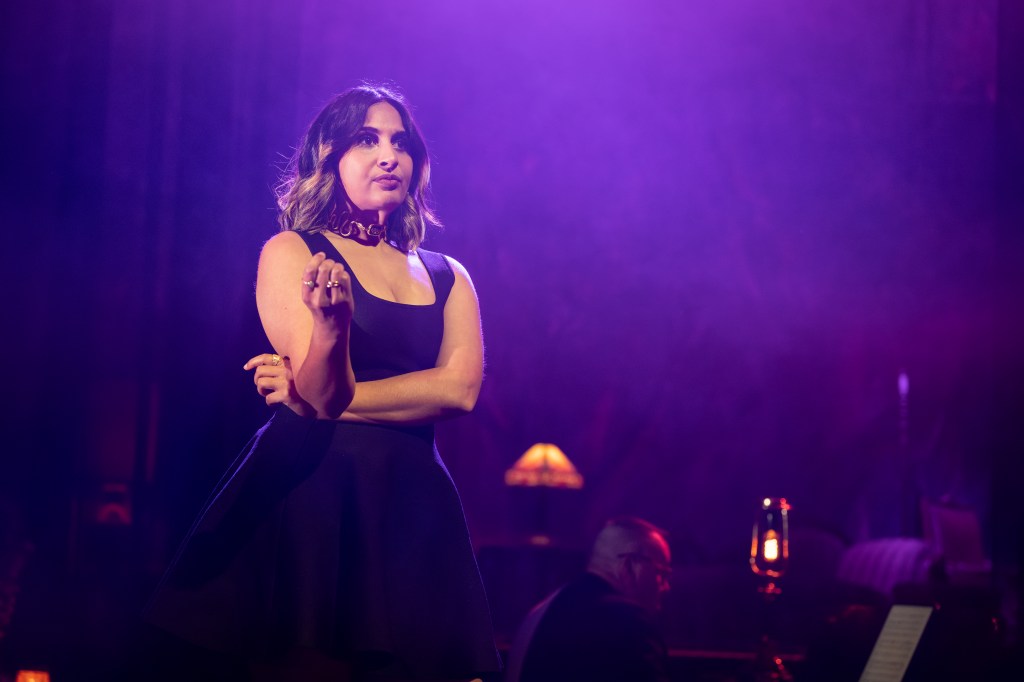
The seeming effortlessness with which the featured performers delivered Sondheim’s vocally and emotionally complex compositions from countless characters was no small feat. Johanna Allen’s “The Worst Pie in London” saw her flexing her comedic chops, and her interpretation of the Dick Tracy tune “Back in Business”, a jazzy romp with a playful scat breakdown, was a definite highlight of the night. Nick Simpson-Deeks’ graceful rendition of “Send in the Clowns” felt like the centrepiece of Act I, and “Buddy’s Blues”, the vaudevillian Act II opener, was entertaining from start to finish. Vidya Makan’s physicality was unmatched; every comedic beat in her performance of “The Boy From…” was hit with ease, and at one point during her performance of “The Miller’s Son”, she writhed around on the floor without a single note missed or a single breath out of place. I was particularly taken by Jacob Rozario, who commanded the stage every time they set foot on it. Endlessly emotive and practically pitch perfect, their takes on “Can That Boy Foxtrot” and “I’m Calm” were personal standouts.
Design
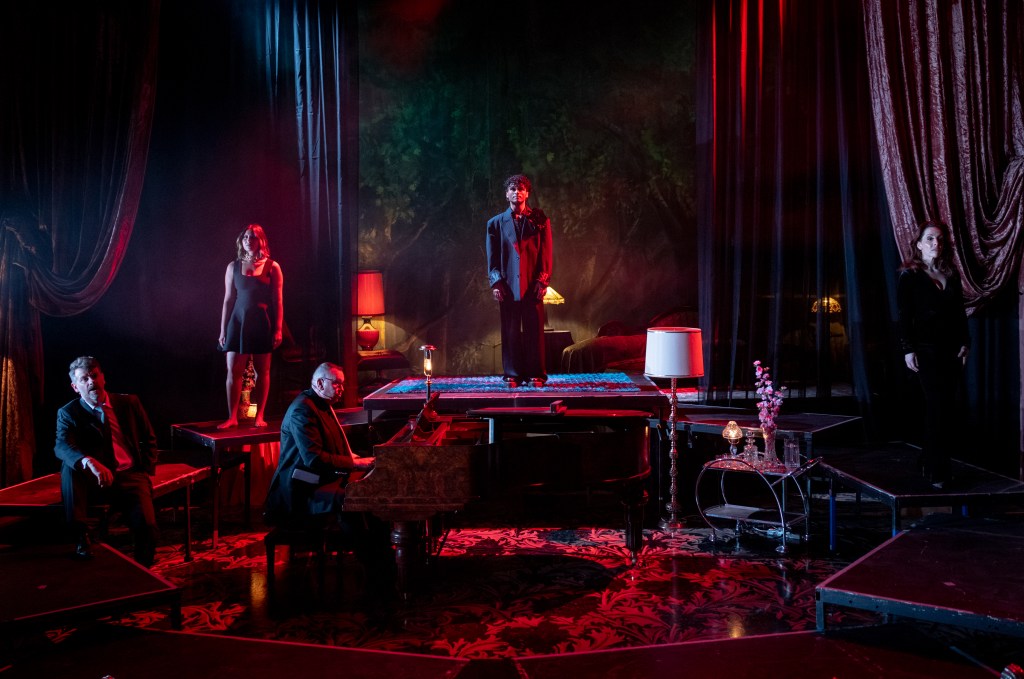
The Theatre Works stage, transformed by designer Rob Sowinski, is a sight to behold. The intimate venue is adorned with cosy antique furniture, vintage lamps of various shapes and sizes, golden velvet curtains and, just in front of the general audience, little round tables topped with red tablecloths at which a few lucky audience members could sit and watch the action up close.
Fittingly, the centrepiece of the stage is the beautiful brown grand piano, commanded by Jones, around which multilayered platforms gather for the performers to traverse throughout the setlist. Sowinski’s lighting design, too, complemented the action perfectly; light and shade created contrast, the colours (or lack thereof) aligned with tonal shifts in the music, and I loved watching the lamps subtly yet seamlessly illuminate and dim based on the atmosphere each song demanded.
The performers, constantly shifting between characters, were all dressed in black, with subtle details distinguishing their clothing from the others. That is with the exception of Jones, who wore a half-white half-black blazer, cleverly including him in yet distinguishing him from the cast. Without traditional costumes or character-specific hair and makeup due to the revue format, each performer relied solely on characterisation – accents, emotion, physicality – to transform from one character to another, and with the help of Tomas Strode’s seamless sound design, every note sang.

Tension
This is the section I would naturally dedicate to discussing what didn’t work for me, but in a shocking turn of events for someone as hyper-critical as I, there’s very little to comment on. At one point during “Getting Married Today” (a song renowned for its rapid-fire delivery), Allen forgot her lyrics, running to Jones’ sheet music to find her place, but the moment was so thematically fitting and she slotted back in so seamlessly that it came across more like a charming bit than a blunder.
If I have one criticism, it’s that for “Live Alone and Like It”, a lesser-known track from the film Dick Tracy, Simpson-Deeks comes out dressed in a white shirt and tan pants. While the costume change works fine for the song, it’s later when the show approaches its emotional conclusion, marked by beautiful harmonies and a strong sense of togetherness, when the incongruousness of the colour palette next to the other performers, all dressed in black with red accents, really stands out. However, with that said, it truly is a testament to the quality and intentionality of Colour and Light that such a small detail was noticeable at all.

Balance
As the set remained stationary throughout, the movements and configurations of the four performers were relied upon heavily to keep the show in a forward trajectory, and Hillman and Drieberg’s seamless blocking managed to tacitly convey character dynamics at every turn. Particularly in the duets, the staging – though simple – never failed to add texture to the stories being told.
In a revue filled to the brim with show-stopping 11 o’clock numbers, “I’m Still Here” from Follies, sung by an electric Makan in a soul-stirring performance that crescendoed into a stubborn declaration of the human spirit, may just be the 11 o’clock number of Colour and Light. Moments after she bellowed those final lines (“And I’m here! Look who’s here! I’m still here!”), her silhouette projected on the wall behind her, the audience erupted in applause, stomping and whooping, clearly having felt every word. Such an atmosphere testifies to Sondheim’s unique capability to cut to the core of the human experience, and Makan’s execution of this formidable number proves that there is still new life to be breathed into the maestro’s material.
Harmony
While each of the featured performers undoubtedly shines in their own right, when they all come together, their beautiful voices layered in four or five-part harmony, the true magic of Colour and Light shines through. Coalescing into a rich, textured blanket of sound, these harmonies alone, especially in the big finale “Being Alive”, are reason enough to attend. And what’s more, the genuine love and admiration the performers have for one another is palpable, making the already artful and captivating show all the more enjoyable to watch.
As professed in “Putting It Together,” art isn’t easy, but exceptional art – of which Colour and Light: The Art of Sondheim most definitely is – can make even the most complex compositions and arrangements look as effortless as breathing. If you’re like me, this show will have you returning to your longstanding Sondheim favourites and making your way through the archives you didn’t know you were missing. Watch This indeed.
Watch This’ Colour and Light: The Art of Sondheim plays til September 27 at Theatre Works.
OLIVIA DI GRAZIA is a student at the University of Melbourne and a sub-editor for The Dialog.
EMMA PARFITT (she/her) is the Dialog’s head editor and has written Dialog reviews alongside studying towards her science degree for the past two years. She is a production manager, stage manager and producer on the Melbourne indie theatre scene and a veteran of student theatre at Union House Theatre.
The Dialog is supported by Union House Theatre.
 The Dialog