

REVIEW BY AKSHITA BENNY
EDITED BY EMMA PARFITT
Anyone who has ever done theatre knows the desperation of when things go wrong. Or if they have not experienced it themselves, they would at least have heard the horror stories. Maybe it was a skipped scene or a missing prop, an actor going on stage at the wrong time, or an incorrect cue from the bio box. Endpapered by Saskia Powles, Felicity Bayne and Campbell Jordan, presented by Above Sea Level Theatre, explores what happens when a play goes wrong from multiple insightful perspectives.
To keep it succinct, Endpapered follows the Lead/Rebecca (Alana Collins) who, after a rough situation, decides to start anew by opening a bookshop with support of her Best Friend (Meron Samson). While peacefully setting up shop, a bombastic accountant who is supposedly her Love Interest named Hugh (Kailen Missen) decides to try to court her – even though she is indifferent to his compliments, whereas her friend seems strangely insistent that they get together. However, this situation somehow keeps on repeating itself, making Rebecca distressed and her Best Friend confused. It is then revealed from the wings that this is a play within a play, with the Assistant Stage Manager (Maya Hall-Davis) and Designer (Ishani Phatarpekar) panicking due to this repetitive predicament. It turns out that Hugh is played by a professional actor who does not want to adapt, but rather stick to the script, irrespective of Rebecca’s distressed state. Tension rises, leading to the Best Friend realising she has not been a true friend to Rebecca, with the sharing a heartfelt moment to set their faults aside.

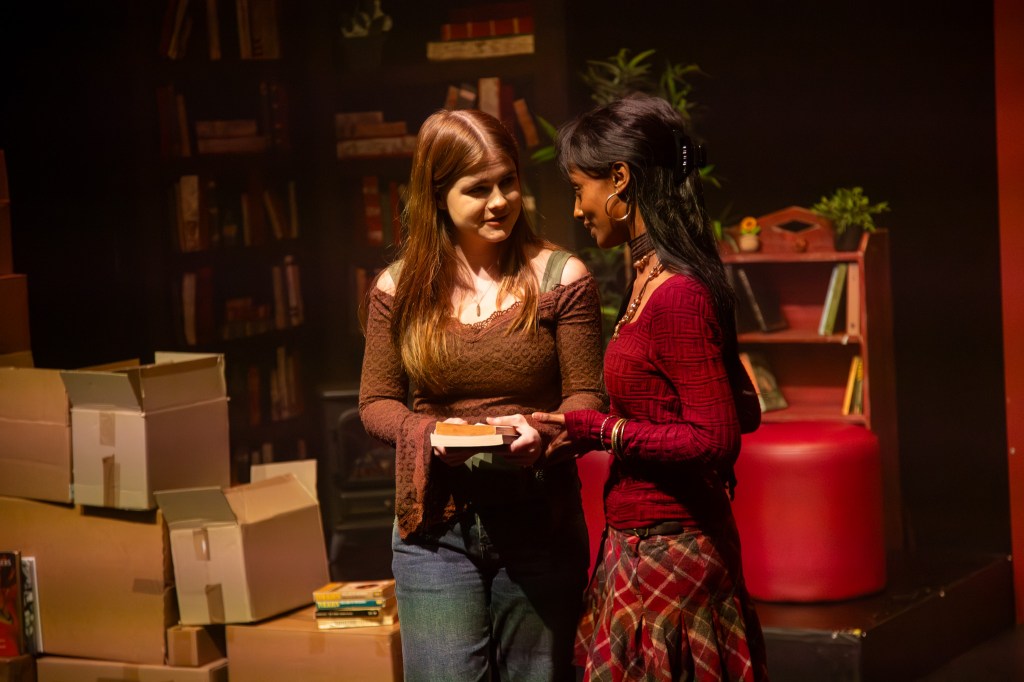
The relationship between Collins’ and Samson’s characters is intimate and fascinating, conveying the beauty of female friendship, especially due to how this play is a parody of early 2000s romcoms full of misogyny and deprecating comments on women. Collins portrays the desperation of the lead with such brutal honesty that you are made to feel so sad for all that is happening to her. This is complimented by Samson’s vivacious performance, which is surprising to know is a debut performance as she does it with such humour and authenticity. This is contrasted with Missen’s egotistical Hugh, clearly a reference to Hugh Grant’s character of the prime minister in the film Love, Actually. As someone who has viewed Missen’s other performances, he excels at comedic roles across the board and it is great to see how naturally he moulds into this character.
Hall-Davis represents the struggles of an Assistant Stage Manager with truthfulness. As someone who has worked alongside production teams, the Assistant Stage Manager position is one of uncertainty, and Hall-Davis excels at conveying how difficult it is to keep yourself together when things go wrong in an extremely stressful production week. This was contrasted by Phatarpekar’s cool Designer, as I am aware how design choices are probably the one factor that drives stage management crazy! Patarpekar clearly understands the skill needed to play an ‘asshole’ character which is impressive to the point that as an audience I started sympathising for Hall-Davis.
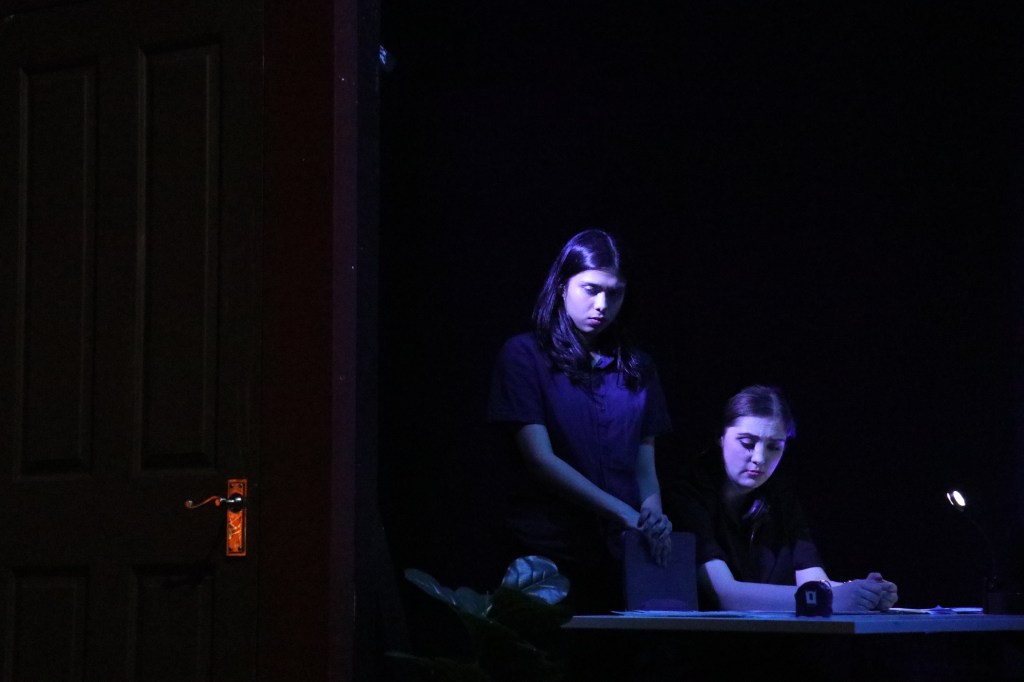
The performers created great dichotomies between each moment, from on stage to ‘off stage’. There were moments where everyone laughed such as from the persistence of Hugh and the Best Friend to the moment where the Designer even threatens to beat up Hugh, reminiscent of the 2000s rom-com genre the play was heavily inspired by. In more serious moments, the actors took to the stage with reverence for their scenes, as they excelled at conveying the troubles plaguing their characters. I found the little bloopers reel at the end very considerate of the production team as not many shows directly acknowledge them during the curtain call even though they have done so much work behind the scenes. This is fitting for a show that explores the conflict of what happens on and off stage. I also found the bloopers reel to be a cute tribute to films of the early 2000s as they often had a bloopers reel where you could see the interactions between cast and crew.
The set and props design by Campbell Jordan and Max Thomson with Anya Singh was immaculate. Upon entering the space, It surprised me that the black curtains lining the sides of the Guild Theatre missing. Instead, they were replaced with red curtains, matching the warm tones of the set. The stage was also smaller, adding to the intimacy of the bookshop, elevating the moments between Rebecca and the Best Friend. The books strewn across the place along with the boxes everywhere elucidating that Rebecca has been going through tough times prior to the escalation of the plot. There was even a cheeky reference to Above Sea Level’s previous show Far Away as a script book was thrown by Missen.

Sabrina Lee and Charlotte Henderson’s costume design created distinct silhouettes for each character, reminiscent of the time period the work is based on. The clever lighting design by Blue Jordan created a homeliness to the bookshop, contrasted by the cool blue lighting of the wings, which is similar to the cool, foreboding lighting in the Guild Theatre wings. Nick O’Brien’s crafty sound design was cheeky ‒ I especially loved the cliché motifs that played when Samson and Missen walked onto stage as it is reminiscent of those early 2000s television shows which had a little theme motif for a specific character that matched their personality. As this play has moments focused on the production team, I would like to voice my appreciation for the work of Stuti Ghosh, Mabel Sward and Emma Guthrie for guiding this production from a managerial perspective. This is a difficult task which they have done a great job at as the performance was well put together.
I found the ending of this play endearing and carefully constructed, enabling Collins and Samson to truly realise their characters’ potentials. I did think though that it was difficult to come to the ending as the initial moments did not seem to amalgamate to result in the ending we saw. I think this could be an interesting moment to develop upon to make the ending feel more integrated into the story. There were also some projection imbalances during moments of high tension, but this is understandable especially on the first night, however the cast did work effectively as an ensemble. There was one question that I had once the performance concluded. There was a door at the back of the bookshop that supposedly had a missing key. I am curious to whether the door was something to later delve upon in a later iteration of the work, or is it intended to be shrouded in mystery?
Overall, it is an honour to have viewed Above Sea Level Theatre’s Endpapered as it demonstrates that sometimes the behind-the-scenes aspects of theatre are truly interesting. It is exciting to see a show that excels in many aspects, especially an original work which was well developed and could have even more room for exploration due to the efforts of the whole team. It is fascinating to see how the early 2000s rom-com genre still influences our modern media and cultural landscape, even though I have not seen many films of this genre. It is lovely to view and partake in new stories being developed in student theatre as it demonstrates that anybody can be creative, and to quote Hugh, an “acting degree from NIDA” isn’t necessarily needed to be able to create something profound. I am keen to see what Above Sea Level will present next as they clearly are a capable and ambitious team who have clear direction in their work.
Above Sea Level’s Endpapered played September 11th – 13th at the Guild Theatre.
AKSHITA BENNY is someone who likes to go to nice cafes and, not to forget, also enjoys watching theatre!
EMMA PARFITT (she/her) is the Dialog’s head editor and has written Dialog reviews alongside studying towards her science degree for the past two years. She is a production manager, stage manager and producer on the Melbourne indie theatre scene and a veteran of student theatre at Union House Theatre.
The Dialog is supported by Union House Theatre.
 The Dialog