
REVIEW BY MYA HELOU
EDITED BY EMMA PARFITT
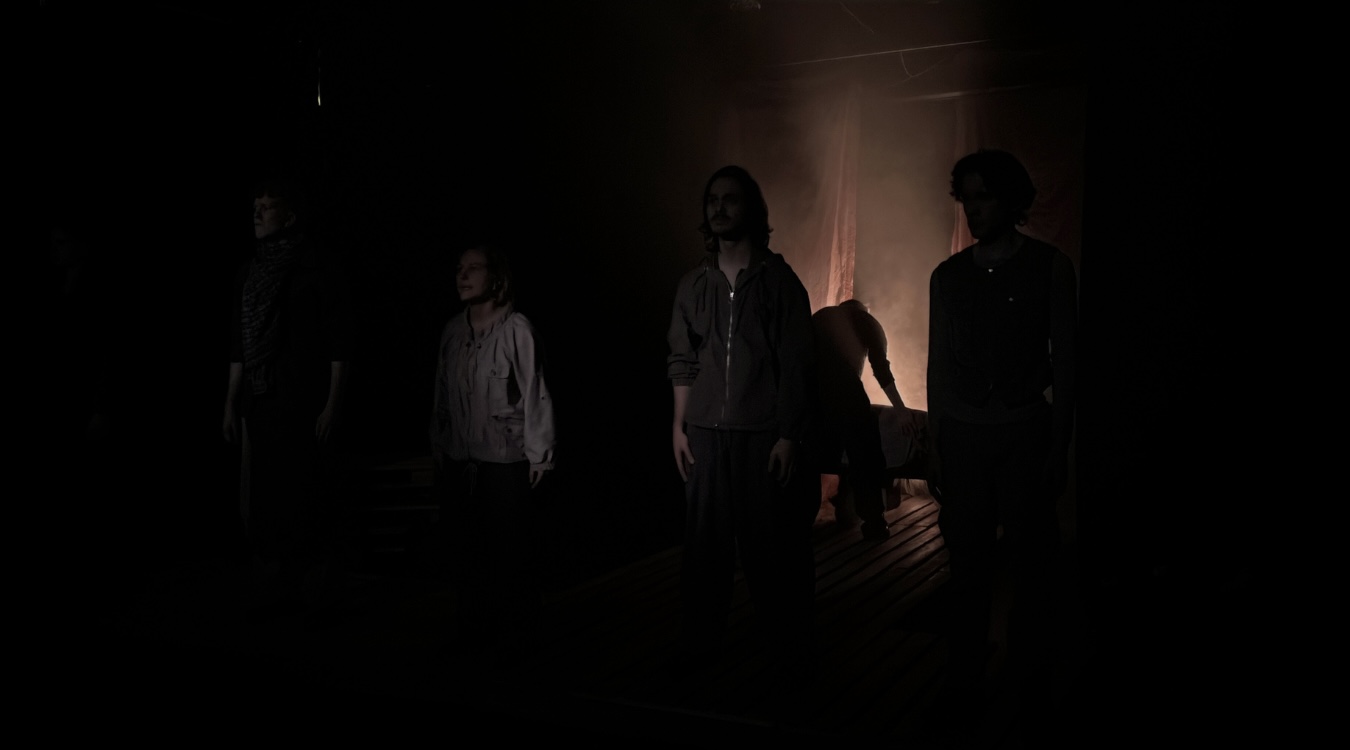
The stage is fully visible when I enter the cozy black-box theatre. Lucas Prescott’s carefully constructed runway of wooden pallets is framed by two white drapes hanging from the ceiling at the back of the stage, oddly human-shaped rubbish bags dumped along the sides. It’s a texturally dense amalgamation that looks like a makeshift rebuilding of something once great. It smells like wood and theatre, and it doesn’t smell of rubbish or death but those linger in the corners of my mind. The rhythmic pre-show music fades and haze pours from between the drapes, a long droning sound buzzing across my skin. The tragedy is about to begin.
Taking on Sophocles’ Oedipus Rex (aka Oedipus the King, aka Oedipus) is no easy task. The ancient subject matter is one thing, along with it being one of a trilogy (the Three Theban Plays), but an entirely different thing is the weight of this particular play. It has survived 2,500 years of performance history with thousands of people (myself included) dedicating time to studying, understanding, reshaping, and simply enjoying its carefully crafted action. Aristotle called it the greatest theatrical plot of all time, and Barkly Theatre’s take on the ancient classic captures some of that old world magic while wading through the present, breathing new polluted life into an old polluted story.

Oedipus Rex is somewhat unique for its era in that it forgoes a prologue, but director Oscar Lidgerwood’s inclusion of one was a choice well made. The Chorus – comprised of Gryff Connah, Finn Corr, Bianca Galvin, Michaela Lattanzio, and Finn Stanley – permeated the stage dressed in drab coloured gear that embodied survival-focused post-apocalyptic worlds perfectly (a joint effort by Georgia Campbell, Elsie Craige, and Ellie Dean). The scene that follows moved fast, chorus members grappling in tightly formed fight choreography, almost falling into the audience, before shifting to a scene of the Sphynx (taken on by Corr) coming face to face and toe to toe with Oedipus (Ali Samaei). There is a profound sense of Thebes on the brink, a confounding mix of strobe effects (by lighting designer Max McKellar) and pounding music (by sound designer Sophia Murphy) that set up a wonderfully executed crumbling foundation for the tragedy to stand on.
Due to the play being ancient, it’s easy to forget that Oedipus is not an elderly senile king with a malicious heart, but is simply a man who blindly fulfils his fate in trying to escape it. There are about a million different ways to play Oedipus, and Samaei’s iteration of the king worked very well to portray a leader both blind to his own destruction and deaf to the help of others. He’s intense and desperate from the start, falling into moments of aggression and mocking pride when confronted with his destructive reality. This Oedipus may talk the talk of saving his people, but he never truly takes the steps to do so until it’s already too late. In a performance quite rife with yelling, I found Samaei to be at his best in the quiet, contemplative moments, the highlight of his performance being in the retelling of the prophecy. Sitting on the edge of the pallet runway and looking directly into the audience, Samaei glided through dismissive hubris, overwhelming disgust, and intense confusion, culminating in a well-played revelation I knew was coming, yet still had me gripping my pen in suspense.

No revelation was as well done, however, as that of Elizabeth Walley as Jocasta. Walley’s performance was the standout for me, Jocasta’s revelatory moment being impossible to miss even in its very subtle and measured depiction of misery. It is easy to play Jocasta as a hysterical caricature or a faded side-character to Oedipus, but Walley perfectly embodied the strength in everything that Jocasta is: worried wife, miserable mother, doting queen, and tragic victim of a prophecy just as destructive to her as it is to her son/husband. Campbell, Craige, and Dean’s costuming shone here, a draped grey dress conjuring a soft makeshift royalty that Walley herself exuded. Every line from Walley had purpose and thought, giving a performance that was believable at every turn, right down to the touching yet distressing maternal nature she treated Oedipus with. Her gorgeous monologue, though not itself the cathartic moment of the play, had my chest swelling with pity and desperation along with her anguished cries to the gods.
Alec Gilbert’s Creon provided a needed contrast to the confusion inherent to Oedipus and Jocasta, being a very grounding – and indeed, a very uncle-like – figure. Gilbert excelled at crafting casually intimate relationships with Oedipus and Jocasta at the start and excelled even more so in altering those relationship as they became more volatile. Creon matched Oedipus on every confrontation while always retaining that level headedness. His defence against Oedipus’ slander managed to be exasperated yet concerned, Gilbert touching on the crux of Creon’s position as brother-in-law (uncle) and Theban official. I greatly appreciated Creon’s role at the conclusion of the climax, McKellar’s lights, Murphy’s music, Lingerwood’s blocking, and Gilbert’s acting all coming together to represent the next step Creon takes in Antigone, one of the other plays in the trilogy; Creon will not escape the fate of Oedipus either.

Tiresias was the character I was most excited to see portrayed (being one of my favourite characters in Athenian drama), and Emmaline May did not disappoint. As the blind seer cursed with horrible visions of a city destroyed, May captured the balance of wry humour and tortured intensity that defines Tiresias. The choice to cast a young woman as opposed to an old man as the ignored and abused truth-teller was, to me, one of the most flawless indicators of the modern recontextualization. May’s Tiresias is certain of the future and being wrecked by it already, facing off against Samaei’s Oedipus to no avail. Her warnings fail to be seen, she is slandered, and she leaves us with the question why try at all if there’s nothing to be done? Unfortunately, this is a question I think many of us ask ourselves at some point, especially in the face of the crumbling climate and the seemingly untouchable state of global politics. Lidgerwood’s direction of this scene particularly felt as though it pointed out to the real world, asking us to ponder the question along with Tiresias.
The Chorus is one of the most important structures in ancient Greek theatre, intended in tragedy to represent the view of the Athenians watching the play when it was first performed. The Chorus in Barkly Theatres’ production did a great job of becoming the voice of the audience perspective, going from a cohesive unit to individual personalities seamlessly. Each chorus member had their own moments to shine; Gryff Connah and Bianca Galvin each delivered tear-jerking monologues, Finn Corr and Finn Stanley provided humour in the face of destruction, and Michaela Lattanzio deftly took on the gut-wrenching cathartic moment with heart-pounding intensity. Their collective performance in the climactic scene was jarring, staring unseeingly into the audience, stoic but devastated as Samaei blindly stumbled into them. The actors held that energy excellently throughout the scene, even though I feel the energy may have peaked a little too soon. The cathartic moment of any Greek tragedy is the most anticipated part, and while the intensity was wonderful, the suspension of it negated some of my ability as an audience member to construct my own horror at what was occurring.
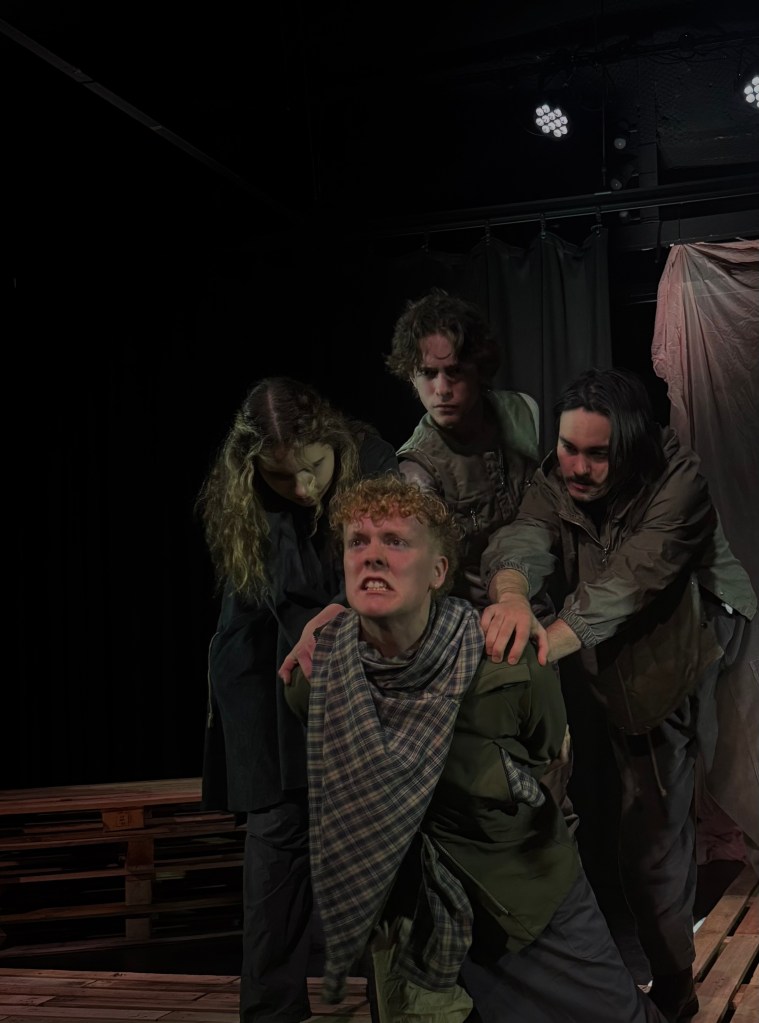
That being said, the choices made with the abridged script were fantastic. When adapting a classic, the decision of what to cut and what to keep is integral, and Lidgerwood’s selection provided a strong foundation for the more modern perspective of the production. The emphasis on monologues about a city in ruins, plague, and the fallacy of power, all directed attention to our lived experience in a society where those in power continually fail to meet our needs and respect our rights. Sometimes it did feel as though this fell to the background in favour of aesthetic appeal, but it always found its way back into the narrative and had its moments to really stand out. I also feel it necessary to give props to the marketing, the cast announcements beautifully working in the play’s motif of eyes, of seeing vs blindness, by having all the actors stare down the camera – even before we enter the theatre, we are made part of the show.
In a world devoid of gods, Lidgerwood’s Oedipus ponders the destruction humans can cause, even (and especially) unconsciously. With modern contextualisation, however, blame doesn’t fall simply on Oedipus, but on every complicit character and every passive audience member. Lidgerwood’s direction points out towards us as the beautifully constructed carnage looks us directly in the face, and all we can really do is look back.
Barkly Theatre’s Oedipus Rex – A Retelling of plays til September 14th at the MC Showroom.
MYA HELOU (they/them) is an English and Theatre Studies major whose love of theatre was fostered by Shakespeare and classical Greek tragedies. They will take every opportunity to discuss either.
EMMA PARFITT (she/her) is the Dialog’s head editor and has written Dialog reviews alongside studying towards her science degree for the past two years. She is a production manager, stage manager and producer on the Melbourne indie theatre scene and a veteran of student theatre at Union House Theatre.
The Dialog is supported by Union House Theatre.
 The Dialog