

REVIEW BY AKSHITA BENNY AND JESSIE WILLIAMS
EDITED BY EMMA PARFITT
MUDfest (Melbourne University Drama Festival) is an annual celebration of student works ranging from photography to performance. Starting back in 1990, MUDfest has become the largest student-run arts festival in Australia, enabling new and emerging creatives within the University of Melbourne community to create new works and explore different concepts. The theme for MUDfest 2025 was Refraction: Art From All Angles which was focused on creating diverse works utilising different mediums. As part of MUDfest 2025, First Light: Theatre and Dance was a showcase that consisted of seven unique short new works ranging from play readings to contemporary dance pieces, all performed and devised by students.
The Union Theatre was transformed into a enclosed and intimate space to suit the occasion, with the audience positioned on the stage. This black box-style space was created to be tailored to each specific piece and allow for the closeness many of these pieces required when going into depth of such personal topics.
Serious Business
Serious Business was the introductory work of the showcase, a movement performance that explored worked on juxtapositions such as those between professionality and comedy. The white dress shirt and tie combination worn by Carlie Shaw and Charlie McArthur contrast with the baggy sports shorts and trousers which match their ties. McArthur would undertake one action, then Shaw would contradict this action, ranging from toe wiggling to pirouettes. However, McArthur discovers they can do something truly shocking, which Shaw then copies, leading to a competitive pants-pulling down choreography to the finale of Rossini’s William Tell Overture, involving switching the pants they are wearing and interesting explorations of how to pull one’s pants down. Concluding their competition, they agree upon a truce, which then results in a criss-cross pants situation, two bodies together, tired from their unserious business.
Shaw and McArthur’s enthusiasm radiated from this piece and laughs emerged from the audience, serving as a reminder that sometimes we do need a break from the seriousness of the world and that this break can come from something as “silly” as pulling one’s pants down on stage. The key moment in this piece for me was when they exited the stage, awkwardly hobbling off in their twisted pants situation, as they had to work together to depart, as if realising the consequences of their business. This did make me chuckle. Serious Business was truly unserious and was a wonderful introductory piece to the showcase.


Convergence Point
After the warm of up goofy, silly movement piece, I was in for a surprise shift in tone for the next piece, Convergence Point. This story, directed by Zhixun Li and performed by Alex Yang and Joey Zhang, was about dreams, realities and how the space we grow up in shapes us into who we are and how we find our drive in life. Convergence Point was performed fully in Mandarin, with English subtitles. While some would think would think having to keep glancing back and forth from the caption screen to the stage would cause a distraction, I was easily able to relish it on the whole.
A young worker is looking to stay connected in his passion of performance art, yet his workplace becomes demanding of him as does his theatre passion. He has lost his heart due to the expectations of the world around him. Due to the unexpectedness of being thrown into a new language, culture and expectation, it was a whirlwind to follow. However, I felt that the main messages of this piece really struck true and were also a shocking divergence to how we, in Australian culture, live and appreciate the arts.
As someone who grew up in an international, but also distinctly southeast Asian space, cultural difference in work ethic and expectations was something that I and many must adjust to. Late nights and early mornings that force the abandonment of personal life are small insights into such a difference.
The set was minimal and used full potential of the lay out, with the stage spaced to hold a simple desk for reality and empty space and a paper bag marked where the past was reflected on. I do have to highlight the impressive use of sound effects and music (Steve Pan) within this near 10-minute piece. Not only did it help separate time, place and view of the world, but it also gave space for Yang and Zhang to act without dialogue.
Ourselves
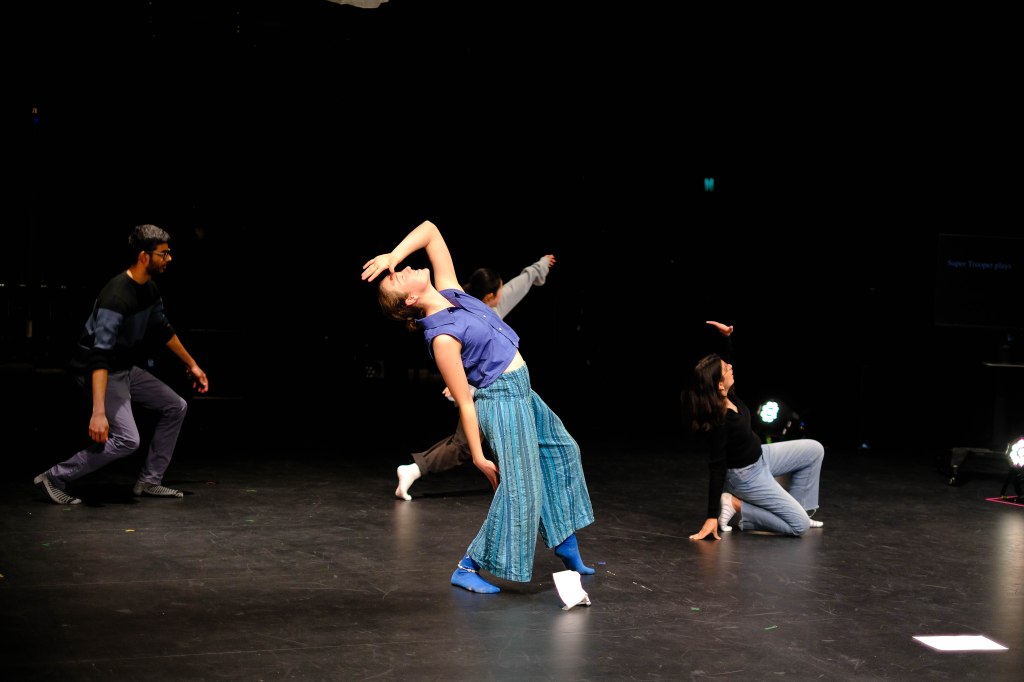
Ourselves, choreographed by Julie Tran, explores the music and movements that make “us”. Tran, along with Aruna Brown, Maanas Kunchala, Nurhildayati and Yashika Hablani, all added their individual flair to the piece that made it feel as if I was viewing a snapshot of their lives, ranging from the banality of getting ready in the morning set to a Bollywood song to having a fun night dancing to ABBA’s Super Trouper. The truthfulness of the performance then revealed the inner turmoils of each character, from the hassle of studying to the mundanity of corporate life, leading to the universal revelation of freedom even when life seems lacklustre. Quietness is instilled, with the performers leaving behind the noise of their lives to listen to the waves. A choice I found interesting was that all the performances had a part of their costume in blue, creating a sense of connectedness between the different lives they live, further instilling their moment of clarity at the end. It was beautiful to see a piece that did not shy away from looking at the simplicity of life, the beauty of routine and the need to sometimes have a moment to ourselves, which kept me thinking about the choices I make on a daily basis and if I had my own “theme song”.
Teko
Teko by Mabel Sward was a shift into heavy themes of depression, mental health and how sometimes we just need that little voice of in our heads to quiet down.
Burnout, depression and lows look different for different people. However, in Teko, it was displayed very clearly as dysfunction and hiding away in a dark room in a messy bed. Teko (Connor Williams), not quite a jiminy cricket and more like the ADHD-hyperfixated frog person, seemed to take on the role of the inner voice, nagging Lane (Vincent Toast Hack) to start the day trying to find something to do. This short scene bared some of the harsh lows faced by many while also exploring how neurodivergent people have that voice within that can greatly affect the self-reflection on such periods of our lives.
One thing that I particularly enjoyed about this piece was the nakedness of it all. The set, being a bed littered with empty drinks and chips bags, displayed a large length of time stuck in the room. The lighting (Esther Luk) used was simple yet cast meaningful shadows. The sound effects (also Esther Luk) were minimal, yet aided in building Teko’s character of the internal ADHD-hyperfixated frog. Teko’s hyper focus on the key phrase “I like the cut of your jibbet” and then the quick change to the water drip loudly emphasized the ideas of stimulation seeking in times of physical understimulation that occurs at such low lows.


Father’s Funeral
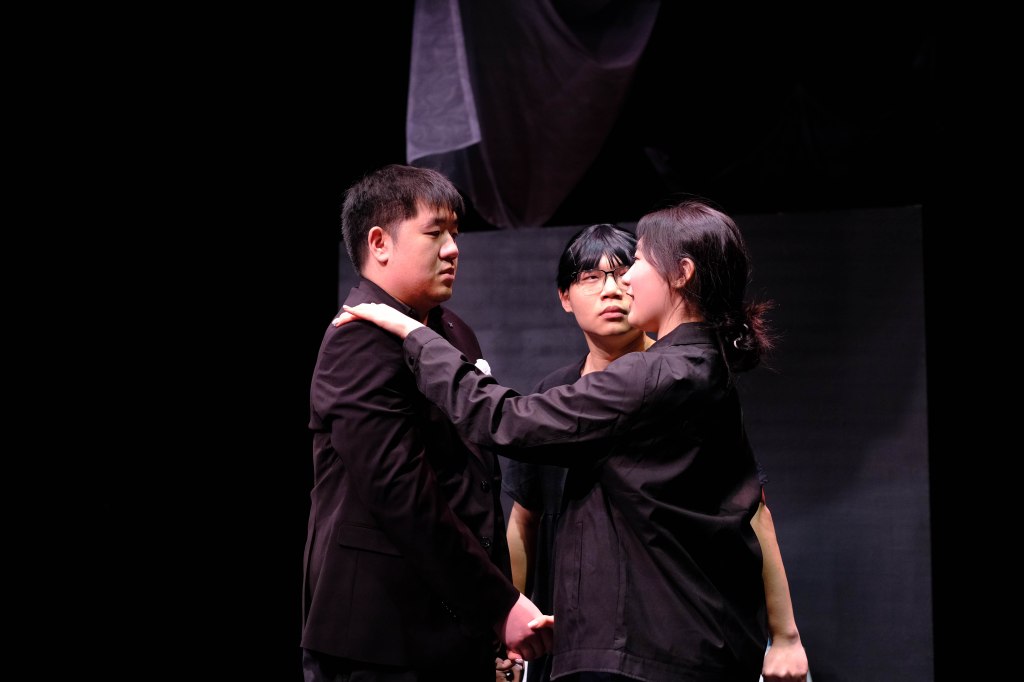
Father’s Funeral was a short comedy performed by members of the Melbourne University Chinese Theatre Group directed by Jinyuan Zuo, exploring grief and how it seems like we do not know the people closest to us. The simple but poignant set design by Xinyue Ji consisted of a man’s portrait, void of facial features, upon a table arranged with flowers. This conveyed the simplicity and instilled the grimness of a funeral. At the scene, a widow is consoled by the manager of the factory her late husband worked at, with some words then being directed to the widower’s son about how he needs to acknowledge that his father’s friends are arriving and that they all have advice to bestow upon him. However, it seems that there was more to his father than he ever knew, as he is visited by a wide array of characters, which to his shock is met with indifference from his mother. Each character was so bizarre that you would not be able to predict who was going to give their condolences; from the brazen mob boss Sis9 with her bodyguards, Albert Einstein exclaiming “E=mc2” randomly, a centaur whose neigh was so impressive and even Saturn (yes, the plant Saturn) accompanied by a little planet. Each quirky character made the audience burst out laughing and it got louder with each introduction. The one character that resonated with me the most was the mother, because who can shoulder off the fact that her late husband who supposedly was a factory worker was also buddies with a centaur!? Overall, Zuo along with Andi Chen, Yijun Cai, Francis, Yinuo Zhang were an entertaining cast who really embodied their characters while making them so wacky. Father’s Funeral was full of laughs contrasting its grim subject matter, revealing that grief really does transform a person, a message that everyone can understand even if they do not speak Chinese Mandarin.


Changeling
Changeling by Charlie Simmons piqued my interest as the premise is an interesting one; the exploration of the experience of neurodiverse and disabled people through the metaphor of being a changeling. A changeling is a shapeshifter.
This short scene, directed by Jessica Fanwong with Mon Wing-Yun, built a world where magic and fae folk are real and are misunderstood by small town human folk. As with many stories before, when something is misunderstood it stokes fear, and fear produces anger. The changeling, a young person, is shunned by many in the village due to the idea of them being “blessed” by the fairy folk. The world building displayed through action and dialogue alone made me interested to see more to a greater level of production.
The actors (Eliška Gidding, Aruna Bown, Tom Worsnop, Samuel Pruscino and Megan Tan) did a great job of introducing who they were and the role they play within the village while also providing context to the magical side of this world. I do wish that there were key props or set that provided separation and distance between characters. Afterwards, I found out that Simmons had to step in last moment to cover one of the roles. This was a pleasant surprise to know that the heart of the writing was also aiding in its portrayal.


WAW, WAW, WAW
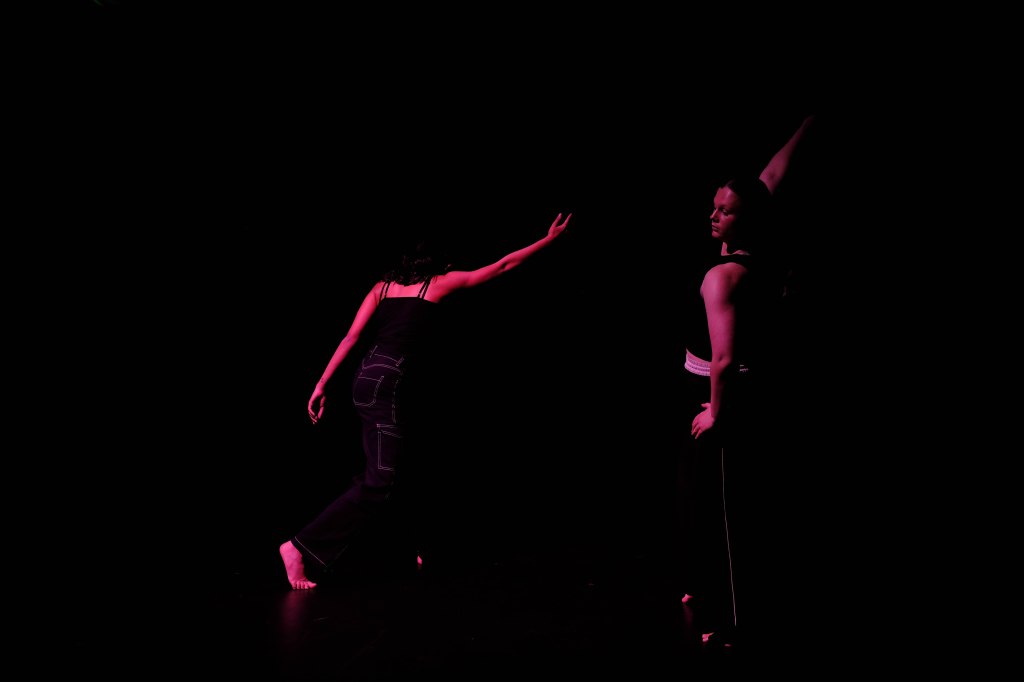
Who Are We, What Are We, Why Are We (WAW, WAW, WAW) served as a daring and bold conclusion to the night. Anna Street (choreographer), Emilee Faulkner, Jinya Toyomaru, Diya Rupramka, Lizzie Cosham and Georgia Sullivan created a well put together piece that explored movement set to an industrial backing track. WAW, WAW, WAW amalgamated solo and ensemble work together, creating succinct and skilled choreography. From the simplicity of the dark athletic wear to the various flips and contortions, the performers were bathed in warm light which brought together the various aspects of this performance. This work explored dichotomies, such as those between solace and community, industry and creativity, hope and fear. I commend Street, Faulkner, Toyomaru, Rupramka, Cosham and Sullivan for incorporating such themes in a short work with such skill. The conclusion of bathing in the warm light as an ensemble was beautiful as each performer graced the stage with their vulnerability, ready to create art and delve into philosophical concepts that sometimes itch our minds. I found it significant that the piece was able to explore so much while being succinct, which then makes me wonder how further development of this piece would change its exploration because it was already beautiful just the way it is.
Ultimately, First Light illuminated the vitality of student theatre and dance within the University of Melbourne. It was a celebration of collaboration, diversity, and the unshakable drive to create.
First Light: Theatre and Dance played August 21st – 23rd at the Union Theatre as part of MUDFest 2025.
AKSHITA BENNY is someone who likes to go to nice cafes and, not to forget, also enjoys watching theatre!
JESSIE WILLIAMS has been involved in theatre for over 10 years in many different areas, including directing, acting and production management which has been a huge part of their life. She is finishing up a major in media and communications, so this combines two big passions.
EMMA PARFITT (she/her) is the Dialog’s head editor and has written Dialog reviews alongside studying towards her science degree for the past two years. She is a production manager, stage manager and producer on the Melbourne indie theatre scene and a veteran of student theatre at Union House Theatre.
The Dialog is supported by Union House Theatre.
 The Dialog