

REVIEW BY BRONTE LEMAIRE
EDITED BY MYA HELOU
When we walk in, there are already whispers from the audience members as they look over the theatre. The set, designed by Sophia Murphy, has already created an off-kilter atmosphere; we’ve been blocked from seeing the stage. A piece of thin white plastic has been stretched across the stage like a translucent wall, embryonic. It’s too tall to see over but I try anyway, only making eye contact with the cyclorama. Ventilator piping is hanging from the ceiling. The lights are pulsing with an orange light. A few audience members cough with the amount of haze that’s been built up before doors opened – it feels like the show has already started.
What proceeds is one of the most impressive opening sequences I’ve ever seen in my life, and I fear I won’t come close to being able to describe it in words. The ensemble emerges and we are introduced to another integral part of the set: a whole lot of connected bin bags. They span across the entire stage and are manipulated by the actors with intimate knowhow. They throw them over their shoulders, they knot them up and flutter them through the air. It’s chaotic yet highly controlled. The ensemble is mesmerizing and exact, no moment goes unwasted, directed by Gryff Connah and Emmaline May to a T. I wonder about the number of times they must have rehearsed the section, and it genuinely makes me tired at the thought. The strength of the ensemble, dramaturgically supported by Narii Salmon, is impossible to ignore throughout the entire show, but this is their biggest highlight. Once they pull down the plastic wall we’re thrust into the first monologue.
ISMENIA revolves around and prods the idea of stuckness. Each of the characters, through their own conscious volition or through external and bodily pressures, are unable to move. They are each stuck in the limbo of wanting to leave, to make the jump, to become active instead of passive. But they can’t or they won’t – the difference between is obscured. The show is structured through each character taking their turn to explain their stuckness.

Some monologues play with humour. We open with a monologue performed by Freyjika Parker, still out of breath from the dazzling display moments before. The tone has been immediately thrown in a different direction, Parker hitting us with her jokey and hesitant delivery about how she secretly wants to become a farmer while obeying her parent’s wishes of working within civil law. We also get Connah, who gives flamboyance in droves as he gossips about a boy he’s got the hots for. It’s a monologue that’s charming, full of character, and also has one of the most relatable parts in the show when he discusses how he purposely doesn’t pursue this boy in order to maintain the boy’s sheen of perfection.


Some monologues are panicked and bodily, such as the ones performed by Simon Brownjohn and Emma-Lee Bonnin. Bonnin’s character wants to jump off a cliff and follow her friend into the cold depths below, but her body won’t move. Bonnin brings a likeability to the character that places us all in her fearful shoes as she looks down in the sea of the ensemble bodies. Brownjohn is frozen in his own fear and possible psychosis of being watched, ready to go to the extreme to remedy it. He brings an urgency that is uncomfortable to watch, we don’t want to get near but we want him to be okay. We also get a stand out use of the malleable set where the ensemble creates giant eyes that truly do watch Brownjohn from behind.
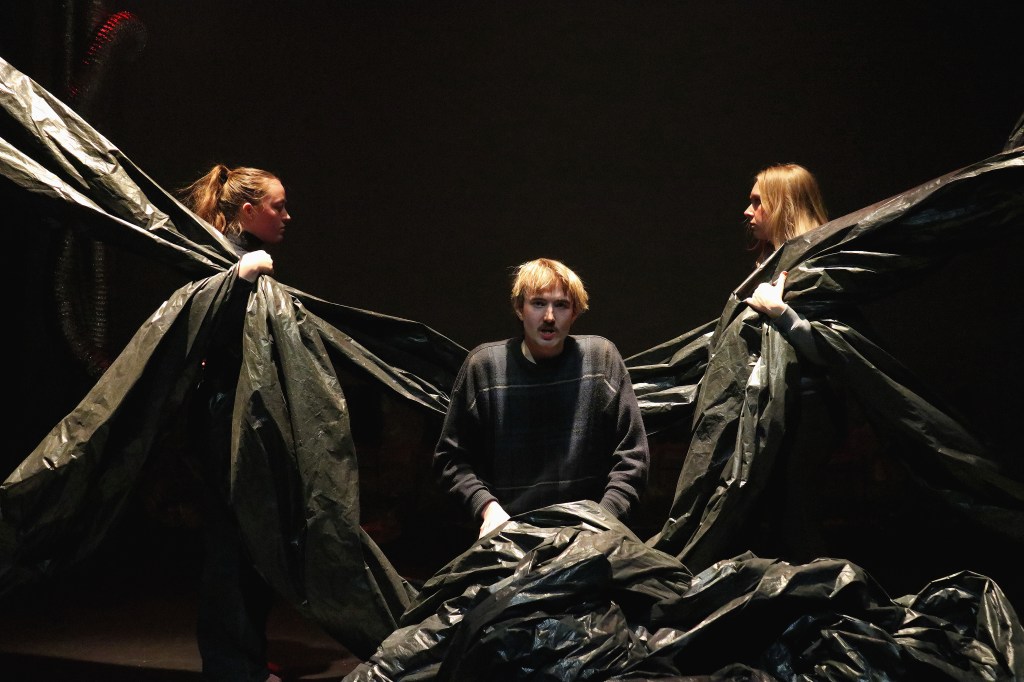

The monologues are broken up by ensemble movement; the set is rearranged to a different setting or image, some following through the monologue itself such as the gentle waving of the plastic for Connah’s beach. Each section is aided by Murphy’s sound design, the lighting design by Lana Rosalea, the composition by Vincent Deguzman and the projected animation of Ami Salinas. They work together seamlessly, creating a consistent aesthetic and touchstone for the show.
Others’ monologues are meditative. May sits and reflects on her relationship with death – a rather detached one – and how it’s been pulled into question ever since her own mother’s health started deteriorating. She’s stuck and she won’t let her mum move on either. May is quiet, reflective and restrained, a true testament that less is often more.

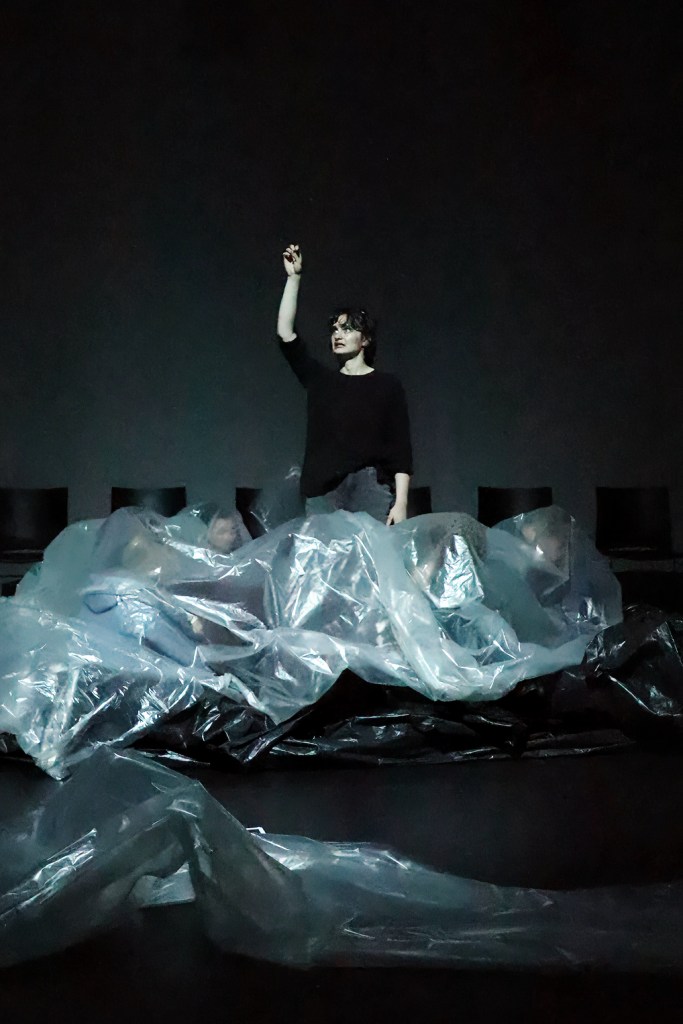
Gabs Rota’s monologue was my favourite. Now I won’t lie, I was already highly anticipating seeing the show after obsessing over their performance as Benvolio in Barkly Theatre’s Romeo and Juliet last year, but the writing of the monologue itself also stood out. Rota emerges from the middle of a nest and begins to tell us a story which takes inspiration from Julia Butterfly Hill, an activist who had set up camp in the branches of a redwood in order to protest logging. We’re a couple hundred days in now, but faith is beginning to waver, not in whether it’s working but whether they can do this anymore. They miss the ground terribly. The flow and build-up of this monologue is painstakingly curated. I had fully teared up by the end. Rota has such a strong yet casual stage presence that fills the room. Each word they spoke was sure and had the effect of coming straight from the heart, not off a script. I felt held by them.
However, in contrast to the other monologues, this character’s stuckness is arguably good (though not for the mental health of the character). But due to it bringing a new angle to stuckness, it allows for us to question whether being stuck is a passive act at all. Stuckness requires maintenance, it requires repression, it requires buckling up and sitting down when everything in you wants to get up and run.
The writing truly does feel like the star of the show. Co-written by two of the actors themselves (Gryff Connah and Emmaline May), the monologues aren’t subtle and I’m glad for it. They are blunt and unwavering in their momentum. They are curated in an order that lets the tone flow over and effect the next, whether in similarity or in juxtaposition. Each monologue has its own niche it’s carved out for itself, not treading over the same territory we just explored. The amount of character imbued in the lines themselves, let alone in their delivery, is any actor’s dream.
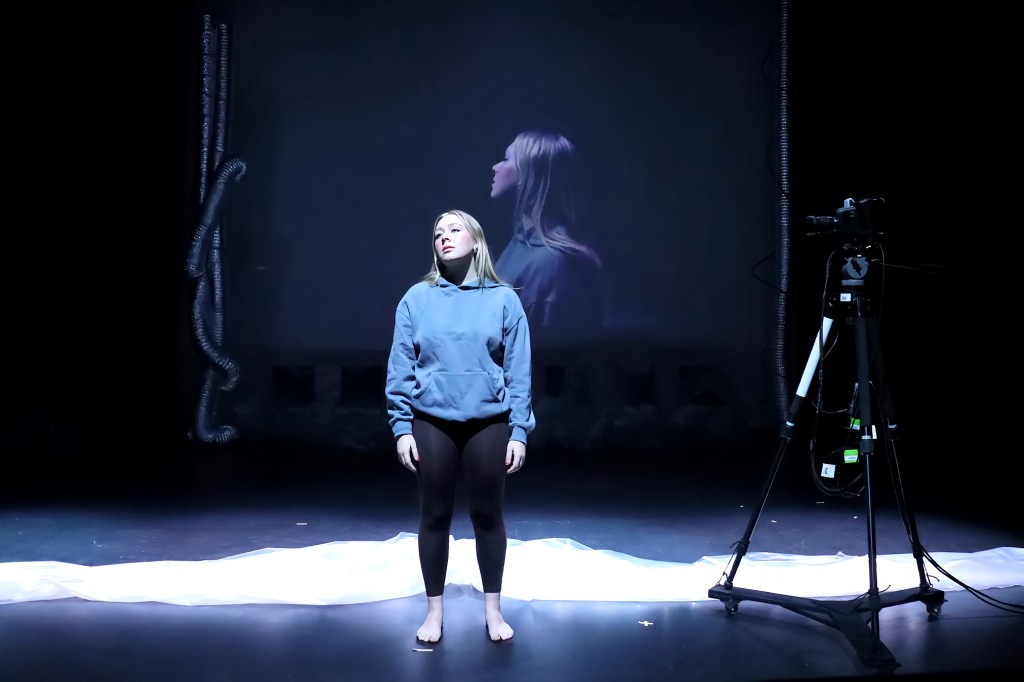
The closing monologue is performed by Cosima Gilbert, who directs it into a camera controlled by Lana Rosalea. The live feed is projected on the back wall, creating an uneasy tone as we see Gilbert from two different angles, sizes, and every so slightly different timing – the live footage being a few milliseconds behind. She lists what she sees as she scrolls through her phone, images that we’ve all seen in our own Instagram reels, evoking that discordant nerve we all have with the tension of swiping from genocide to someone’s beach proposal. It’s uncomfortable and yet we’re all stuck in the algorithm’s apathetic grasp. Gilbert looks at us and begins to ignore the camera; we are now part of this. We are stuck in the audience and the camera lens turns to us. I can see the top of my head projected on the screen.
ISMENIA posits that ‘people care about stories as long as they evolve.’ But what happens if you’re stuck? Who will bother to hear your story then? You have nothing to give them except the same words you gave them last time they came by.
Eleven Eleven are constantly pushing the envelope and this is their most glorious one yet. I truly do hope that ISMENIA is performed in the future as I would kill to see it again. It’s extremely current and built from a seemingly endless pool of skill from the cast and production team. As cliche as it is to say, I truly can’t wait to see what they do next.
ISMENIA by Gryff Connah and Emmaline May played August 7th – 9th at the Guild Theatre.
BRONTE LEMAIRE (any) is a writer and theatre maker who loves witnessing what emerging artists can achieve. Bronte loves analysing and picking apart what makes art work and function (or not!) in order to learn and steal some inspiration for herself.
MYA HELOU (they/them) is an English and Theatre Studies major whose love of theatre was fostered by Shakespeare and classical Greek tragedies. They will take every opportunity to discuss either.
The Dialog is supported by Union House Theatre.
 The Dialog