
REVIEW BY JESSICA FANWONG
EDITED BY RACHEL THORNBY
“I can smell what you did, I can smell it on you…”
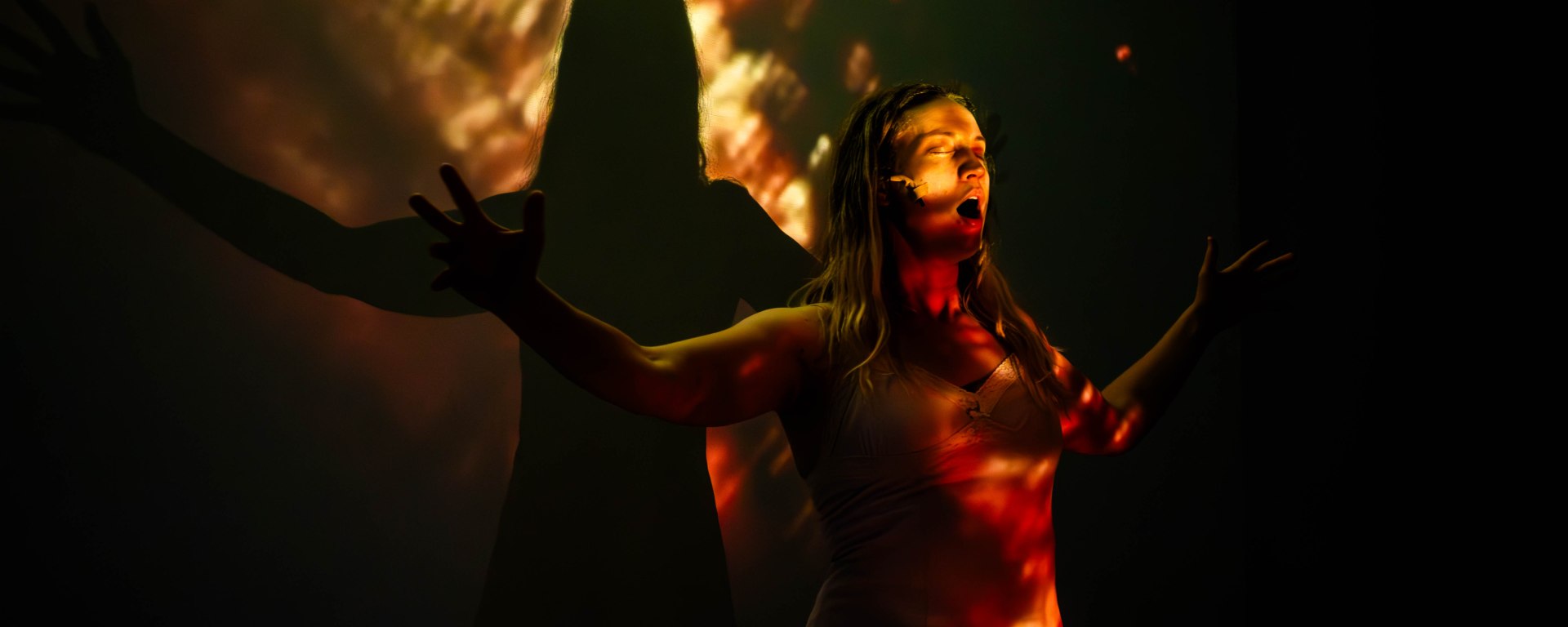
Visceral and intimate, Liminal Theatre’s The Selkie Project marks the company’s return with a highly experimental and carefully crafted character study of the selkie.
Created by Georgie Durham (who also performs as the selkie) and directed by Draf Draffin, The Selkie Project is a retelling of the popular Irish and Scottish selkie myth. The selkie, from the Scots word “selich” meaning seal, is a creature that exists in the liminal space between seal and human. Naturally seabound, selkies can come onto land by shedding their seal skins, allowing them to experience brief moments of life on land. But their longing for the sea always calls them back. Legends often tell of when humans, entranced by the elegance and otherworldly beauty of the selkie, steal their seal skins — effectively trapping the selkie in their human forms and the rigid confines of human social conventions.
The Selkie Project itself is a pun. Brought to life by immersive projections by Ivana Sokol, this performance allows the audience to see the story through the selkie’s eyes. The play starts with very minimalist staging – bare white walls enclosing a faceless woman in a simple white dress lying prone on the ground. It is a scene that gives prenatal feels. The convulsive movements of the woman coupled with eerie background music portrays the moment of transition – the shedding of the seal skin. Portrayed in a scene of heavy physical acting by performer Georgie Durham. With such naked staging and no fancy props, costumes, or set pieces to hide behind, the heavy lifting of the show falls upon the performance prowess of Durham as the selkie.
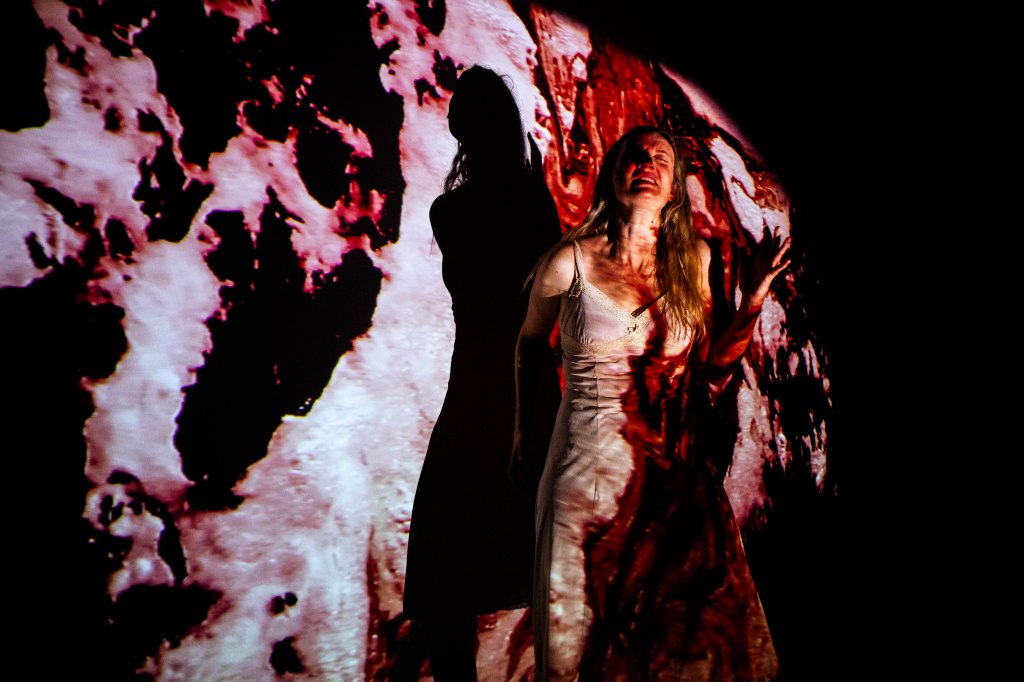
Durham delivers the one-woman show with a highly commendable and emotionally evocative performance that explores themes of self-alienation, grotesque femininity, identity confusion and painful homesickness.
Corporeal dissociation is a large theme of the first half of the show. The first 30 minutes of the performance centres around the selkie after her seal skin was stolen off her. Trapped in her human form, the selkie is forced to grapple with not just the overwhelming confusion of the intricate, heavily regulated human society but also the unfamiliarity of her own body. From learning about “fleshy sticks” that are fingers, to the “mountain [-looking]” breasts, Durham portrays this puberty-like transition scene with a childlike wonder. But besides these light-hearted body-part adjustments, the performance does not shy away from the more sinister and disturbing elements of body-transformation.
“What is that stink inside me?” is a refrain threading throughout the show. The transitioned body parts are also a stark reminder of the selkie’s displacement, her loss of freedom and her confinement in the human gender roles of wife and motherhood. At the heart of it all, is the selkie’s loss of identity, stuck in an alien world where she does not belong.
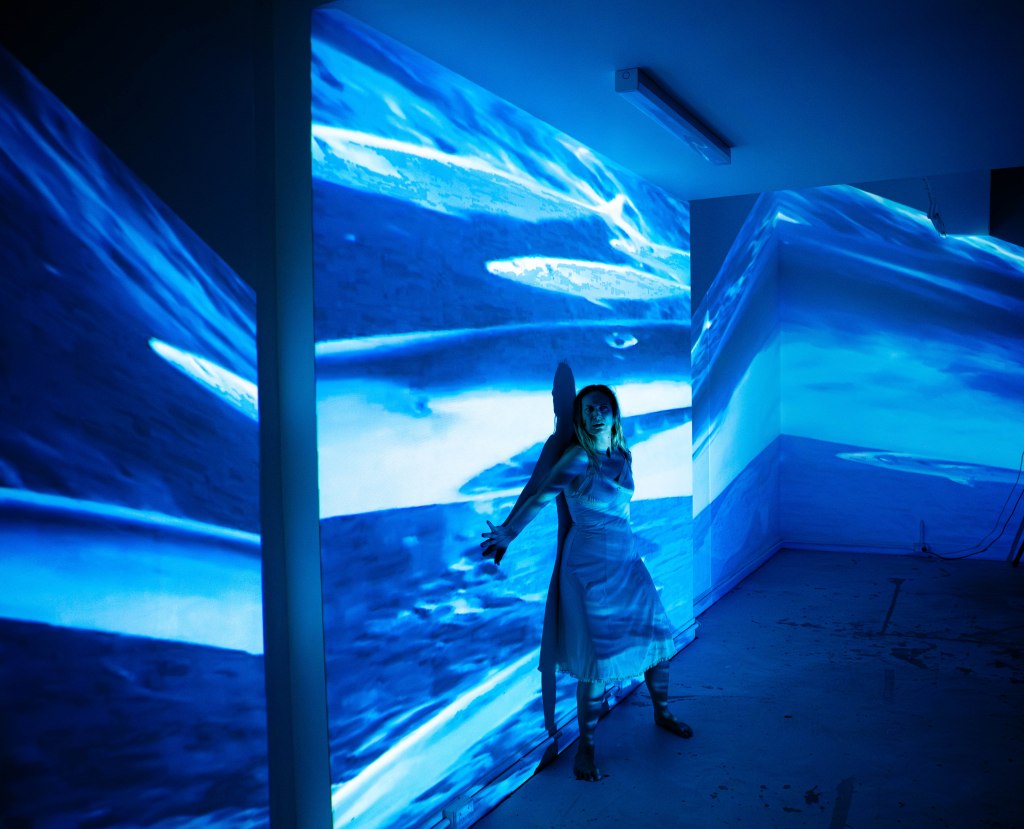
This alienation is aptly portrayed by a series of powerful accompanying projections which illuminate the three white walls that seemingly cage her. From the swirling tuna brands on supermarket aisles, to the flowery wallpaper of a ‘homely’ living room, distorted images from the surrounding human world flash across her mind. A particular highlight for me is the scene of the underwater fish, where the calming projection of the subterranean depths is interrupted with uniquely urban noises – skidding cars, bell-chimes, honking, etc. This shows how trapped the selkie feels in the inescapable human world.
Another standout feature I think was done really well is the depiction of dual personalities. In her human form, the selkie never loses touch with her seal identity. Yet living in a human world heavy-laid with social codes and cues, her seal qualities are seen as unnatural, compelling her to quickly learn and mask. Her dissonance and sensory overload is something I deeply connected with as a neurodivergent person. My favourite line is in the supermarket scene when the selkie is asked to pay and she replies with “money? I didn’t bring money, I’m a seal, I didn’t know.” Her blunt confusion is such a heartwarmingly funny scene that points at just how much more complex the human world is to the relative simplicity of the oceans.
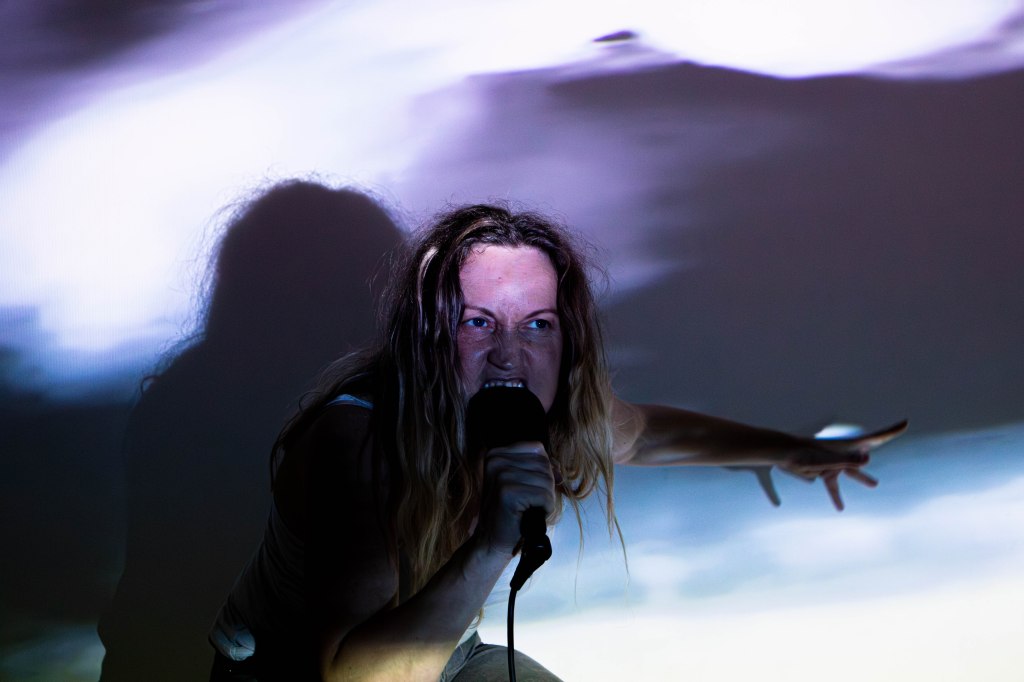
To deal with the overwhelming demands of the human world, Durham presents a powerful portrayal of split personalities. To the chaotic external world the selkie talks in a high-pitched shrilly, seal-like voice that sounds excessively cheerful. But most of the time, she retreats into a rich internal world where her thoughts are conveyed through a deep meditative voice in a stream of consciousness style.
This disjointed stream of consciousness styled speech that fills the first half of the show can make the performance difficult to watch and comprehend. When performed, many of the lines run into each other with varied pacing and constant jumps across time and topics. While many of the lines are rich with imagery and vividly beautiful, they are also hard to follow. This disconnection is aggravated by the unfortunate technical issues experienced by the projection, which broke the flow of the trance-like performance multiple times through the show. While technical mishaps are often out of the control of the creative team, I still believe the show can benefit from more overall smoother transitions, and perhaps some lighting or other symbolisms to orient the audience during time jumps.
The second half of the show portrays the effects of intergenerational trauma on the selkie’s daughter, also played by Durham, after the selkie found her skin and returned back to the seas. I found the jump between the two sections quite abrupt, and it took me a while to realise the story is now transitioned to the selkie’s daughter. This is especially because the two characters are played by the same actress which thematically builds a greater connection between mother-daughter, but for the audience who are unfamiliar with the story, the one costume change from a white dress to red may not be enough to notice they are now seeing a different character. Some more variations in lighting and sound to convey this is a different time era, or more distinct changes in the style of speech between the two characters, can be immensely helpful in setting the characters apart.
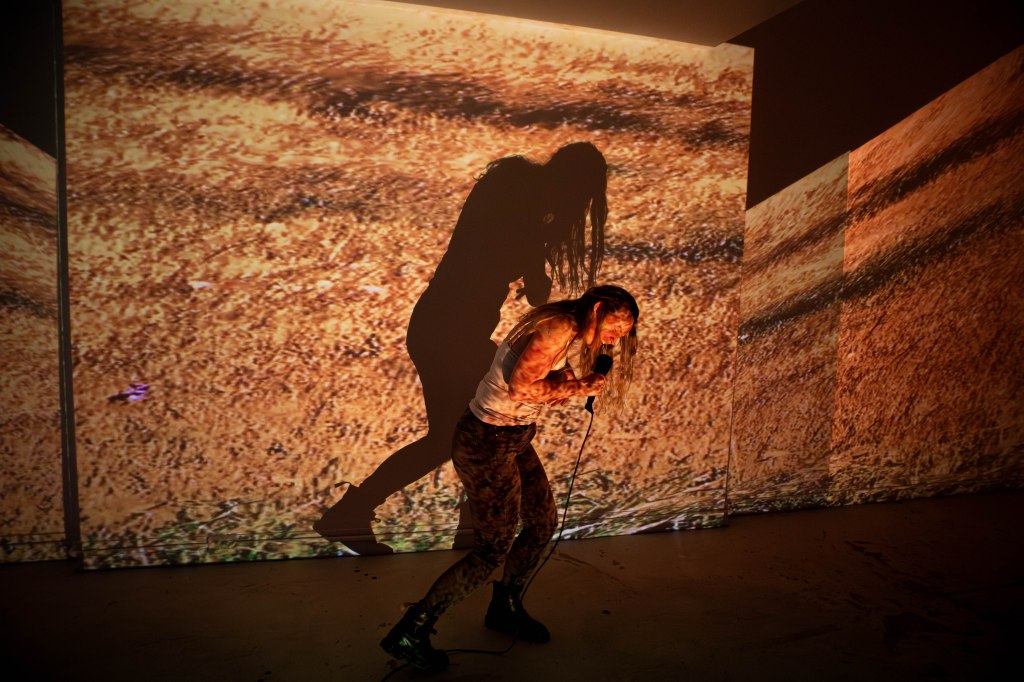
The daughter’s anguish is presented through a slam poetry performance in a bar, where the daughter spitefully relates the story of her selkie mother who abandoned her child. Her pent up rage is built throughout the performance to the thrashing, angsty live-accompaniment of guitarist Stella Delmenico. This female angst culminates in the daughter’s vengeful proclamation “I am going to play a new fucking game, burn the house down… I’ll make a new coat from the ashes!” While this portrayal can represent the daughter taking agency and breaking the walls and social confines that imprisoned her mother – she herself as a hybrid misfit daughter cannot escape into the oceans with a seal coat. I found this portrayal problematic. While the daughter’s anguish is understandable it is also notable that so much of the anger is directed towards the mother who left, instead of the father who intentionally tore away the selkie’s identity by hiding her seal coat. In this sense, the selkie is just as much a misfit and prisoner of the alienating human world as her daughter but is seemingly given the bigger blame for the child’s trauma. I wish the play explored more into the mutual longing for autonomy and belonging shared by mother-daughter. A deeper look could also have been given to the damage caused by the father and the wider human society in forcing the suppression of identity and enforcing compulsory masking to fit-in to acceptable social expectations. Without further unpacking, the show can lean dangerously close to feeding into narratives of victim-blaming and the female-on-female rivalry that is unfortunately too common in storytelling.
All in all, Liminal Theatre’s The Selkie Project is a compelling and raw performance that while disorientating at times, is powerfully performed by clearly talented Georgie Durham with considered directions from Draf Draffin. It is a show that revels in its own visual imagery that invites audiences to feel and sense instead of to analyse or be entertained.
Theatre Works, Liminal Theatre and Performance, and Georgie Durham’s The Selkie Project played June 12 – 21st at Theatre Works Explosives Factory.
JESSICA FANWONG (she/her) is a Naarm/Melbourne based writer, theatremaker and creative arts enthusiast currently studying Masters in Arts and Cultural Management. Her work can be found on Farrago and in independent theatre scene.
RACHEL THORNBY is a media and communications and creative writing student currently studying in Melbourne.
Photography by Renan Goskin and Lincoln Gidney.
The Dialog is supported by Union House Theatre.
 The Dialog