

REVIEW BY SHIXIN WANG
EDITED BY EMMA PARFITT
ENGLISH VERSION BELOW
当提起蛇,你会想到什么?是《圣经·创世纪》伊甸园中那条引诱夏娃吃下禁果的堕落的象征,还是希腊神话中头发由蛇构成、一对视就能将人变成石头的邪恶美杜莎?从东方到西方,“蛇”作为一个重要的文化意象频繁地在各种神话传说中出现。而它们,常常与“罪恶“、“危险”、“诱惑”等特点联系起来。中华剧社的《青蛇》,却为我们展示了一种截然不同的蛇的形象:它有蛇性,有人性,甚至有佛性。
《青蛇》是2013年由中国著名女导演田沁鑫导演、编剧的话剧,改编自中国当代知名女作家李碧华(由她的另一部小说《霸王别姬》改编的电影获得了第46届戛纳国际电影节金棕榈奖)的同名小说。《青蛇》的故事实际来源于中国古代一个流传了千年的民间传说《白蛇传》:宋朝年间,有一条修炼千年的蛇妖化作人类女子名为白素贞,同她的侍女小青(百年青蛇所变)在杭州西湖游玩,和人类男子许仙同船避雨,对他一见钟情。白素贞和许仙结为夫妻,却被金山寺的和尚法海发现。法海让许仙给白素贞喝下雄黄酒,使白素贞展露出了蛇的本体,把许仙吓死了。白素贞去天庭盗取灵芝仙草,复活许仙,法海却把许仙带到金山寺软禁。为了见到许仙,白素贞和小青同法海打斗,水漫金山寺,伤害了其他生灵。最终,法海将生完孩子的白素贞镇压于雷峰塔下。

和民间传说不同的是,话剧《青蛇》把故事的主角从白蛇变为青蛇,并在原来的版本之上增添了小青与法海的爱情线。在话剧里,小青变成人之后和许多人类男子欢爱,享受肉体的欢愉,但她心中爱的却是和尚法海。她是妖,本只有动物的欲望,却因为法海懂了人的情爱;法海是人,却想修炼成佛,摆脱肉体和人性的禁锢。但最终,时间过去千年,在民国时期,雷峰塔倒塌,法海在圆寂前对小青说出“你我没有分别”,暗示着这场“妖、人、佛”的纠缠,终究融为一体,混沌不清。
Chinese Theatre Group本次的制作(导演嘭嘭)十分优秀,可以看出,无论是演员表演,还是幕后的灯光、音乐、服装、舞美等等,都努力在当前技术和人力成本上做到最好。尤其是饰演青蛇(王思睿Vicky)和白蛇(付华晨 Natalie)的两位演员,不仅需要记住长达三个小时的台词,还要练习中国古典舞,用舞蹈展示蛇的灵动和妩媚。最开始青蛇、白蛇出场的那一幕,两位演员从地上缓缓起身,从头、肩、颈、手臂到腿如起伏的海浪,配合变幻的灯光和悠扬的音乐,将蛇妖化人的过程诠释得栩栩如生。两位演员的表演也将小青的灵动可爱和白素贞的沉稳老成形成了鲜明的对比。
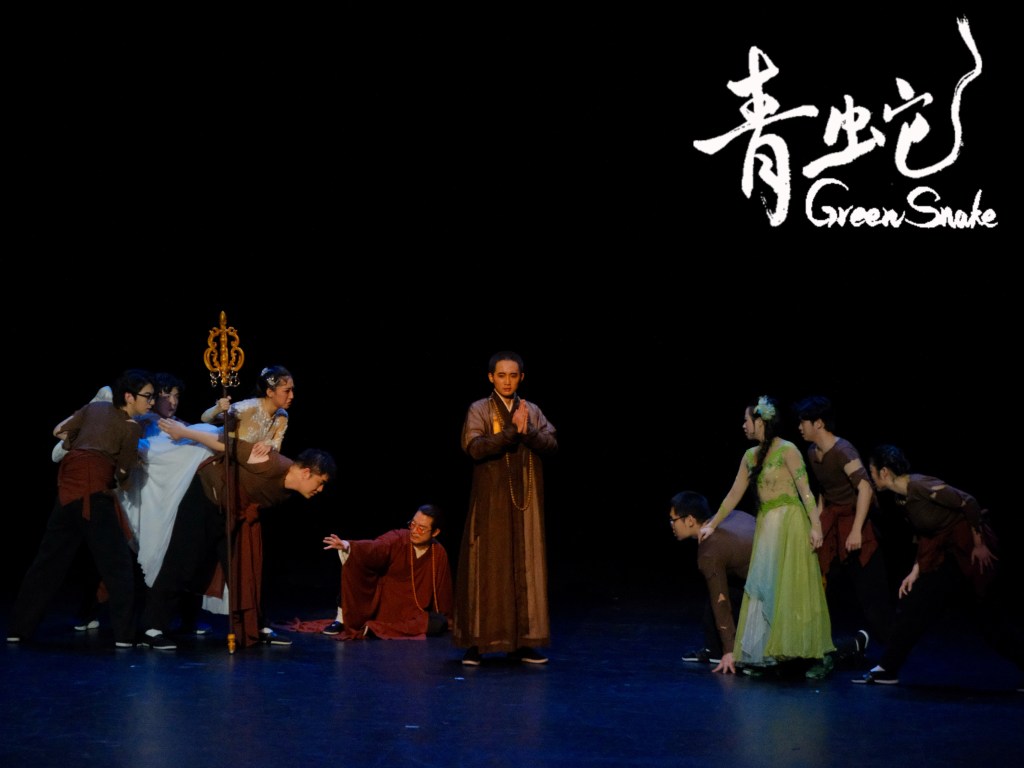
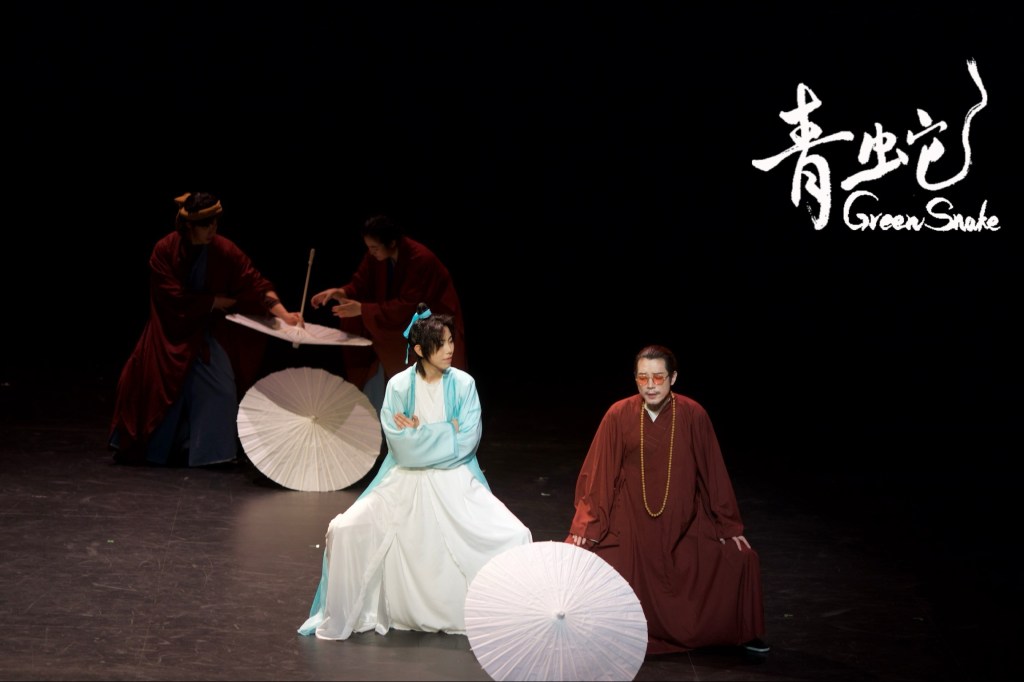
饰演法海的演员(田晨凯)扮相十分出色,清瘦挺拔的身躯和不怒而威的气质,将一个威严庄重、清心寡欲的和尚形象展现得活灵活现。许仙这个男性角色由女演员(珂尔)反串,虽然在人物丰满程度上和其他主角比略显单薄,但珂尔的表演很好地突出了许仙的懦弱无能、畏畏缩缩。“花和尚”济着(Andy)是法海的反面,他喝酒、吃肉、游戏人间,茶色墨镜和扎小辫的油头造型为他的形象塑造加分许多。六位歌队成员(戴兴邦、 卢柏林、 周彦臻,、燕嘉宁Jenny Yan、华梓淳、吴一迪)的表现同样让人惊喜。他们的群体角色从僧人、到百姓、到群妖无缝衔接,同时每个人还担任了捕快、西域商人、仙翁等角色。能歌善舞,巧言善辩,在整部剧中起到了渲染氛围、转换时空、叙事抒情等多重作用。Hefei Elaine Wang为演员们精心设计的服装和妆容不仅贴合角色,也让观众轻易地回到剧里的时代。
在舞台布景方面(由胡雨晗Hannah设计),这部剧同样展示了中国传统美学特色。中式美学注重“写意”,用简单的意象就能建立整个场景,因此并没有太多繁杂的道具,有时甚至只是一个灯光和演员的动作,就能让观众理解场景。比如许仙和白素贞初见时,仅仅只是用了浅蓝色的灯光(由Geneta Lo设计)和演员临湖照影的动作,就让观众明白,这一幕发生在西湖的桥上。而表现这一点甚至不需要有一座实体的“桥”出现在舞台。这种略微抽象的表达是和西方戏剧注重写实和细节有很大不同的地方。

音乐方面,作为观众,有时会觉得演员讲述大段台词时过于干涩,需要一些音乐做铺垫。比如“水漫金山寺”的群妖打斗一幕,角色之间激烈的争斗仅仅靠演员的肢体动作体现。如果能在配乐中加上中国传统戏曲中紧促的鼓点,并配合灯光和投影的高速变换,将声光电同步运用,更有助于塑造紧张和恢弘的场面。除此之外,我很喜欢最开始寺庙一幕中《春歌》的选用,使观众从外界的喧嚣脱离出来,沉浸在安静祥和的氛围中(声音设计:赵肃桐)。
《青蛇》最后一场的表演是5月31日,这一天是中国农历的“五月初五”,是端午节,也是白蛇喝下雄黄酒、显露出蛇妖本相的日子。在这个独一无二的晚上,我坐在墨尔本的剧场里,和台上台下几百名演员和观众共同做了一场三小时的东方幻梦。作为一名中国留学生,我非常惊喜能在墨尔本看到这么经典的中式美学作品,并且看出了剧组满满的诚意和努力。我真挚地希望,未来能有更多像《青蛇》这样的中国好剧,出现在墨尔本和世界各地的舞台上。
What comes to mind when you think of a snake? Is it the symbol of depravity in the Garden of Eden in the Bible, which tempted Eve to eat the forbidden fruit, or is it the evil Medusa in Greek mythology, whose hair is made up of snakes and who can turn a person into stone at the first glance? From the East to the West, snakes frequently appear in various myths and legends as an important cultural image. They are often associated with characteristics such as sin, danger, and temptation. The Chinese Theatre Group’s Green Snake, however, presents us with a very different image of the snake: it has a serpentine nature, a human nature, and even a Buddha nature.
Green Snake is a 2013 play written and originally directed by the renowned Chinese female director Tian Qinxin, adapted from the novel of the same name by the acclaimed contemporary Chinese author Li Bihua (whose other novel, Farewell My Concubine, won the Palme d’Or at the 46th Cannes International Film Festival for its film adaptation). The story is based on the ancient Chinese folklore The Legend of the White Snake, which has been passed down for thousands of years. During the Song Dynasty, a thousand-year-old snake demon transformed into a human woman named Bai Suzhen, along with her maid, Xiao Qing (a hundred-year-old snake), who were traveling in Hangzhou’s West Lake. While sheltering from the rain on a boat, Bai Suzhen fell in love at first sight with Xu Xian, a human man. Bai Suzhen and Xu Xian got married, but were discovered by Fa Hai, a monk at the Jinshan Temple. Fa Hai forced Xu Xian to give Bai Suzhen a drink of realgar wine, which caused Bai Suzhen to reveal her snake body and frighten Xu Xian to death. While Bai Suzhen went to Heaven to steal the elixir of Lingzhi and revive Xu Xian, Fa Hai placed him under house arrest at the Jinshan Temple. In order to see Xu Xian, Bai Suzhen and Xiao Qing fought with Fa Hai, flooding the Temple and harming the local human residents. Eventually, Fa Hai suppressed Bai Suzhen, who had just given birth, under the Leifeng Pagoda.
Unlike the folklore, the story is retold with Green Snake taking over the protagonist role from White Snake, and a love story between Xiao Qing and Fa Hai is added to the original version. In the play, Xiao Qing has turned into a human being and has had sex with many human men, enjoying the pleasures of the body, but it is the monk Fa Hai whom she loves in her heart. She was a demon and had only animal desires, but because of Fa Hai, she came to understand human love. Fa Hai, a human, aspired to become a Buddha and escape the confinement of flesh and humanity. In the end of the play, a thousand years have passed. During the period of the Republic of China, the Leifeng Pagoda collapsed. Before death, Fa Hai says “there is no difference between you and me” to Xiao Qing, giving up the previous efforts to educate Xiao Qing to become a human. Demon, Man and Buddha are entangled into one finally, provoking permanent chaos.
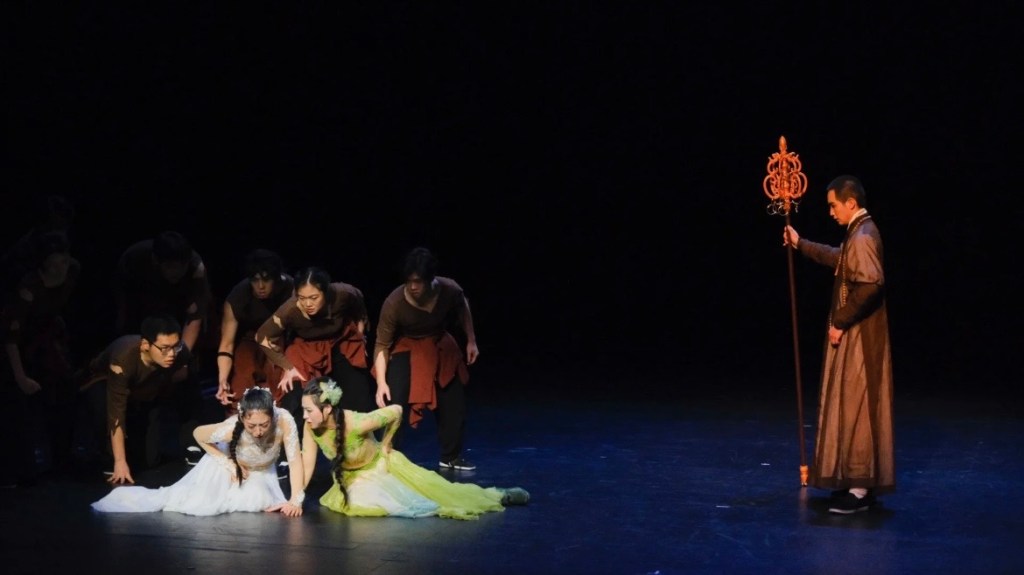
Chinese Theatre Group’s production, directed by Pengpeng, is excellent. It is evident that the cast, as well as the behind-the-scenes departments (lighting, music, costumes, choreography, etc.), have done the best they can to adapt the original version with the current available resources. The actresses playing Green Snake (Sirui Vicky Wang) and White Snake (Huachen Natalie Fu) not only had to memorise their lines for a three-hour-long marathon, but also practiced classical Chinese dance to demonstrate the snake’s agility and flirtatiousness through movement. Especially in the very first scene where Green Snake and White Snake appear, the two actresses slowly rise from the ground, from their heads, shoulders, necks, arms to their legs like undulating waves. With changing lights and melodious music, it felt like seeing the real process of the snake demon transforming into a human being.
Chenkai Tian as Fa Hai was in fine costume (designed by Hefei Elaine Wang), with a lean and upright body and an imperious manner that brought the image of a solemn and dignified monk with a pure heart to life. The male role of Xu Xian was played by actress Ke Er. Although the character was not as fully developed as Xiao Qing and Bai Suzhen, her performance successfully highlighted his indecisiveness and weakness. The “Flower Monk”, Ji Zhe, performed by Andy, is the opposite of Fa Hai. He drinks, eats meat and plays the world, with teal sunglasses and a dreadlocked greasy head styled to add to his portrayal. The six members of the singing team (Xingbang Dai, Bolin Lu, Yanzhen Zhou, Jenny Yan, Zichun Hua, Yidi Wu) are equally impressive. Their roles shifted smoothly from monks, to people, demons, as well as constables, merchants from the Western regions, and monsters. They were able to sing and dance vividly and dynamically, and played multiple effects throughout the play, such as rendering the atmosphere, transforming time and space, and narrating and lyricising the story.
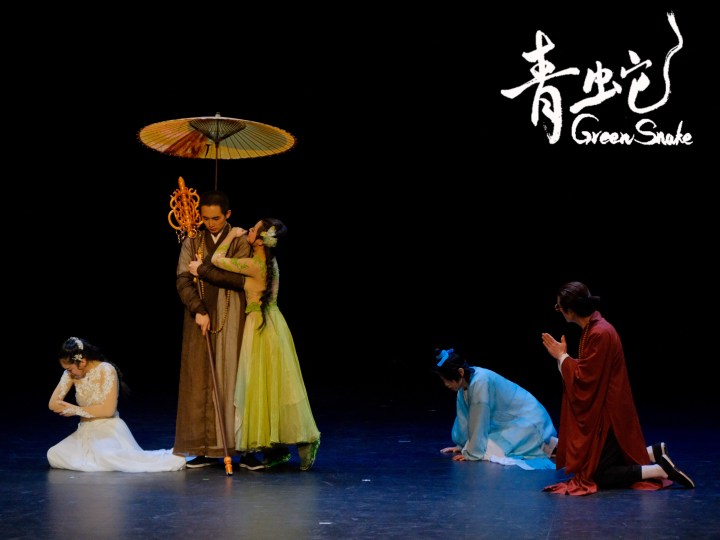
The play also showcases traditional Chinese aesthetics in its stage setting (Hannah is the set & props designer). Chinese aesthetics focuses on “imagery”, using simple symbols to depict the scene. Therefore, there are not too many complicated props, sometimes even just a light (designed by Geneta Lo) and the movement of the actors can make the audience understand the scene. For example, when Xu Xian and Bai Suzhen meet for the first time, the audience can understand that this happens on the bridge over the West Lake just by the soft blue light on the stage and the actors’ actions of facing down and looking at the shadows in the water. This scene does not even require a physical bridge to appear on stage. This kind of abstract expression is very different from the typical Western theatre, which often focuses on realism and details.
As an audience member, I sometimes felt that music could have been used to pave the way for the longer lines, which occasionally felt dry in their delivery. For example, in the scene “Water Floods the Jinshan Temple”, the intense fight scenes between the characters were mainly shown by the physical movements of the actors. If the soundtrack could be accompanied by the urgent drum beats of traditional Chinese opera, paired with the high-speed changes in lighting and projection, the tension could be amplified. The simultaneous use of sound and light would help to create a tense and magnificent scene. In particular, I love the choice of the “Spring Song” in the temple scene at the very beginning, which detaches the audience from the hustle and bustle of the outside world and gives them a sense of quiet and peace (sound designed by Sutong Zhao).
The last show of Green Snake was on 31 May, the fifth day of the fifth month in the Chinese lunar calendar, the Dragon Boat Festival, and the day when the White Snake drank realgar wine and revealed herself as a snake demon. On this unique evening, I sat in a Melbourne theatre and shared a three-hour beautiful dream with hundreds of actors and audience members on stage and off. As an international student from China, I was pleasantly surprised to see such a classic Chinese aesthetic production in Melbourne, and could see that the cast was full of sincerity and put lots of effort into presenting it. I sincerely hope that in the future, there will be more great Chinese dramas like Green Snake on stages in Melbourne and around the world.
Green Snake 青蛇 presented by Melbourne University Chinese Theatre Group played May 29th – 31st at the Union Theatre.
SHIXIN WANG is a Master of International Journalism student at the University of Melbourne. With experience in digital marketing and reporting, she has covered diverse topics ranging from cultural reviews to social issues. You can find more of her work at her website, https://shixinwangportfolio.wordpress.com/.
EMMA PARFITT (she/her) is the Dialog’s head editor and has written Dialog reviews alongside studying towards her science degree for the past two years. She is a production manager, stage manager and producer on the Melbourne indie theatre scene and a veteran of student theatre at Union House Theatre.
The Dialog is supported by Union House Theatre.
 The Dialog