
REVIEW BY TARAS SCURRY
EDITED BY EMMA PARFITT
In Element Theatre Company’s original comedy The Banquet Guide by Esther Li, on a weekend night the comedy divulges into the quirky and licentious lives of one house and its guests. Entering the brilliantly intimate setting that is the Guild Theatre, where the seats seemed to cling right above the stage, I looked down. At first, in all honesty, this was me trying to find the translation screen, but then I looked at Esther Li’s set. Positioned to the left were two soft cushioned chairs, a love seat and an unimposing wooden table. To the right was a mock bar like one that you’d find in a middle-class suburban home. The middle of the stage was vacant, primed and ready for this delightful chaos.
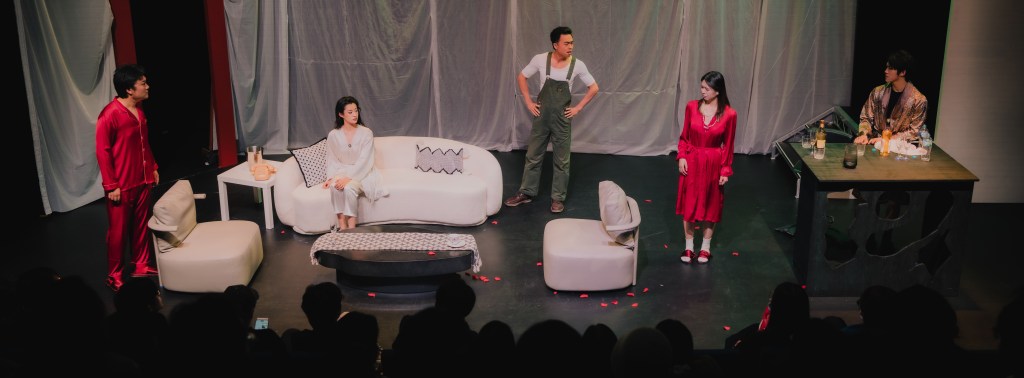
Jeffy Lu and Roisin Li as Bernard and Jacqueline, the owners of the house, got the fire started. The vision of the play was clearly expressed from the very beginning through costume (by Jiayi Sun) with Jacqueline dressed maternally and Bernard in a suit which was amusingly both awkward and clunky, much like him. The dialogue was quick and was only further hastened by the arrival of Robert (Joey Zhang), a chum of Bernard’s invited over for dinner. However, the action only truly began with the arrival of Suzette. Played by Anny Su, she proved to be both cunning and endearing. Her role was as the cook but as with many things in this play that just changed and changed.
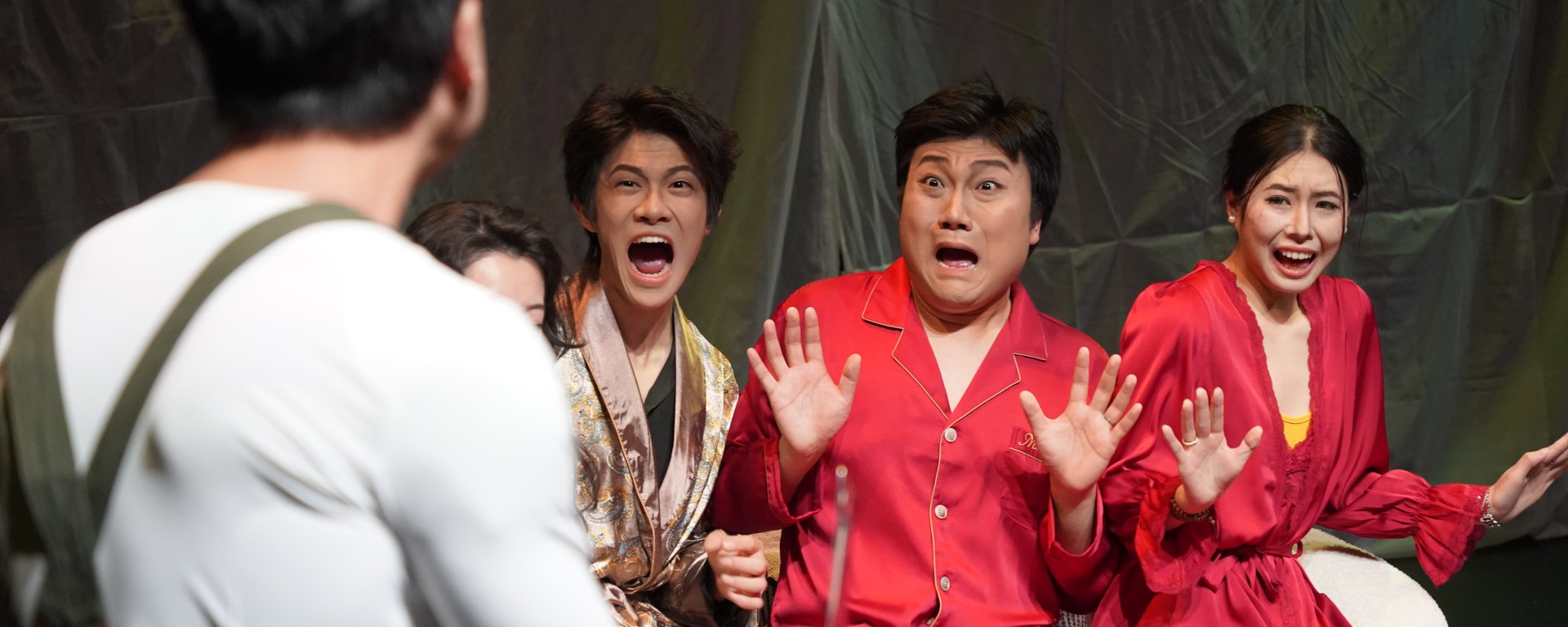
The characterisation of Suzette pretending to play various roles on the behalf of Bernard and Robert was a fantastic plot point but one that grew tired too quickly. Perhaps it was the fact that the subtitle screen was in the corner and with no knowledge of Mandarin other than how to say “hi” it was easy to lose track. In spite of this, each time Su had to morph into a slightly different role her stage presence gave full display to Suzette’s effervescence and quick-thinking. As such, whenever Bernard and Robert had to reinvent a lie to Suzette or to tell her a new story even more disorder ensued. This allowed for some rip-roaringly ridiculous scenes, which caused such an eruption of laughter inside the Guild Theatre that it could have broken the Richter scale.
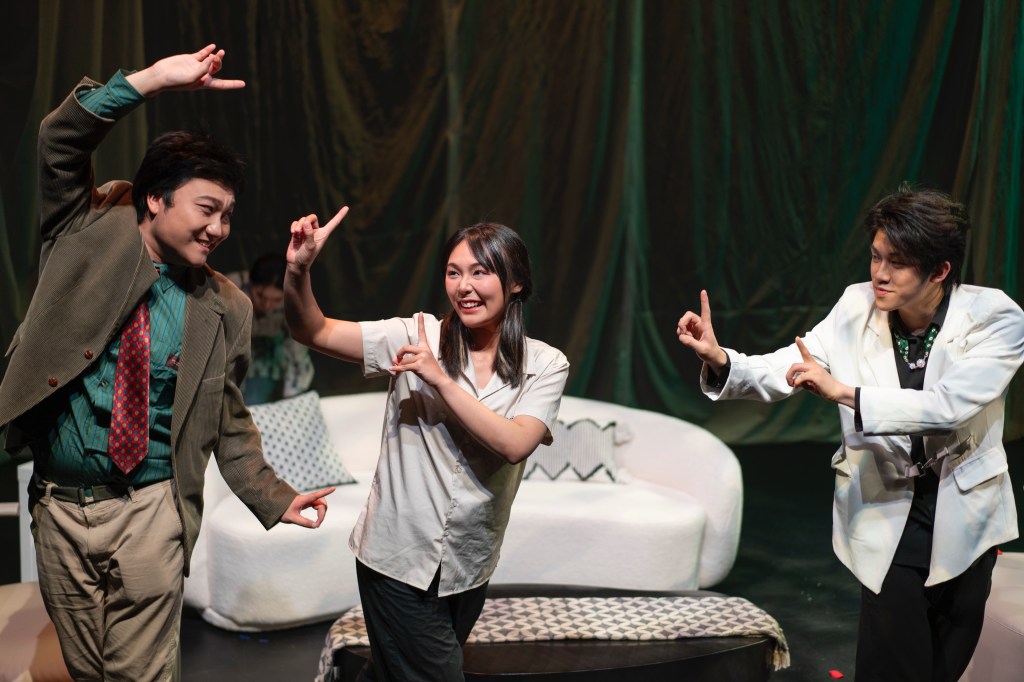
Once again, a new character emerged, and the playwright and director should take a bow. Esther Li’s ability to continuously keep the audience engaged and feeling as though there could be conflict at any moment is something you can’t credit enough as a member of the audience. Suzanne, played by Jarreau Zhu, was a fantastically written and delivered character. Zhu performed the role of the mistress well. Less animated by comparison to everyone else on set, she suffused a naturalistic element of theatre onto the stage. This was both refreshing and a greatly appreciated point of contrast.
As you can imagine with the arrival of a mistress on stage, the plot thickened. The already apparent complexity of the plot was compounded. Whilst it was a good idea to have a plot which could be so expansive yet centralised to one location, it did come with its pros and cons. What made it brilliant was that it facilitated immense curiosity and a feeling that you were a rabbit caught in the headlights when coupled with the fast nature of many scenes. Although, on a more critical note it resulted in slow paced scenes being hard to follow and disruptive to the rhythm rather than supportive. They felt at times disjointed and did not add explanation. The buzz from the rampantly fast scenes, however, fuelled the audience with thought and humour, as achieved through lie on lie being told, Bernard or Robert nearly getting caught out and a myriad more rollercoaster junctures.
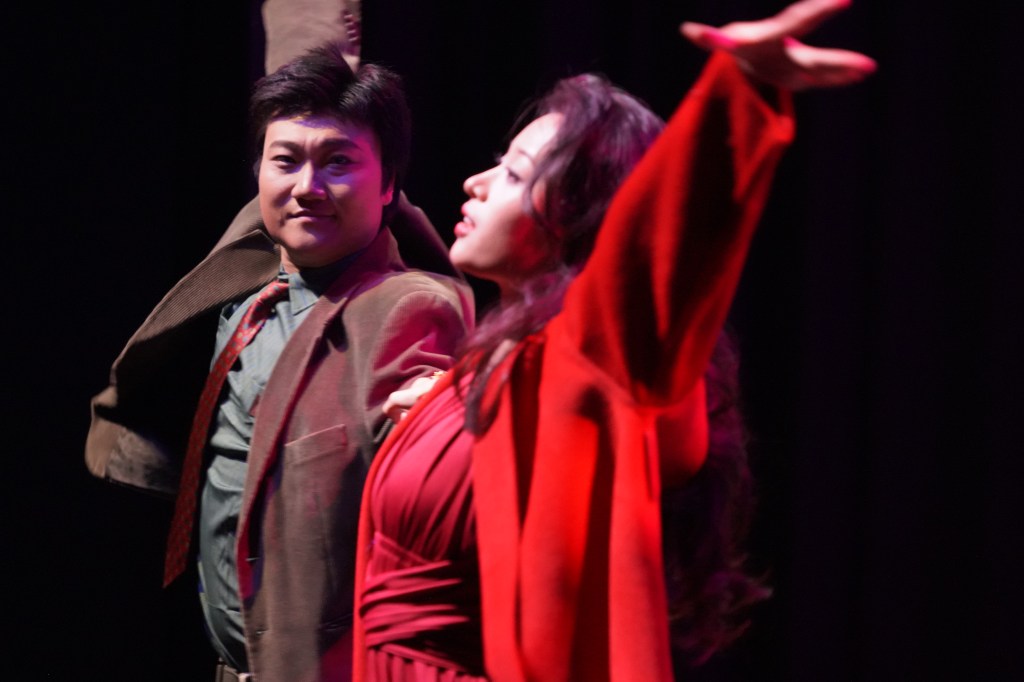
The play only got better as it went along as reflected through Eliot Zhu’s lighting, which set the mood with strong, epic theatre style reds and oranges beaming down on the cast. A strong moment from the lighting team as the arrival of George (Cheung Yiu), Suzy’s real husband, complimenting another well-woven entrance of a new character. The arrival of George precipitated a brief change to Greek theatre style. In doing so, the stage became ablaze with a rich and deep red. Contrastingly the absence of light played just as pivotal a hand. It channelled a more playful display of comedy with the cast prancing around trying to bed hop fecklessly. This made the play a success, the strength of playwrighting by transitioning in new characters for one, the lighting team greater animating the faces of the actors and above all the execution of each role by all actors/actresses.
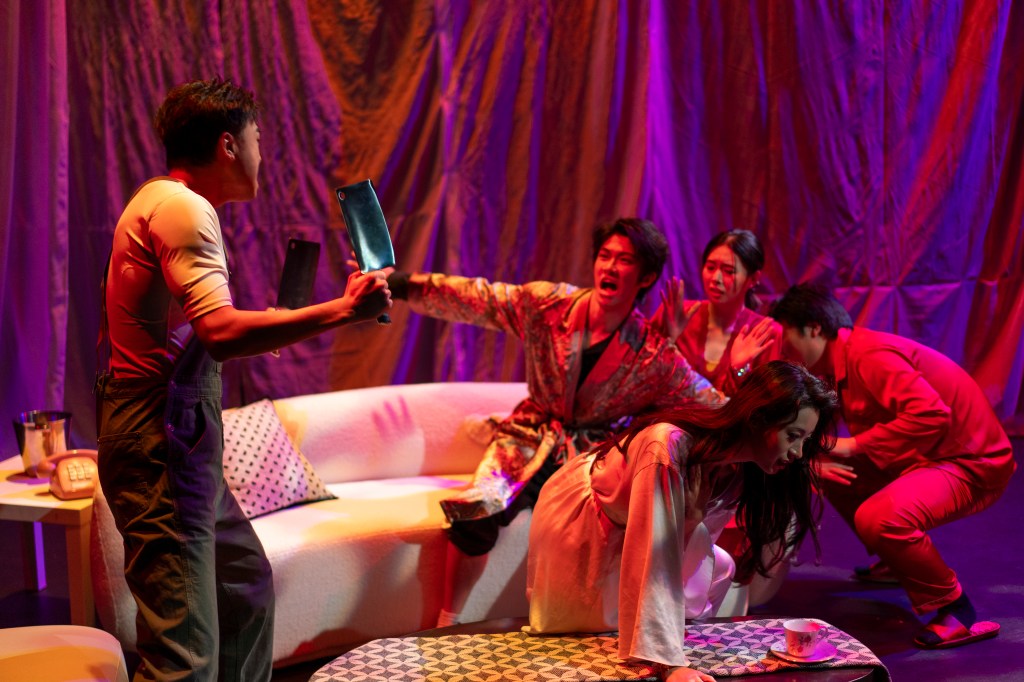
By far the most interesting scene was the final one, after everyone had gone home, leaving just Jacqueline and Bernard. What made this so fascinating was the change of cast members as Su and Yiu played them as opposed to Zhu and Lu: a fitting resolution with Jacqueline and Bernard sitting as the lights faded away in a way that was fitting to the nature of the play’s absurdity and adaptability. On face value, one could say that this change added nothing, but that’s not true. It causes speculation about the entire play: who is who, who is pretending, who is the real Jacqueline and Bernard. Like Dr. Jekyll, this play had two faces on the entire time as reflected through the duplicitous characterisation, changing of theatre styles and ultimately this final scene.
Element Theatre Company has developed something that is jam-packed and experimental. It may not run smoothly all the time, but for the most part it provided the crowd with laughter and speculation. It was best when using quick wit coupled with rhythm: the cast with their brilliant stage presence and the crew with their apt set design. A testament to the overall quality of Esther Li’s direction and writing prowess is that it can be boiled down to a singular word: fun!
Element Theatre Company’s The Banquet Guide by Esther Li played May 22nd-24th at the Guild Theatre.
TARAS SCURRY is currently studying a Bachelor of Arts majoring in Philosophy. He deeply enjoys the arts and is thrilled to be part of The Dialog.
EMMA PARFITT (she/her) is the Dialog’s head editor and has written Dialog reviews alongside studying towards her science degree for the past two years. She is a production manager, stage manager and producer on the Melbourne indie theatre scene and a veteran of student theatre at Union House Theatre.
The Dialog is supported by Union House Theatre.
 The Dialog